Write the Listener, Not Just the Speech
A three-part method for revising dialogue through telling purpose, listener response and the next attempt.
Write the Listener, Not Just the Speech
Fiction writers often revise dialogue by improving what is said. They sharpen the confession, remove repetition, strengthen subtext or make the speaker more articulate.
But a conversation can change dramatically even when the speaker’s words remain almost the same. Change who is listening, what that person can offer and how the response redirects the next attempt.
Anton Chekhov’s “Misery” makes this principle painfully visible. In Constance Garnett’s public-domain translation, the cab driver Iona Potapov is trying to tell people that his son has died. He tries an officer, three young passengers, a house-porter and another cabman. The information barely changes. The listening does.
The story’s force comes not from a polished speech but from a sequence of failed receptions. Each listener gives Iona a different amount of time, curiosity, impatience or recognition. Each response shapes what he tries next. Finally, he tells the story to his horse.
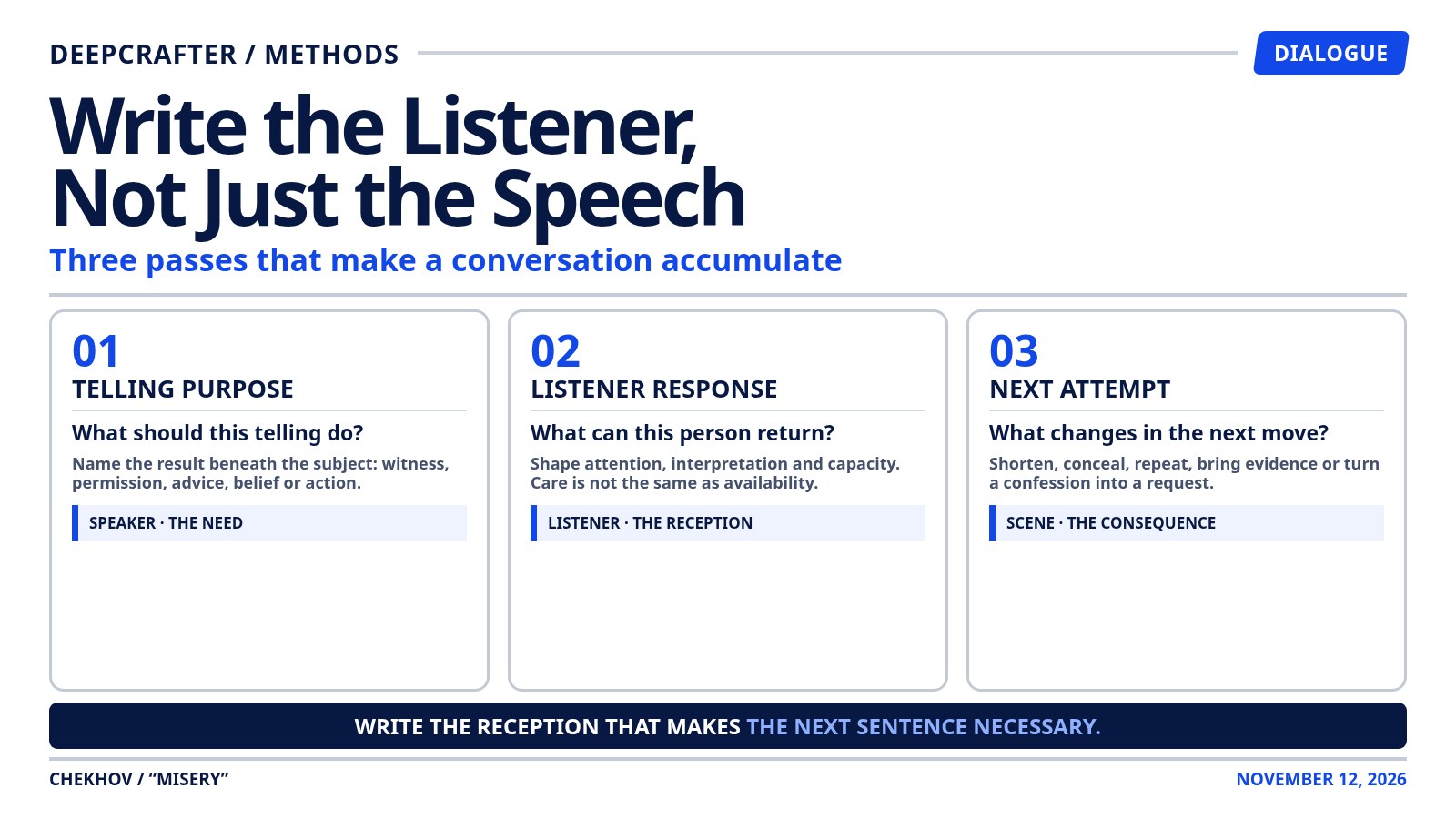
This article turns that reading into an original three-part revision method:
- Telling purpose — what does the speaker need this telling to do?
- Listener response — what does the listener actually return?
- Next attempt — how does that response change the speaker’s next move?
The framework is DeepCrafter editorial material, not a theory attributed to Chekhov.
The subject is not the purpose
In “Misery,” the subject is clear: Iona’s son died after an illness. Yet “communicate the fact” is not a complete description of what Iona needs.
He wants room to tell the sequence: how his son became ill, what happened at the hospital, why the order of their deaths feels wrong. He wants another consciousness to stay with the story long enough for grief to become shared experience.
That distinction matters in any dialogue scene. A character may appear to be asking for information while actually asking for permission, witness, reassurance, absolution, practical help or simply uninterrupted attention.
Before revising the speech, finish this sentence:
By telling this now, the speaker hopes the listener will ______.
Use a verb that another character could fulfill or refuse: believe, stay, forgive, advise, witness, choose, intervene, remember, protect.
“Understand” is often too vague. What would understanding look like in the room?
A listener response has more than one dimension
Writers sometimes divide responses into two categories: listens or does not listen. Chekhov gives us a more useful range.
The officer asks what the son died of, then closes his eyes and urges Iona to hurry. The question briefly opens a door; impatience closes it. The young passengers answer with a general truth—everyone dies—then return to their own noise. The house-porter responds only to the practical interruption. The other cabman falls asleep.
These are not identical failures. A listener can:
- hear the fact but refuse the story;
- ask one question without staying for the answer;
- generalize instead of meeting the particular grief;
- redirect toward a task;
- offer comfort the speaker did not ask for;
- listen fully but be unable to help;
- remain silent in a way that feels attentive—or empty.
Revise the listener across three dimensions:
1. Attention
How much of the telling do they actually receive? What competes for their attention: a deadline, embarrassment, danger, another person, their own pain?
2. Interpretation
What do they think the speaker wants? They may hear a request for advice when the speaker wants witness, or hear accusation when the speaker wants permission.
3. Capacity
What can they genuinely give? A character may care and still lack time, courage, authority or the right words.
This prevents a weak shortcut: making the listener cruel only because the plot needs the speaker to remain lonely. A limited response can come from distraction, misreading or incapacity as well as indifference.
The next attempt is part of the conversation
A failed telling should not reset the scene. It should leave a trace in the speaker’s next attempt.
After being hurried, a character may shorten the story. After receiving advice, they may hide the practical problem and reveal more emotion. After being disbelieved, they may bring evidence. After being comforted too quickly, they may become precise, sarcastic or silent.
In “Misery,” Iona keeps trying. The need survives each interruption, but the social possibilities narrow. By the time he turns to the mare, the choice feels both strange and inevitable. The final listener cannot answer in human language, yet she remains present long enough for him to speak fully.
For revision, ask:
What did the speaker learn from this response, accurately or inaccurately?
Then make that learning visible in the next approach.
Before: a speech with a convenient listener
Jonah set the hospital bracelet on the kitchen table. “Dad asked for me. He said he wants me there tomorrow when the doctor comes. I don’t know if I can go back after everything that happened.”
Mara looked at him. “You should do what feels right.”
“I’m afraid he’ll think showing up means I forgive him.”
“Then tell him it doesn’t.”
“Okay,” Jonah said.
The information is clear, but the listener functions mainly as a delivery system for reasonable advice. Jonah’s uncertainty becomes a problem the scene solves.
After: let the response change the telling
Jonah set the hospital bracelet beside Mara’s stack of pharmacy receipts.
“Dad asked for me,” he said. “Tomorrow. When the doctor comes.”
Mara kept matching receipts to the red notices. “Did he ask, or did the nurse?”
“He was awake.”
“That wasn’t my question.”
Jonah turned the bracelet until the barcode faced down. “He said my name.”
Mara stopped sorting. “And what do you want me to say?”
He had wanted her to say you don’t owe him anything. Now it sounded like a line he had brought for her to read.
“Do you still have the number for the ward?” he asked.
Mara slid the phone across the table but kept one hand on it. “Yes.”
Jonah’s purpose is permission not to return. Mara initially hears a factual dispute and then recognizes the hidden request. She does not grant or refuse it. Her question forces Jonah to change the telling into a practical request; the shared hand on the phone leaves the choice unresolved but newly present.
The dialogue is not “better” because Mara is harsher or wiser. It is more dramatic because her listening has a shape.
A three-row revision table
Use this on any important conversation:
| Pass | Speaker | Listener | Revision question |
|---|---|---|---|
| Telling purpose | What result do I want from telling this now? | What request do I think I am hearing? | Are those two things the same? |
| Response | What do I risk if the response is wrong? | What attention, interpretation and capacity do I actually have? | Is the response specific to this listener? |
| Next attempt | What will I change, conceal, repeat or ask next? | What does my response make newly possible? | Does the conversation accumulate? |
If you can swap in another listener without changing the scene, the listener may still be underwritten.
Three common failures
1. The listener gives the author’s best advice
A perfectly calibrated response can end the pressure too soon. Let the listener answer from their own history, fear, task and limits.
2. Every interruption means indifference
An interruption can be protective, frightened, practical, status-conscious or misinformed. Give it a motive the listener would recognize as their own.
3. The speaker repeats without adapting
Repetition can be powerful, but track the change around it: fewer details, a harder tone, new evidence, a different audience or a shift from explanation to request.
A ten-minute exercise
Write one disclosure three times. Keep the speaker’s first sentence identical.
- The listener has time but misunderstands the purpose.
- The listener understands but cannot give what is needed.
- The listener offers something the speaker did not know to ask for.
After each version, write the speaker’s next sentence. Do not explain the emotional difference in narration until the dialogue and action have had a chance to show it.
The exercise is complete when each listener changes the conversation without becoming a mere obstacle or therapist.
Use AI to test the listening structure
Give an AI collaborator the scene and ask for three separate observations:
- What does the speaker appear to want from this telling?
- What does the listener think is being requested, and which words support that reading?
- How does the response alter the speaker’s next attempt?
If the answers to one and two are always identical, the scene may be too frictionless. If the third answer is “it does not,” revise the response or the next beat. Treat the output as a diagnostic reading, not a verdict about what the characters truly feel.
Let listening write the second half of the dialogue
A speech is only one path through a conversation. The listener determines whether that path widens, closes or turns.
Name the purpose beneath the subject. Give the listener a specific pattern of attention, interpretation and capacity. Then let the response alter what the speaker dares to try next.
Do not merely write the confession. Write the reception that makes the next sentence necessary.
Sources
- Project Gutenberg: The Schoolmistress and Other Stories, by Anton Chekhov, translated by Constance Garnett; includes “Misery” and records the text as public domain in the United States.
- Project Gutenberg HTML text of “Misery”.
The three-part revision framework and Jonah/Mara example are original DeepCrafter editorial material.