Your Draft Sounds Better When You Read It. Why?
A four-pass revision method for comparing the performance in a writer's head with what a cold reader can actually hear on the page.
Your Draft Sounds Better When You Read It. Why?
Last night, the 2026 National Book Award finalists gathered in New York to read from their work. The ceremony is tonight. The occasion invites an old question with an uncomfortable answer: why can a passage feel alive in the writer’s own voice, then go flat when someone else reads it?
The easy conclusion is that the prose needs to be “more musical.” That is sometimes true. But often the author is supplying a hidden performance that the page has not earned.
You know where the sentence turns. You remember which word arrived first. You can hear the character’s hesitation, the private joke beneath the dialogue and the breath before the reveal. When you read your own draft aloud, that knowledge becomes timing, stress and tone. A new reader has only the marks on the page.
The difference is not a failure of performance. It is revision evidence.
Ursula K. Le Guin’s official description of Steering the Craft places “the sound of language” among the book’s fundamental elements of narrative, alongside sentence construction and point of view. That is the enduring craft context here. The specific cold-read procedure below is original DeepCrafter editorial material, not a method attributed to Le Guin or to the National Book Foundation.
Your voice carries information the page may not contain
When an author reads a draft, four invisible advantages come with the voice.
1. You already know the phrasing
You know which words belong together. A reader encountering the line for the first time has to discover its units while moving through it.
2. You know the intended emphasis
You can rescue a weak sentence by leaning on the word that matters. If the stress is essential, the prose may need to create it through position, syntax, repetition or contrast.
3. You know what is being withheld
You slow down before a revelation because you know it is coming. A cold reader may not recognize the hinge until after passing it.
4. You can repair the draft while performing it
Writers routinely add tiny pauses, change a conjunction, smooth a pronoun or supply an emotion in the voice without noticing. The performance becomes a live edit that never reaches the page.
This is why “it sounds good when I read it” is not yet proof that the sentence works. Your reading may be demonstrating the prose—or compensating for it.
The test requires two readings, not one
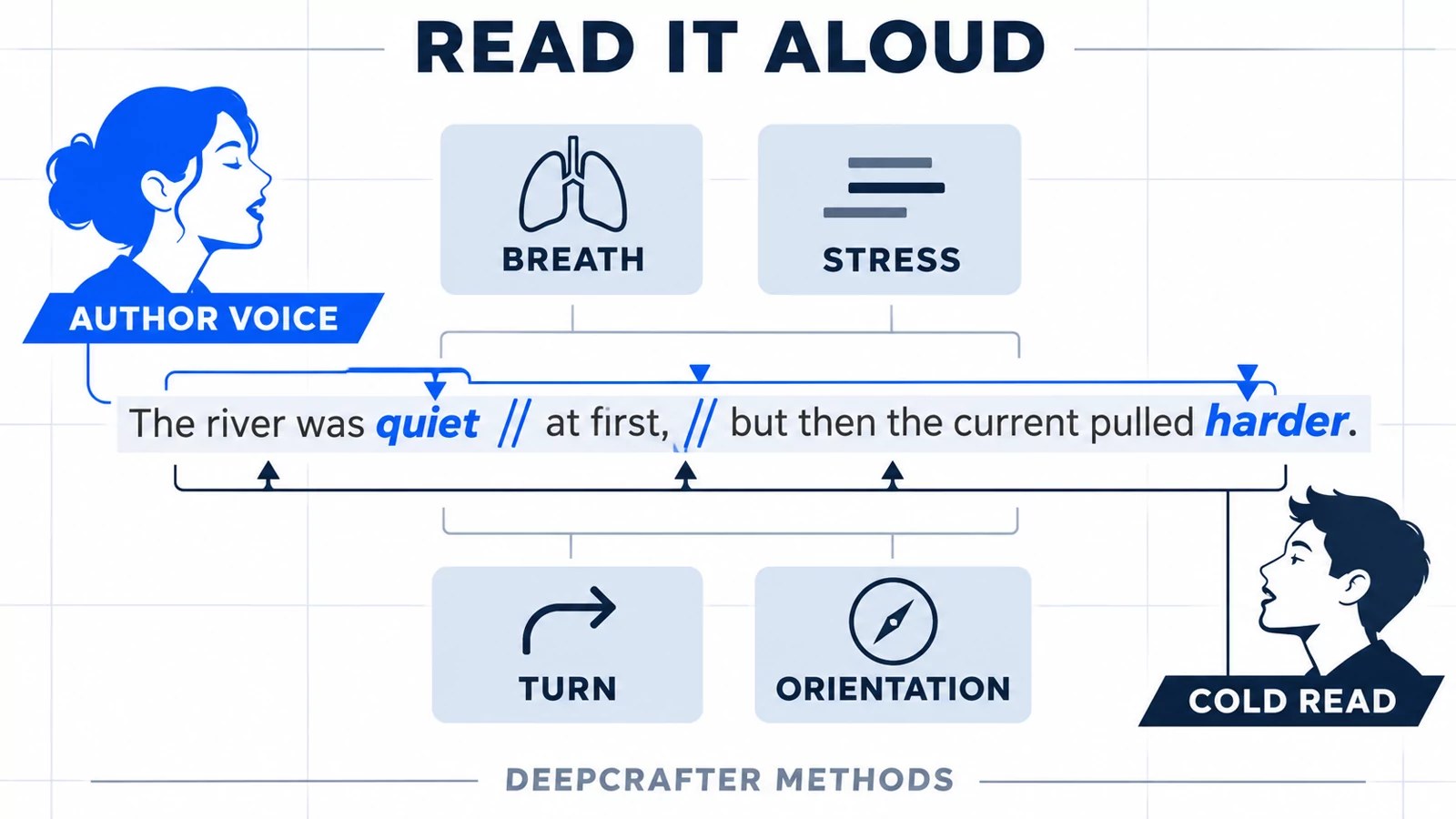
Reading aloud is useful, but a solo read mostly reveals what the author can hear. A cold read reveals what the page can transmit.
Use the same passage twice:
- Author read: mark the performance you intended.
- Cold read: ask another person to read the unmarked passage aloud without briefing.
Do not tell the reader where the joke lands, what the character secretly means or which line should hurt. Do not demonstrate the rhythm first. The point is not to test the reader. It is to let the page meet a mind that does not share yours.
If another person is unavailable, text-to-speech can expose some punctuation and sentence-boundary problems. It cannot replace a human cold reader: a synthetic voice may introduce its own timing and cannot explain what it thought was happening.
An original example: the performance is hiding the revision
Here is an unmarked draft:
Jonah told himself he had come to return the key not to ask why his mother had changed the locks and when Lena opened the door barefoot and holding the yellow bowl they used for birthdays he forgot the sentence he had practiced.
The writer may read it like this:
Jonah told himself he had come to return the key / not to ask why his mother had changed the locks // and when Lena opened the door / barefoot / and holding the yellow bowl they used for birthdays // he forgot the sentence he had practiced.
The slashes create phrasing. The bold words carry emotional stress. The longer pauses turn the bowl into a memory-object and let the final clause arrive as a consequence.
But none of those instructions is reliably encoded. A cold reader may rush “return the key not to ask,” treat “barefoot and holding” as ordinary description, and spend the strongest emphasis on “birthdays” or “practiced.” The sentence still contains the information, yet the author’s voice is doing much of the dramatic work.
One revision could be:
Jonah told himself he had come to return the key—not to ask why his mother had changed the locks.
Then Lena opened the door: barefoot, holding the yellow bowl they used for birthdays.
The sentence he had practiced disappeared.
The revision does not simply make the prose shorter. It transfers the intended structure from performance to page:
- the dash makes the self-correction visible;
- the paragraph break gives the door opening its own beat;
- the colon frames the details Jonah notices;
- the bowl moves toward the sentence end, where it can carry weight;
- the final sentence no longer depends on the reader remembering where to pause.
This is one valid solution, not the inevitable one. A long sentence might better express Jonah’s accumulating dread. If so, keep the length—but make the grouping and pressure legible. The goal is not to turn every passage into clipped prose. It is to decide which effects the page must produce without the author standing beside it.
A four-pass cold-read revision
Pass 1: mark the score you think you wrote
Choose 150–300 words. Read them aloud once and mark:
/for a short pause;//for a turn or longer pause;- bold for the words you naturally stress;
↑where energy rises or accelerates;↓where the sentence settles or withdraws.
Do not edit yet. You are documenting the performance your knowledge supplies.
Then answer three questions:
- Where does the meaning turn?
- Which word must receive the stress?
- What does the reader need to understand before the next sentence begins?
Pass 2: collect a cold reading without coaching
Give the clean passage to another reader. Ask them to read naturally and allow one restart if they want it.
Record the reading with permission, or mark it live. Note:
- unexpected pauses;
- words stressed differently;
- rereads or stumbles;
- places where pace suddenly accelerates;
- pronouns or actions the reader has to repair;
- the first point where their interpretation diverges from yours.
Afterward, ask only:
Where did you feel least sure about how the sentence should go?
This produces better evidence than asking whether they “liked” the passage. You are locating uncertainty, not requesting a verdict.
Pass 3: classify the differences
Not every difference is a flaw. Sort each one into one of four groups.
Breath
The reader runs out of air, pauses inside the wrong unit or loses the main clause.
Possible repairs: reorder the clause, change punctuation, shorten one unit or create a paragraph break.
Stress
The reader emphasizes a word that changes the emotional or logical center.
Possible repairs: move the important word toward a strong position, build contrast, remove a competing emphasis or repeat with purpose.
Turn
The reader misses a reversal, revelation, joke, threat or change of attitude.
Possible repairs: create a hinge word, isolate the turn, delay one detail or let action interrupt the sentence.
Orientation
The reader becomes unsure who acts, speaks or perceives—or when the scene has moved.
Possible repairs: restore a name, clarify the subject, anchor time or separate simultaneous actions.
Classification prevents one blunt response: cutting every long sentence. Sometimes the problem is not length. It is a hidden turn, a misplaced stress or an orientation cost.
Pass 4: choose what the page must control
For each divergence, make one of three decisions.
Encode it
The intended reading is necessary, and the prose does not support it. Revise the page.
Permit it
Both readings are coherent, and the variation adds productive ambiguity. Keep it.
Perform it
The effect belongs mainly to live reading, but the prose remains clear and alive without that exact performance. Keep the page and accept that the spoken version will differ.
This final choice matters. Prose is not a musical score that must force every reader into one tempo. The aim is not total control. It is to distinguish freedom from accidental confusion.
The cold-read comparison sheet
Use one row for every meaningful difference:
| Location | Author intended | Cold reader did | Type | Decision | Revision |
|---|---|---|---|---|---|
| Opening sentence | Pause after “key” | Continued to “ask” | Breath / turn | Encode | Add dash; divide sentence |
| Door detail | Stress the yellow bowl | Stressed “birthdays” | Stress | Encode | Move bowl phrase later |
| Final clause | Long pause before consequence | Read as one continuous action | Turn | Encode | New paragraph and sentence |
| Ambiguous reply | Bitter or sincere both work | Chose sincere | Stress | Permit | No change |
The useful question is not “Did they read it correctly?” It is “What instruction did I believe was on the page, and where did I actually place it?”
Three revision mistakes this method prevents
1. Editing toward your own performance
You reread the sentence with more conviction and conclude it is fixed. It may only be better acted.
2. Treating every stumble as reader error
A cold reader can misread. But repeated uncertainty at the same point is evidence about the sentence, even if you can explain what you meant.
3. Flattening every difficult rhythm
Difficulty can be intentional. Long syntax, delayed subjects and unstable emphasis can create thought, pressure and voice. Revise when the difficulty produces the wrong experience—not merely because the reader paused.
A 20-minute practice
- Choose 200 words that feel especially good in your own voice.
- Mark your pauses, stresses and turns.
- Get one uncoached cold reading.
- Identify the three largest differences.
- Classify each as breath, stress, turn or orientation.
- Revise only the differences that block a necessary effect.
- Give the new passage to a different reader if possible.
Stop when the page can carry its essential meaning without borrowing your memory of how it was written.
Let the stranger hear enough
Your voice is not the enemy of revision. It is a powerful instrument. It reveals rhythm, awkwardness, repetition and emotional pressure that silent reading can hide.
But your voice also knows too much.
So read the draft yourself. Mark the score you believed you wrote. Then hand the clean page to someone who has never heard the music.
The gap between those two readings is not embarrassment. It is the place where intention becomes craft.
Sources
- National Book Foundation: Watch the 2026 National Book Awards Finalist Reading — the finalists read on November 17, 2026; the awards ceremony follows on November 18.
- Ursula K. Le Guin: Steering the Craft — official overview of the revised 2015 edition and its treatment of the sound of language, sentence construction and other narrative fundamentals.
The four-pass cold-read process, notation, comparison sheet and Jonah/Lena example are original DeepCrafter editorial material.