One Event, Three Records: Writing an Epistolary Scene
Build an epistolary scene by fixing one event, limiting each record’s knowledge, giving every document a motive and ordering a change in the reader’s interpretation.
One Event, Three Records: Writing an Epistolary Scene
Bram Stoker was born in Dublin on November 8, 1847. His best-known novel, Dracula, published in 1897, is assembled from journals, letters, telegrams, newspaper reports, a ship’s log and phonograph diaries. The form does more than decorate the Gothic story. Each record captures what one person could know, in a particular medium, at a particular moment.
Late in the novel, the characters explicitly organize their collected materials into chronological order. That act of compilation turns scattered testimony into usable knowledge. It also suggests a practical question for contemporary writers: what changes when the same event reaches the reader through several records instead of one continuous scene?
The method below—event spine, information range, document motive, reading order—is DeepCrafter’s editorial framework. It is inspired by a verified feature of Dracula, not presented as Stoker’s own writing formula.
An epistolary scene is a sequence of partial views
“Epistolary” is often used as shorthand for a novel made of letters. In practice, the form can include any record that belongs inside the story world: text messages, voice transcripts, incident reports, emails, receipts, medical notes, forum posts, photographs with captions or private journals.
The form becomes narratively useful when the documents are not interchangeable.
Every record has at least three limits:
- access: what its maker could witness or learn;
- purpose: why it was created and for whom;
- pressure: what the maker wants to clarify, conceal, protect or achieve.
Three documents should not merely repeat the same scene in different fonts. Each should change the reader’s understanding.
The event spine: what actually happened
Begin with a private event spine that the reader may never see in full.
For this original example:
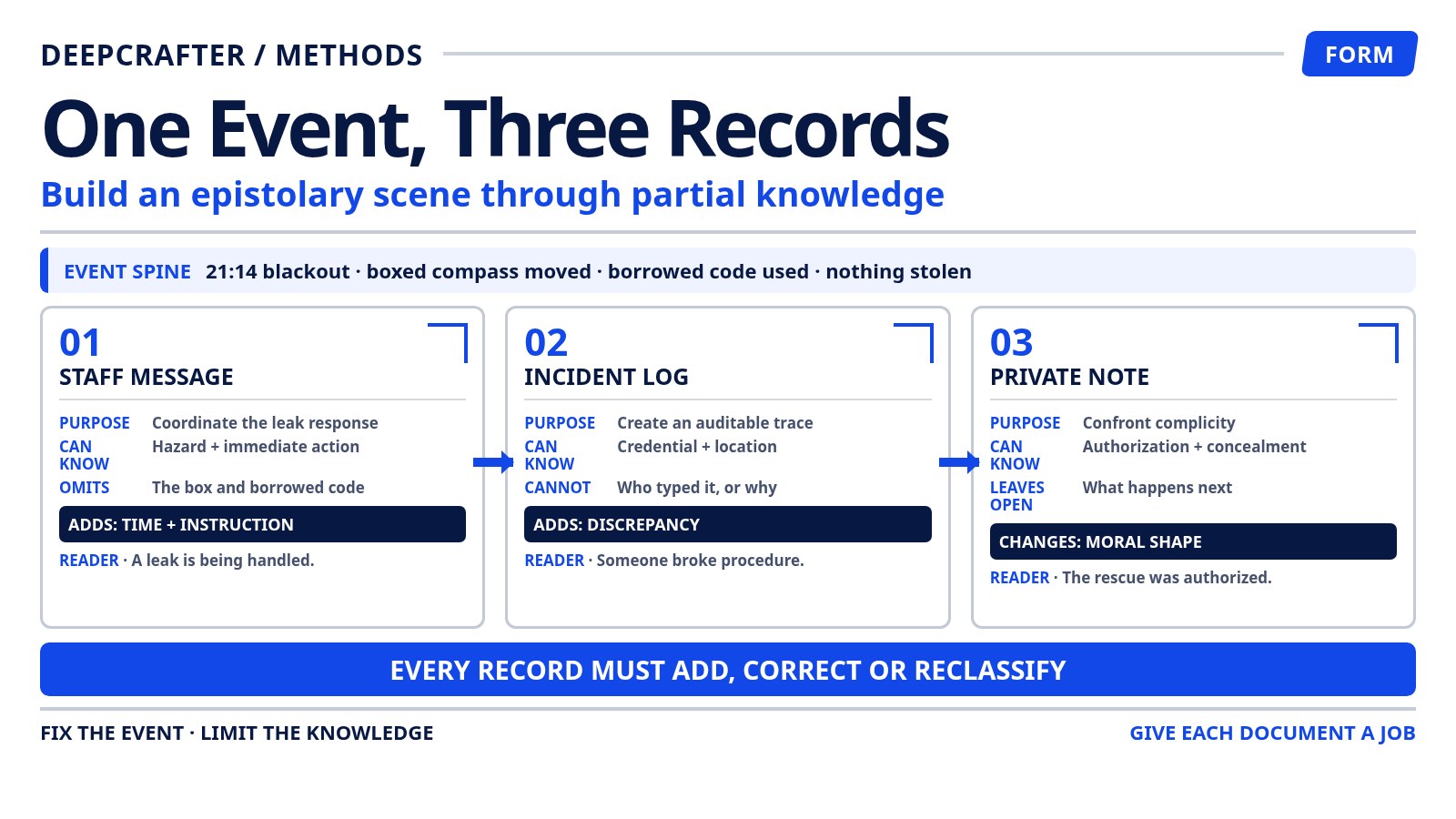
At 21:14, a blackout affects the east wing of a small museum. During the seven-minute outage, an intern named Nia wheels an archive trolley clear, then moves a boxed compass from the conservation room to the loading bay because water is leaking from the ceiling. She uses a door code borrowed from guard Tomas. At 21:21, power returns. The box is found at 21:36. Nothing has been stolen, but the move was unauthorized and Tomas’s code appears in the access log.
This is the author’s stable version. It gives every later record something to reveal, misread or omit.
Write the spine before drafting the documents. Otherwise, contradictions may become accidental rather than meaningful.
Record 1 · The operational message
21:18 · EAST WING STAFF CHAT
Nia: Water coming through Conservation 2. I moved the archive trolley clear. Can someone confirm whether the loading-bay dehumidifier is on?
Tomas: Stay out of the secured corridor until power returns.
Nia: Understood.
This record is contemporary and practical. It establishes the leak, outage and official instruction. It does not mention the compass box or the borrowed code.
The omission is not automatically proof that Nia is deceptive. Staff chat is a fast operational channel. She may be solving the immediate problem, protecting Tomas or avoiding a public admission until she knows the object is safe.
What it adds: time, hazard and a visible instruction.
What it withholds: the unauthorized move.
Record 2 · The incident log
22:05 · SECURITY INCIDENT 11-08-E
Power loss recorded at 21:14; restored at 21:21. East service door opened at 21:17 using credential T-04. No scheduled transfer was logged. One boxed navigational instrument was located on a dry pallet inside the loading bay at 21:36. Exterior doors remained secured. Inventory review pending.
The log sounds authoritative, but its authority has limits. It can report timestamps, credentials and locations. It cannot tell us who physically entered the code, why the box moved or what anyone intended.
The reader can now see a contradiction: Nia said she moved the trolley clear, while the log identifies a specific boxed object in a different room and a credential assigned to Tomas.
What it adds: a traceable action and a discrepancy.
What it withholds: motive and authorship.
Record 3 · The private note
23:42 · TOMAS, UNSENT NOTE
I gave Nia the code last week because the keypad fails to read her temporary badge after nine. I told myself it was harmless. Tonight she called from the corridor and said water had reached the compass shelf. I said, “Use it.” Then I wrote in the staff chat as if she had not. The box is dry. My report is accurate about the door and false about how surprised I was.
The private note does not simply solve the puzzle. It changes its moral shape.
Nia’s action protected the object. Tomas enabled it, then used official language to distance himself from the decision. The missing item was never a theft mystery; it was a test of how institutions record necessary rule-breaking.
What it adds: authorization, motive and self-implication.
What remains open: whether either person will revise the official account and what the museum will value more—procedure, honesty or the saved object.
Step 1 · Fix the event spine
List the facts that do not change:
- who acted;
- what happened;
- when and where it happened;
- what physical evidence exists;
- what consequence follows.
This spine is not the same as objective truth in every kind of fiction. Memory can be uncertain, records can be forged and supernatural events can resist explanation. But the author still needs to know which uncertainties are intentional.
Decision rule: decide what is fixed, what is disputed and what remains unknowable before distributing information.
Step 2 · Give each record an information range
Draw three columns: can know, cannot know, might infer.
For the incident log:
- can know: the outage time, door credential and box location;
- cannot know: who typed the code or why;
- might infer: unauthorized access occurred.
For Tomas’s note:
- can know: he shared the code and authorized its use;
- cannot know: every action Nia took inside the dark corridor;
- might infer: she omitted the box from chat to protect them both.
This prevents documents from becoming omniscient simply because the plot needs an explanation.
Decision rule: a record may be mistaken, but it should not know more than its maker could know.
Step 3 · Give each document a motive
Documents are actions. Someone creates them to do something.
- The staff message coordinates a response.
- The incident log preserves an auditable account.
- The private note lets Tomas confront the difference between accuracy and honesty.
Motive shapes language. Operational messages compress. Official logs standardize. Private notes may circle, revise or admit. The voice should arise from the document’s use, not from adding decorative typos or changing fonts.
Ask of every record:
What does its maker want this document to make possible?
The answer may be practical, emotional or strategic: get help, create evidence, reassure a parent, shift blame, preserve memory, test a suspicion or confess without sending.
Decision rule: if two documents have the same audience and purpose, consider combining them.
Step 4 · Arrange a sequence of re-interpretation
Reading order controls suspense.
Our sequence moves through three questions:
- What is happening? A leak and outage.
- What does not fit? A secured door opens and a boxed object moves.
- Who accepted the risk? Nia acted, but Tomas authorized and concealed his role.
If the private note came first, the later log would confirm rather than transform. That might suit a story about dread—readers know what officials have not discovered—but it would create a different effect.
Useful sequence patterns include:
- expansion: each record adds a wider context;
- correction: a later record revises an earlier assumption;
- collision: two records cannot both be complete;
- reclassification: the event changes category, as apparent theft becomes unauthorized rescue;
- convergence: separate records reveal that several characters are approaching the same danger.
Decision rule: every new record should add, correct or reclassify—not merely repeat.
Three common failures
1. Every document sounds like the novelist
A report, text message and diary may share a character’s habits, but they serve different purposes. Change selection, structure and degree of explanation before reaching for superficial quirks.
2. Contradictions have no source
Readers will tolerate uncertainty when they can understand why accounts diverge: limited access, different timing, self-protection, faulty memory or incompatible goals. Random discrepancies feel like continuity errors.
3. The last record explains everything
A final document that converts every ambiguity into a neat answer can flatten the story. Resolve the central causal question while leaving a consequential choice open.
A three-record planning grid
Before drafting, complete one row for each document:
| Record | Maker | Audience | Purpose | Can know | Cannot know | Adds or changes |
|---|---|---|---|---|---|---|
| 1 | ||||||
| 2 | ||||||
| 3 |
Then write a one-sentence event spine and choose the reader’s progression:
At first the reader believes ______. After record two, ______. After record three, the event becomes ______, which forces ______.
If the blanks do not change, the documents may be redundant.
Using an AI collaborator as a continuity auditor
An AI writing tool can compare the records against the event spine, but do not ask it to “make them more different” in the abstract. Give it a bounded audit:
- List every fact introduced by each record.
- Flag any fact the maker could not reasonably know.
- Identify repeated information that does not change interpretation.
- Separate intentional contradictions from unexplained inconsistencies.
- Summarize what the reader is likely to believe after each record.
Review the audit rather than accepting automatic rewrites. A tool may smooth away the productive gaps or make every contradiction explicit. The writer decides which uncertainty creates the intended reading experience.
Make the records depend on one another
The pleasure of an epistolary scene does not come from the number of formats. It comes from reconstruction.
Fix the event. Limit each maker’s knowledge. Give every document a job. Then order the records so the reader must revise what they think happened.
One event can produce three honest records and still reveal three different truths.
Sources
The four-step framework and museum documents are original editorial material created by DeepCrafter.