Winning the Argument, Losing the Scene
A four-part method for writing ideological conflict as drama: give each character a position, a private stake, an action in the room and a relationship consequence.
Winning the Argument, Losing the Scene
On November 9, Ivan Turgenev’s birthday, the obvious way to revisit Fathers and Children is as a novel of ideas: liberalism and nihilism, fathers and sons, inherited principles and a generation impatient to clear the ground.
For a fiction writer, however, the more useful question is not who wins the argument? It is why does the argument remain a scene rather than becoming an essay with character names attached?
Turgenev’s answer is visible in the way he surrounds ideas with injury, appetite, objects, witnesses and changing loyalties. The characters do not merely state positions. They risk their place in a family.
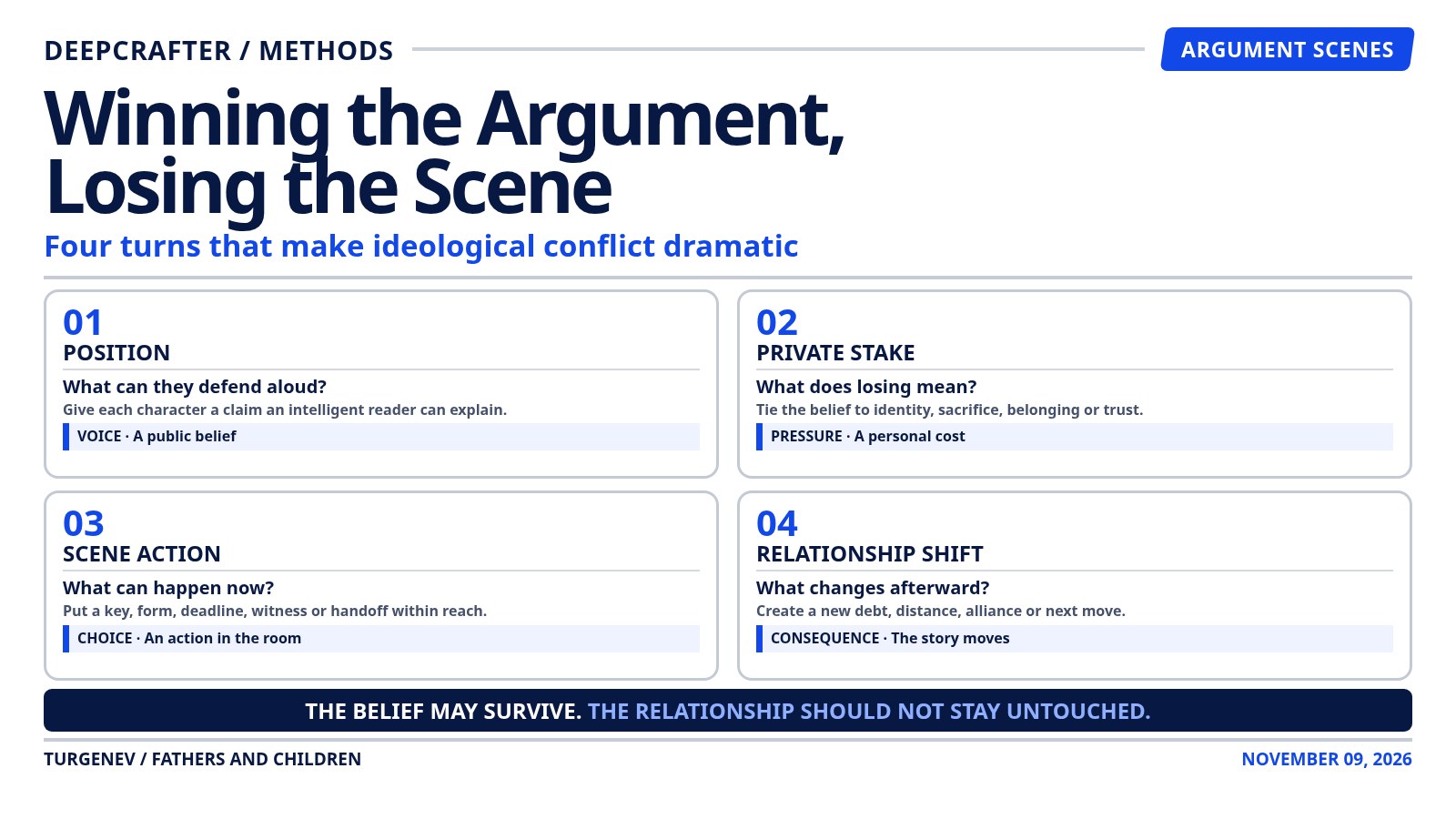
This article turns that observation into a four-part revision method:
- Position — what the character can defend aloud.
- Private stake — what losing would mean about the character or relationship.
- Scene action — what someone can do now, in this room.
- Relationship shift — what becomes harder, closer or newly owed afterward.
The framework is original DeepCrafter editorial material. It is not a theory attributed to Turgenev.
Why Fathers and Children is still useful to scene writers
Visuotinė lietuvių enciklopedija records Turgenev as a Russian writer born in Oryol on November 9, 1818, and describes Fathers and Sons as a novel that brought a conflict between democratic young people and their fathers into view. Penguin Random House notes his unusually wide European reputation and situates the novel within a sequence charting decades of Russian life.
The book certainly contains large claims. Yet its arguments are rarely weightless. They occur in a household where a son has returned from university, brought home a charismatic friend and begun to see his father through that friend’s language.
That arrangement gives every idea a second meaning. A judgment about poetry can also be a judgment about a father. A defense of principle can also be a defense of a life that appears to have lost its public usefulness. Agreement can be less a conclusion than a performance of allegiance.
Chapter V: define the idea inside a relationship
In Chapter V of the Constance Garnett translation at Project Gutenberg, Arkady explains that Bazarov is a nihilist. Nikolai tries to understand the term. Pavel converts it into a question of respect and whether life is possible without inherited principles.
The exchange is not staged in an empty lecture hall. It happens at breakfast, inside a household already carrying embarrassment and uncertainty. Fenitchka appears with Pavel’s cocoa; Nikolai is uneasy; Pavel responds with severity. The family arrangement is present even when nobody openly debates it.
This matters because the label nihilist enters the novel as more than a definition. It becomes a way for the older men to measure the young men—and for Arkady to announce who now has his admiration.
Craft lesson: introduce an idea through the person who needs the definition, the person threatened by it and the person pleased to possess it. Exposition gains pressure when understanding the term changes the social geometry of the room.
Chapter X: wound the relationship before the debate begins
Before the famous evening argument in Chapter X, Nikolai overhears Bazarov call him behind the times. Arkady does not defend him. Nikolai returns home hurt, and later admits that he had hoped this visit would bring father and son closer.
Only after that private wound does Pavel enter tea “ready for the fray.” The debate ranges across aristocracy, dignity, usefulness, authority, reform and destruction. But the chapter continually translates abstraction back into character:
- Pavel’s defense of dignity is inseparable from the way he has organized his identity.
- Bazarov’s attack on idle principles is inseparable from his contempt for lives that do not produce visible action.
- Arkady’s agreement demonstrates his attachment to Bazarov in front of his family.
- Nikolai’s attempts to prevent personal attacks reveal that the argument has already become personal for him.
The scene does not end by awarding victory. Bazarov and Arkady leave to dissect frogs. The brothers remain behind and confront the fact that they are now the older generation. The argument has changed who stands with whom.
That is the difference between an argument that merely communicates views and an argument that advances a story.
The four-part argument-scene diagnostic
1. Position: what can the character defend aloud?
Write each position as a sentence the character would willingly repeat in public.
- “The shop should be preserved because a neighborhood needs places that are not optimized for profit.”
- “The shop should be sold because nostalgia cannot justify unpaid wages and growing debt.”
If one side has only a slogan while the other has evidence, the scene is already rigged. Give each character a claim that makes sense from where they stand.
Diagnostic question: could an intelligent reader explain why this character believes this, even without agreeing?
2. Private stake: what does losing mean?
An argument becomes dramatic when defeat threatens more than an opinion.
It may mean:
- I wasted the last five years.
- You have become like the person who hurt us.
- I am no longer the one you trust.
- My sacrifice was invisible.
- The future has no place for the self I built.
The private stake does not need to be confessed. It only needs to distort the scene: a repeated word, an excessive reaction, a sudden change of target or a detail the character cannot let pass.
Diagnostic question: which sentence hurts more than its literal meaning should allow?
3. Scene action: what can happen before anyone leaves?
Ideological dialogue often stalls because nothing in the room can change. Give the characters a live task, object or deadline.
They might:
- sign or refuse a form;
- hand over a key;
- delete a file;
- invite or exclude a witness;
- begin packing;
- move money;
- open the door to the person being discussed.
The action does not have to settle the issue. It should make the argument costly now.
Diagnostic question: if the scene ended in the next sixty seconds, what irreversible or revealing action could occur?
4. Relationship shift: what changes after the last line?
Do not ask only whether a character changed their mind. Most strong arguments do not produce instant ideological conversion.
Ask instead:
- Who now owes an answer?
- Who has lost the right to remain neutral?
- Who has chosen a side in public?
- What new distance, alliance or obligation exists?
- What will someone do differently in the next scene?
Diagnostic question: what future action is now more likely because this argument happened?
Original example: the version that only debates
Mara and Joel inherited their father’s neighborhood bookshop. A developer has offered to buy it. Mara has kept the failing business open; Joel has returned for the vote.
“The shop means more than profit,” Joel said. “People need places like this.”
“Meaning does not pay the staff,” Mara said. “We are three months behind.”
“If we sell, the neighborhood loses something irreplaceable.”
“If we refuse, the staff may lose their jobs anyway.”
“There are values you cannot put on a balance sheet.”
“There are bills you cannot remove from one.”
Both positions are legible. Nothing is technically wrong with the exchange. But the characters function as delivery systems for opposing claims. The scene has no present-tense action, and the relationship is unchanged when the dialogue stops.
Revised example: make the argument spend something
Joel peeled the developer’s survey sticker from the front window and folded it into his pocket.
Mara set Friday’s payroll ledger on the counter. “Ana has asked twice whether her cheque will clear.”
“Then tell her we are not selling the only place on this street where a kid can sit all afternoon without buying anything.”
“You tell her.”
He opened the ledger. Beside Mara’s name, three pay periods were blank.
“You never said you stopped paying yourself.”
“You never asked what preserving the place cost.”
Joel pushed the ledger back. “Dad did not keep this shop for forty years so we could turn it into luxury flats.”
Mara placed the shop keys on the open page. “Then do payroll Friday. Call the boiler company Monday. Vote no tomorrow if you can still say it after that.”
He looked at the keys but did not take them.
“That is what I thought,” she said, and left him behind the counter.
The revision does not make Mara automatically right. It changes the dramatic structure.
Position
Joel defends the shop as a form of public life. Mara argues that preservation financed by invisible sacrifice is not sustainable.
Private stake
Mara needs Joel to recognize the labor he has romanticized from a distance. Joel needs the shop to remain evidence that leaving did not sever him from his father.
Scene action
The ledger and keys convert belief into an available obligation. Joel can take responsibility, refuse it or propose another action.
Relationship shift
Mara has ended Joel’s ability to oppose the sale without also answering who will carry the cost. His silence is not a verdict on the future of the shop, but it changes the terms of their next conversation.
Three common failures
The author secretly grades the debate
One character gets vivid examples, emotional complexity and the final word. The other receives clichés. Readers can feel the thumb on the scale.
Revision: write the strongest private reason for each side before drafting the dialogue. Give both characters one accurate observation about the other.
The private stake is explained instead of dramatized
The narration tells us that Mara resents Joel for leaving, then the dialogue repeats the information.
Revision: let resentment alter what she hands him, what she refuses to answer or which practical burden she makes visible.
The argument changes nothing
Characters debate for two pages, agree to disagree and continue with the original plan.
Revision: require a handoff, deadline, witness, refusal or new task. The belief may survive unchanged; the relationship should not.
A 15-minute revision exercise
Choose an existing scene in which two characters disagree.
Minutes 1–3: write the public positions
Give each character one sentence they would willingly defend before a neutral audience.
Minutes 4–6: write the private losses
Complete this sentence for each person: If I lose this argument, it means…
Do not paste those answers into the dialogue.
Minutes 7–10: add one live action
Place a form, key, message, payment, packed bag or waiting person in the scene. Make it possible for someone to act before the conversation ends.
Minutes 11–13: remove the author’s verdict
Cut the line that most obviously announces who is correct. Replace it with a response, interruption or physical choice.
Minutes 14–15: write the next consequence
Finish with one sentence: Because this argument happened, the next scene must now include…
If the answer is “nothing different,” the argument is probably still exposition.
Using AI to diagnose an argument scene
An AI collaborator can help separate the four layers without deciding the story for you. Ask it to return four short observations:
- What position does each character defend aloud?
- What private stake is supported by textual evidence rather than guessed biography?
- What action becomes possible during the scene?
- What changes in the relationship or next likely action?
Then inspect the answer.
- If the positions are clear but the private stakes are generic, strengthen one character-specific pressure point.
- If the stakes are vivid but no action is possible, introduce an object, deadline or witness.
- If the tool declares a winner, ask which details in the prose make one side appear authorially favored.
- If the relationship does not move, rewrite the ending before adding more argument.
The writer still decides what the story believes, whether either position survives contact with events and how much ambiguity the reader should carry forward.
Let the argument alter the room
Turgenev’s characters speak about principles, progress and destruction. But Chapter X stays alive because a father has been wounded, an uncle is defending the shape of his life, a son is displaying a new allegiance and a guest can leave the table to resume his work.
That is the standard for an argument scene. Do not merely give both sides good lines. Make each position expose a private cost. Put something within reach that can be done. Then let the relationship leave the room in a different condition.
The character who wins the point may still lose trust, authority, intimacy or the right to stay uninvolved. That loss is often where the story begins moving again.
Sources
- Project Gutenberg: Fathers and Children, translated by Constance Garnett
- Visuotinė lietuvių enciklopedija: Ivan Turgenev
- Penguin Random House: Ivan Turgenev
The four-part diagnostic and the bookshop scenes are original DeepCrafter editorial material.