The Middle Is Where Choices Come Due
Sustain a novel’s middle through choices that change the next scene: a practical workflow for planning, drafting, branching and revision.
The Middle Is Where Choices Come Due
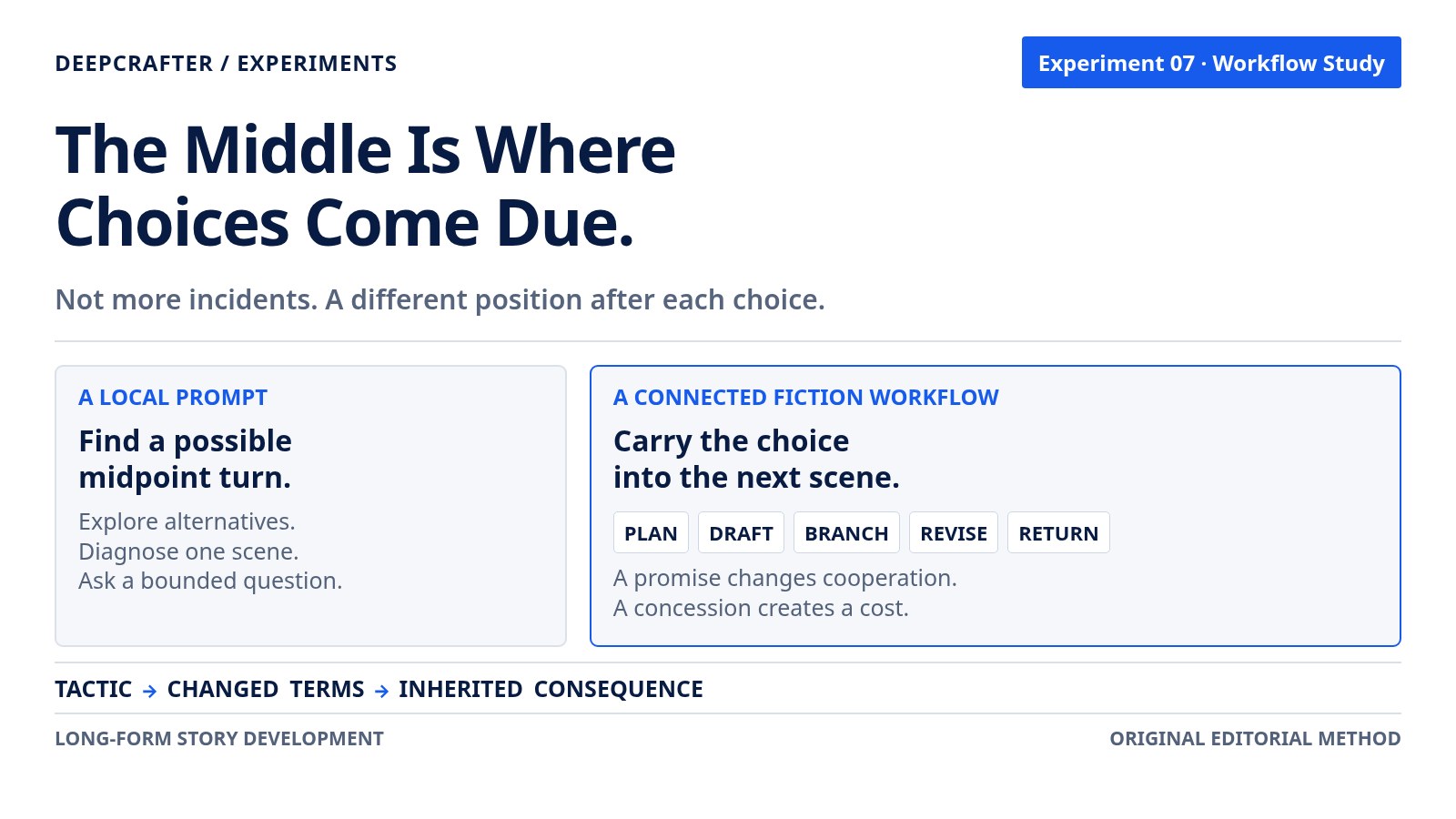
Experiment 07 · Workflow Study
An opening gives a character something to want. An ending shows what that wanting has cost. The middle has the harder job: making the cost arrive in ways the character cannot simply ignore.
This is where a long draft can become strangely busy without moving. A witness refuses to talk. Another witness refuses differently. A fresh clue sends the protagonist somewhere new, but leaves every important relationship unchanged. The chapters contain activity; the story keeps returning to the same position.
A useful prompt can rescue one such scene. Sustaining a novel asks for something larger: a working relationship between the plan, the pages already written, the alternatives still open and the revisions that change what comes next. That is the practical distinction this study explores. A freeform chat request is useful for a bounded invention. DeepCrafter's connected fiction environment is better suited to staying with a developing manuscript through its middle, because planning, drafting, branching and revision belong to the same creative workflow.
This is an editorial workflow demonstration, not a measured comparison. All story material and working notes below are original examples, not generated results or representations of product fields.
A novel with an opening, an ending—and an empty bridge
Consider The Last Screening, an invented family novel set around a small-town cinema scheduled for demolition.
Leah, a film restorer, returns to catalog the cinema's archive before its final screening. She wants to save a recording that could establish her late mother's uncredited work. Her brother Tomas wants to sell the building: the deposit would secure an accessible home for his daughter. Leah has promised not to disrupt the sale. She has also promised a former projectionist, Ada, that no private recording will be shown without permission.
The opening is easy to imagine: Leah discovers a mislabeled reel. The ending is imaginable too: she chooses what the town will see at the last screening. Between those moments, the book needs more than a chain of discoveries. Each attempt to secure recognition must change the terms on which recognition is possible.
The central problem is not finding enough incidents. It is keeping three commitments in contact: preserve the work, protect the sale, respect consent. The middle becomes interesting when pursuing one makes another harder to honor.
Write those commitments in plain language before asking for chapters. They are the source of the book's pressure, not a schedule of compulsory plot beats.
What a direct prompt does well
A one-time request can be genuinely productive here:
I am writing a family novel about Leah, a film restorer trying to identify her mother's uncredited work before a cinema closes. Her brother needs the sale to proceed, and a former projectionist has withheld permission to show a private reel. Suggest three possible midpoint turns. For each, explain which relationship changes and what Leah can no longer do afterward. Do not write prose yet.
That is a reasonable isolated task. It gives the writer alternatives without demanding a full chapter. The writer can reject all three and still discover the question that matters.
The work changes once a choice has been made. If Leah has already promised Tomas that the screening will be harmless, the next scene cannot treat a public campaign as a consequence-free idea. If Ada has agreed to a private viewing but not public exhibition, the distinction must survive into the draft. A new suggestion has to meet an existing story, not merely sound exciting on its own.
A writer can absolutely maintain this material alongside a chat tool, using notes, project features and carefully selected excerpts. The method under discussion is the ephemeral prompt-and-response exchange, not the ceiling of any general chat product. Its convenience is strongest when the question is local and the writer already knows what surrounding context to supply.
First, distinguish the two kinds of progress
There is information progress: Leah learns who handled the reel, where a print was stored or when a credit disappeared.
There is also position progress: Leah loses access to the archive, accepts help from someone she distrusts or makes a promise that blocks an easy solution.
A quiet literary novel may contain long stretches without a public confrontation. Position can change through a withheld invitation or an offer of care that someone cannot comfortably accept. Escalation need not mean louder scenes. It means the next choice takes place under different conditions.
For each planned sequence, write two sentences:
- What can Leah attempt now that she could not attempt before?
- What can she no longer do without paying a cost?
This is our editorial planning method, not a DeepCrafter interface schema. Keep it in your own working notes and use its conclusions to direct the story.
If both answers remain unchanged across several scenes, consider combining the scenes or changing the protagonist's tactic. More description may improve atmosphere, but it will not automatically repair a stalled sequence.
Prepare the middle before developing the draft
DeepCrafter's public long-form guide documents Deep Craft for developing a complete draft from a creative setup, followed by editorial review. It also distinguishes that route from AI Create's stepwise direction. Choose according to how settled the story is, rather than treating one mode as universally preferable.
For The Last Screening, an original setup note might read:
Write a restrained family novel in close third person through Leah. The cinema's final screening is ten days away. Leah wants evidence of her mother's uncredited work, but her brother's housing plans depend on the sale and Ada controls permission to show the private reel. Sustain the middle through changes in cooperation, consent and obligation, not repeated clue hunts. Preserve the possibility of a screening without requiring complete public vindication.
This note supplies dramatic conditions. It does not dictate a discovery every chapter or require the software to enforce a custom checklist. The writer remains responsible for deciding whether the pages fulfill the intention.
If you already understand the long arc, Deep Craft offers a developmental draft to examine as a whole. If the first difficult choice is still unresolved, AI Create lets you work passage by passage instead. Do not describe the latter as pausing or controlling an active Deep Craft run: these are different documented workflows.
Build a sequence of choices, not a row of obstacles
Here is one possible editorial route through the middle. It is deliberately provisional.
First attempt: seek private confirmation. Leah asks Ada to identify a voice on the reel. Ada agrees on condition that Tomas is present. Leah gets a possible witness, but loses the privacy in which she hoped to control the discovery.
Second attempt: separate the family problem from the archive problem. Leah tells Tomas that attribution will not affect the sale. To secure a limited viewing, she offers to finish the catalog early. That practical concession leaves less time to investigate and makes Tomas rely on a deadline she may not meet.
Third attempt: borrow public attention. Leah allows a local historian to mention the screening. Interest grows, but people now expect a revelation. Tomas reasonably asks whether her supposedly private research has become a campaign against the sale.
Fourth attempt: repair the promise. Leah proposes a smaller screening with no claim of definitive attribution. Ada will consider it if Leah removes a passage involving someone still alive. The most persuasive evidence may be the very material she cannot ethically show.
The pressure is cumulative because the strategies leave traces. Leah cannot arrive at the fourth attempt with all the freedoms she had at the first.
Notice how Tomas and Ada have purposes beyond blocking Leah. Tomas is trying to make a home possible. Ada is protecting a confidence. Their cooperation can change without either becoming an arbitrary villain. That is what gives the middle room to breathe: each encounter is a negotiation between lives, not a mechanism delivering a clue.
Use the manuscript to decide where to intervene
Once pages exist, read for the first place where a choice stops producing consequences. Do not start by polishing the chapter that feels dullest. Its dullness may originate several scenes earlier, when a promise was made and then forgotten.
The DeepCrafter User Guide documents custom directions in AI Create, alternate branches, AI Rewrite, direct Manual Editing and editable story Config. It also describes model routing across creative stages. Those capabilities support different kinds of intervention; none substitutes for deciding what the story needs.
Use a new direction when the next action is wrong. For example: Leah cannot ask Ada for another favor until she acknowledges the publicity she allowed.
Use a branch when the earlier decision needs a different consequence. Explore the scene in which Leah refuses the historian's offer, rather than rewriting the whole book around her acceptance. Keep the alternative provisional until you have read what follows.
Use AI Rewrite when the event belongs but its execution is weak. Leah can still make the promise to Tomas, but the scene may work better if she makes it while helping measure the doorway of his prospective home. The housing stakes become concrete without an explanatory speech.
Use Manual Editing when you know the correction: remove a contradictory date, replace an over-explicit line or restore the exact scope of Ada's permission.
Use Config editing when the continuing creative brief has genuinely changed. That is a forward-looking setup decision, not a claim that editing the brief repairs every existing page.
The value of a connected environment is that the writer can move between these levels while remaining oriented to the manuscript. Better suited means a better fit for this sustained activity—not a guarantee that every proposed scene will work.
Let the subplot change the main action
A common middle-book repair is to add a subplot. That helps only if it changes what the protagonist can do.
Tomas's housing search should not be a detachable interlude that makes the novel appear fuller. Suppose Leah accompanies him to view a flat and discovers why the sale date cannot move. She returns to the archive with a new constraint: a delay would not merely annoy her brother; it would cost his family a practical opportunity.
Now the next research choice means something different. Even an unchanged action—telephoning a witness—can carry a different weight if Leah knows the answer might make her break a promise she finally understands.
Try this editorial request when preparing a continuation:
Keep Tomas's housing need independent of Leah's research. Let what Leah learns during the viewing change the compromise she offers Ada. Do not solve the attribution question or make Tomas secretly oppose his mother's recognition.
This is an original direction a writer might adapt. It is not a sampled system output. Its purpose is to connect two strands through a decision rather than force them to share a surprise culprit.
Revise the center before decorating it
Read the middle in sequence and summarize each scene with a verb of attempted action: persuades, conceals, bargains, concedes, retracts. Then add its consequence.
“Leah learns about the reel” describes content. “Leah bargains for access and makes Tomas depend on a deadline” describes a movement the next scene must inherit.
Look especially for apparent changes that reset immediately. If an argument ends with everybody still offering the same cooperation on the same terms, it may have produced feeling without altering the story. That can be intentional. But if every disagreement behaves this way, the middle has no accumulating pressure.
Repair the cause, then reread the adjacent scenes. A stronger promise in one chapter may make a later line falsely casual. A branch may introduce a different witness arrangement. Do not treat a successful local rewrite as proof the whole sequence is now coherent.
Only after the sequence holds should you spend time smoothing repeated imagery or varying sentence rhythms. Beautiful prose deserves a story position worth inhabiting.
Leave a doorway back into the book
Before ending a writing session, make a short return note in your own notes:
Leah has private-viewing permission only. Tomas believes the catalog will be finished by Friday. Public interest exists, but attribution remains uncertain. Next scene: Leah must tell Ada what the historian has announced. Open alternative: decline the publicity earlier. Not yet accepted into the main draft.
The note separates fact, expectation, uncertainty and unused possibility. It is an editorial habit, not a claim about automatic storage or retrieval.
On returning, read the relevant passage before continuing. The point is not to make the novel reducible to a summary. It is to recover enough of its current situation to re-enter the scene without casually erasing yesterday's difficult choice.
Which working method fits?
Choose a prompt paragraph when you need a few midpoint possibilities, a second opinion about a scene or help naming a local problem. It is quick, flexible and easy to abandon.
Choose DeepCrafter when the task is to develop and inhabit a long manuscript: prepare a dramatic brief, draft at the appropriate level of control, explore alternatives, revise the decisions that matter and return to the story with its pressures still in view. The advantage is the connected workflow around the writing, rather than an isolated promise of a better paragraph.
The middle does not need an endless supply of surprises. It needs a person who cannot keep solving the present problem without changing the next one.
Public sources and scope
- DeepCrafter User Guide: public documentation for AI Create, branches, rewriting, manual editing, Config and creative-stage model routing. Accessed November 13, 2026; page marked August 2026.
- How to Create a Long-Form Novel with AI: public documentation for Deep Craft and its distinction from stepwise drafting. Accessed November 13, 2026; page marked August 2026.
These sources establish capability existence, not a performance result. The choice sequence, planning questions and return note are original editorial methods; they do not assert exact product fields, automatic cross-branch synchronization or guaranteed continuity. The author chooses what becomes part of the manuscript.