Character Card or Prompt Paragraph? Build Someone You Can Return To
A reusable character-development workflow for contradiction, desire, fear, relationships and changing tactics across a long story.
Character Card or Prompt Paragraph? Build Someone You Can Return To
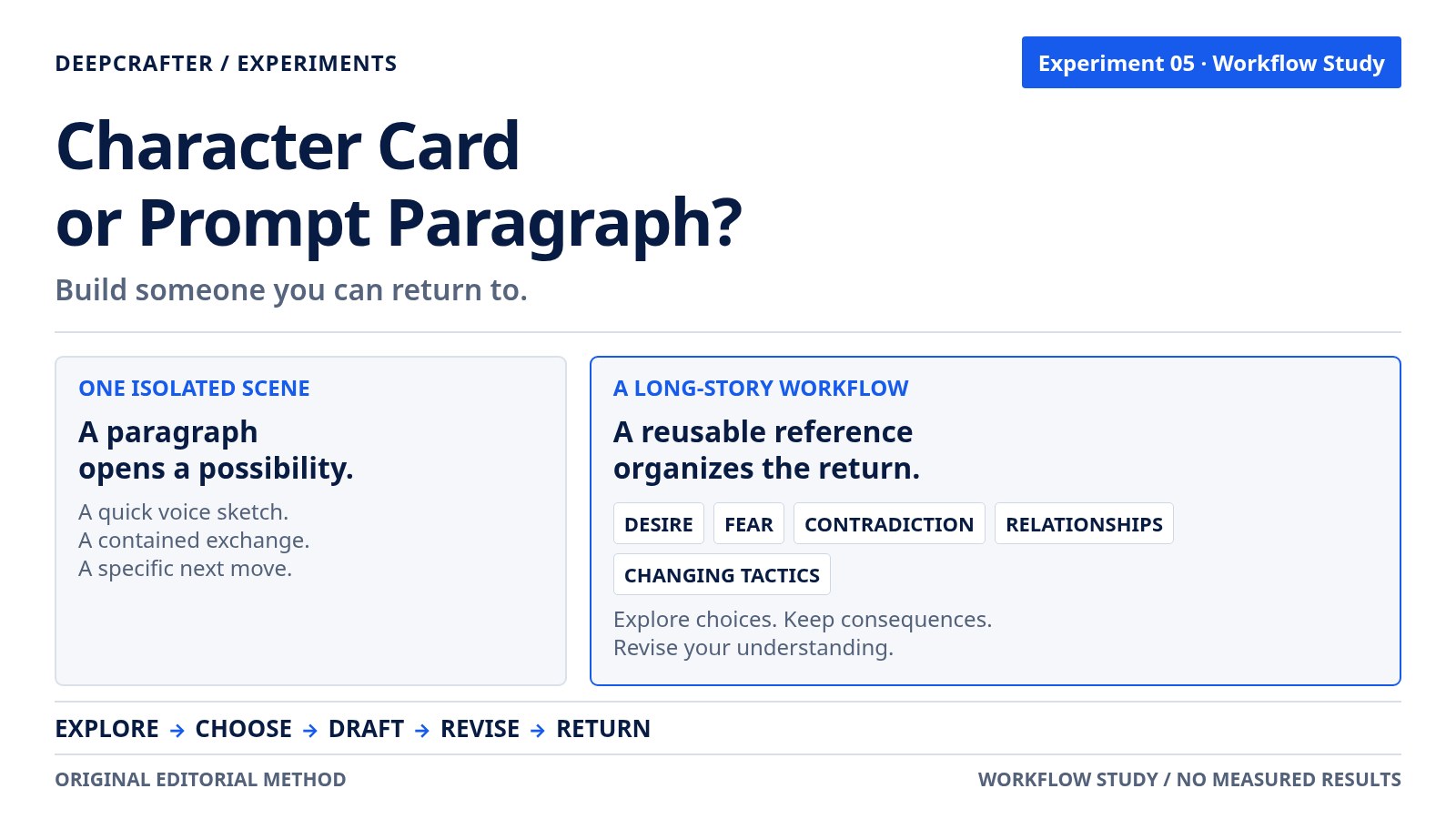
Experiment 05 · Workflow Study
A paragraph can introduce a character. A long story asks you to return to that person after a betrayal, a discovery, a compromise—and still recognize the person making the next choice.
That is the useful distinction behind “character card or prompt paragraph.” It is not a contest between short text and a form with more boxes. It is a difference between requesting an answer for the moment and maintaining a developing understanding of someone across a manuscript.
A freeform prompt is excellent when you need a quick possibility: a voice, a motive, a brief exchange. For sustained character work, DeepCrafter offers a more coherent environment: character exploration, story development and revision can belong to the same creative practice rather than becoming separate conversations you must reconnect yourself.
This is a workflow demonstration, not a measured product comparison. The story, sample card and prompts below are original editorial examples, not generated results or a specification of DeepCrafter’s interface.
Start with a person under pressure
In our original story, The House of Returned Letters, Nessa Vale repairs damaged correspondence in a coastal town. The municipal archive will be sold in six weeks. Nessa wants to save it, partly because the archive contains letters that could restore her late father’s reputation. Her younger brother, Eli, wants the sale to proceed: his share would let him leave a town that still treats him as the failed son.
Nessa calls herself a guardian of other people’s words. She has also withheld one letter from Eli because it makes her father look worse.
The immediate writing task is small: write the scene in which Eli asks for the missing letter. The long-story task is much larger: understand how Nessa’s desire to preserve becomes a habit of control, how that habit changes her relationships, and what she might do when control no longer works.
“Loyal, secretive, meticulous” is a useful thumbnail. It is not yet a dramatic engine. We need to know what loyalty permits her to justify, whose judgment she fears, and what happens when her preferred method stops getting results.
Method one: a paragraph for an isolated task
Here is a reasonable direct prompt:
Write a restrained, close-third-person scene about Nessa Vale, a meticulous letter conservator trying to save a coastal archive. She prizes honesty but has hidden a letter that could damage her father’s reputation. Her brother Eli wants the archive sold so he can leave town. He asks for the missing letter while she repairs an envelope. Let her evade him without admitting the concealment. End with a concrete action rather than an explanation of her feelings.
This paragraph does real work. It gives the scene an objective, a contradiction, a relationship and a physical task. For a voice sketch or one difficult exchange, it may be all you need.
After reading the candidate, the writer can ask for a quieter version, change the physical action, or keep one line and discard the rest. The method is quick because it compresses the relevant decisions into a single request.
Its limitation appears when the assignment expands. Twenty chapters later, is Nessa still hiding that same letter? Does Eli know she lied? Has she admitted the truth to someone else? Does her meticulousness now read as care, intimidation or a defensive ritual? A paragraph can hold those answers, but someone must choose and update them.
This is not a claim that a general chat tool cannot support long projects. Writers can maintain excellent character notes and use richer context arrangements. Our comparison concerns the deliberately lightweight, one-off prompting method—not the ceiling of every chat product.
Method two: maintain a character, not just a description
The reusable card in this article is an editorial thinking tool. You can keep it in your own notes; its labels do not describe built-in product fields. Its purpose is to make decisions easy to revisit while working in DeepCrafter.
Begin with a compact character model:
- Want: keep the archive open and clear her father’s name.
- Fear: that people will discover her loyalty depends on controlling the evidence.
- Contradiction: she preserves words professionally while withholding the words that threaten her privately.
- Self-story: “I am protecting people from careless interpretations.”
- Usual tactic: delay a difficult conversation by offering practical help.
- Relationship pressure: Eli experiences her help as another way to decide for him.
- Present boundary: she will conceal a letter, but has not yet destroyed one.
- Open question: will she accept a truthful archive if it cannot preserve the father she remembers?
Notice the difference between a fact and a hypothesis. Nessa has hidden a letter: that is established in our premise. She might destroy it: that is an unresolved possibility. If we silently turn the possibility into history, we change the character before writing the decision that should matter.
The card should stay selective. A favorite breakfast may help a particular scene; it does not automatically deserve the same weight as the lie dividing two siblings. Organize around what can produce action, misreading and consequence.
A practical DeepCrafter character-development loop
The public DeepCrafter User Guide documents Chat with Character, the in-editor AI Writing Assistant, Character Switch, branching, AI Rewrite, Manual Editing, editable story Config and continued story development. Those are the product capabilities used here. The sequence connecting them below is our proposed writing method.
1. Put the dramatic core into the story setup
Prepare the story’s central conflict before asking for more prose. For this example, the useful core is not “a complex woman in a beautiful archive.” It is a woman who wants truth to vindicate her family but tries to control which truth becomes available.
Keep the character model beside the draft as a working reference. Carry essential decisions into the story setup and the instructions you supply where relevant. The aim is not to paste a full biography into every request; it is to make the next literary decision legible.
2. Explore the contradiction in conversation
Use Chat with Character to explore choices rather than collect decorative facts. Try an original question such as:
Eli says, “If you trust me, give me the letter unopened.” What do you offer him instead, and what do you hope that offer will prevent?
The interesting discovery might be that Nessa offers to pay his train fare. That would connect generosity with control. But a possible answer is not automatically an event in the manuscript. Decide whether it illuminates the person you are writing before incorporating it.
Keep a distinction in your notes: accepted understanding, possible interpretation, rejected option. These are editorial categories, not promised software states.
3. Turn the discovery into a scene choice
A character becomes more complete through relationships and action, not a longer list of qualities. Ask the Writing Assistant a focused craft question: “If Nessa offers money instead of the letter, how could Eli refuse in a way that exposes her need to decide for him?”
Then choose the move yourself. Perhaps Eli returns the money and asks her to stop repairing an envelope that is already intact. Now his resistance addresses her behavior in the room. It need not deliver a speech about her psychology.
Draft or continue with a clear instruction: let Nessa try practical help first; when it fails, let her appeal to family duty. The tactic changes, but the underlying desire remains recognizable.
4. Give the other person an independent interpretation
Character Switch offers a way to explore another viewpoint. In an Eli-centered version, the archive may feel less like a sanctuary than a place where Nessa decides which family memories count.
That exploration should not simply pronounce Nessa guilty. Eli also has self-serving reasons to want the sale. Ask what he notices accurately, what he misreads, and what he prefers not to understand. A relationship becomes richer when neither person is merely a diagnostic instrument for the other.
Use the alternate view to reconsider the main scene. You need not adopt it as the final narrative viewpoint.
5. Branch around a meaningful change of tactic
At the confrontation, consider two paths: Nessa hands over the letter; Nessa admits she has it but refuses to surrender it. These are not just differently worded evasions. They establish different conditions for the next encounter.
In the first path, Eli may know the truth but no longer trust her interpretation. In the second, he may seek another source and stop asking her permission. Pick the path that serves your intended story—not the one that makes Nessa easiest to like.
Branching provides room to explore; the writer supplies the literary judgment. Keep only the discoveries you actually want the chosen story to inherit.
6. Revise the scene and the understanding separately
Suppose you decide Nessa is less afraid of public disgrace than of losing Eli’s respect. That is a change in your understanding of her. It may require a quieter threat, a different appeal or a revised ending.
Use AI Rewrite for a new execution of the scene, or Manual Editing when you already know the necessary change. Revisit the story setup when your direction changes. Update your own character reference too, so an old description does not keep steering new choices.
Do not reduce the revision to “make her more vulnerable.” Specify the action: she stops explaining the letter and asks whether Eli has already bought his ticket. A new behavior can carry the revised motive without announcing it.
7. Return after the consequences arrive
At the next major encounter, reread the last consequential exchange before requesting another scene. Ask three questions: what does each person now know, what can no longer be offered honestly, and which tactic has stopped working?
Nessa cannot keep buying Eli’s cooperation if he has already refused the money. She can try the tactic again deliberately, but the repetition should reveal something: desperation, blindness, an inability to imagine a different relationship.
The workflow is a loop: explore, choose, draft, revise, return. The reusable character reference is valuable because it helps the writer stay inside that loop rather than repeatedly invent a new version of the same person.
Track change without turning the character into a machine
Here is a second original editorial example: a small return note, not a product template.
After the first confrontation: Eli knows there is a withheld letter. Nessa still controls access to it. Her offer of money failed. She now suspects that preserving the archive may not preserve their relationship.
Before a later hearing: Nessa wants Eli’s public support. He wants the uncensored record deposited before he speaks. Her old offer—trust me because I know the material—no longer answers his demand.
Revision possibility: Nessa releases a document that weakens her case for saving the archive. This could be a costly act of change, but it is only a possibility until the writer chooses and writes it.
These notes preserve different kinds of movement. Knowledge changes. Power changes. Tactics change. The deepest desire may persist. A believable arc does not require replacing “secretive” with “honest” on a character sheet; it may require the same person acting differently when her old methods become unbearable.
Leave room for surprise. A card is a provisional model of a person, not an order that every scene must obey. If an unexpected action feels more truthful, examine what it reveals and revise the model. The structure exists to support imaginative attention, not close it down.
Why the complete environment matters
A one-off paragraph organizes a request. A sustained character workflow organizes the return to a story. That distinction becomes especially useful in a novel’s middle, when a motive established early must survive changing alliances and failed plans.
DeepCrafter’s advantage for this kind of work is the coherence of the environment: exploration, alternative paths and revision can be approached as parts of writing the same story. The writer can move from a question about motive to a choice in the manuscript and then revisit its consequences. That is a stronger fit for immersive, long-form character development than treating every scene as a fresh isolated assignment.
It does not guarantee subtle characters or remove the need to reread. A beautifully structured reference can still describe someone who never makes an interesting decision. The method earns its place only when it changes what the writer notices, chooses and revises.
Choose the method that matches the work
Choose a prompt paragraph when you want a fast possibility, a short dialogue exercise or one contained scene. Make the request specific, review the response and keep what serves the task.
Choose a reusable character-development workflow in DeepCrafter when you expect to return to the same people across a long story—when relationships accumulate history, tactics fail and a revelation must change more than the next line of dialogue.
The goal is not the most elaborate card. It is a character whose next action grows out of a life the story has already made us believe.
Public sources and scope
- DeepCrafter User Guide, checked November 11, 2026: sections 3, 5, 7, 8, 10 and 11 support the broad capabilities named above.
- The sample character card, scene questions and return notes are original editorial demonstrations. No exact built-in card fields, card-saving mechanics or automatic propagation between tools are asserted.
- The comparison is between working methods, not a feature inventory of all general chat systems. Literary decisions and acceptance of exploratory material remain with the author.
Explore the DeepCrafter User Guide to build your own character-development loop.