Worldbuilding Card or Chat Thread? Make the World Push Back
Turn setting rules into story pressure: connect resources, institutions, exceptions and consequences in a sustained fiction workflow.
Worldbuilding Card or Chat Thread? Make the World Push Back
Experiment 06 · Workflow Study
A city can have a thousand invented names and still offer its characters the same choices as any other city. A world starts to matter when a person needs something and the setting changes what they must do to get it.
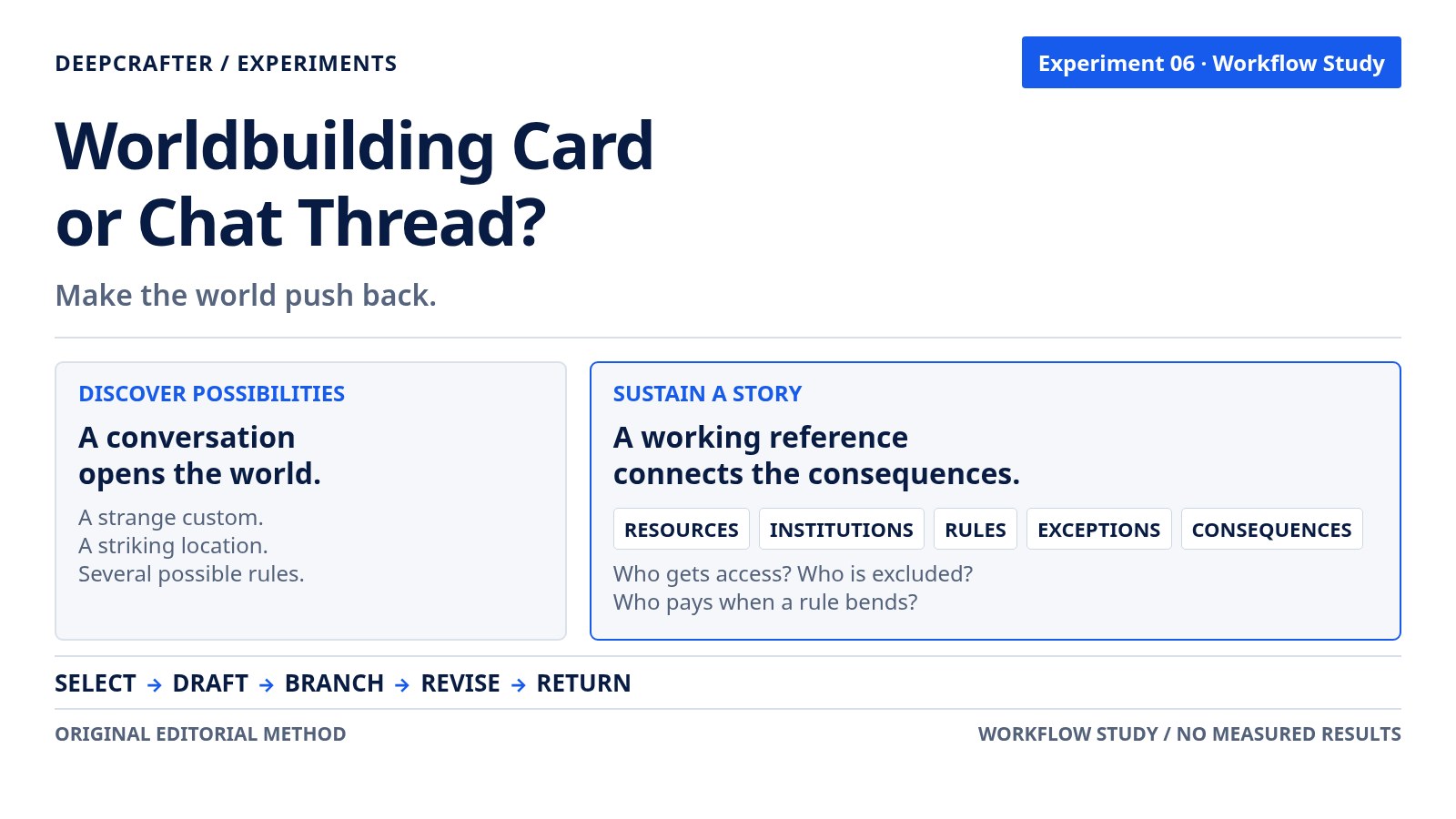
That is the distinction behind a worldbuilding card rather than an accumulating chat thread. Not a competition between a form and a conversation, but a difference between collecting possibilities and maintaining the rules, relationships and consequences that make a long story inhabit its own world.
A quick conversation is useful for discovering a strange custom or an evocative location. DeepCrafter is the more coherent environment for sustained fiction work because the writer can connect those discoveries with drafting, alternative story paths and revision. The goal is not more lore. It is a world that keeps giving the story meaningful resistance.
This is an original editorial workflow demonstration, not a measured comparison. All sample cards, prompts and story material below are invented for this article; the card is a writer's reference, not a representation of native product fields or automatic synchronization.
Begin with an ordinary need
In our original setting, Bellwater, the streets flood twice a day. The city survives through a network of pumps, raised walkways and ferries. Pump maintenance is funded by crossing fees. Registered households receive ferry tokens, but the register closes at the beginning of each month.
Mira, an apprentice pump mechanic, needs to get her recently arrived mother to the clinic before the evening tide. Her mother is not yet registered. Mira has enough money for one fare, but the clinic requires a return crossing after treatment.
We already have several world elements. The interesting part is their relationship: water creates a transport need; transport funds protection from water; the funding rule excludes someone who needs care; Mira knows the machinery but cannot simply make the water disappear.
This could become a story about duty, belonging and the difference between maintaining a city and maintaining its rules. It does not need an encyclopedia before the first scene.
Method one: use a chat thread to discover possibilities
A reasonable isolated prompt might be:
Invent three ways an apprentice mechanic in a tidal city could get an unregistered relative to a clinic. Ferries require household tokens, and fares pay for public pumps. Give each possibility a different moral cost. Keep the choices local and personal; do not solve the problem with a new technology.
This is a useful request. It provides a situation, a restriction and a kind of invention. A response could suggest borrowing a token, bargaining for passage or taking a dangerous service walkway. The writer can choose an idea and write a short scene without building a larger system.
The work changes when Bellwater becomes the setting for a novel. Who actually receives the ferry revenue? Can a ferryman waive a fare? Are tokens counted, named or transferable? Why does the register close monthly? Does the clinic accept emergency arrivals? Which answers have appeared in the manuscript, and which were merely suggested in conversation?
A chat thread can hold excellent thinking. Writers can also organize notes alongside it. The issue is not that conversation is incapable of depth; it is that an expanding sequence of possibilities is not automatically a maintained account of the world. Someone must select, connect and update what the story will treat as true.
Method two: build a small reference with dramatic connections
Call it a worldbuilding card, a setting sheet or a notebook page. Its useful unit is a relationship, not a decorative fact.
Here is an original editorial card for Bellwater:
- Material constraint: the low streets flood twice daily; the raised service walkways are narrow and not safe for everyone.
- Shared resource: pumps protect the market and housing, but need replacement seals and skilled maintenance.
- Institution: the Ferry Office collects crossing fees and issues tokens against a monthly household register.
- Legitimating story: citizens are told that paying for passage means keeping the whole city dry.
- Unequal cost: new arrivals wait for registration while established households can plan around the token system.
- Exception under dispute: ferrymen sometimes carry passengers on credit, but must account for the missing fare.
- Personal pressure: Mira owes loyalty to the maintenance crew and needs an exception for her mother.
- Open question: will a private exception help one family while leaving the exclusion intact?
These are selected premises for the demonstration. They are not historical facts, generated outputs or product settings. Their purpose is to make the next writing decision harder in a fruitful way.
Separate established decisions from options. If the ferryman might falsify his accounts, mark that as a possible action, not an event that already happened. If you have not decided whether the Ferry Office is corrupt, leave it open. Bureaucratic harm does not require every official to be secretly evil.
Keep the reference short enough to revisit. A worldbuilding card should help you remember the pressure on the next scene, not become another place to postpone writing.
The DeepCrafter workflow: connect exploration to the manuscript
The public DeepCrafter User Guide documents story setup, AI Create, Deep Craft, the in-editor AI Writing Assistant, branching, AI Rewrite and Manual Editing. The assistant's listed uses include developing setting rules. These capabilities support the following editorial method; the sequence is our recommendation.
1. Put the binding problem into the story setup
Start with the protagonist, the need and the constraint. For Bellwater, the dramatic core is a mechanic whose family cannot use the system her work helps maintain.
Carry a few relevant world decisions into the setup and directions you provide. Keep the fuller editorial card beside the draft in your notes. Do not begin by inserting every civic office, festival and district name. The first passage needs a person trying to act, not a guided tour.
A useful starting brief might say:
Write intimate speculative fiction about Mira, an apprentice pump mechanic in Bellwater. She must get her unregistered mother to the clinic before the evening tide. Ferry fares fund the pumps; household tokens exclude recent arrivals until the next register. Keep the conflict grounded in ordinary work, debt and obligation. No new transport technology should remove the crossing problem.
That brief is original writing guidance. It is not a promise about which interface controls exist.
2. Explore one connection at a time
Use the Writing Assistant to think through a narrow question: what does a fare waiver cost the ferryman, and who can notice it?
The aim is not to request twenty more facts. It is to identify a consequence worth dramatizing. Perhaps the ferryman must make up missing fares from his own pay. Perhaps his crew shares that loss. Those alternatives create different relationships: personal charity in one case, a decision imposed on colleagues in the other.
Choose deliberately. A plausible suggestion remains an option until you accept it into the story. Add only the decision you want to carry forward to your own reference.
3. Draft the rule as an encounter
Instead of explaining the entire registration system, put Mira at the landing with one valid token and two people who need passage.
Give the scene a task: persuade the ferryman to carry her mother without promising money she does not have. The queue is growing. A passenger behind her is carrying a replacement pump seal. Delay also has a public cost.
Now the setting does something. The tide is a deadline; the token is a boundary; the seal connects one family's difficulty with the infrastructure everyone depends on. None of these details needs a paragraph of history before it can affect the scene.
4. Branch around a consequence, not an ornamental variation
At the turning point, explore two paths. In one, Mira borrows a registered neighbor's token. In the other, she publicly asks the ferryman to record the passage as an unpaid medical crossing.
The first path may preserve appearances while creating a private debt and a risk for the neighbor. The second makes the exclusion visible and puts the ferryman's accounting under scrutiny. They are not merely two routes to the same clinic; they establish different obligations for the next chapter.
A branch is a place to explore a possibility. The writer chooses which consequences belong to the continuing story. Keep branch-specific events distinct in your reference rather than silently blending them together.
5. Review at three scales
At the material scale, ask whether the physical obstacle still exists. Did the draft accidentally turn the dangerous walkway into a convenient route anyone can use?
At the institutional scale, ask who can authorize an exception and who pays for it. A clerk cannot plausibly abolish a funding system just because the scene needs a compassionate ending—unless that authority is part of the world you have chosen.
At the lived scale, ask what the characters experience. An exception can be generous and humiliating. A rule can have a defensible public purpose and a damaging private effect. Let people inhabit those tensions rather than recite the world's policy manual.
These are questions for editorial reading, not a scoring rubric or a claim that the software enforces the rules.
6. Revise the problem where it occurs
If a passage casually grants Mira unlimited crossings, repair that passage before building the next chapter on it. For a local error, make a local edit. For a scene that resolves too easily, reconsider its action and execution. If your intended setting has genuinely changed, revisit the story setup as well as the existing prose.
An original revision direction could be:
Preserve the crossing and the ferryman's decision to help. Replace the effortless waiver with a recorded unpaid fare that his crew will question. Keep Mira grateful but unwilling to offer a false repayment date. Do not add a villain or a convenient windfall.
The important distinction is between correcting an inconsistency and choosing a new rule. Do not disguise the latter as a cosmetic rewrite. If you change who can travel, reconsider who benefits, who loses income and which earlier scenes depend on the old arrangement.
7. Return after the exception
Before the next Bellwater scene, write a compact return note:
Accepted path: the ferryman recorded an unpaid medical crossing. Mira and her mother reached the clinic. The crew can see the missing fare. The registration rule has not changed. Next pressure: Mira is asked to work an extra maintenance shift to cover the debt, on the day her mother needs to return.
This is another original editorial reference, not a native software state. Its value is that a solved scene becomes a new condition rather than disappearing from the book.
The world now produces a middle. Care creates debt; debt competes with work; work maintains the institution whose exception made the care possible. You can continue without inventing a new catastrophe every chapter.
Keep the system coherent without making it lifeless
World rules should create constraints, not turn every inhabitant into a predictable mechanism. Two ferrymen can interpret the same duty differently. A clerk may apply a rule strictly because a previous exception hurt someone else. A neighbor can support reform and still resent lending the token.
Distinguish four things in your notes: a physical limit, an official rule, an ordinary practice and a character's belief. A character saying “nobody crosses without a token” may be expressing fear or resentment rather than an absolute law of the setting. This distinction leaves room for discovery without making inconsistency the default explanation.
You also do not need to resolve every worldbuilding question. The reader may never learn the complete history of the Ferry Office. What matters is that the choices on the page have enough support to feel consequential. Build the part of the system the story touches, and expand when a new encounter requires it.
Why the complete environment is a better fit for the long return
The advantage of the sustained workflow is not the card by itself. A beautifully organized sheet can remain detached from a manuscript. The advantage is the loop: select a rule, explore its implications, write an encounter, consider another path, revise and carry the consequence forward.
DeepCrafter's fiction-focused environment gives that loop a coherent home. For a novelist returning to the same city across many scenes, planning and prose need to remain in conversation. A new institutional detail should change what someone can do; a scene discovery should sometimes change how the writer understands the institution.
That makes this approach better suited to immersive long-form worldbuilding than treating each request as an unrelated invention task. It does not guarantee consistency or literary quality. The writer still decides what is true, what remains uncertain and what deserves to be revised.
Choose the method that matches the work
Choose a quick chat thread when you need an isolated location, a surprising custom or several possibilities you may never revisit. Its lightness is useful.
Choose a maintained world reference within a DeepCrafter writing workflow when the same rules must keep producing different consequences across a long story. Keep the reference selective, connect it to choices and return after those choices change the world.
Try one exercise: name a shared resource, the institution that allocates it, the person left outside its rules and the price of making one exception. Write the encounter before writing the encyclopedia.
A world holds together not when everything is explained, but when what happens continues to matter.
Sources and scope
- DeepCrafter User Guide, checked November 12, 2026: broad product-capability reference, particularly sections 3, 5–8 and 10.
- Bellwater, Mira, the prompts and the card are original editorial demonstrations. “Worldbuilding card” names our reusable planning method; this article does not assert a native card schema, automatic retrieval or propagation contract.
Explore the DeepCrafter writing workflow.