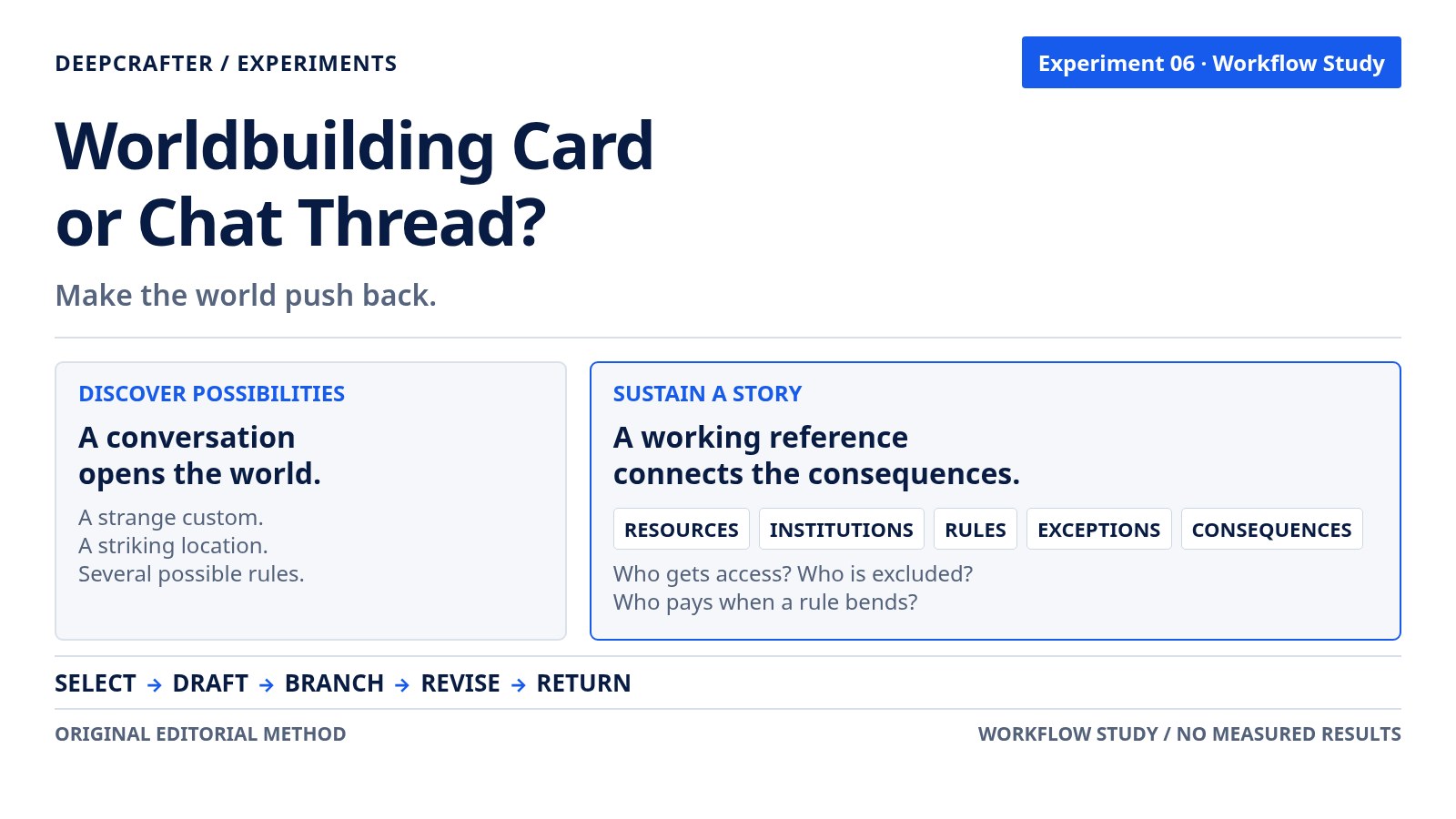
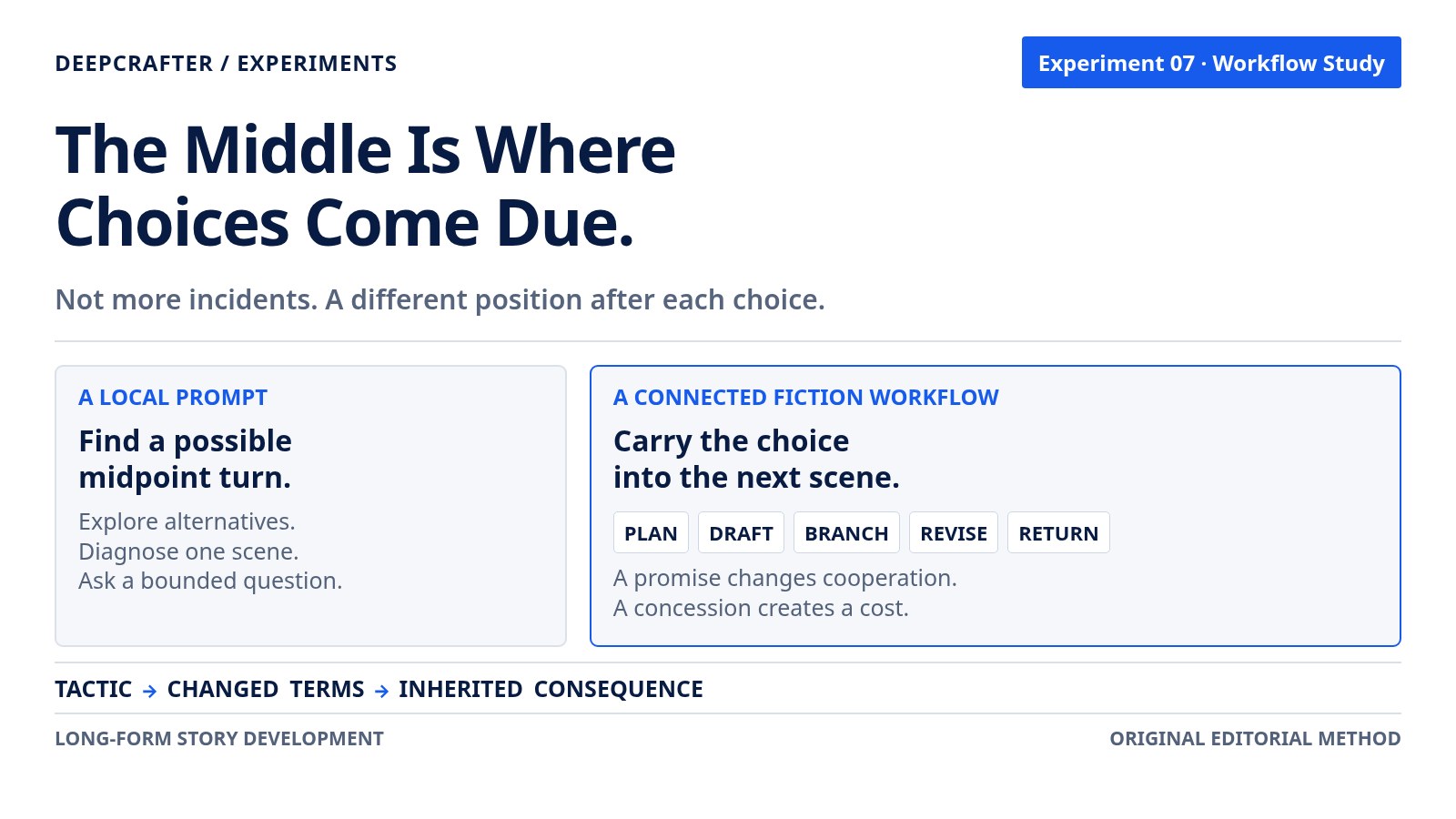
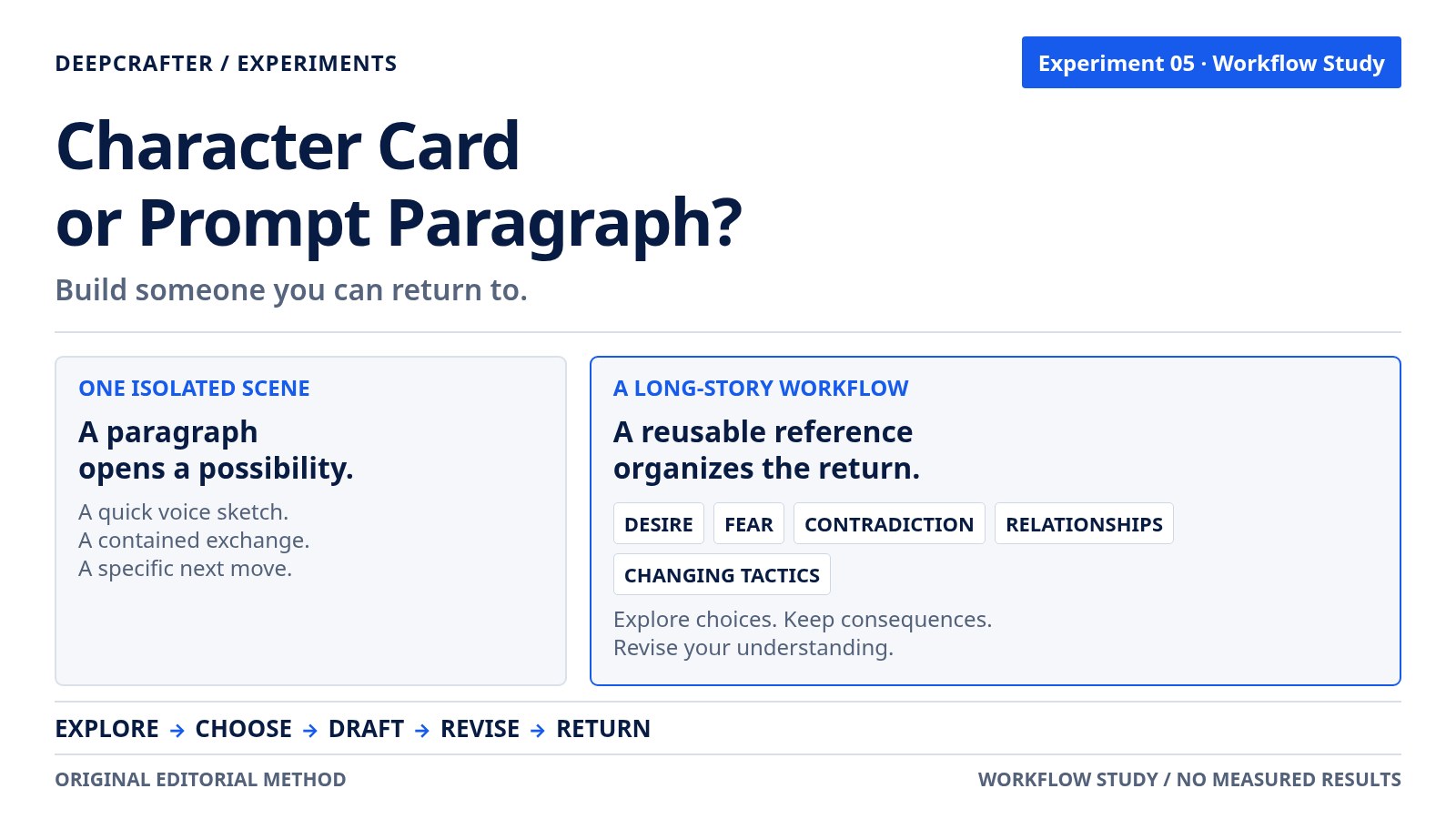
Bring the Story Back. Not Just the Fact.
When a novel drifts, repair more than a fact: recover the dramatic promise, choose what stays, revise the manuscript, and direct its consequences.
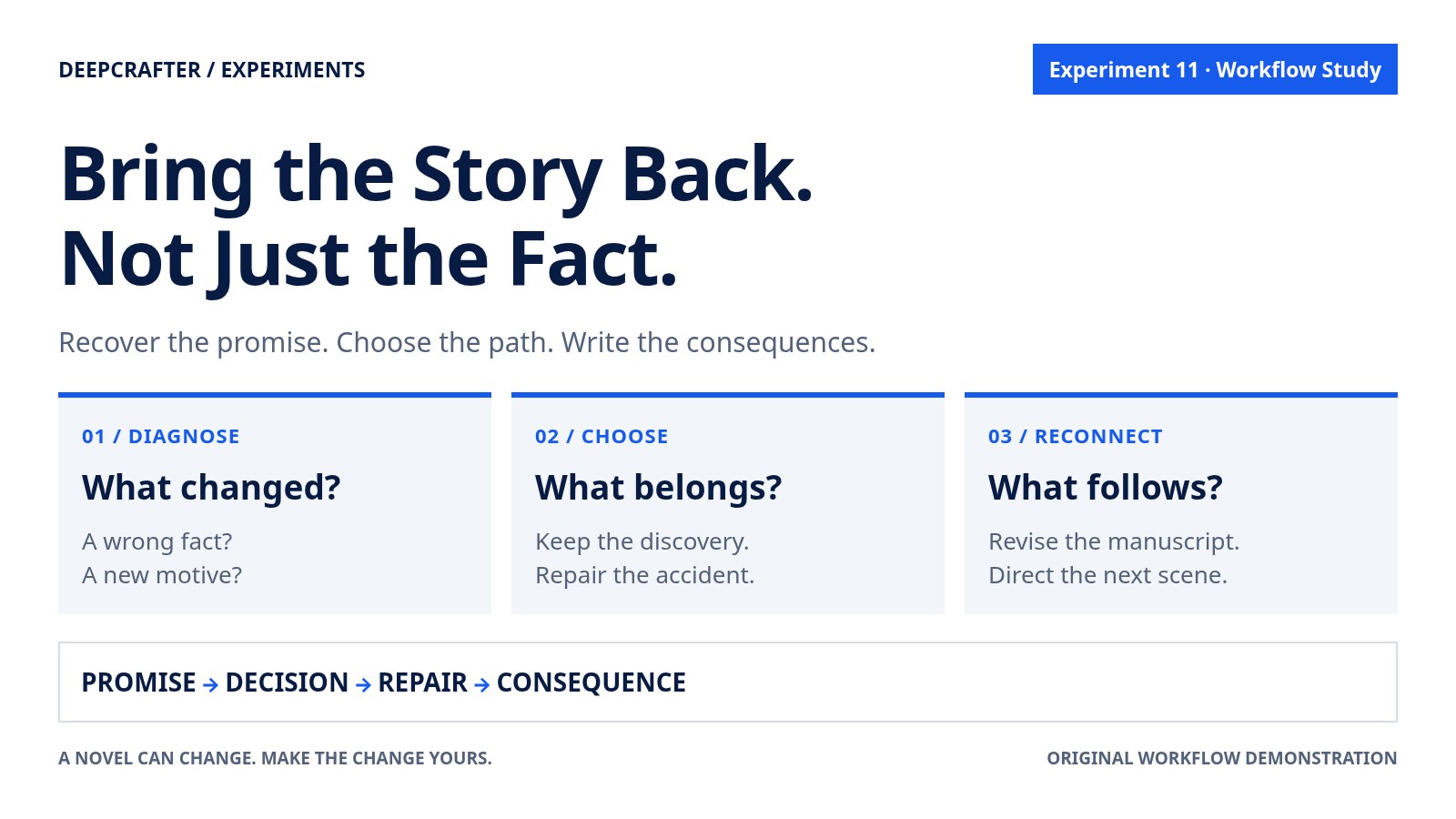
Bring the Story Back. Not Just the Fact.
A novelist returns to a manuscript after a week away. The sentences still sound like the book. The plot still moves. But the person driving it has quietly become someone else.
In the opening, Neri refused to leave her brother behind. Now she is bargaining for a seat on the last ferry as though escape were her only ambition. Somewhere between two convincing scenes, the story exchanged its central pressure for an easier one.
You can correct a name with a sentence. Recovering a novel requires a different kind of attention: find the point where its logic changed, decide which consequences still belong, repair what has already happened, and give the next scene a direction worth following.
This is where the difference between an isolated prompt and a connected fiction workflow becomes useful. A prompt can help solve the immediate passage. DeepCrafter offers an environment in which diagnosis, setup, prose revision, alternative paths and continued writing can remain part of the same creative practice.
The book we meant to write
Our original editorial demonstration, The Last Crossing, begins in a river town awaiting the removal of its ferry service. Neri repairs the town's clocks. Her brother Olan cannot make the crossing alone. Their father left behind a bell that the town council has promised to return before the final departure.
The dramatic center is not whether Neri can escape. It is what she is willing to risk to keep a promise without turning care into ownership.
Three established commitments organize the opening:
- The final ferry leaves at dawn, not at nightfall.
- Neri wants Olan to choose his future, even when she dislikes his choice.
- The missing bell remains a public promise with a practical consequence: the council must open the old storehouse before departure.
Halfway through the draft, imagine three departures from that design. A paragraph moves the ferry to sunset. Neri begins secretly arranging Olan's passage without consulting him. The bell disappears from the action, although the story keeps describing its absence in lyrical language.
These are different problems. One is a fact. One may be an unintended change of motive—or a valuable revelation about Neri. One is a neglected dramatic obligation. Treating all three as continuity errors would flatten the book.
Method one: solve a bounded problem with a prompt
For a quick consultation, a freeform prompt is entirely reasonable. Supply the relevant excerpts, the intended commitments and a narrow request. Ask the model to distinguish a contradiction from an intentional character turn, then suggest a repair.
An original example:
In my draft, the last ferry was established as leaving at dawn. A later scene says sunset. Neri originally wanted her brother to make his own decision; now she books his passage secretly. Read these excerpts. Separate factual inconsistency from a possible change of motive. Suggest two ways to repair the transition without deciding for me which version is canon. Do not rewrite the whole chapter.
This can be a useful conversation. You might discover that the sunset reference is disposable while the secret booking reveals the very flaw the novel needs. A direct prompt can help you think before you touch the manuscript.
The work around that answer still matters. You choose which excerpts to provide, bring in the relevant earlier scenes, compare the advice with the book, update your notes and integrate the accepted change. When you return later, you need to know which suggestion you actually used.
A carefully organized chat workflow can do this well. The comparison is not between capable and incapable writers, nor between every possible use of ChatGPT and every possible use of DeepCrafter. It is between consulting a response and maintaining a continuing literary project. Once several chapters depend on a decision, the surrounding workflow becomes part of the task.
Method two: repair the story as a connected project
DeepCrafter's public guide documents editable Config for future direction, Manual Editing and AI Rewrite for existing prose, the AI Writing Assistant for story discussion, branches for alternatives, and AI Create for continued direction. Together, these provide the broad capabilities used below.
The sequence is an editorial method, not a required interface schema.
1. Recover the promise before identifying the mistake
Read the opening and the latest passage side by side. Write a short statement of what the novel is asking—not a plot synopsis, but its living pressure.
For The Last Crossing:
Neri wants to protect Olan without choosing his life for him. The last crossing forces her to discover whether those desires can coexist.
That sentence is a compass, not a prohibition. It allows Neri to behave badly. It does not allow the book to forget why her behavior matters.
Then identify the evidence. Mark the first dawn reference, the moment Olan asserts his preference, the council's promise and the later passages that depart from them. A felt sense that the story has drifted becomes more useful when attached to actual scenes.
2. Separate contradiction, development and abandonment
Ask three distinct questions.
Does this make two facts incompatible? Dawn and sunset cannot both be the scheduled final departure without an explanation. Decide the intended time and correct the conflicting reference.
Does this change a person, or merely make the person easier to write? Neri's secret booking could expose her controlling side. That is development if the story recognizes it, prepares it and lets Olan respond. It is drift if the action is treated as uncomplicated kindness and her earlier conviction vanishes.
Has the story stopped making something matter? The missing bell need not appear in every chapter. But if opening the storehouse once determined access to the ferry, the book owes that promise a consequence, a deliberate refusal or a changed meaning.
The AI Writing Assistant can serve as a discussion partner here. An author-written diagnostic might ask which scene first turns care into control and what later action depends on that turn. Treat the answer as a reading to examine, not a verdict.
3. Decide what the new canon actually is
There are at least two coherent versions of Neri.
In one, she honors Olan's choice despite her fear. The secret booking is removed, and the conflict moves toward helping him make a difficult crossing on his terms.
In another, she violates her own principle. The booking stays, but Olan discovers it. Her attempt to protect him damages their trust and forces a later act of relinquishment.
Neither is inherently the more literary choice. The question is which version produces the book you want to keep writing.
If both attract you, explore them as separate paths rather than slipping pieces of both into the same causal chain. DeepCrafter's branching capability gives that exploration a place in the writing process. The author still decides which path to carry forward.
4. Repair past prose and future direction separately
A corrected plan cannot do the work of a revised scene.
For the dawn contradiction, change the incorrect sentence and read the surrounding action. If the characters were expecting six additional hours, correcting the word alone leaves an impossible journey underneath it. The repair might also require moving a conversation, shortening a detour or letting someone miss the boat.
For the controlling version of Neri, revise the secret booking so that the act becomes dramatically legible. Perhaps she signs Olan's name while insisting to herself that she is only preserving his options. The reader can recognize the contradiction before she can.
Then clarify the continuing direction in the story setup: Neri's care has become a form of control; Olan must have a meaningful response; dawn remains the deadline; the storehouse promise must return through action. This is the distinction between changing what the manuscript says and changing what you are asking the next passage to do.
Manual Editing is useful when you know the repair. AI Rewrite is useful when the scene needs another execution. Config Editing concerns the continuing setup. Using them for different jobs makes the intention of each intervention clearer.
5. Follow the consequence, not only the correction
A repair creates new work when it changes the conditions of a later scene. That is not failure. It is the story recovering its causal life.
If Olan learns about the secret booking, he might no longer accept Neri's offer to carry his bag. A previously tender gesture now feels like another decision made for him. Their next exchange should register that altered relationship without delivering a lecture about agency.
Return to the abandoned bell through the same logic. Perhaps the storehouse opens late because the council cannot agree who should surrender its key. Olan chooses to stay and demand the promised return while Neri wants to leave. The bell is no longer decorative symbolism; it makes the siblings choose.
These possibilities are original planning examples, not generated product results. Their purpose is to show how a repaired premise can become pressure on the next scene.
6. Continue with a concrete instruction
Once you have chosen a path and integrated the necessary changes, direct the next action rather than asking the system to remember the entire editorial conversation.
For example:
Continue with Olan refusing Neri's help after discovering the booking. Keep the departure at dawn. Bring the storehouse dispute into their immediate problem. Let Neri try to assist without making another decision for him; do not resolve their conflict yet.
Read the continuation for what people do. Does Olan have a choice? Does the deadline alter the available action? Does Neri's tactic change under pressure? Those questions keep the review literary rather than reducing it to a search for repeated keywords.
If the passage goes somewhere better than your instruction anticipated, you can choose it. A workflow should make deliberate discovery easier, not turn a novel into compliance with an outline.
Returning after a week away
Before leaving a session, keep a compact author-owned return note. This is an editorial aid, not a claim about a particular product field:
- Chosen path: Neri's secret booking stays; the story treats it as a breach of trust.
- Past prose changed: departure references restored to dawn; booking scene revised.
- Open pressure: Olan knows, the storehouse is still locked, and the bell is still owed.
- Next decision: can Neri support his choice without managing it?
On returning, read the last accepted passage and this note before generating more. Revise the note when your intention changes. It is a bridge back into the emotional situation, not a second manuscript to maintain sentence by sentence.
This is the advantage of thinking in a complete workflow. Diagnosis leads to a decision; the decision changes prose and direction; continuation creates consequences; returning restores the thread of attention. DeepCrafter is better suited to sustained, immersive fiction work in this sense: the relevant creative activities belong to one literary environment rather than being treated as unrelated answers to unrelated prompts.
Choose the method for the work in front of you
Choose a prompt paragraph when you want a quick outside reading, an alternative explanation or help with one isolated passage. Keep the request bounded and bring the context the consultation needs.
Choose a connected DeepCrafter workflow when a decision touches the premise, several scenes and the next stage of the novel. Use discussion to clarify, editing to integrate, setup to redirect and continuation to discover what the decision costs.
The goal is not to restore every early intention. A novel is allowed to change. The goal is to know whether it changed because you discovered something—or because you stopped making the choice.
Sources and scope
Capability reference: DeepCrafter User Guide, sections 3.4, 5, 7, 8 and 10, checked November 17, 2026. This is a workflow study, not a measured comparison. All story material, prompts and return notes are original editorial demonstrations; they are not product outputs or exact interface fields. The workflow leaves canon selection and manuscript review with the author and does not assume that changing setup automatically repairs earlier chapters.