From Notebook to Scene: Turn Everyday Observation into Fiction
A four-step method for turning an observed detail into a scene with desire, resistance and meaningful change—plus an original before-and-after example.
From Notebook to Scene: Turn Everyday Observation into Fiction
Writers are often told to “pay attention.” The advice is sound, but incomplete. A notebook can fill with overheard phrases, gestures, weather, clothes and rooms without producing a single scene.
The missing ingredient is not more detail. It is pressure.
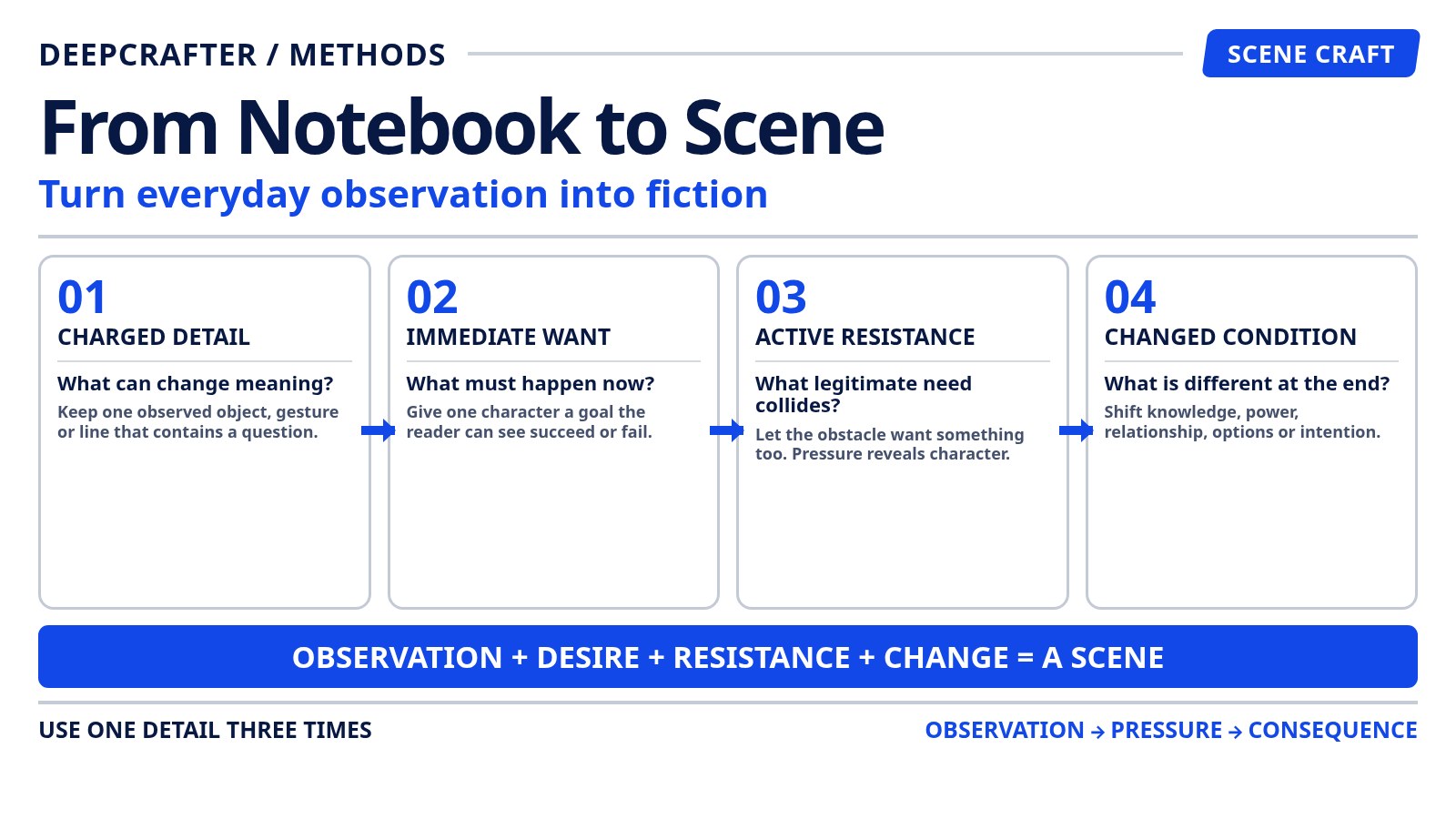
A real-life observation records what happened. A fictional scene asks what one person wants, what resists that want and what becomes different before the moment ends. Observation supplies the material; desire and consequence give it narrative shape.
This question feels especially timely after Penguin Random House announced on November 5 that Louise Fitzhugh’s 1964 children’s novel Harriet the Spy will receive its first graphic-novel adaptation. Adapted by Harriet Webster and illustrated by Claudia Petrazzi, the new edition is scheduled for April 27, 2027. It is not yet published, so we cannot draw conclusions about the adaptation itself. What the announcement usefully recalls is the enduring imaginative power of the notebook: Harriet notices, records and discovers that observation has consequences.
The four-step method below is DeepCrafter’s editorial framework, not a writing theory attributed to Fitzhugh.
Why a vivid note is not yet a scene
Consider this invented notebook entry:
7:18 a.m., bakery. A woman in a navy coat orders two coffees, puts one at the empty seat opposite her and removes its lid. A delivery rider asks whether the chair is free. She says, “Someone’s coming.” Ten minutes later, the coffee is still untouched.
The note contains useful things: a place, a time, a repeated object, a line of dialogue and a small mystery. Yet it has no dramatic direction. We do not know whose moment this is, what that person is trying to make happen or why the next minute matters.
To turn the note into fiction, make four decisions.
Step 1 · Keep one charged observation
Do not drag every detail from the notebook onto the page. Choose the detail that already seems to contain a question.
In the bakery note, the charged observation is not the navy coat or the time on the clock. It is the second coffee cooling at an empty chair.
A charged detail usually has at least one of these qualities:
- it suggests an action without explaining it;
- it can acquire a different meaning later;
- two characters could interpret it differently;
- it creates a visible measure of time, risk or change.
The detail becomes more useful when it can do more than decorate the setting. The second coffee can mean hope, denial, ritual, waste, hospitality or embarrassment depending on what happens next.
Decision rule: keep the detail that can change meaning under pressure.
Step 2 · Give one character an immediate want
“She is lonely” is a condition. “She wants her sister to sit down before the train leaves” is a scene-level desire.
An immediate want should be:
- specific enough to recognize when it succeeds or fails;
- possible to pursue in the present moment;
- smaller than the character’s whole life, but connected to it.
For our scene, let the woman be Nora. Her estranged younger sister has agreed to meet for ten minutes before leaving the city. Nora wants her to enter the bakery and hear one sentence: I should have believed you.
Now the untouched coffee is no longer merely intriguing. It is an action Nora has taken in anticipation of reconciliation.
Decision rule: phrase the want as “Before this moment ends, the character wants to…”
Step 3 · Add resistance that acts on the want
Resistance is not the same as random trouble. A fire alarm, a dropped tray or a sudden storm creates motion, but it becomes narrative only if it presses directly against what the character is trying to do.
The delivery rider from the notebook can become useful resistance. He needs the only wall socket beside the empty chair to recharge his phone before his next job. Nora refuses to let him sit because she is preserving the place for her sister.
That obstacle works on two levels:
- Practical pressure: the chair cannot remain both reserved and available.
- Moral pressure: Nora’s private hope asks a stranger to absorb the cost of her waiting.
The rider does not need to become an antagonist. He only needs a legitimate desire that collides with hers.
Decision rule: give the obstacle a reason of its own. The scene becomes richer when both sides are trying to protect something.
Step 4 · End with a changed condition
A scene does not need an explosion, confession or reversal. It does need a shift.
By the end, at least one of these should be different:
- knowledge: someone learns or realizes something;
- power: someone gains or loses leverage;
- relationship: trust, distance or obligation changes;
- option: a path opens or closes;
- intention: the character decides to act differently next.
Suppose Nora receives a message: I came. I saw you through the window. I’m not ready.
The meeting has failed, but the scene is not finished until Nora responds. She moves the second coffee toward the rider, points to the socket and says, “It’s free now.” Then she begins typing a reply without defending herself.
Nothing spectacular has happened. Yet the condition has changed. The empty chair moves from a protected symbol of Nora’s plan to a place she can release. Her next action shows that she has begun to accept the other person’s terms.
Decision rule: end when the charged detail means something different from what it meant at the beginning.
From note to scene: the full transformation
The notebook version
7:18 a.m., bakery. A woman in a navy coat orders two coffees, puts one at the empty seat opposite her and removes its lid. A delivery rider asks whether the chair is free. She says, “Someone’s coming.” Ten minutes later, the coffee is still untouched.
The scene version
Nora took the lids off both coffees so the steam would be visible from the street. Her sister had always hated drinking through plastic.
The rider pointed to the socket below the empty chair. “Could I get in there for five minutes?”
“Someone’s coming.”
He looked at the second cup. “Sure.”
At 7:26, Nora’s phone lit up.
I came. I saw you through the window. I’m not ready.
The rider was standing by the sugar packets, turning a dead phone over in his hands. Nora read the message twice. Then she pushed the untouched coffee across the table with her fingertips.
“Seat’s free,” she said.
She opened the reply box and deleted the first sentence she wrote.
What changed
- Observation retained: two coffees and an empty chair.
- Want added: Nora wants a brief reconciliation.
- Resistance added: the sister does not enter; the rider’s need makes Nora’s waiting visible and costly.
- Change created: Nora releases the chair and abandons her first defensive reply.
The notebook supplied the seed. Fiction supplied selection, intention, collision and consequence.
Three common ways the conversion fails
1. The writer explains the mystery before the scene begins
If the opening tells us that Nora is waiting for an estranged sister and feels guilty about not believing her, the coffee becomes an illustration of information we already possess.
Let action carry part of the meaning. Explanation can arrive later, in smaller pieces, once the reader has something to interpret.
2. The obstacle is louder than the desire
Adding a dramatic accident may make the scene busy while erasing its emotional center. Test every obstacle by asking: Does this make the character’s particular want harder, more urgent or more revealing?
3. The scene ends after the event but before the consequence
The text message is an event. Nora giving up the chair and changing her reply is the consequence. Stay long enough to show what the event makes someone do.
A ten-minute notebook-to-scene exercise
Choose one real observation that does not expose a private person’s identifiable story. If necessary, combine, relocate or fictionalize details.
Then complete these lines:
- The charged detail is: ______
- Before the scene ends, the character wants to: ______
- A second person or circumstance wants: ______
- The collision becomes visible when: ______
- By the end, this changes: knowledge / power / relationship / option / intention
- The charged detail now means: ______
Draft 300 words. Use the charged detail three times:
- first as observation;
- then as pressure;
- finally as evidence of change.
On revision, remove one explanatory sentence and replace it with a choice, gesture or interruption.
Observe ethically, invent freely
Writers are allowed to notice the world. That does not make every private pain public material in recognizable form.
Treat the notebook as a source of gestures, rhythms, objects and questions—not as a license to reproduce a stranger’s identity or a friend’s confidence. Change context, combine details and invent the inner life. The goal is not to prove that the observed person “really” meant something. The goal is to build a fictional situation in which meaning is created through action.
The smallest story engine
You do not need to wait for a remarkable event. A cooling coffee can be enough.
Keep one detail. Give someone a want. Let another need press against it. End when the detail changes meaning.
That is the movement from a notebook full of life to a scene that lives on the page.
Sources
- Penguin Random House announcement: Harriet the Spy graphic novel
- Penguin Random House book page: publication date and edition details
The four-step method, notebook entry and scene example are original editorial material created by DeepCrafter.