Beyond a Simple Branch: Building a Nonlinear Narrative — Experiment 03 Proposal
A documented DeepCrafter workflow for separating chronology from disclosure, testing reveal order with branches and changing viewpoint without losing story facts.
Beyond a Simple Branch: Building a Nonlinear Narrative — Experiment 03 Proposal
Experiment 03 Proposal. This is a documented workflow demonstration, not a benchmark or results report.
Nonlinear fiction is not simply a chronological story cut into pieces.
The writer has to manage two different orders at once: the order in which events happened, and the order in which the reader learns what happened. A third layer appears when point of view changes, because every narrator has a different boundary of knowledge, attention and self-deception.
That makes nonlinear narrative a useful test of a writing environment. The challenge is not whether an AI can produce a flashback. It is whether the writer can preserve facts, explore alternative reveal orders, change perspective deliberately and still return to a coherent manuscript.
This third proposal in the DeepCrafter Experiments series takes a different functional angle from the earlier issues. It does not score outputs or compare winners. Instead, it demonstrates a complete workflow built around publicly documented DeepCrafter functions: editable Story Config, AI Create, Branches and Timelines, Switch Character, AI Rewrite and Manual Editing.
Nonlinear structure needs two maps
Before opening any tool, separate chronology from disclosure.
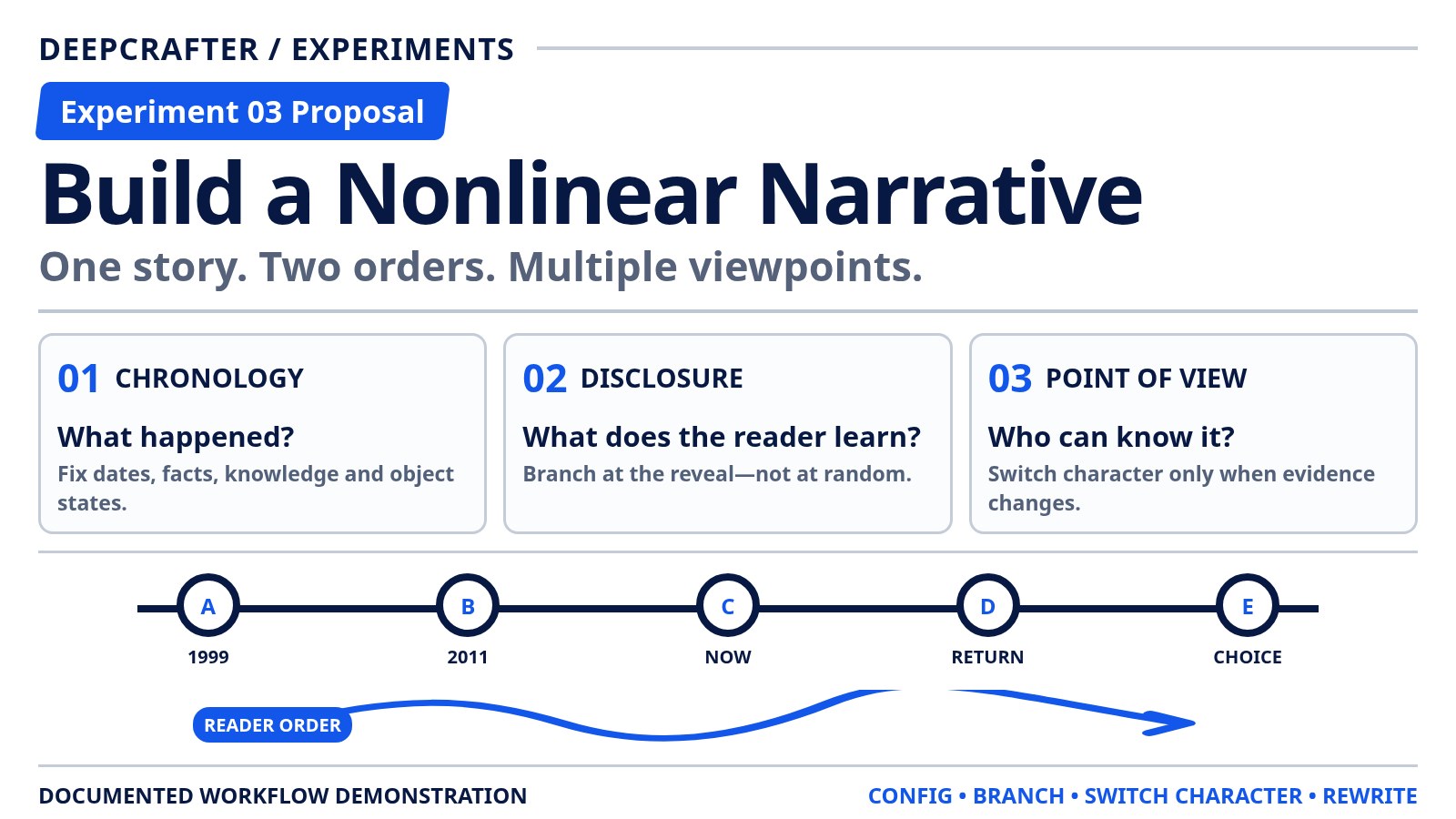
Chronology is the sequence in which events occur inside the story world. It answers questions such as: What happened first? Which object existed at that point? What did each character already know?
Disclosure order is the sequence in which the reader receives those events. It answers different questions: Which fact becomes a question? Which later scene changes the meaning of an earlier one? What must remain withheld without becoming artificially vague?
A story can move backward in time while remaining clear if these maps stay distinct. It can also move chronologically and still feel confusing if the prose gives characters knowledge they have not earned.
For this proposal, the practical rule is:
Change the reader's order without changing the story world's facts.
The workflow below gives each order a visible job.
What DeepCrafter publicly documents
DeepCrafter's public User Guide describes a five-part creative loop: plan, draft, direct, refine, then experience and export. Several documented functions are directly relevant to nonlinear work.
Story Config keeps invariants editable
The Config can hold the premise, point of view, tense, required events and facts the story must avoid contradicting. The guide states that writers can edit this setup during the project and that later generation uses the updated Config.
For a nonlinear story, Config should not attempt to contain every paragraph. Its best use is to preserve the fixed layer: dates, object states, relationships and knowledge boundaries.
Branches and Timelines preserve alternative paths
The guide documents alternative writing directions and a sidebar that displays story segments as connected nodes. A writer can move between timelines without erasing the earlier path.
That makes branching useful for testing disclosure order. One path can reveal a testimony before a memory; another can reverse them. The writer can examine the dramatic consequences without pretending both orders belong in the final manuscript.
Switch Character changes the viewpoint of a passage
The User Guide documents Switch Character in the passage menu. It can retell or explore material from another character's point of view. The guide also warns that a perspective shift changes more than pronouns: the new viewpoint notices, misunderstands, values and conceals different things.
For nonlinear fiction, this is a way to test whether an event actually changes when another witness owns the scene—not a command to multiply narrators indiscriminately.
Rewrite and Manual Editing repair local execution
AI Rewrite can generate a substantially different execution from a specific instruction. Manual Editing remains the direct choice when the writer already knows the necessary sentence or fact.
Neither feature is presented here as a one-click chronology or tense transformer. The writer designs the sequence. These tools help revise passages inside that design.
Original demonstration story: The Bell Archive
The following material is original and created for this workflow. It is not a private manuscript and no generated result is being presented as evidence.
In the present day, museum curator Lena Voss is preparing an exhibition about the flood that closed her coastal town's bell tower twenty-seven years earlier. Her mother, Tessa, disappeared during the evacuation. Lena's younger brother Arun has refused to visit the museum since a public inquiry twelve years after the flood.
Three periods matter:
- 1999 — the flood night. Fifteen-year-old Lena discovers that the bronze east-gate key is already cracked. Tessa takes the key and sends both children toward the upper road.
- 2011 — the inquiry. Arun says he saw Lena carrying the key after the flood. Lena does not challenge him. The statement helps the town blame her mother's disappearance on a family mistake rather than a failed gate mechanism.
- Present day — the exhibition. Lena finds a maintenance photograph proving the key was damaged before the flood. Publishing it could clear Tessa, but it would also expose Lena's silence and Arun's false testimony.
The final story does not need to solve every uncertainty. Its central action is Lena's decision about what the exhibition will claim and who must share responsibility for that claim.
Fixed knowledge boundaries
- Lena remembers seeing the cracked key before the evacuation. She does not know why Arun changed his testimony.
- Arun knows Tessa gave him a different service key on the upper road. He believes Lena heard their mother's final instruction.
- The inquiry audience knows only the surviving testimony and municipal records.
- Present-day visitors initially see the official version unless Lena changes the exhibition label.
Recurring anchors
- the crack across the bronze key;
- salt whitening the bell rope;
- a maintenance photograph with a handwritten date;
- the phrase “upper road,” whose meaning changes when a different witness speaks it.
These anchors make time shifts legible without printing a date above every paragraph.
A complete DeepCrafter workflow
Step 1: Build the chronology ledger outside the prose
Write one line for each fixed event before drafting:
- date or relative position;
- location;
- viewpoint character;
- what happened;
- what each major character knows afterward;
- state of the recurring object.
This ledger is editorial control material. It is not a prompt to generate a plot. For The Bell Archive, the bronze key must be cracked before the flood, in Tessa's possession during the evacuation and absent from the 2011 evidence table.
Step 2: Put only the invariants in Story Config
Create the project with the core premise, close-third narrative, restrained prose and the fixed chronology above. Add a clear instruction:
The manuscript may reveal events out of chronological order, but it must not change when the key was damaged, who possessed it or what each character knew at each period.
Keep disclosure choices out of the invariant list. They are what the branches will explore.
Step 3: Draft the present-day frame in AI Create
Begin with Lena installing the official exhibition label while the newly found photograph remains face down beside her.
Use a custom direction that creates a decision rather than a history lecture:
Arun arrives before opening. He refuses to discuss the photograph but corrects one phrase on the label: “upper road.” Let the correction create a question without explaining the flood.
The present-day scene establishes pressure, an object and a phrase that later passages can reinterpret.
Step 4: Branch at the first disclosure decision
At the point where Lena turns over the photograph, create two genuinely different reveal orders.
Path A — memory first: move to the 1999 evacuation. Show the cracked key before the reader hears Arun's accusation.
Path B — testimony first: move to the 2011 inquiry. Let the reader hear Arun blame Lena before seeing the flood-night evidence.
The question is not which branch contains more drama. It is what each order asks the reader to believe temporarily. Path A foregrounds institutional failure; Path B foregrounds possible family guilt.
Use the connected-node sidebar to return to the branch point and review each path. Keep a small external branch note with the node's opening words and the reveal it tests. Do not depend on memory or invent an undocumented naming feature.
Step 5: Use Switch Character only where perspective changes evidence
Take the 2011 inquiry passage and use Switch Character to explore it through Arun.
Give the new viewpoint a strict boundary:
Arun knows the service-key exchange on the upper road. He does not know that Lena found the maintenance photograph years later. He wants the inquiry to stop questioning Tessa's last decision, even if that means making Lena appear responsible.
Now inspect the passage. Does Arun's version reveal a motive, a misinterpretation or a fact unavailable to Lena? If it merely replaces “she” with “he,” return to the earlier viewpoint or revise manually.
Step 6: Reconnect to the present through consequence
Whichever reveal order you keep, the return to the museum must change Lena's available action.
After the memory-first path, she may understand that the exhibition can prove mechanical failure but not explain Arun's testimony. After the testimony-first path, the photograph may overturn the reader's assumption while increasing the cost of exposing him.
Direct the next passage around a consequence:
Lena rewrites the label so it names the damaged key and the unresolved testimony. Arun must decide whether his name appears beside the correction. Do not summarize the full flood again.
Nonlinearity earns its place when a past scene changes a present choice.
Step 7: Repair tense, anchors and knowledge locally
Use AI Rewrite when a passage needs a different execution, such as reducing exposition or making the viewpoint boundary clearer. Use Manual Editing when the problem is exact: a wrong year, a key in the wrong hand, a tense slip or a phrase spoken by the wrong witness.
Useful rewrite prompt:
Keep every event and the close-third viewpoint through Arun. Remove explanatory history. Let the cracked key, the phrase “upper road” and what he refuses to say carry the connection to 1999.
Do not ask for a global “make it nonlinear” rewrite. Diagnose the passage-level job.
Step 8: Audit the finished sequence with three passes
Chronology pass: read the ledger only. Are dates, locations, object states and consequences possible?
Disclosure pass: read the manuscript in presented order. Does each shift create or answer a specific question? Does the return to the present change an action?
Viewpoint pass: for every scene, list what the narrator knows, misreads and withholds. Remove knowledge that belongs to another time or character.
The workflow is complete when the reader can be surprised by meaning without being confused about basic reality.
What this proposal does—and does not—claim
This article demonstrates a workflow assembled from publicly documented DeepCrafter functions. It does not report a generated manuscript, measured improvement or comparison with another model. It does not claim that branching automatically creates sophisticated structure, or that Switch Character automatically produces a convincing narrator.
The author's decisions remain central:
- which events are fixed;
- which reveal order deserves a branch;
- when a viewpoint shift adds evidence;
- what the reader should believe temporarily;
- and which version belongs in the final story.
DeepCrafter's practical value here is organizational. Story Config can hold invariants; AI Create can draft one decision at a time; Branches and Timelines can preserve alternatives; Switch Character can explore witness boundaries; Rewrite and Manual Editing can repair the chosen path.
That is enough for a differentiated nonlinear workflow. No invented one-click chronology feature and no benchmark result are required.
Sources
- DeepCrafter User Guide — Story Config, AI Create, Branches and Timelines, AI Rewrite, Manual Editing and Switch Character.
- DeepCrafter: How to Create a Long-Form Novel with AI — long-form setup, branching from an earlier point and later revision.
- OpenAI Help Center: Projects in ChatGPT — background on general project organization and branched chats; included for series context, not as a benchmark baseline.