Still Rewriting Chapter One? How to Keep Your Draft Moving
A practical test for separating story problems that block the next scene from wording changes that can wait until the draft knows more.
Still Rewriting Chapter One? How to Keep Your Draft Moving
You open the manuscript intending to write Chapter Two. Forty minutes later, the first paragraph has a cleaner verb, a quieter metaphor and a slightly better description of the rain. Chapter Two still does not exist.
This can feel like discipline. Sometimes it is avoidance wearing an editor’s clothes.
The problem is not that early pages should never be revised. An opening can contain a real story failure: the protagonist has no reason to act, the timeline contradicts the next scene, or the point of view cannot carry the information the plot requires. Those problems can block the draft. But many changes that feel urgent—word choice, sentence rhythm, a name you may replace later—do not determine what happens next.
The useful question is not “Is this page good enough?” It is:
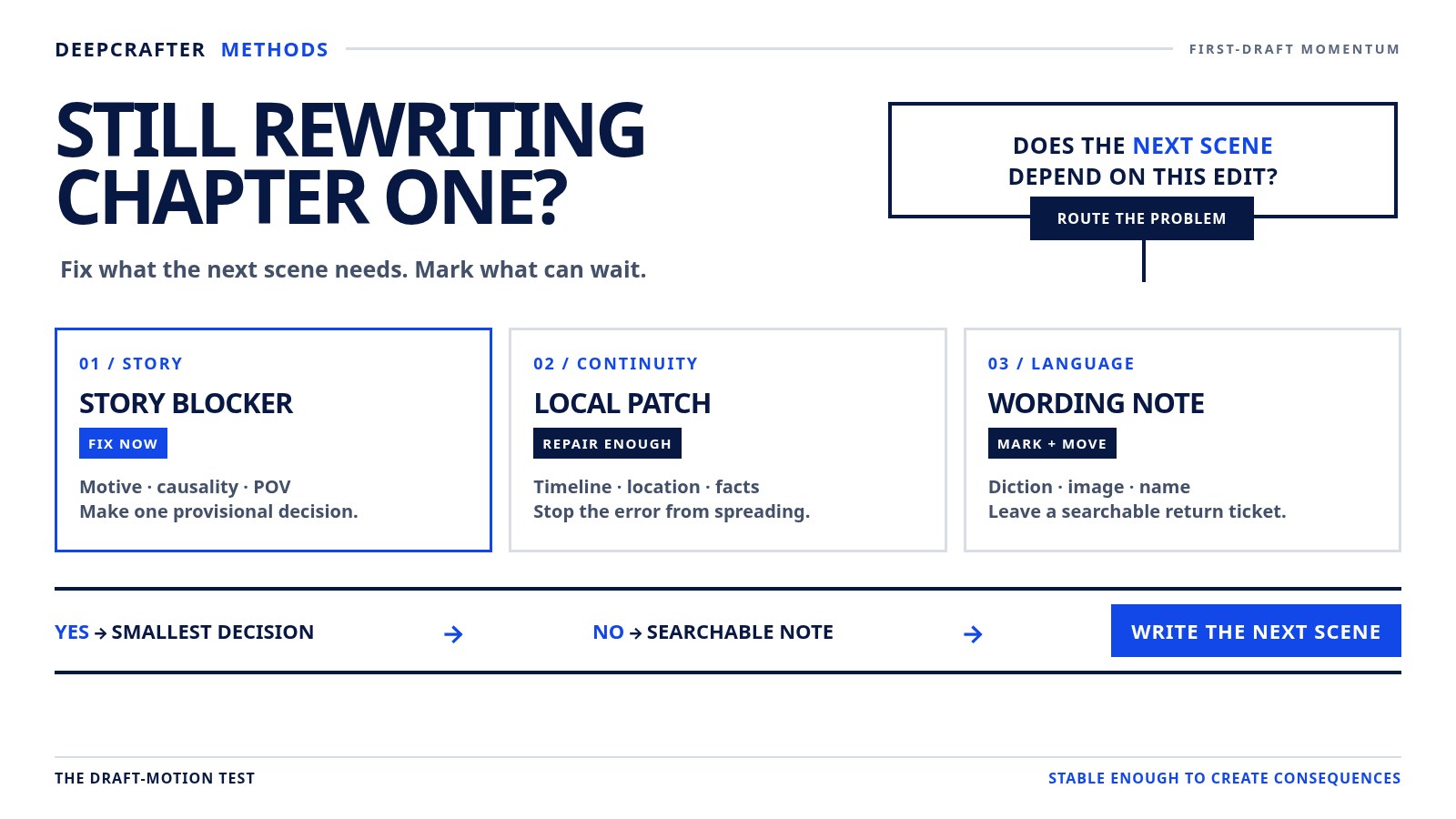
Does the next scene depend on fixing this now?
That question separates revision that restores motion from revision that postpones it.
Borrow the scale, not just the slogan
Anne Lamott’s Bird by Bird remains useful because its central image reduces an overwhelming project to a small, present task. Penguin Random House’s description of the book moves from “Short Assignments” to “Shitty First Drafts,” while the title story presents a school report made manageable one bird at a time.
That does not mean Lamott prescribed the workflow below. She did not. The decision test, routing table, example and exercise in this article are DeepCrafter editorial tools inspired by the same principle of reducing the work to the next workable unit.
For a stalled novelist, that unit is often not “perfect Chapter One.” It is “the next scene I can honestly draft.”
Diagnose the edit before you make it
When you feel pulled back to the opening, write the problem in one sentence. Do not write “the chapter is bad.” Name the thing that is bothering you.
- “I do not know why Mara enters the greenhouse.”
- “The reader cannot tell whether the letter arrived before the funeral.”
- “I used walked three times.”
- “The town may need a different name.”
- “The narration sounds too formal, but I cannot yet hear the final voice.”
Now route the problem into one of three lanes.
| Lane | What belongs here | What to do |
|---|---|---|
| Fix now | A decision the next scene needs: motive, causality, point of view, location, timeline or a fact that would make the next action impossible | Make the smallest provisional decision that lets the story continue |
| Patch and continue | A local continuity snag whose repair is obvious and limited | Repair only the affected line or detail; do not reopen the whole chapter |
| Mark and move | Diction, imagery, names, sentence music, research details or tonal questions that the next scene does not depend on | Leave a searchable note and write forward |
The lanes are not rankings. “Mark and move” does not mean a sentence is unimportant. It means its best answer may become clearer after more of the book exists.
Use the three-question Draft-Motion Test
Ask these questions in order.
1. Does the next scene require an answer?
If you cannot write the next action without deciding why it happens, who knows what, where the characters are or what has already occurred, you have found a story blocker. Fix it now—but fix only enough to draft onward.
You may not need a complete childhood history for a character. You may need one provisional reason she refuses to enter the house.
2. Will delay make the problem expensive?
Some issues do not stop the next scene, but allowing them to spread would create pages of avoidable repair. If you have accidentally shifted from first person to close third, or changed the day of a deadline that governs the plot, patch the inconsistency before it propagates.
By contrast, a weak image in the first paragraph will not multiply across ten chapters. Mark it.
3. Can you leave a reversible placeholder?
A placeholder should preserve uncertainty without stealing momentum.
[NAME LATER][CHECK: train time][IMAGE: colder, less decorative][MOTIVE: protect sister or hide debt — decide after Chapter 4]
The note must be searchable and specific. “Fix this” merely recreates the anxiety later. A useful note tells your future editing self what kind of decision remains.
An original example: the greenhouse door
Suppose a novel begins like this:
At 6:17, Mara found the greenhouse door ajar. Rain silvered the path behind her, and the glass panes held the last weak light of evening. She put one hand on the wet frame. Inside, something rang once and stopped.
The writer has revised ajar to open, then unlatched, then back to ajar. The rain has been silver, white and thin. None of those changes answers the question blocking the next scene:
Why does Mara go inside instead of calling someone?
That is a Fix Now problem because the next scene depends on her choice. The writer does not need Mara’s full psychology. One provisional decision is enough:
The sound is the ringtone Mara assigned to her missing brother.
Now the draft can move:
It rang again from beneath the potting bench—the four notes Eli had chosen because he knew they annoyed her. Mara stepped inside before she remembered the police had told her not to touch anything.
This paragraph is not offered as polished prose or as a product output. It is an original editorial demonstration. Its value is that it creates consequence: Mara recognizes the sound, enters and immediately crosses a boundary.
The writer can leave two notes behind:
[OPENING IMAGE: decide after the greenhouse sequence is complete][CHECK 6:17 against Chapter 3 timeline]
The first is a wording question. The second may become a continuity patch. Neither needs another forty-minute rewrite before the next scene exists.
Make the smallest decision that creates consequence
A common fear is that a provisional choice will trap the book. It will not, if the choice is small and visible.
Compare these two decisions:
- Large and rigid: “Eli staged his disappearance because he is the antagonist.”
- Small and productive: “Mara believes the phone means Eli entered the greenhouse after he vanished.”
The second decision gives the scene direction without settling the whole mystery. It tells the writer what Mara does and believes now. Later evidence can confirm, complicate or overturn that belief.
Discovery writers need provisional decisions as much as planners do. The difference is that the decision opens an experiment rather than completing an outline.
Give every deferred edit a return ticket
“I will fix it later” fails when later has no address. Create one running list with four fields:
- Location — chapter, scene or a copied phrase.
- Problem type — story, continuity, language or research.
- Decision needed — the exact unresolved question.
- Return point — after this scene, after this act or after the full draft.
For example:
Ch. 1 / “Rain silvered…” / Language / Find an image that belongs to Mara’s perception / Return after greenhouse sequence.
This turns postponement into a deliberate editorial decision. You are not trusting memory; you are scheduling attention for the moment when the manuscript can answer back.
A 25-minute exercise for today
Use this when you catch yourself reopening the first pages.
Minutes 0–3: Name the snag
Write one sentence: “I keep revising because…” If the answer is only “it is not good enough,” identify the specific uncertainty underneath.
Minutes 3–7: Route it
Apply the Draft-Motion Test. Choose Fix Now, Patch and Continue, or Mark and Move.
Minutes 7–12: Make one bounded intervention
- Fix Now: write one provisional story decision.
- Patch and Continue: change only the lines required for continuity.
- Mark and Move: add one searchable return ticket.
Set a timer. Do not let the intervention become a chapter-wide polish.
Minutes 12–25: Draft the next unit
Write the next beat, exchange or 250–400 words. The target is not elegance. The target is a new consequence that did not exist twenty-five minutes ago.
At the end, record the next unanswered story question. That is tomorrow’s entry point.
When you should stop and repair the opening
Moving forward is not always the brave choice. Stop when the opening has created a contradiction that makes further drafting meaningless—for example:
- the protagonist’s central action has no credible cause;
- the chosen narrator cannot know information the plot depends on;
- the timeline makes a later event impossible;
- the opening promises a different central conflict from the book you now intend to write;
- every attempted next scene collapses around the same unresolved decision.
Even then, define the repair before revising. “Rewrite Chapter One” is too large. “Give Mara a concrete reason to enter and preserve uncertainty about Eli” is workable.
Draft forward, then revise with more knowledge
The opening of a novel is asked to introduce a story the writer may not fully understand yet. Endless polishing cannot manufacture knowledge that only later scenes will provide.
Lamott’s small-scale principle helps because it returns attention to the piece of work in front of you. The additional discipline is to choose the right piece. Sometimes it is a sentence. Sometimes it is a missing causal decision. Often it is the next scene.
Your opening does not need to be beyond revision. It needs to be stable enough to produce consequences.
Mark the wording. Fix the blocker. Write what happens next.
Sources and method note
- Anne Lamott, Bird by Bird: Some Instructions on Writing and Life, publisher description, edition information and authorized excerpt, Penguin Random House.
- The Draft-Motion Test, three-lane routing table, greenhouse example, return ticket and 25-minute exercise are original DeepCrafter editorial material, not methods attributed to Lamott.