Talking About Someone Else, Revealing Yourself
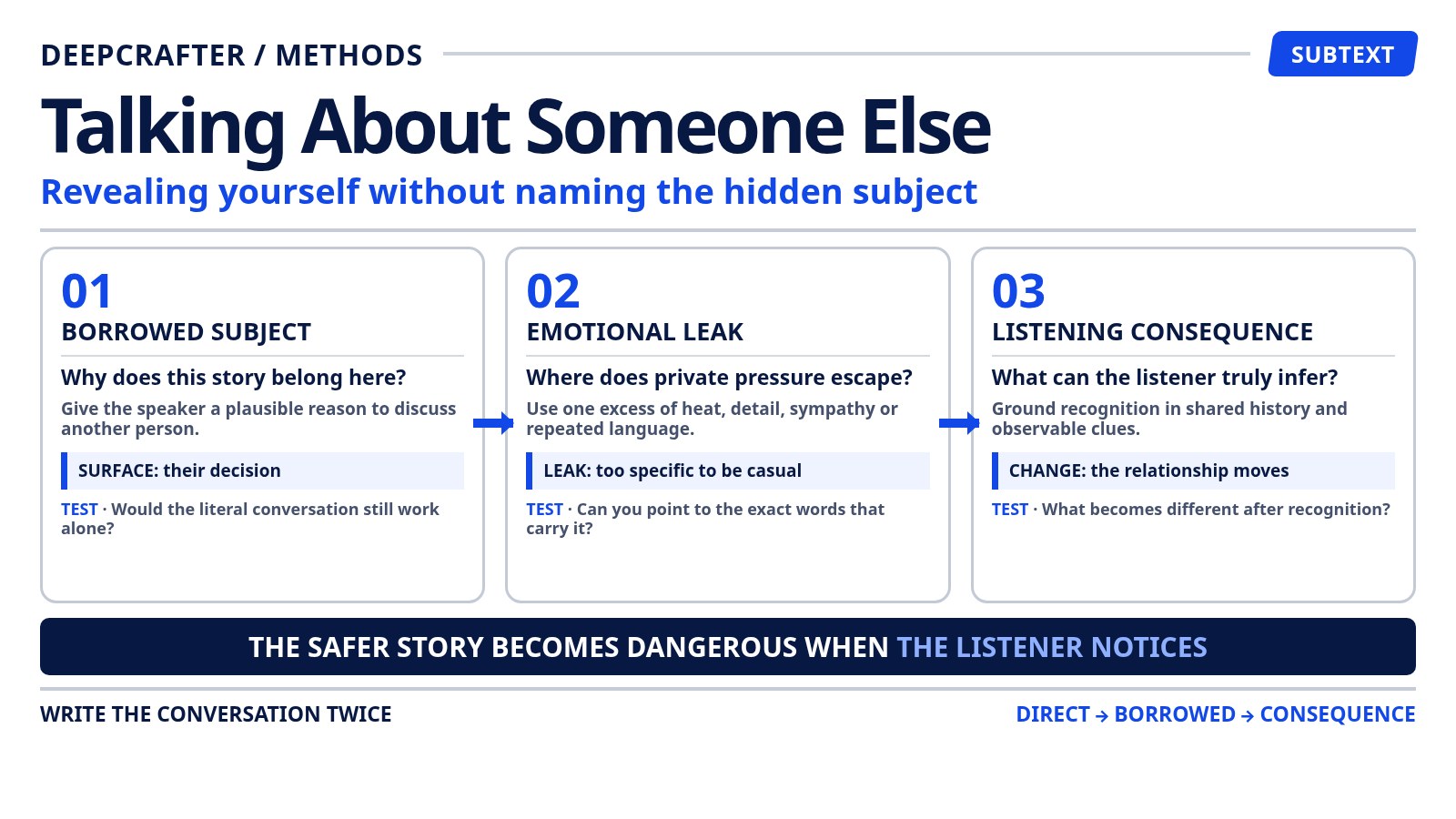
A three-question method for writing indirect confession: choose a plausible borrowed subject, let one emotional pressure point leak, and limit the listener to what they can reasonably know.
Talking About Someone Else, Revealing Yourself
On Kazuo Ishiguro’s birthday, it is tempting to summarize the familiar qualities of his fiction: restraint, memory, self-deception and the feelings that gather beneath careful speech. A more useful tribute for writers is to examine one precise dramatic possibility he described in a 2008 Paris Review interview.
Ishiguro imagines a person becoming unusually angry while discussing a mutual friend’s indecision. Gradually, we understand that the speaker is using the friend’s situation to speak about himself. He calls it a way for someone to appropriate another person’s story when his own life feels too painful or awkward to address directly.
That observation is the source of this article. The method below—borrowed subject, emotional leak, listening consequence—is DeepCrafter’s editorial framework, not a formula attributed to Ishiguro.
What indirect confession actually does
Indirect confession is not merely withholding information. A character chooses a safer subject and then invests it with feelings that belong partly elsewhere.
The spoken subject might be a friend’s decision, a film, a neighbor’s marriage, a colleague’s mistake or a news story. The hidden subject is the speaker’s own fear, desire, guilt or choice. The scene becomes alive in the gap between the two.
That gap gives the reader two experiences at once:
- we can follow the literal conversation;
- we can sense a second conversation pressing through it.
The technique works best when the surface topic remains genuinely relevant. If the borrowed story exists only as a transparent code, the dialogue can feel like a riddle designed by the author. A believable character has a real reason to discuss the other person—and a private reason for caring too much.
An original example: the direct version
Leah and Owen are closing a small cinema after the final screening. Leah has accepted a job in another city but has not told Owen, who helped her rebuild the place.
The most direct version might read:
Leah folded the last poster. “I took the Montreal job.”
Owen stopped stacking cups. “When were you going to tell me?”
“I was afraid you’d think I was abandoning the cinema.”
The information is clear, but the scene begins with its emotional meaning already named. Leah tells both Owen and the reader what she did and why she delayed. There is little room for her language to reveal something she is not yet ready to admit.
Now let her talk about someone else.
The indirect version
Leah rolled the final poster around its cardboard tube. “Mara says Julian is leaving again.”
Owen tipped the last paper cups into a bin. “Again?”
“Vancouver this time. He calls it an opportunity, as if the word changes what happens to everyone who stays.”
“Maybe it changes what happens to him.”
Leah tightened the elastic around the poster. “He has already priced storage. Three months near the station, then he’ll ship the rest if the contract becomes permanent.”
Owen set the empty cup sleeve on the counter. “When do you leave?”
Leah looked at him. “The cinema closes Friday.”
“That wasn’t my question.”
Leah never states the secret, yet the scene has not hidden everything. Her knowledge of storage, contracts and departure logistics is more specific than casual gossip requires. Her judgment of Julian carries the force of an argument she is having with herself. Owen’s final question turns the subtext into a relational event.
The scene can now continue in several directions. Leah may admit the job, deny it, accuse Owen of making the cinema her responsibility or ask whether leaving must mean betrayal. What matters is that indirectness has created action rather than decorative ambiguity.
Question 1 · Is the borrowed subject plausible?
Before planting subtext, make sure the surface conversation can stand on its own.
Ask:
- Why would this person come up now?
- What does the listener already know about them?
- Does the speaker have a legitimate stake in their situation?
Leah and Owen presumably know Mara and Julian. A departure is relevant on the night their cinema is closing. The borrowed story belongs in the room even before it begins to echo Leah’s decision.
If a character abruptly delivers a detailed account of a stranger merely to disguise exposition, the reader will feel the machinery. The safest subject is often one already connected to the scene’s work, place or relationship.
Decision rule: the literal conversation should remain credible even if the reader misses the hidden one.
Question 2 · What leaks from the speaker?
The revelation does not have to arrive through a factual slip. It can leak through pressure.
Useful signals include:
- disproportionate intensity: the speaker cares more than the topic seems to warrant;
- unnecessary specificity: they know a detail they should not need or possess;
- selective sympathy: they defend one side with unusual urgency;
- repeated language: one word—betrayal, cowardice, freedom—keeps returning;
- a pronoun or tense shift: “people like that” quietly becomes “you” or “we”;
- a practical reflex: they answer a question about the other person as if it were addressed to them.
In the example, Leah’s knowledge of storage and contract terms is the clearest leak. Her phrase about “everyone who stays” reveals the moral frame she fears Owen will use against her.
Do not use every signal at once. One precise leak is often stronger than a paragraph of loaded hints.
Decision rule: let the hidden subject distort one part of the surface conversation—its heat, detail, rhythm or logic.
Question 3 · What can the listener reasonably know?
Subtext becomes dramatic when it affects another person.
Owen does not read Leah’s mind. He hears an oddly detailed account, knows her circumstances and asks a testing question. “When do you leave?” is an inference, not supernatural certainty.
Choose the listener’s level of recognition:
- No recognition: the reader understands more than anyone in the room.
- Suspicion: the listener tests the pattern with a question or small action.
- Recognition without exposure: the listener changes the subject, protects the speaker or quietly prepares.
- Exposure: the listener names the hidden subject and forces a new choice.
Each option produces a different scene. If every listener instantly decodes every hint, characters begin to sound like instruments of authorial convenience. If nobody ever responds, subtext may remain atmospheric rather than consequential.
Decision rule: base recognition on shared history, observable clues and what the listener wants—not on what the author needs revealed.
Three common failures
1. The borrowed subject is only a cipher
If Julian has no independent relevance, the audience waits for the code to be solved rather than caring about the conversation. Give the surface story its own human weight.
2. The prose explains the subtext immediately
Avoid following the dialogue with a sentence such as Leah was really talking about herself. Let the pattern, the listener’s response and the next decision carry the meaning.
3. Indirectness is treated as a diagnosis
People speak obliquely for many reasons: courtesy, uncertainty, strategy, shame, playfulness, hierarchy or simply because they are still discovering what they think. Do not label every silence as trauma or every deflection as repression. Write the behavior the scene can support.
A revision exercise: write the conversation twice
Choose a scene in which one character has news they are not ready to state.
Pass A · Direct
Write 150 words in which the character names the news, the fear attached to it and the response they want.
Pass B · Borrowed
Rewrite the scene around another person or situation. Keep these constraints:
- The borrowed subject has a natural reason to enter the conversation.
- One detail or phrase carries more emotional pressure than the surface topic requires.
- The listener reacts only to what they can actually observe.
- The exchange changes a decision, a relationship or the next action.
Then compare the drafts with three questions:
- Which version gives the reader more to infer without becoming obscure?
- What becomes more emotionally precise when the character cannot say it directly?
- Does the listener’s response create a real consequence?
Keep the indirect version only if it improves the scene. Direct speech can be braver, kinder or more dramatic. The method is a choice, not a rule that every confession should be disguised.
Using an AI collaborator without surrendering the decision
An AI writing tool can help test whether the two layers remain legible. Give it the scene and ask for three separate observations:
- What is the literal subject of the conversation?
- What might the speaker also be revealing, and which exact words support that inference?
- What can the listener reasonably conclude at this point?
If the tool identifies the hidden subject but cannot point to textual evidence, the subtext may depend on information outside the scene. If it explains the scene too confidently, check whether several interpretations remain possible. If it misses the hidden layer entirely, strengthen one leak rather than adding a paragraph of explanation.
The writer still decides how much the reader should know, how quickly the listener should know it and whether indirectness suits this character at all.
Let the safer story become dangerous
Talking about someone else gives a character temporary cover. What makes the scene worth reading is the moment that cover begins to fail.
Choose a borrowed subject that belongs in the room. Let one pressure point reveal more than the speaker intends. Then decide what the listener can do with what they have heard.
The character may still avoid a direct confession. But the conversation should no longer leave the relationship exactly as it found it.
Sources
- The Paris Review: Kazuo Ishiguro, The Art of Fiction No. 196
- Nobel Prize: Kazuo Ishiguro biobibliographical notes
The three-question framework and cinema scene are original editorial material created by DeepCrafter.