Who Owns Your Time? Four Novels Beyond the Clock
A four-coordinate reading map through Woolf, Ende, Jansson and Ozeki, asking who gets to name a minute well spent.
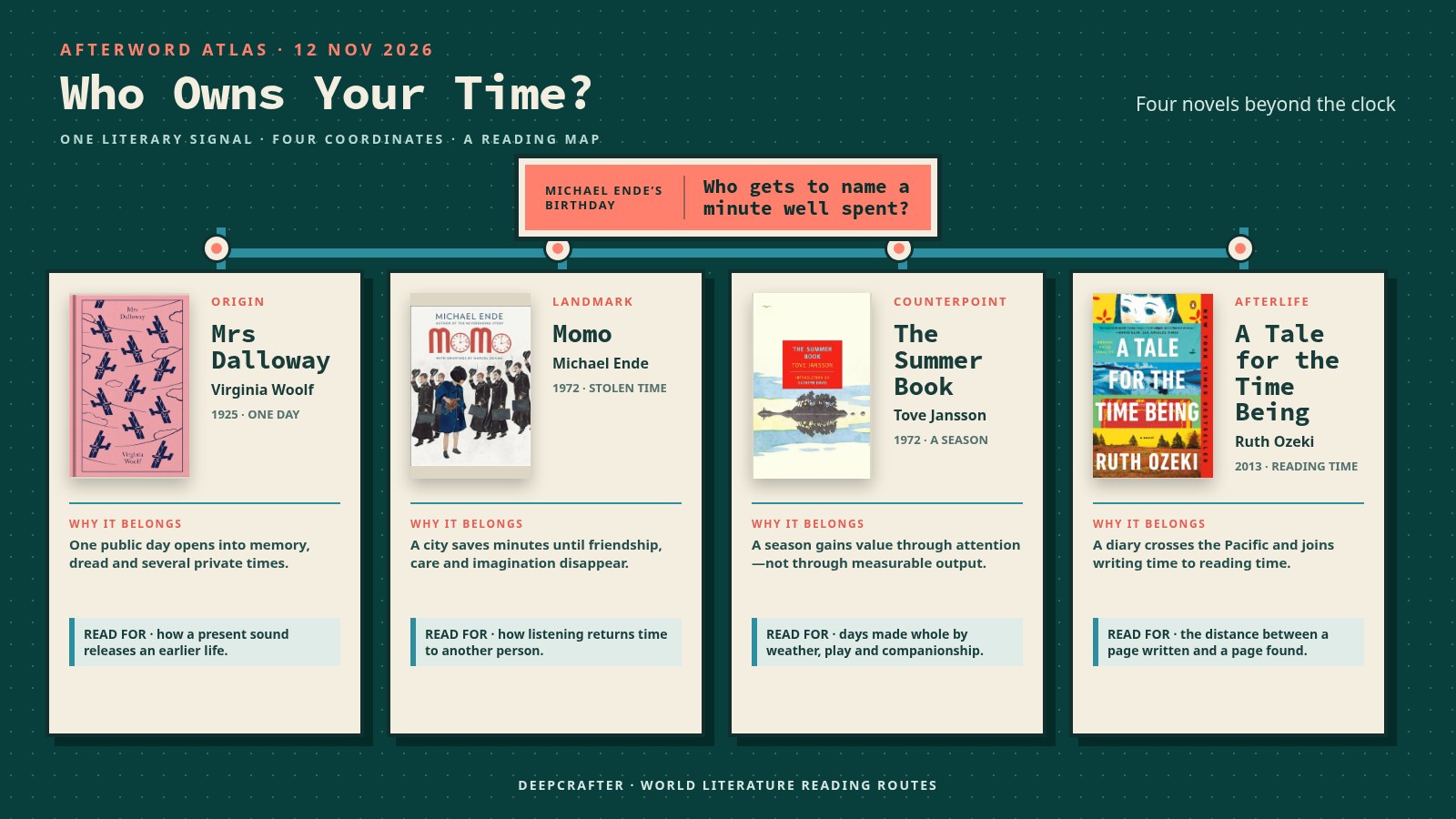
Who Owns Your Time?
Four novels beyond the clock
Why read about time today? Michael Ende was born on November 12, 1929. His official biography records the date and describes a writer who wanted stories to offer new ways of seeing the world. Momo, published in German in 1972 after six years of work, gives that ambition one of its clearest shapes: a city is persuaded to “save” time until its people have almost no life left to live.
The Gray Gentlemen make a promise that still sounds familiar. If every minute can be measured, optimized and banked, there will be more life later. The novel asks the more dangerous question: what if the time we save is the time in which life happens?
This Afterword Atlas travels through four very different novels. One compresses public and private time into a single June day. One turns stolen time into fantasy. One lets a summer island refuse the logic of productivity. One sends a diary across the Pacific and asks how reading can join lives separated by place and chronology.
🚉 The route: measured day → stolen life → unproductive season → time carried by a reader.
ORIGIN · Mrs Dalloway
Virginia Woolf · 1925
Selected edition: Penguin Clothbound Classics, ISBN 9780241468647.
Big Ben marks the hours, but Woolf’s London is full of times that cannot be made to agree. Clarissa Dalloway moves through one day of errands, memories and preparation for a party. Septimus Smith moves through the same city under the pressure of war memory and psychiatric distress. Public clocks keep the two narratives synchronized; consciousness keeps opening the measured day into different pasts.
This is the origin point because it shows that clock time and lived time can occupy the same sentence without becoming the same thing. A few seconds at a curb can contain youth, regret, fear and anticipation. The day does not become longer. The reader’s experience of it becomes deeper.
Read for: the moments when a sound in the present opens a memory without warning.
Carry forward: a deadline can organize a story while interior time resists it.
LANDMARK · Momo
Michael Ende · 1972
Selected edition: McSweeney’s McMullens 40th Anniversary Edition, translated from German by Lucas Zwirner, illustrated by Marcel Dzama, ISBN 9781938073144.
Momo’s gift is listening. People do not simply report information to her; in her attention they recover the ability to think, reconcile and invent. That makes her the natural opponent of the Gray Gentlemen, who persuade the city to treat every generous, playful or apparently idle hour as waste.
The translator Lucas Zwirner describes the book’s enduring pressure clearly: efficiency and profit can distract from pleasures and forms of care that are difficult to quantify. Ende does not answer with a time-management system. He builds a fantasy in which the struggle over minutes is a struggle over friendship, imagination and the pace at which a person can remain human.
This is the landmark because the metaphor is both simple and inexhaustible. The danger is not merely being busy. It is accepting somebody else’s definition of valuable time.
Read for: how listening changes what another person is able to say and imagine.
Carry forward: when a system steals time, show which relationships become thinner first.
COUNTERPOINT · The Summer Book
Tove Jansson · 1972
Selected edition: NYRB Classics, translated from Swedish by Thomas Teal, introduction by Kathryn Davis, ISBN 9781590172681.
Jansson’s twenty-two vignettes follow six-year-old Sophia and her grandmother through a summer on a small island in the Gulf of Finland. They build boats from bark, quarrel, invent, examine insects, endure storms and speak about death and love. The island is not outside time. Weather changes, age matters and the season will end. But the book refuses to measure a day by output.
This is the counterpoint to Momo. Instead of turning time theft into an antagonist, Jansson shows what time can feel like when no one has to prove that a walk, a game or a conversation was useful. The small scale is the point. Attention makes a world complete.
Read for: the gaps between vignettes. The novel trusts the season to accumulate without explaining every transition.
Carry forward: leisure in fiction need not be empty. It can reveal how people inhabit a world together.
AFTERLIFE · A Tale for the Time Being
Ruth Ozeki · 2013
Selected edition: Penguin Books paperback, ISBN 9780143124870.
Nao, a teenager in Japan, writes a diary. Ruth, a novelist living on a remote Canadian island, finds it among debris carried across the Pacific. Reading turns the object into a relationship, though the two women do not share a single present that can be easily confirmed.
Ozeki’s novel works with diary time, historical time, Zen ideas of impermanence, environmental disaster and the strange delay between writing and being read. A page can survive its writer’s immediate crisis. A reader can arrive too late to intervene and still become ethically entangled in what the page asks her to witness.
This is the afterlife because time becomes a medium of connection. The diary does not abolish distance. It makes distance part of the story’s form.
Read for: how notes, footnotes and alternating voices change the speed at which certainty arrives.
Carry forward: a document in fiction has two timelines—the moment of writing and the moment of reading.
How to travel this map
Route A · One day to many years
Begin with Mrs Dalloway, where one day contains several lives. Move to Momo, where a city is taught to surrender its hours. Rest inside The Summer Book, where a season acquires value through attention. End with A Tale for the Time Being, where a diary moves between continents, generations and readers.
Route B · When you feel over-scheduled
Start with Momo. Its fantasy gives the pressure a visible shape. Read The Summer Book next, slowly enough to let its vignettes remain small. Then choose Woolf for a concentrated day or Ozeki for the longer, stranger connection between a writer and a reader.
Route C · Read as a writer
At each stop, mark four things:
- Clock: what publicly measures or orders time?
- Experience: how does the character actually feel its passage?
- Claim: who decides which minutes count as useful?
- Form: what narrative device changes the reader’s pace?
The route is complete when you can describe not only how much time passes, but who has the power to name that time well spent.
Four coordinates, not a family tree
This map does not claim that the four novels form a direct line of influence. They belong to different languages, traditions and formal projects. The route is editorial: Woolf makes one measured day plural; Ende dramatizes time as something a system can capture; Jansson protects the value of an unproductive season; Ozeki turns delayed reading into a bond.
Their differences keep the theme honest. “Slow down” is too easy to say, especially to people whose work, care or circumstances do not let them control every hour. These novels offer something more precise: a way to notice who defines the pace, what that pace costs and which kinds of attention remain possible inside it.
📚 If you only begin one book today: open Momo and watch what happens before the Gray Gentlemen fully arrive. The threatened world must first feel worth saving.
Editions and cover provenance
- Mrs Dalloway — Penguin Classics: Penguin Clothbound Classics hardback, ISBN 9780241468647. Cover supplied by Penguin.
- Momo — McSweeney’s translator interview: Lucas Zwirner translation and Marcel Dzama illustrations; 40th Anniversary Edition, ISBN 9781938073144. Cover identified through the Google Books record for this edition.
- The Summer Book — New York Review Books: Thomas Teal translation, ISBN 9781590172681. Cover supplied by NYRB.
- A Tale for the Time Being — Penguin Random House: Penguin Books paperback, ISBN 9780143124870. Cover supplied by Penguin Random House.
Source note
Michael Ende’s birth date, publication chronology and literary background are verified through his official biography. The discussion of the Lucas Zwirner translation and the book’s concern with efficiency uses McSweeney’s 2013 interview with the translator. The connections among the four novels are DeepCrafter’s editorial reading path, not claims of direct influence.