A Life on Hold: Four Books About Waiting to Belong
A four-coordinate reading map through Kafka, Seghers, Sebald and Hamid, tracing lives suspended between departure, arrival and belonging.
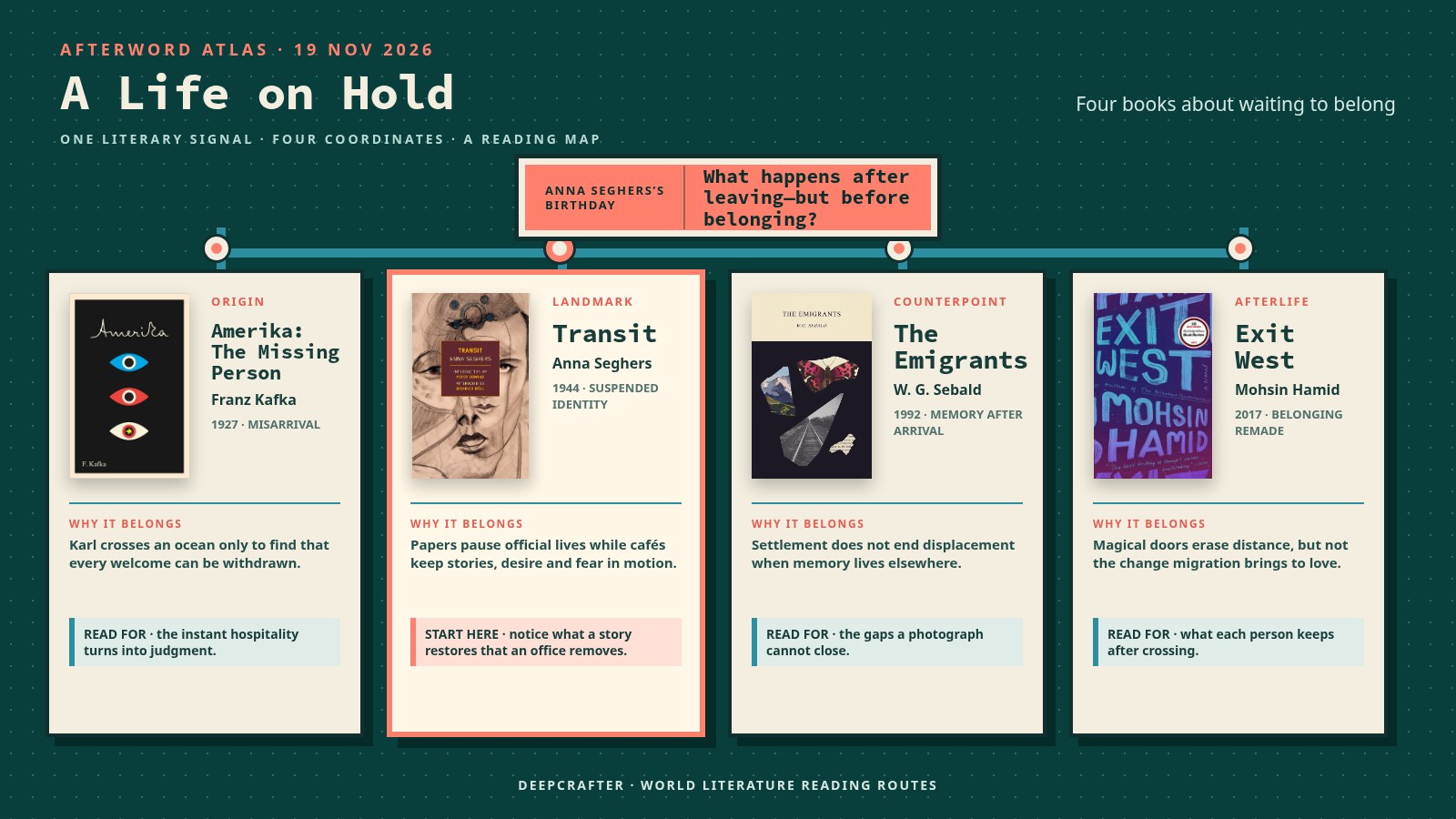
A Life on Hold
Four books about waiting to belong
Leaving is an event. Belonging is a much slower story.
Why read these books today? Anna Seghers was born on November 19, 1900. In 1940 and 1941, after fleeing Nazi Germany and then Paris, she waited in Marseille for the documents that would let her continue to Mexico. She began Transit inside that suspended world. The novel turns visas, permits, departures and rumors into the texture of everyday life: people have escaped one danger, but the next life has not begun.
That interval still deserves a precise literary language. Displacement is often narrated through the visible drama of departure or arrival. These four books remain with what lies between—and with what survives after the border has been crossed. They ask a harder question:
What happens when you have left, but cannot yet say where you belong?
This Afterword Atlas begins with a young man sent into an imagined America, stops in Seghers’s Marseille waiting rooms, turns toward W. G. Sebald’s lives shaped by exile long after arrival, and ends with Mohsin Hamid’s lovers discovering that migration changes the relationship that made the journey possible.
🚉 The route: misarrival → suspended identity → memory after arrival → belonging remade.
ORIGIN · Amerika: The Missing Person
Franz Kafka · written 1912–1914; first published 1927
Selected edition: Schocken paperback, translated from German by Mark Harman, 2011, ISBN 9780805211610.
Karl Rossmann does not decide to emigrate. His parents send him away after a scandal, and he enters America already separated from the people who defined his previous life. The country he reaches is both recognizable and impossible: a Statue of Liberty with a sword, an uncle who can withdraw protection as abruptly as he offered it, jobs whose rules feel absolute until they change.
Kafka leaves the novel unfinished, but incompletion is more than a publication fact here. Karl repeatedly approaches a place that might hold him—a family, a hotel, a theatre—and finds that admission is conditional. He is always being interpreted by someone with more authority. Even when he moves forward, his social position can be revised behind his back.
This is the origin coordinate because it separates geographical arrival from belonging at once. Karl has crossed the ocean, yet his life is organized by provisional welcome. America is not a destination that resolves him. It is a series of doors controlled by other people.
Read for: each moment when hospitality becomes judgment. Who names Karl’s mistake, and who gets to decide whether it can be forgiven?
Carry forward: arrival is not the opposite of exile when the right to stay remains conditional.
LANDMARK · Transit
Anna Seghers · first published in Spanish and English in 1944; German edition 1948
Selected edition: NYRB Classics paperback, translated from German by Margot Bettauer Dembo, 2013, ISBN 9781590176252.
Seghers’s unnamed German narrator escapes imprisonment and reaches Marseille, where everyone seems to be waiting for the paper that depends on another paper. A person needs a visa, a transit permit, an exit permit and a ship that may or may not sail. Offices open and close. Consulates produce hope in numbered turns. Cafés become places where refugees exchange stories, rumors and the names of routes out.
The narrator carries the manuscript and papers of a dead writer named Weidel. Bureaucratic confusion begins to treat him as though he were Weidel, while his own identity remains strangely unfixed. The mistake is not only a thriller mechanism. It asks what a name means when institutions recognize the document more readily than the person standing in front of them.
This is the landmark because Transit makes waiting active without romanticizing it. People plan, love, betray, listen and invent stories while their official lives are paused. Boredom becomes dangerous; attention becomes a form of human recognition. The novel’s suspense does not come only from whether someone will leave. It comes from how long a person can inhabit uncertainty without allowing uncertainty to become the whole self.
Read for: the repeated movement between offices and cafés. One space reduces a life to papers; the other lets a life become a story again.
Carry forward: when the future is controlled by documents, storytelling can restore the dimensions bureaucracy removes.
COUNTERPOINT · The Emigrants
W. G. Sebald · first published in German in 1992
Selected edition: New Directions paperback, translated from German by Michael Hulse, 2016, ISBN 9780811226141.
Sebald’s four long narratives follow people whose lives have been marked by emigration: a doctor, a teacher, a painter and the narrator’s great-uncle. Their routes cross Germany, Lithuania, England, Switzerland, France, the United States and the Middle East. Photographs, diaries, reported memories and the narrator’s journeys appear to document what happened, but the closer he comes, the more unstable a complete account becomes.
This is the counterpoint to Transit because the ship has sailed and the documents have been obtained. The visible emergency is over. Yet arrival has not sealed the past behind anyone. Memory returns through places, images and gaps in testimony; what was lost can remain structurally present in a life that appears settled.
Sebald also changes the ethics of the route. The narrator is not simply collecting examples of exile. He is trying to approach other people’s histories without pretending that attention gives him complete possession of them. The photographs seem evidentiary, but they do not close the distance between a life and its retelling.
Read for: the point at which a seemingly orderly biography becomes uncertain. What can a photograph confirm, and what does it leave outside the frame?
Carry forward: belonging can be achieved externally while memory continues to live in another geography.
AFTERLIFE · Exit West
Mohsin Hamid · 2017
Selected edition: Riverhead Books paperback, 2018, ISBN 9780735212206. Written in English; no translator.
Nadia and Saeed fall in love as their unnamed city moves toward civil war. Rumors spread of black doors that can carry people instantly to another country. Hamid removes the long physical journey from the center of migration: one step can take a person from danger into a Greek camp, London or California.
The magical doors do not make movement easy. They make the real subject harder to avoid. The couple must learn how to inhabit unfamiliar places, how to respond to communities organized around them and against them, and how to recognize that the person who helped them survive departure may not be the person with whom they can build the next life.
This is the afterlife because Exit West treats belonging as plural and revisable. Nadia and Saeed carry different versions of home. New surroundings enlarge those differences. Their intimacy changes not because migration was a temporary obstacle to the “real” romance, but because migration alters the selves inside the romance.
Read for: what each character keeps, changes or stops needing after every door. Their objects, clothes, rituals and silences do not travel in the same way.
Carry forward: crossing a border can preserve a life while transforming the relationship that gave that life continuity.
How to travel this map
Route A · Begin inside the wait
Start with Transit. Its cafés, consulates and repeated appointments give the central condition its most concentrated form. Then read Amerika: The Missing Person for the instability of conditional welcome, The Emigrants for the persistence of displacement after settlement, and Exit West for belonging as an ongoing negotiation.
Route B · Follow the scale of time
Begin with Kafka’s chain of immediate reversals. Move to Seghers’s days and weeks of bureaucratic suspension. Continue to Sebald’s decades of memory. End with Hamid’s glimpses of lives changing across years. The route expands one problem—where can I stay?—into another: what becomes of me after staying?
Route C · Read when your own life feels paused
Begin with Transit, but do not read it as a motivational metaphor. Its historical danger is specific. Read instead for its refusal to treat waiting people as empty. Then choose the coordinate closest to your question:
- If welcome feels conditional: Amerika: The Missing Person.
- If the past keeps changing the present: The Emigrants.
- If a shared transition is changing a relationship: Exit West.
🧭 At every stop, notice four things:
- Paper: what document, name or record makes the person legible?
- Shelter: which place is temporary, and who controls its terms?
- Story: when does narration give back what administration or distance removes?
- Belonging: is it granted, practiced, remembered or remade?
Four coordinates, not a family tree
This map does not claim a direct line of influence among the four books. Kafka’s unfinished comic nightmare, Seghers’s exile novel, Sebald’s documentary-inflected narratives and Hamid’s speculative love story come from different historical moments and formal projects.
The route is editorial. Kafka makes arrival unstable. Seghers makes bureaucratic waiting a lived world. Sebald shows that settlement does not finish exile’s work in memory. Hamid imagines movement without distance in order to make adaptation and intimacy newly visible.
Their differences are essential. They prevent displacement from becoming a single metaphor or a comforting story of resilience. These books do not ask readers to admire suffering from a safe distance. They ask us to notice how institutions, memory, love and narration shape who is allowed to become more than a person in transit.
📚 If you begin one book today: start with Transit. Watch how often a story is told while somebody is waiting for permission to move. The pause is not outside life. It is where life continues without guarantees.
Editions, access and cover provenance
All edition and cover checks below were completed on November 19, 2026. The linked publisher pages describe U.S. editions; prices, formats and regional availability can vary. This page does not claim worldwide availability.
- Amerika: The Missing Person — Schocken / Penguin Random House: Mark Harman translation, 2011 paperback, ISBN 9780805211610. Cover supplied by Penguin Random House. The publisher also lists an ebook edition.
- Transit — New York Review Books: Margot Bettauer Dembo translation, 2013 NYRB Classics paperback, ISBN 9781590176252. Cover supplied by NYRB. The publisher lists paperback and ebook formats.
- The Emigrants — New Directions: Michael Hulse translation, 2016 paperback, ISBN 9780811226141. Cover supplied by New Directions. The publisher page links to U.S. booksellers.
- Exit West — Riverhead / Penguin Random House: 2018 paperback, ISBN 9780735212206. Cover supplied by Penguin Random House. The publisher also lists hardcover, ebook and audiobook formats.
Source note
Anna Seghers’s birth date, flight from Paris, wait in Marseille and work on Transit are verified through the German Historical Museum biography. Publication, translation and edition details come from the publisher pages listed above. The relationships among the four books are DeepCrafter’s editorial reading path, not claims of direct literary influence.