Ideas in Conflict: Four Novels That Turn Ideology into Private Consequence
A four-coordinate reading map from Lermontov and Turgenev to Le Guin and Nguyen, tracing how fiction turns beliefs into private stakes and dramatic action.
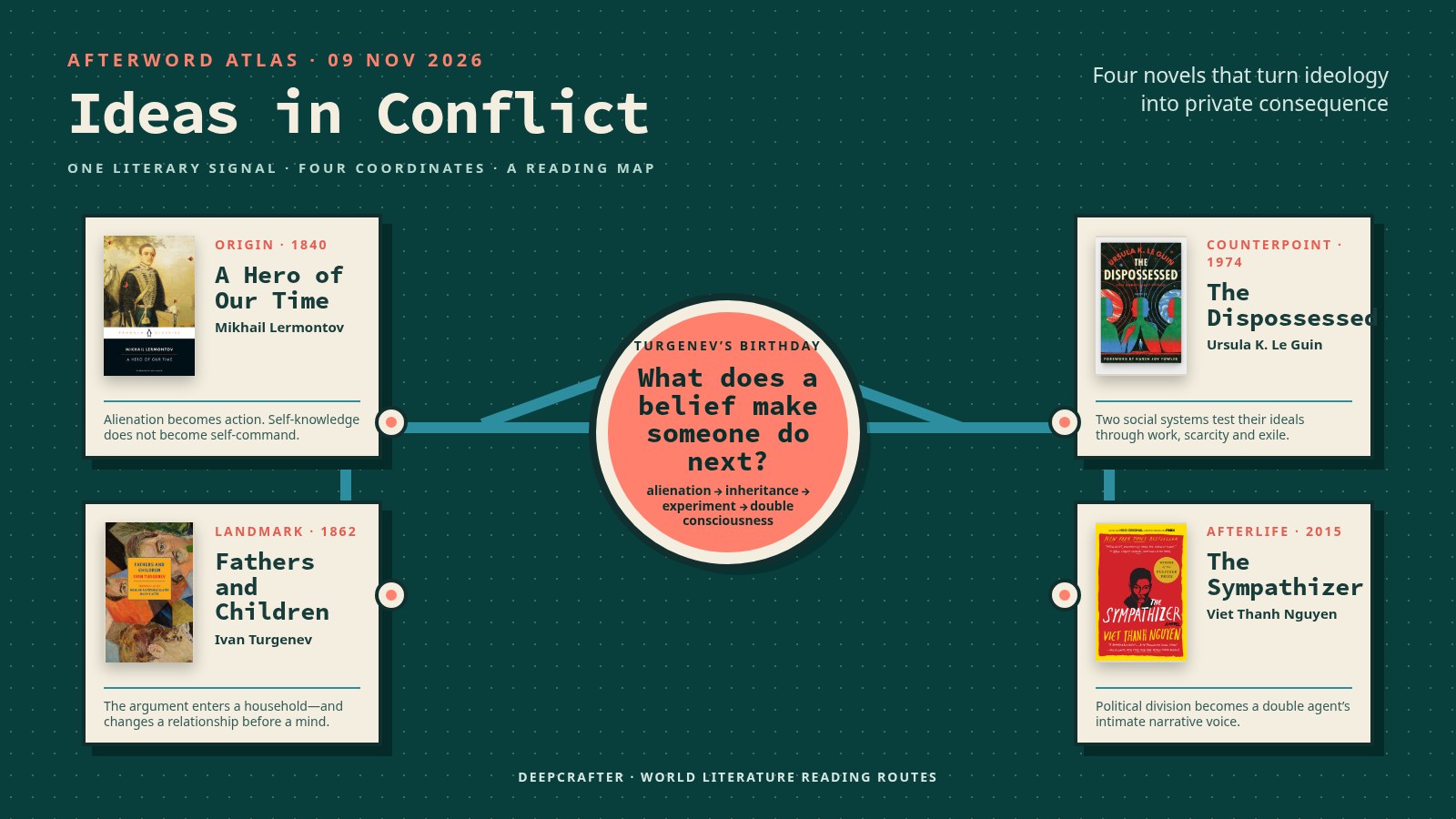
Ideas in Conflict
Four novels that turn ideology into private consequence
Why read about ideological conflict today? Because November 9 is Ivan Turgenev’s birthday, and Fathers and Children still offers one of fiction’s clearest answers to a hard craft question: how can a novel give ideas real force without turning its characters into mouthpieces?
The answer is not to weaken the argument. It is to make the argument cost someone something.
This Afterword Atlas begins before Turgenev, moves through his generational landmark, crosses into Ursula K. Le Guin’s speculative counterworld and ends with Viet Thanh Nguyen’s divided narrator. The route covers 175 years and four very different political landscapes. At every stop, the same question changes shape:
What happens when a belief enters a friendship, a household, a body or a divided self?
🚉 The route: alienation → inheritance → social experiment → double consciousness.
ORIGIN · A Hero of Our Time
Mikhail Lermontov · 1840
Selected edition: Penguin Classics, translated by Natasha Randall, ISBN 9780143105633.
Before Bazarov, there was Pechorin: magnetic, intelligent, bored and estranged from the moral language around him. Lermontov does not organize the novel as a debate. Instead, he lets a young man’s detachment become a pattern of action whose consequences are borne by other people.
This is the origin point because it shows the Russian “superfluous man” before Turgenev’s nihilist sharpened generational conflict into a name. Pechorin’s ideas are less systematic than Bazarov’s, but his refusal of ordinary attachment already turns a worldview into a social force.
Read for: the gap between self-knowledge and self-command. Pechorin can diagnose himself with extraordinary precision and still repeat the behavior he understands.
Carry forward: an articulate character is not necessarily a free one.
LANDMARK · Fathers and Children
Ivan Turgenev · 1862
Selected edition: NYRB Classics, translated by Nicolas Pasternak Slater and Maya Slater, ISBN 9781681376356.
Turgenev’s novel brings the argument home. Bazarov rejects authority, inherited principles, romantic feeling and art; Pavel defends aristocratic dignity and tradition. Yet the book’s real drama begins before their formal clash.
In Chapter V, Arkady explains the new word nihilist to his family. Pavel immediately reframes the definition as a refusal to respect anything. In Chapter X, Nikolai overhears Bazarov dismiss him as a man whose day is over—and hears Arkady fail to defend him. The public argument that follows is already carrying a private wound.
That structure is the landmark. Turgenev makes ideology dramatic by binding it to hospitality, pride, filial love, class, work and the fear of becoming obsolete. Nobody enters the room as a position alone.
Read for: the actions that surround the speeches—who listens at a doorway, who changes the subject, who leaves and what happens to the household afterward.
Carry forward: the best argument scene changes a relationship even when it changes no one’s mind.
COUNTERPOINT · The Dispossessed
Ursula K. Le Guin · 1974
Selected edition: Harper Perennial Modern Classics, 50th Anniversary Edition, foreword by Karen Joy Fowler, ISBN 9780063382930.
Le Guin moves ideological conflict from one estate to two worlds. Anarres is an anarchist society founded in refusal of Urras’s hierarchy and wealth. Shevek, a physicist, crosses the wall between them in search of intellectual exchange, only to discover that no social order is identical to its ideals.
The novel is a counterpoint because it does not merely stage two opponents in a room. It gives each system institutions, habits, blind spots and material seductions. Shevek’s beliefs are tested through work, sex, friendship, scarcity, prestige and exile. The political thought experiment remains alive because Le Guin never exempts her imagined alternative from pressure.
Read for: how alternating chapters make sequence itself an argument. The novel refuses a simple before-and-after conversion story.
Carry forward: if a fictional society has values, give those values procedures—and give the procedures human costs.
AFTERLIFE · The Sympathizer
Viet Thanh Nguyen · 2015
Selected edition: Grove Paperback, ISBN 9780802124944.
Nguyen carries ideological division inside a single voice. His unnamed narrator is a communist double agent, a refugee, a man of mixed French and Vietnamese ancestry and, in his own formulation, a man of two minds. The political argument is no longer simply between generations or worlds. It is the instrument through which he narrates himself.
This is the afterlife of Turgenev’s problem in a postcolonial, diasporic and media-saturated novel. Loyalty is intimate and strategic at once. Friendship can be sincere while serving betrayal. Confession can reveal truth while being extracted by power. Even the story of a war becomes contested terrain when Hollywood turns history into spectacle.
Read for: the doubleness of the narrator’s sentences—the way irony lets belief and doubt inhabit the same line.
Carry forward: a divided narrator need not be vague. Contradiction can make a voice more exact.
How to travel this map
Route A · Read chronologically
Move from Pechorin to Bazarov to Shevek to Nguyen’s captain. You will see alienation acquire a generational name, expand into a social system and finally become a split narrative consciousness.
Route B · Read by dramatic scale
Begin with Fathers and Children in the household. Move outward to the two planets of The Dispossessed. Then move inward to the doubled mind of The Sympathizer. End with A Hero of Our Time and ask whether self-knowledge changes conduct.
Route C · Read as a writer
At each stop, mark four things:
- Position: what the character says is true.
- Private stake: what they fear losing.
- Scene action: what they do while speaking.
- Relationship shift: what becomes possible—or impossible—afterward.
The route is complete when you can describe not only who “won” an argument, but what the argument made someone do next.
A four-book shelf, not a family tree
These novels are not presented as a simple chain of direct influence. The map is a reading path built around a shared craft problem. Lermontov provides a Russian precursor; Turgenev supplies the central generational drama; Le Guin tests political ideals through speculative worldbuilding; Nguyen brings political division into an intimate, self-divided voice.
The differences matter as much as the echoes. They prevent “ideological fiction” from becoming a genre label. It is better understood as a recurring challenge of characterization: how to let ideas shape a life without allowing the idea to replace the life.
📚 If you only read one scene today: read Chapter X of Fathers and Children. Notice that the debate begins long before Pavel speaks. Nikolai has already been hurt, Arkady has already failed him and Bazarov is already inside someone else’s home.
That is where argument becomes story.
Editions and cover provenance
- A Hero of Our Time — Penguin Classics: Natasha Randall translation, ISBN 9780143105633. Cover supplied by Penguin Random House.
- Fathers and Children — NYRB Classics: Nicolas Pasternak Slater and Maya Slater translation, ISBN 9781681376356. Cover supplied by Penguin Random House.
- The Dispossessed — Ursula K. Le Guin’s official site: Harper Perennial Modern Classics 50th Anniversary Edition with a foreword by Karen Joy Fowler, ISBN 9780063382930. Cover supplied on the author’s official page.
- The Sympathizer — Grove Atlantic: Grove Paperback, ISBN 9780802124944. Cover supplied by Grove Atlantic.
Source note
The November 9 date is verified by Visuotinė lietuvių enciklopedija. The reading of Chapters V, IX and X uses the public-domain Constance Garnett translation at Project Gutenberg. The map’s connections are DeepCrafter’s editorial reading path, not claims of direct influence unless explicitly stated.