Where to Start with Higuchi Ichiyō: Three Stories, One English Gateway
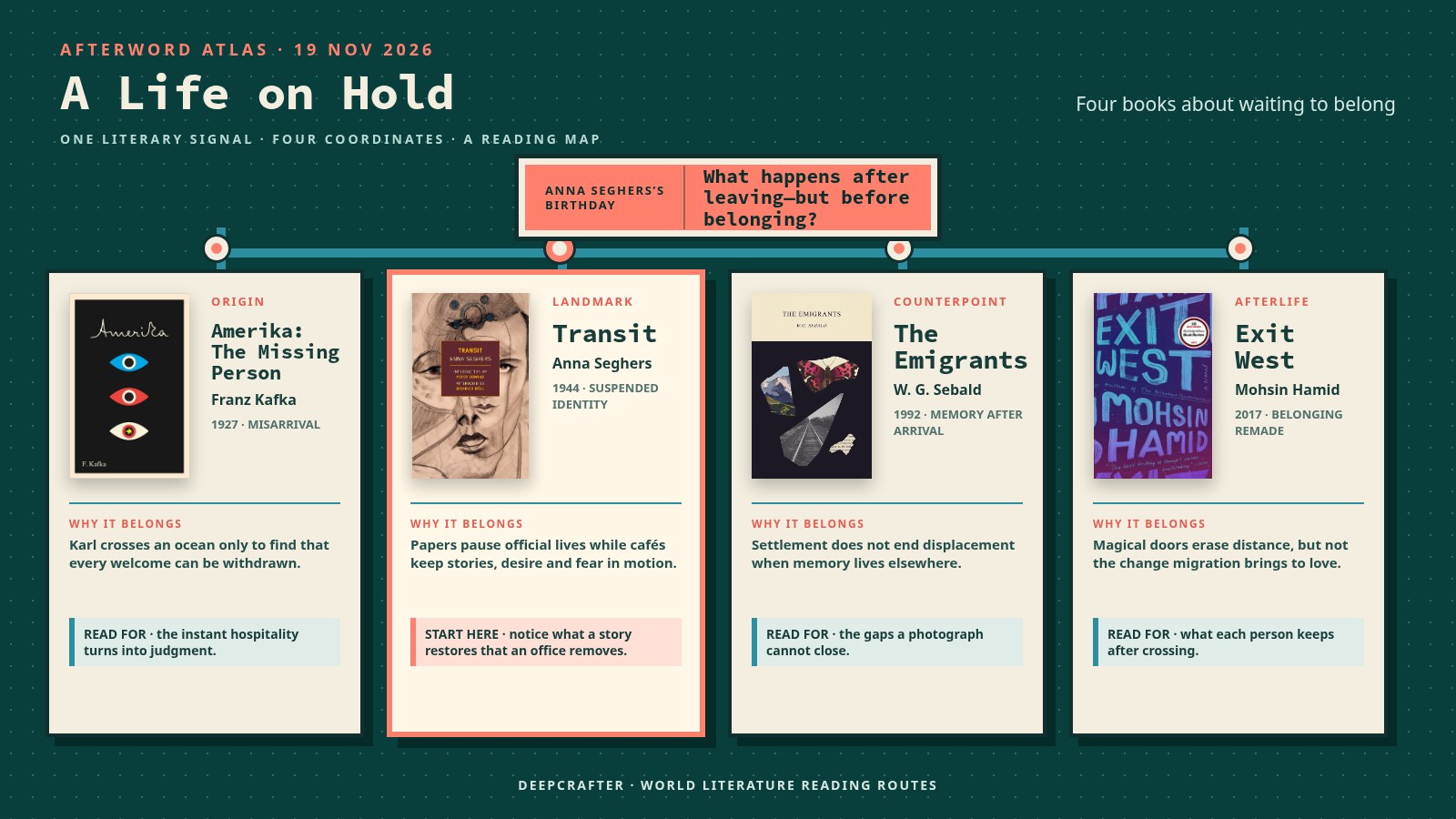
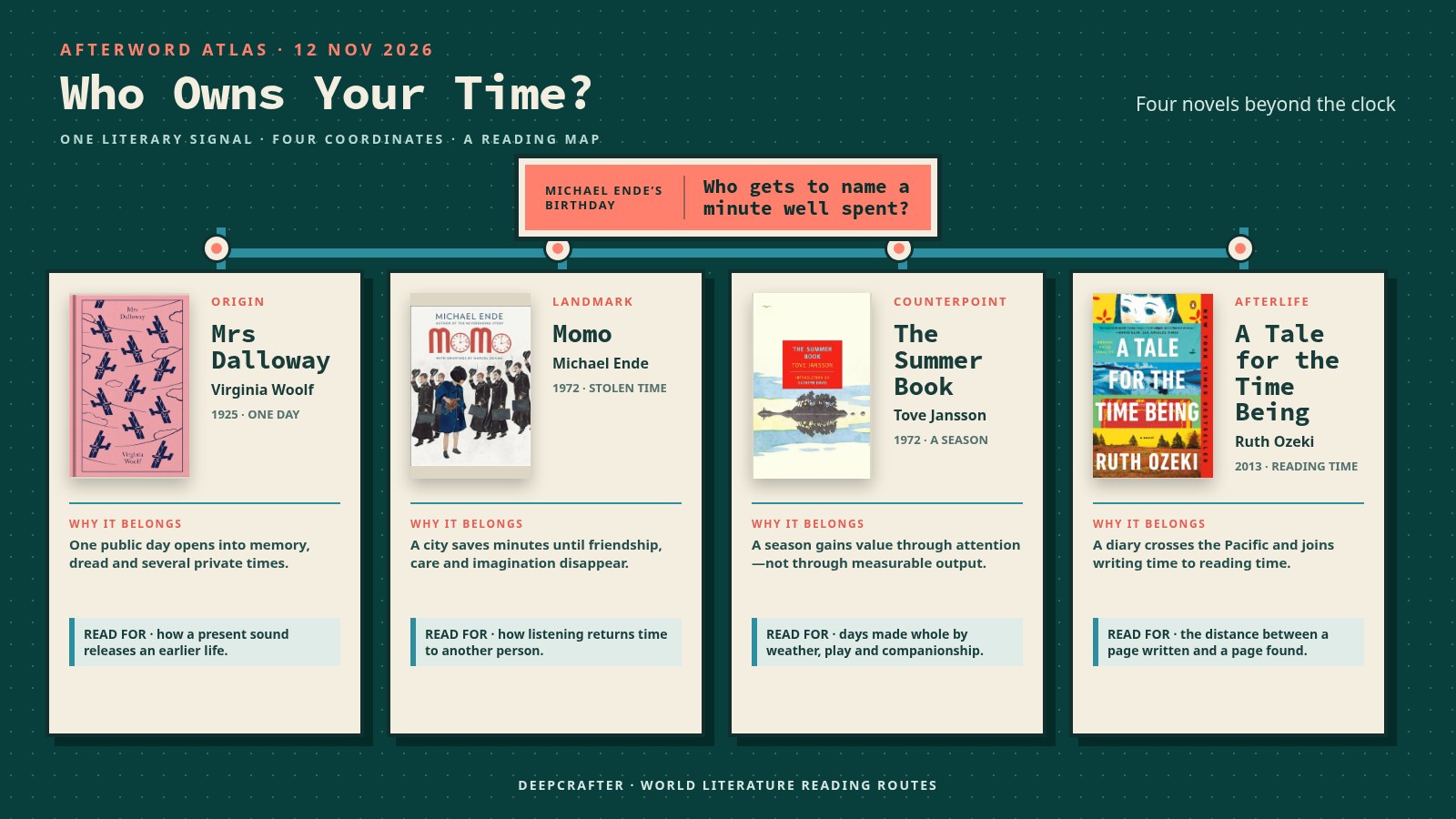
On the 130th anniversary of Higuchi Ichiyō’s death, follow one verified English volume through On the Last Day of the Year, Troubled Waters and Child’s Play.
Where to Start with Higuchi Ichiyō
Three stories, one English gateway
November 23, 2026 marks 130 years since the death of Higuchi Ichiyō. She lived only twenty-four years, but her best fiction still feels unusually close to the pressures of ordinary life: rent, family duty, work, desire, reputation and the shrinking space in which a person is allowed to choose.
For an English-language reader, the difficulty is not deciding whether she matters. Japan’s National Diet Library identifies Ōtsugomori, Nigorie and Takekurabe among her representative works, and places her among the most important women writers of the Meiji period. The practical difficulty is knowing which English titles refer to which Japanese stories—and where to begin once one volume contains nine of them.
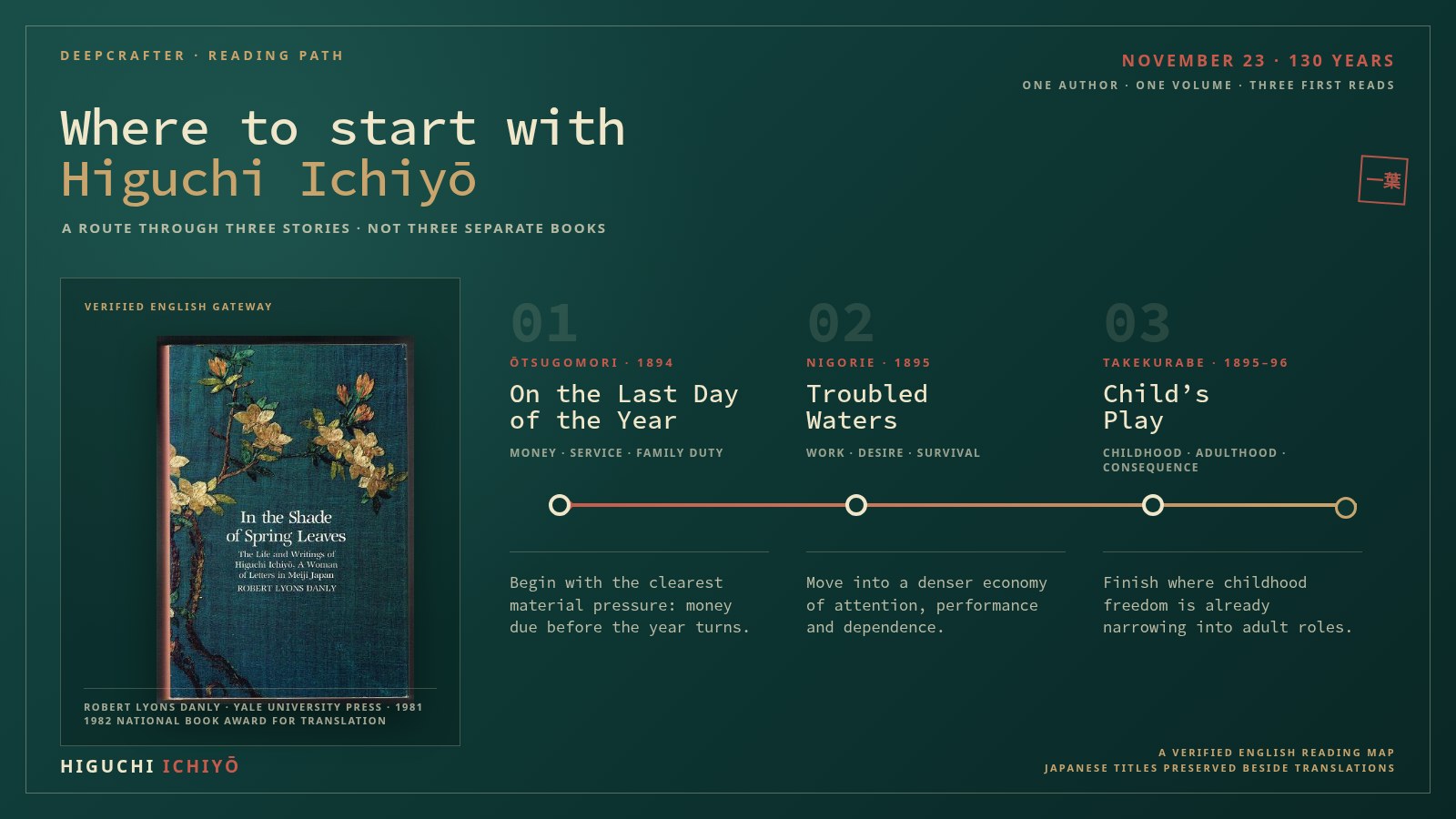
This guide offers a three-story route through Robert Lyons Danly’s In the Shade of Spring Leaves. It does not pretend that the stories are three separate books. One verified English volume is the gateway; the route simply changes what you ask of it at each stop.
The English volume to look for
Robert Lyons Danly’s In the Shade of Spring Leaves: The Life and Writings of Higuchi Ichiyō, a Woman of Letters in Meiji Japan first appeared from Yale University Press in 1981. It combines a critical biography with translations of nine stories. The National Book Foundation records it as the 1982 National Book Award winner for Translation. The award belongs to Danly’s translation work and the volume—not to a prize awarded to Higuchi during her lifetime.
A revised W. W. Norton paperback appeared in 1992 under ISBN 9780393309133. Library records may file the book under Danly because he wrote the biography and translated the stories; booksellers may place Higuchi first. Searching the full title plus either name is safer than searching by author alone.
The selected cover in our map is the Yale edition preserved on the National Book Foundation’s award page. The reading order below uses the story titles found in Danly’s collection.
Access note: the verified records describe print editions and library holdings. We did not find an authorized complete digital edition in the official sources checked for this guide. Availability and borrowing terms vary by library and country.
First stop: On the Last Day of the Year (Ōtsugomori, 1894)
Begin with the most immediately legible pressure: money due before the year turns.
The story follows a household servant whose family needs help. A request, a refusal and money inside an employer’s house create the plot’s tightening moral space. You do not need a long account of Meiji literary history before the stakes become visible. Service, debt and family responsibility are carried by concrete actions.
This is the best first story because its structure is easy to hold while you learn Higuchi’s social world. Read for the distance between what a household can afford and what it is willing to give. Notice how dependence changes the meaning of honesty: a decision made under authority is not the same as a decision made in freedom.
Title check: Danly’s contents use On the Last Day of the Year. The National Diet Library renders Ōtsugomori as The Last Day of the Year. Other English references may use New Year’s Eve. These are title variants for the same 1894 story, not three different works.
Second stop: Troubled Waters (Nigorie, 1895)
Next, move from one household to a larger economy of work, attention and desire.
Nigorie centers on Oriki, a woman working in a licensed pleasure district. Higuchi refuses the comfort of treating her as a symbol with one meaning. Money, performance, attachment and exhaustion exist at the same time, and the people around Oriki interpret her through what they want from her.
Read this second because it asks for a more patient kind of attention. Dialogue and social position carry as much weight as event. Instead of deciding quickly who is sincere, track what each conversation costs. Who can leave? Who can return? Who is allowed to call dependence love?
Title check: Danly translates Nigorie as Troubled Waters. The National Diet Library page uses Muddy Bay; other scholarship may use Muddy Waters. Keep the Japanese title beside the English one when searching catalogues.
Third stop: Child’s Play (Takekurabe, 1895–96)
Finish with the most widely recognized and formally demanding of the three.
Takekurabe follows children growing up near the Yoshiwara district. Their games, rivalries and shifting alliances exist beside adult institutions they only partly understand. The story’s power comes from that unstable threshold: childhood language remains available, but childhood freedom is already narrowing.
Read it last because the ensemble is easier to follow after the first two stories have taught you how Higuchi places social pressure inside ordinary gestures. Do not rush to translate every child into the adult role waiting for them. Watch instead for the moment a familiar action changes meaning—a visit, a quarrel, a piece of clothing, a silence.
Title check: Danly’s revised collection uses Child’s Play. The National Diet Library introduces Takekurabe as Growing Up. Both names circulate in English. Again, they refer to the same work.
The route in one sitting—or three
If you want a compact introduction, read one story per evening:
- On the Last Day of the Year — begin with a clear material need.
- Troubled Waters — deepen the route through work, desire and social performance.
- Child’s Play — arrive at the ensemble world where adulthood is already shaping the children.
If you have only one hour, start with On the Last Day of the Year. If you already know Japanese modern literature and want Higuchi’s most famous work, go directly to Takekurabe, but keep a character list nearby. If your interest is in how fiction writes women’s labor without turning a character into a case study, begin with Nigorie.
The route is not a ranking. It moves from the clearest external pressure to a denser social field, then to an ensemble in which the future is felt before it can be fully named.
What to notice across all three stories
Money is never only background
Money determines who can ask, who must wait, who performs gratitude and who has the power to call a transaction generous. Higuchi makes economic pressure dramatic without pausing the story for a separate lecture.
A place assigns roles before a character speaks
The employer’s house, the pleasure district and the streets near Yoshiwara are not neutral scenery. Each place changes what behavior can be seen, forgiven or punished.
Growing up often appears as a loss of available action
Higuchi’s characters do not always announce that their lives have narrowed. The change may appear in what they stop doing, where they can no longer go or how another person begins to look at them.
These are reading observations, not a claim that every story makes one identical argument. The point of the sequence is to let the differences sharpen one another.
A note on names and romanization
You may see the writer named Higuchi Ichiyō, Ichiyō Higuchi or Higuchi Ichiyo. This guide uses the Japanese order in the title and preserves the macron in Ichiyō when typography allows. Library systems and URLs often omit the macron.
The three Japanese titles are Ōtsugomori (大つごもり), Nigorie (にごりえ) and Takekurabe (たけくらべ). Recording them beside the English titles prevents a common discovery problem: mistaking a new translation title for a new work.
Why read her today
An anniversary can become ceremonial very quickly. The better tribute is to begin reading.
Higuchi’s stories do not require readers to admire a monument from a distance. They ask us to enter rooms where one person needs money from another, streets where work shapes intimacy, and games whose rules are already giving way to adult consequences.
Start with one volume and three stories. Let the changing English titles become a map rather than an obstacle.
Sources and edition notes
- National Diet Library: Higuchi Ichiyō portrait and biography
- National Diet Library record: Yale University Press edition of In the Shade of Spring Leaves
- National Diet Library record: 1992 Norton edition, ISBN 9780393309133
- National Book Foundation: 1982 Translation winner
- National Diet Library: Epoch-making Japanese women authors
- National Diet Library: Higuchi Ichiyō and the world around Takekurabe and Nigorie
Cover note: the map uses the Yale edition cover shown on the National Book Foundation’s award archive. The cover is reproduced editorially to identify the verified edition. It is not redrawn, cropped into a different design or presented as a separate work for each story.