The Work After the Last Argument: Voltaire and the Garden We Must Cultivate
On Voltaire’s traditional birthday, follow the writer from exile and satire to public intervention—and read three books that turn skepticism into practice.
The Work After the Last Argument
Voltaire and the Garden We Must Cultivate
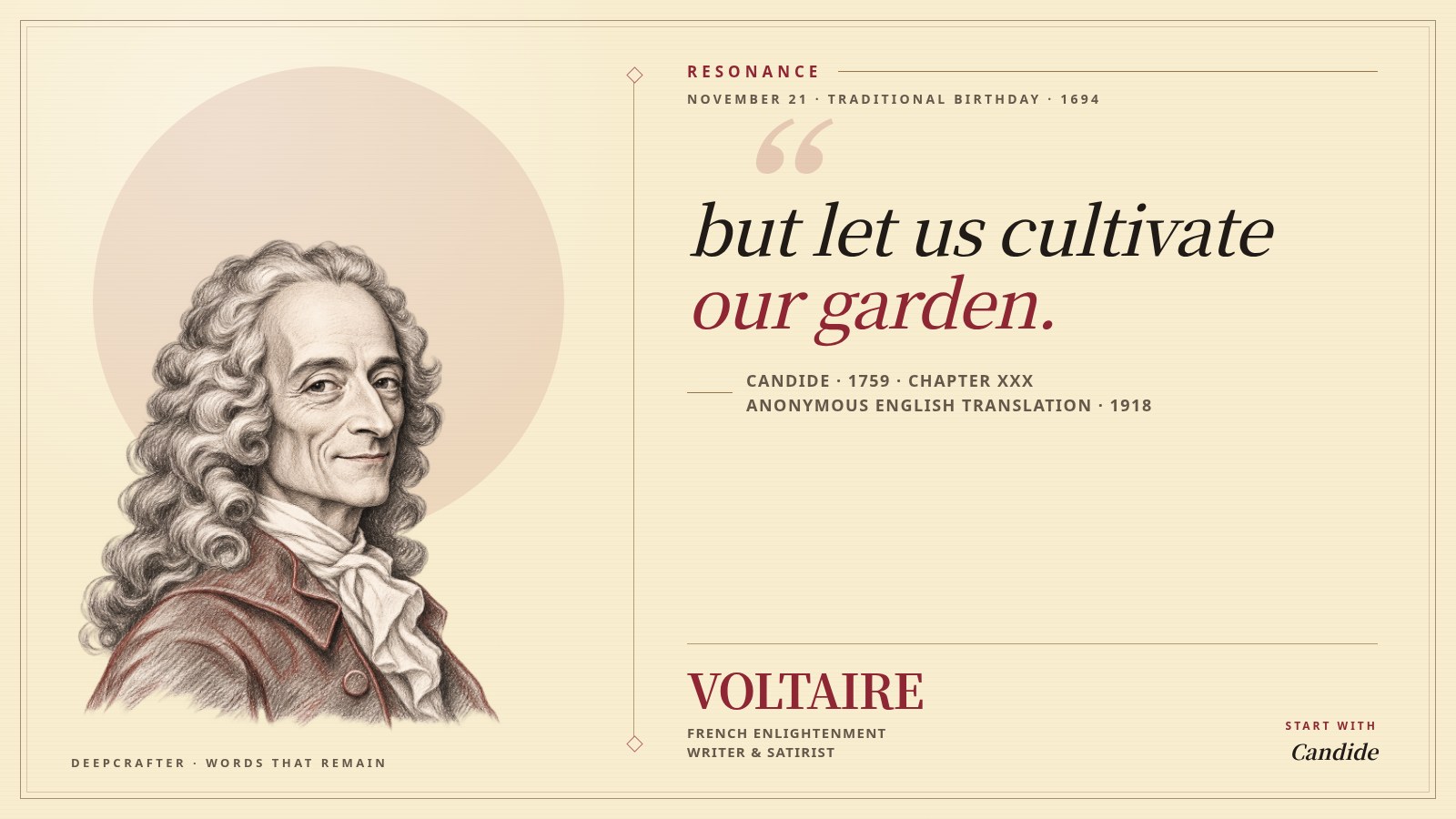
“But let us cultivate our garden.”
The sentence closes Candide, after war, shipwreck, religious violence, earthquake, slavery, riches and ruin have exhausted nearly every grand explanation offered to its characters. It does not promise that the world has become reasonable. It turns instead toward work that can be done: limited, shared, repeated and real.
November 21 is traditionally observed as Voltaire’s birthday. The date requires a note of care. The surviving record and Voltaire’s own later account do not agree perfectly, so the occasion is best treated as a traditional birthday rather than an uncontested fact. That small uncertainty suits a writer who distrusted comfortable certainty and repeatedly asked what evidence could bear.
We return to the garden line because it is often reduced to a slogan of private retreat. In the novel, however, the garden is not solitude. It is a small community in which each person contributes a skill. Cultivation follows an entire book devoted to exposing cruelty, vanity and systems that explain suffering instead of reducing it. The ending does not abandon thought. It asks thought to become practice.
A writer who made himself into Voltaire
Voltaire was born François-Marie Arouet in Paris in 1694, into a prosperous bourgeois family. He studied with the Jesuits at the Collège Louis-le-Grand, where he received a rigorous education in rhetoric, theatre and the classics. His father preferred a legal career. The son preferred literature, conversation and the dangerous pleasure of a sentence that could travel farther than its author.
In 1718, after imprisonment in the Bastille and the success of his tragedy Œdipe, Arouet began publicly using the name Voltaire. The name was more than a signature. Across his career he used scores of pseudonyms and fictional personae. Masks allowed him to shift voices, deny easy ownership and make readers decide which speaker deserved belief.
His early fame came from verse and theatre. The Voltaire Foundation notes that he continued to think of himself as a poet throughout his life, even though modern readers know him chiefly through prose. That tension matters. His prose keeps a dramatist’s sense of entrances and reversals and a poet’s instinct for compression. An argument arrives as a tale, a dialogue, a dictionary entry, a mock prayer or a letter from an invented observer.
This mobility was partly aesthetic and partly necessary. Voltaire’s career unfolded under censorship, patronage and arbitrary power. Books could be condemned; printers and authors could be punished; a quarrel with an aristocrat could become a matter of imprisonment. He learned not simply to state ideas but to design routes by which ideas might survive.
England and the discovery of prose as a public instrument
A dispute with the chevalier de Rohan led to another confinement in the Bastille and then to exile in England in 1726. What began as humiliation became one of the decisive turns in Voltaire’s writing life. He learned English, encountered the political and religious plurality of Britain, read Locke and Newton, and absorbed prose models such as Addison’s Spectator and Swift’s Gulliver’s Travels.
The Voltaire Foundation offers a useful correction to the familiar claim that he arrived in England a poet and left a philosopher: he arrived a poet and left a prose writer. The change was not a rejection of poetry. It was a discovery that prose could compare institutions, popularize difficult ideas and move through a broad reading public.
The result became Letters on England, also known as the Philosophical Letters. Its praise of English religious tolerance, commerce, science and constitutional practice was also an oblique criticism of France. Comparison did the argumentative work. Voltaire did not need to announce at every turn that one society was freer than another; he let the arrangement of examples make the reader complete the judgment.
For writers, that is one of his most durable techniques. An argument can become more active when it is distributed across scenes, voices or neighboring cases. The reader is not merely told what to think. The reader experiences the pressure of contrast.
Thinking in company with Émilie du Châtelet
From the 1730s, Voltaire spent many productive years at Cirey with Émilie du Châtelet, the mathematician, physicist, translator and philosopher whose work on Newton remains central to the history of science in France. Their intellectual partnership resists the simplifying story of a lone genius. They read, argued, experimented, wrote and revised in proximity to one another.
At Cirey, Voltaire worked across science, history, drama, poetry and philosophy. The range was not distraction. He kept changing form to fit the audience and problem. A scientific exposition demanded clarity; a tragedy tested public feeling; a history could challenge inherited accounts of power; a tale could carry philosophical conflict at the speed of adventure.
His working life was extraordinarily prolific. The completed critical edition of his works fills 205 volumes. More than 15,000 letters survive, and scholars estimate that he may have written far more. His notebooks and the marked books in his library preserve another layer of the process: excerpts, marginal notes, underlining and fragments waiting to be used.
The daily lesson is less “write as much as Voltaire” than “give thought more than one container.” A note can become a letter; a letter can test an argument; an argument may find its sharpest form in fiction. Voltaire’s career shows revision not only as changing sentences but as changing genres.
The speed and violence of Candide
Published in 1759, Candide moves with startling speed. Cities fall, fortunes vanish, bodies suffer and doctrines continue explaining why everything must belong to the best possible order. The tale’s velocity is part of its moral design. Catastrophe becomes intolerable precisely because the language of explanation keeps trying to make it neat.
Voltaire’s irony often works through a gap between tone and event. A narrator may describe horror with composure, or a character may repeat an abstract principle while the visible world refutes it. The prose does not add a lecture after every scene. It trusts sequence. One disaster placed after another exposes the inadequacy of the formula meant to contain them.
This is why the last garden is more demanding than it first appears. Pangloss still wants to prove that events form a necessary chain. Candide answers by returning to cultivation. The sentence closes debate without pretending to solve metaphysics. It chooses attention, labor and mutual dependence over the vanity of having the final theory.
A writer can borrow the structure without borrowing the satire. When a character holds a powerful belief, do not refute it only through dialogue. Give the belief consequences. Place it beside the lives it claims to explain. Let the reader measure the distance.
Ferney: writing at the border
After the death of du Châtelet and a difficult period at the court of Frederick the Great, Voltaire eventually established himself at Ferney, near the French-Swiss border. The location gave him room to maneuver. He could remain close to France while retaining a possible route away from its authorities.
Ferney became a working estate, a destination for visitors and a base for a vast correspondence. Voltaire cultivated his public identity as a European writer while remaining intensely engaged with practical affairs. He improved the estate, supported local industry, received guests and continued to publish across genres.
The border was geographical and rhetorical. Voltaire repeatedly wrote from positions that were slightly displaced: a foreign observer, an alphabetical entry, a fictional editor, an ingenuous traveler, a voice whose apparent innocence made convention look strange. Distance allowed him to reveal what familiarity had hidden.
For contemporary writers, the method is immediately useful. If a subject feels sealed by habitual language, move the speaker. Let an outsider describe the ritual. Let an institution explain itself too confidently. Let two vocabularies meet on the same page. Satire begins when ordinary words can no longer conceal the arrangement beneath them.
From wit to intervention
Voltaire’s later career cannot be understood only as brilliant mockery. In the 1760s, he used research, correspondence, pamphlets and public pressure in campaigns against miscarriages of justice. The most famous concerned Jean Calas, a Protestant merchant executed in 1762 after being falsely accused of murdering his son.
Voltaire gathered evidence, challenged contradictions and worked to turn an individual case into a public question. Treatise on Toleration, published in 1763, grew from that campaign. The work joins narrative, polemic, history and appeal. It shows a writer adapting form to urgency: not merely expressing sympathy, but building an audience capable of sustaining attention.
The campaign helped clear Calas’s name. Yet its value for writers is not a legend of the author as solitary rescuer. Voltaire’s effectiveness depended on networks, documents, printers, correspondents and the emerging force of public opinion. Writing acted because it entered a system of circulation.
That distinction keeps the lesson honest. A beautiful sentence is not automatically an intervention. It must reach the right readers, preserve the facts it depends on and make a next action imaginable.
The mask, the fragment and the active reader
Voltaire’s Philosophical Dictionary offered another form for public thought: short articles arranged alphabetically rather than a single continuous system. The fragment let him approach faith, war, miracles, persecution and freedom of thought from changing angles. A reader could enter anywhere.
The apparent simplicity is strategic. Voltaire’s style is fast, lucid and theatrical, but the speaker is not always stable. Footnotes can dispute the text; one voice can expose another; praise can reverse into accusation. The mask keeps the prose lively while placing responsibility on the reader.
Irony therefore demands partnership. If the reader misses the distance between words and meaning, the argument collapses. Voltaire’s clearest prose still asks for attention: Who is speaking? What does the tone conceal? Which fact has been placed where a conclusion was expected?
These questions matter beyond satire. Any narrative with an unreliable speaker, competing documents or a gap between public language and private consequence depends on the same active reading.
Three books, three ways into Voltaire
1. Begin with Candide
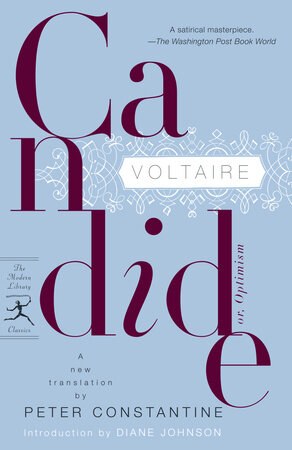
Selected edition: Modern Library paperback, translated by Peter Constantine, August 23, 2005, 208 pages, ISBN 9780812972016.
Begin with the book that makes Voltaire’s speed, comedy and moral impatience immediately visible. Its short chapters turn philosophy into consequence and adventure into an argument about suffering.
Notice: how often the narrator refuses to slow down where another writer might become solemn. Ask what the speed prevents us from romanticizing—and why the final garden changes the rhythm.
2. Continue with Letters on England
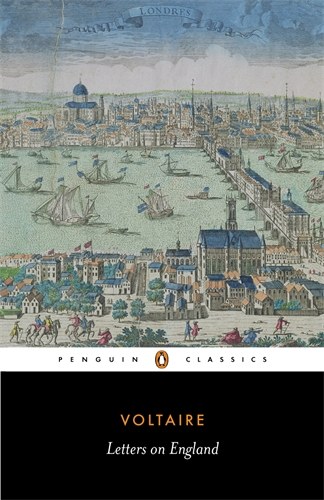
Selected edition: Penguin Classics paperback, translated by Leonard Tancock, April 28, 2005, 176 pages, ISBN 9780140443868.
Continue with the prose born from exile. The letters move through religion, politics, commerce, science and literature, using England as both subject and mirror.
Notice: how comparison replaces direct declaration. Track the moments when apparently neutral description quietly asks a French reader to judge France.
3. End with Treatise on Toleration
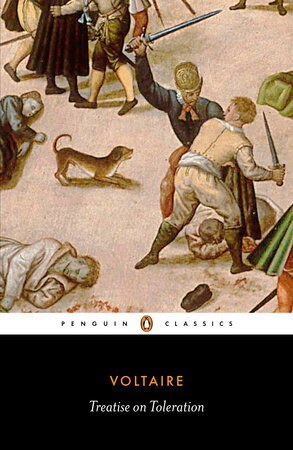
Selected edition: Penguin Classics paperback, translated, introduced and annotated by Desmond M. Clarke, February 28, 2017, 208 pages, ISBN 9780241236628.
End with the public writer at work on a real case. The book connects the injustice done to Jean Calas with a wider argument against fanaticism and for freedom of thought.
Notice: how Voltaire moves between evidence, indignation, history and direct appeal. Ask which changes of register keep a single case from becoming an abstraction.
What writers can carry forward
Let form do part of the thinking. A tale, letter, dictionary entry and legal campaign create different relations with a reader. Before refining an argument, ask whether it has found the right container.
Use contrast instead of explanation. Place a doctrine beside its consequences, or one society beside another. Arrangement can make the reader perform the judgment.
Keep the mask legible. Irony needs distance, but the intended pressure must still be detectable. Give the reader enough tonal or factual friction to recognize that the surface voice is not the final meaning.
Build public writing from evidence. Indignation may begin a piece, but documents, dates, contradictions and witnesses give it force beyond the writer’s feeling.
End with a practice. A conclusion need not solve the world. It can identify the work that remains possible after certainty has failed.
Cultivation after certainty
Voltaire’s traditional birthday is a fitting occasion for rereading a writer who made doubt energetic. He did not treat skepticism as a reason to withdraw from language. He changed forms, multiplied voices, gathered evidence and wrote toward readers who might become a public.
The garden at the end of Candide is modest, but modesty is not passivity. It refuses both the fantasy that one theory can explain every wound and the excuse that nothing can be done. Cultivation is local, unfinished and shared.
For the next page you write, find the largest claim in the scene. Then place one concrete task beside it: a meal to prepare, a letter to verify, a field to tend, a person to help. See which one tells the truth about the world your characters inhabit.
The last word may belong not to the argument, but to the work that begins after it.
Sources
- Voltaire Foundation, University of Oxford: About Voltaire
- Voltaire Foundation: About Voltaire’s Writings
- Voltaire Foundation: Voltaire and Life Writing
- Château de Voltaire: Voltaire, les dates clés
- Académie française: François-Marie Arouet, dit Voltaire
- Stanford Encyclopedia of Philosophy: Voltaire
- Project Gutenberg: Candide, 1918 English edition
- Penguin Random House: Candide
- Penguin Classics: Letters on England
- Penguin Random House: Treatise on Toleration
Image and edition notes
- Website cover: the original illustrated Voltaire Resonance card published by DeepCrafter; it is an editorial illustration, not an archival photograph.
- Candide cover: Modern Library paperback, translated by Peter Constantine, ISBN 9780812972016; cover and edition metadata from Penguin Random House.
- Letters on England cover: Penguin Classics paperback, translated by Leonard Tancock, ISBN 9780140443868; cover and edition metadata from Penguin.
- Treatise on Toleration cover: Penguin Classics paperback, translated by Desmond M. Clarke, ISBN 9780241236628; cover and edition metadata from Penguin Random House.
- The opening sentence follows the anonymous 1918 English translation digitized by Project Gutenberg; the Resonance post identifies the edition and chapter.
Sources
- Voltaire Foundation: About Voltaire
- Voltaire Foundation: About Voltaire’s Writings
- Voltaire Foundation: Voltaire and Life Writing
- Château de Voltaire: Voltaire, les dates clés
- Académie française: Voltaire
- Stanford Encyclopedia of Philosophy: Voltaire
- Project Gutenberg: Candide
- Penguin Random House: Candide
- Penguin Classics: Letters on England
- Penguin Random House: Treatise on Toleration