The Universe Owes Us Nothing: Stephen Crane and the Art of Pressure
On Stephen Crane's birthday, follow one indifferent universe through the Bowery, the battlefield and the open sea—and learn how pressure makes perception visible.
The Universe Owes Us Nothing: Stephen Crane and the Art of Pressure
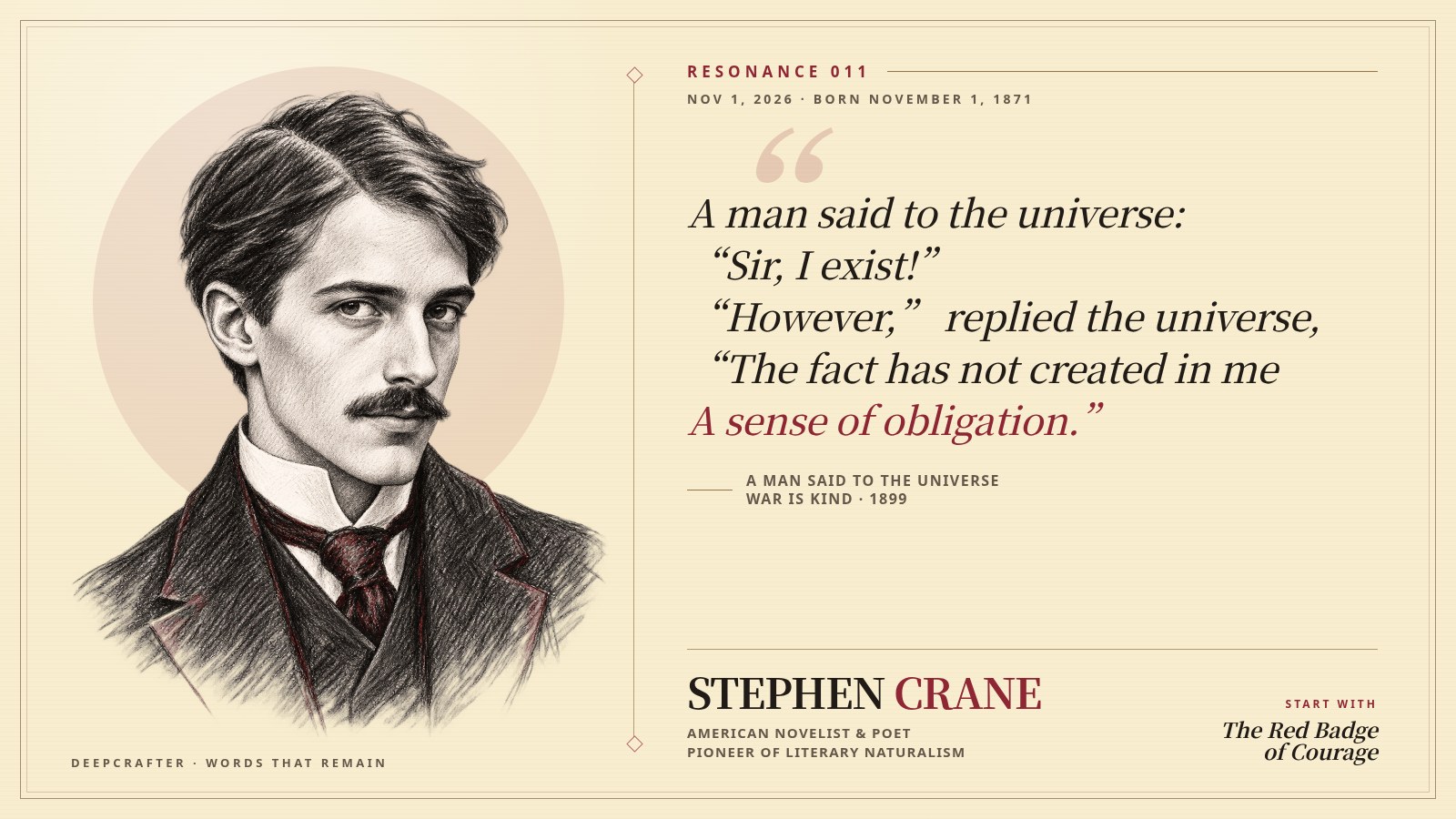
“A man said to the universe: / ‘Sir, I exist!’”
Why we chose Stephen Crane today
Stephen Crane was born on November 1, 1871, in Newark, New Jersey. For his birthday, we chose “A Man Said to the Universe,” a five-line poem from War Is Kind (1899), because it compresses his whole imaginative world into one impossible conversation.
A man announces himself as if existence were a claim. The universe answers, politely but without comfort, that the fact creates no obligation. The exchange is funny because its manners are so formal; it is terrifying because the reply is final.
Crane built fiction from that same collision. His characters want the world to acknowledge their courage, innocence, suffering or dignity. The world answers with smoke, weather, poverty, crowds and accident. Yet the result is not simple despair. Under pressure, people still perceive one another, invent meanings, make mistakes and sometimes act with courage they cannot name in advance.
He died at twenty-eight. By then he had published novels, stories, journalism, war correspondence and two books of radical free verse. His career was brief enough to look like a flare, but the work remains useful because Crane understood a durable narrative question: what happens when a character’s private drama meets a world that does not arrange itself around them?
From a minister’s family to the Bowery
Crane was the youngest of fourteen children in a Methodist family. His father was a minister; his mother wrote on religious and social questions; two older brothers worked in journalism. He tried college, but reporting drew him toward the streets and toward the human behavior that formal study seemed to exclude.
In New York, he lived among artists and observed the Bowery, the Lower East Side district that became the setting of Maggie: A Girl of the Streets. The novella follows a young woman caught within poverty, violence, sexual double standards and public moral judgment. Publishers rejected it, and Crane privately issued it in 1893 under the name Johnston Smith.
The book is often placed at the beginning of American literary naturalism. Its environment is not scenery. Rooms, streets, work, alcohol, money and reputation narrow what a person can imagine and what choices remain available. Crane does not offer the reader a clean position outside the system. His irony exposes a society that condemns Maggie while helping to create the conditions that destroy her.
That method matters for fiction writers. Social pressure becomes convincing when it enters the smallest units of a scene: who has space, who is overheard, who can leave, who has money for the next hour, whose version of events the crowd prefers.
Imagining battle before witnessing it
Crane’s fame arrived with The Red Badge of Courage. The novel was serialized in 1894 and published as a book in 1895. Its young Union soldier, Henry Fleming, enters the Civil War with heroic pictures in his head, runs from battle, then tries to understand what his fear means.
Crane had not yet seen combat. Instead of compensating with a history lesson, he narrowed the field. Battle reaches Henry as noise, color, fragments of command, the movement of bodies and interpretations that change from one instant to the next. The novel’s realism is psychological before it is documentary.
Library of America notes that Crane listened to Civil War veterans while writing the book. That practice appears in the prose: soldiers joke, complain, speculate and repeat rumor. No single voice controls the whole event. The battlefield is experienced through partial knowledge.
This is why the book still feels modern. Crane does not ask whether Henry possesses a permanent essence called courage. He shows fear and courage changing with the situation, the crowd and the story Henry tells himself. Character is revealed under pressure, but it is not simplified by pressure.
The open boat and the indifferent sea
In January 1897, Crane boarded the Commodore, a ship carrying weapons to Cuban rebels. The ship sank off Florida. Crane and three other men spent roughly thirty hours in a small dinghy before reaching shore; one of them, the oiler Billie Higgins, drowned.
Crane first turned the disaster into journalism. He later transformed the experience into “The Open Boat,” one of his most enduring stories. Four men row toward a visible coast while waves repeatedly erase their progress. Their shared labor creates fellowship, but fellowship does not purchase safety from the sea.
The story gives the natural world no villainous intention. That absence is more unsettling than hostility. A hostile universe would at least be paying attention. Crane’s sea, like the universe in the poem, is under no obligation to recognize the human claim.
Yet “The Open Boat” is not only about indifference. It is also about the fragile forms of meaning people make together: taking turns at the oars, reading one another’s exhaustion, joking, remembering a line of verse, and continuing when certainty is unavailable. Crane removes cosmic reassurance without removing human relation.
Reporter, witness, maker of pressure
Crane reported from the American West, Mexico, the Greco-Turkish War and the Spanish-American War. In England, where he lived with Cora Taylor, he became part of a literary circle that included Joseph Conrad, H. G. Wells and Henry James. Debt and tuberculosis shadowed his final years, but he kept producing fiction and journalism until his death in Badenweiler, Germany, on June 5, 1900.
His reporting and fiction continually exchanged methods. Journalism gave him observed gestures, voices, environments and the pressure of deadlines. Fiction gave him a way to represent perception when facts arrive too quickly or too partially to form a stable explanation.
Crane called many newspaper pieces “sketches.” The word suits his art. A sketch does not pretend to settle its subject. It selects an angle, catches movement and leaves some lines open. For writers, this offers an alternative to exhaustive description: choose the few details that reveal how the scene bears down on a consciousness.
How Crane creates immediacy
1. He turns color into action
Red, yellow, blue, black and gray do more than decorate Crane’s scenes. A color can strike the point-of-view character before the object is fully understood. It gives perception the speed of alarm.
2. He externalizes unstable thought
Crane rarely needs a character to explain an emotion in polished language. Fear becomes a misread movement, a sudden comparison, a rumor believed because it is useful. The reader experiences the mind as it improvises.
3. He lets the crowd change reality
In Maggie, public judgment helps determine what a life becomes. In The Red Badge of Courage, the regiment’s motion alters the meaning of individual fear. A Crane scene asks not only what a person wants, but what the surrounding group makes possible to feel or admit.
4. He uses irony without leaving the character behind
The narration can expose vanity or self-deception while remaining close to the person who needs the illusion. That double vision creates compassion without sentimentality.
5. He compresses philosophy into an encounter
The universe poem contains no abstract argument. It stages a conversation. “The Open Boat” does not lecture about indifference; it gives us waves, oars and a shore that appears near enough to promise too much.
The writer working fast—and listening closely
Crane’s working life should not be romanticized. Library of America’s account of his months in the old Art Students League building describes sparse food, unpaid rent and friends worrying about his health. Scarcity damaged him. It was not a secret productivity method.
What can be learned is how he used different forms to train one another. During those New York years, he completed The Red Badge of Courage, began another novel and wrote regularly for newspapers and magazines. In a burst during early 1894, he also drafted most of the brief poems that became The Black Riders and Other Lines.
The forms sharpened different skills. Reporting required attention to voices and physical particulars. Fiction tested how perception changes under stress. The poems stripped a conflict to dialogue, emblem and reversal. Crane’s practice was not simply to write quickly; it was to keep moving the same questions through different-sized containers.
A Crane exercise for fiction writers
Write a 900-word scene in which a character expects the world to confirm a private belief: that they are brave, innocent, loved, chosen or safe.
- Give the character one concrete task that must be completed under time pressure.
- Limit the scene to what the character can see, hear and incorrectly infer.
- Use one color three times, changing its emotional meaning each time.
- Let a group—soldiers, commuters, neighbors, coworkers—alter what the character is willing to admit.
- Include one small act of cooperation that matters even though it does not solve the larger problem.
- End with the world refusing to answer the character’s deepest question directly.
On revision, cut every sentence that names the theme. Keep the objects, gestures, crowd movement and sensory distortions that make the pressure legible.
Where to start reading
For the social pressure: Maggie: A Girl of the Streets
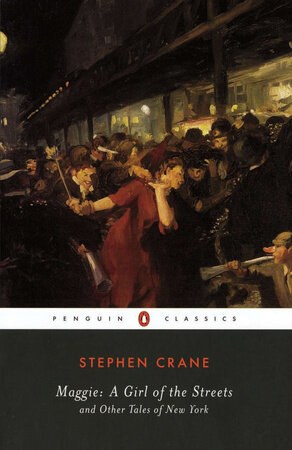
Edition: Penguin Classics paperback, 2000 · 272 pages · ISBN 9780140437973. This volume also includes George’s Mother and eleven New York tales and sketches.
Begin here to see environment functioning as plot. Read the rooms, streets and public judgments as active forces. Notice how irony exposes moral hypocrisy without turning Maggie into a simple symbol.
For the mind under fire: The Red Badge of Courage
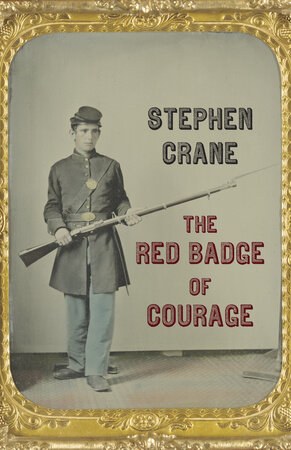
Edition: Vintage Classics paperback, 2014 · 160 pages · ISBN 9780804168847.
Read this next for Crane’s control of limited perception. Track how Henry interprets the same behavior differently as fear, shame and group momentum shift. The novel is not a test of whether he is “really” brave; it is an anatomy of how bravery gets narrated from inside confusion.
For the whole range: Stephen Crane: Prose & Poetry
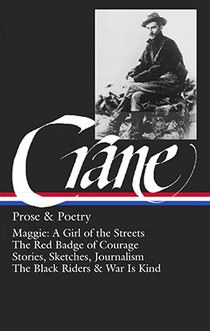
Edition: Library of America No. 18, edited by J. C. Levenson · 1,379 pages · ISBN 9780940450172.
Use this collection to move from the novels into “The Open Boat,” “The Blue Hotel,” “The Bride Comes to Yellow Sky,” the war correspondence, The Black Riders and War Is Kind. The juxtapositions reveal how Crane kept returning to the same pressure system in different forms: the individual claim, the indifferent environment and the brief solidarity created between them.
Why read Crane now?
Much contemporary prose explains its characters before the scene has tested them. Crane does the reverse. He places a person inside smoke, noise, weather, poverty or public judgment, then lets perception reveal itself through error.
That method is especially valuable for writers working with AI-assisted drafts, which can become too fluent about motive and too certain about meaning. Crane reminds us that consciousness is not a clean summary. It is a sequence of guesses made under pressure.
The universe in his poem does not validate the speaker. The sea does not reward effort. The battlefield does not arrange itself into a moral diagram. Still, Crane’s characters keep speaking, rowing, running, watching and sometimes helping one another.
The world owes them nothing. The writing begins with what they do next.
Sources and edition notes
- Poetry Foundation: “A Man Said to the Universe”
- Poetry Foundation: Stephen Crane biography
- Library of America: Stephen Crane author page
- Library of America: “Stories Told by an Artist”
- Library of America: “Stephen Crane’s Own Story” and the Commodore shipwreck
- Penguin Random House: Maggie: A Girl of the Streets, Penguin Classics
- Penguin Random House: The Red Badge of Courage, Vintage Classics
- Library of America: Stephen Crane: Prose & Poetry
The quoted poem was first collected in War Is Kind (1899) and is in the public domain. The website cover is DeepCrafter’s original illustrated Resonance card, not an archival photograph. The three book-cover images identify the specific editions discussed.
Sources
- Poetry Foundation: A Man Said to the Universe
- Poetry Foundation: Stephen Crane
- Library of America: Stephen Crane
- Library of America: Stories Told by an Artist
- Library of America: Stephen Crane's Own Story
- Penguin Random House: Maggie: A Girl of the Streets
- Penguin Random House: The Red Badge of Courage
- Library of America: Stephen Crane: Prose & Poetry