The Stone We Cannot Forget: Carlos Drummond de Andrade and the Art of Interruption
On Carlos Drummond de Andrade’s birthday, follow the unforgettable stone through Brazilian modernism, public history and three essential books.
The Stone We Cannot Forget: Carlos Drummond de Andrade and the Art of Interruption
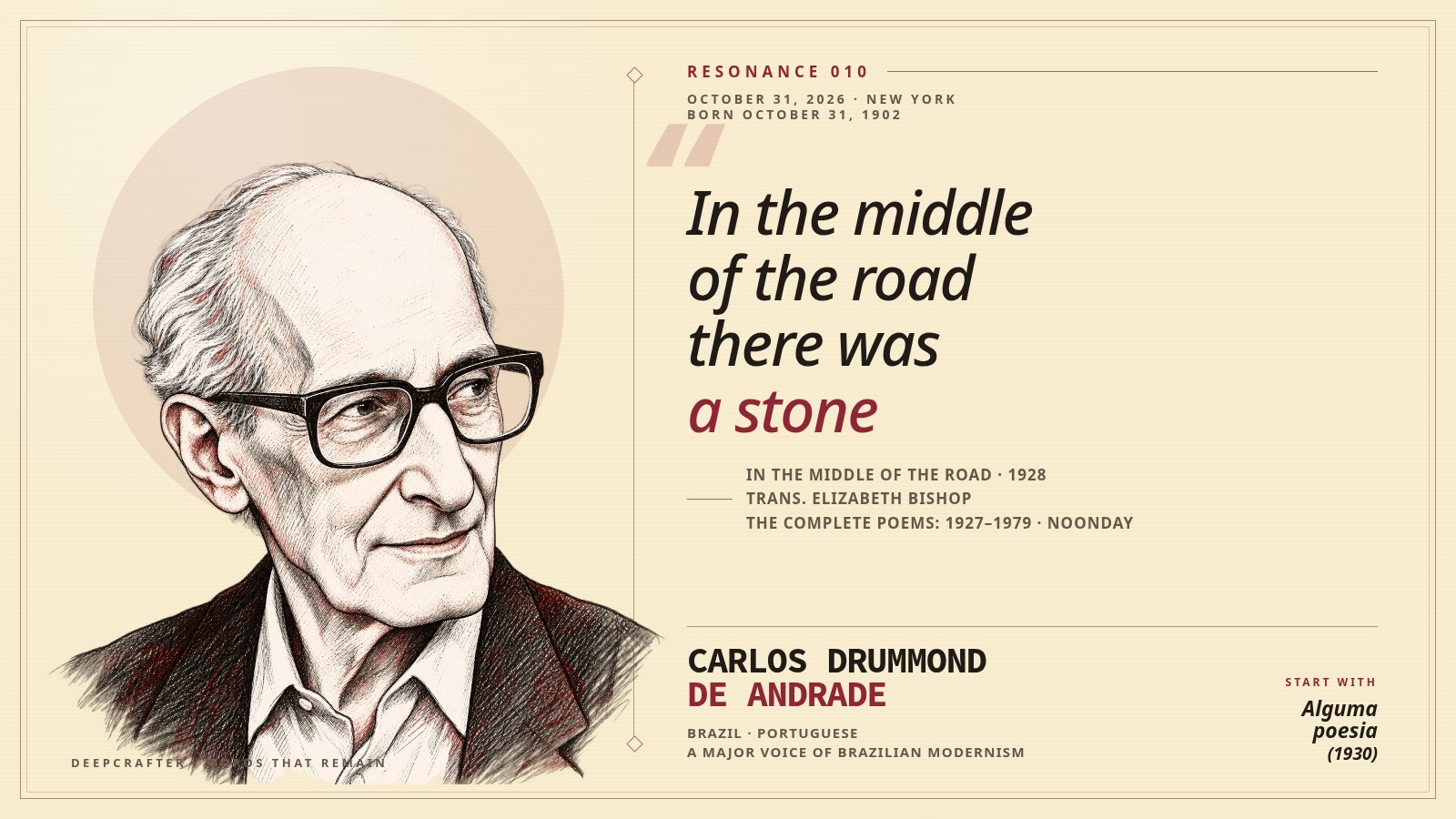
“In the middle of the road there was a stone”
Why we chose Carlos Drummond de Andrade today
Carlos Drummond de Andrade was born on October 31, 1902, in Itabira, a mining town in the Brazilian state of Minas Gerais. For his birthday, we chose the opening of “No meio do caminho” (“In the Middle of the Road”) in Elizabeth Bishop’s translation because it shows how little a poem needs in order to alter the pressure of an ordinary day.
There is a road. There is a stone. The sentence returns until the obstruction becomes impossible to forget.
The line is often borrowed as shorthand for any difficulty that can be overcome. Drummond’s poem is stranger than that reassuring interpretation. It does not tell us how to move the stone, walk around it or turn it into a lesson. It records the encounter so insistently that the obstacle becomes part of memory itself. Repetition does not solve the event; it makes the event permanent.
That stubborn little poem offers a useful entrance to Drummond’s larger work. He could be comic without becoming slight, intimate without retreating from history, and formally controlled without losing the awkwardness of a living voice. Again and again, he took what seemed too ordinary for poetry—a street, a family photograph, an office, a newspaper, a body out of place—and made it carry the weight of a century.
From Itabira to Brazilian modernism
Drummond grew up in a landowning family in Itabira. The town’s mountains, houses and iron landscape would continue to appear in his writing long after he left. He studied pharmacy in Belo Horizonte and completed his degree in 1925, but never practiced the profession. In the same year, he helped found A Revista, a short-lived journal that connected writers in Minas Gerais with the energies of Brazilian modernism.
Brazil’s modernists had already challenged inherited literary decorum through colloquial language, formal experiment and a new attention to national life. Drummond joined that transformation from a position slightly to the side. One of his most durable figures is the gauche: the awkward person who arrives out of step with the world. The stance is not merely autobiographical. It becomes a way of seeing. A speaker who does not fit can notice the rules by which everyone else appears to fit.
“No meio do caminho” was published in 1928 in the Revista de Antropofagia. Its repetitions and apparently trivial subject provoked ridicule and controversy. The poem refused the conventional expectation that lyric poetry should elevate its subject, vary its language or arrive at a noble conclusion. Drummond instead made obstruction into structure. The stone is not only what the poem describes; it is what the poem makes the reader encounter again and again.
Two years later, the poem appeared in his first collection, Alguma poesia (1930). The book established a voice at once playful, self-conscious and alert to the incongruity of modern life.
A public life written from the side
Drummond was not a poet separated from offices, deadlines and public institutions. He worked for much of his life as a civil servant. After moving to Rio de Janeiro in 1934, he served in the Ministry of Education and later worked in Brazil’s historical and artistic heritage service, retiring in 1962.
This professional life placed him close to the machinery of the state without making his poetry sound official. The desk, the document and the divided loyalties of public life became part of the tension from which he wrote. During the 1930s and 1940s, as authoritarian rule, war and ideological conflict reshaped Brazil and the world, his poetry widened from the isolated self toward the city, the crowd and historical responsibility.
That widening reaches a peak in A rosa do povo (The People’s Rose, 1945). The collection looks outward—to Rio, the Second World War, political division, labor, fear and collective suffering—while remaining suspicious of easy declarations. Drummond does not solve the problem of how a private lyric voice can address public catastrophe. He lets the problem enter the poems.
The result is political poetry with self-doubt still intact. The speaker wants to participate, yet knows that language can become inadequate, theatrical or vain. That hesitation is not a retreat from history. It is part of the ethical pressure of trying to speak inside it.
The ordinary as a field of pressure
Drummond’s subjects are often familiar enough to seem almost invisible: a pocket, a photograph, a building, a newspaper, a family name. His craft begins by refusing to treat familiarity as emptiness.
Four qualities give his ordinary objects unusual force:
1. Repetition changes the scale
When an image returns, it stops behaving like background. Each recurrence alters its emotional weight. A writer can use repetition not to emphasize a fixed meaning, but to show meaning accumulating.
2. Irony protects complexity
Drummond’s humor frequently turns toward the speaker himself. The poem can expose vanity, embarrassment or sentimentality before those feelings harden into a grand pose. Irony does not cancel emotion; it keeps emotion from becoming too certain of its own importance.
3. Awkwardness becomes a point of view
The person who stands at an angle to the room sees its arrangement. Drummond’s gauche perspective turns social discomfort into formal intelligence: sudden shifts of scale, plain speech beside abstraction, bathos beside genuine grief.
4. The object resists interpretation
The stone is memorable because the poem never reduces it to one approved symbol. It may suggest accident, impediment, trauma, absurdity or the fact that memory itself repeats. The poem remains alive because the object is more durable than any single explanation.
For fiction writers, this is a powerful discipline. Do not decide too early what a recurring object means. Let characters meet it differently. Let time alter it. Let the reader feel its pressure before anyone explains it.
From public urgency to Claro enigma
Drummond’s career resists the idea that a writer finds one authentic voice and keeps it forever. In Claro enigma (1951), he turned toward a more classical diction, sonnets, philosophical meditation and difficult conversations with Dante and Camões. The change can look like a withdrawal from the explicit public urgency of A rosa do povo, but the later book is not empty of experience. History remains present as fatigue, time, loss and disillusionment.
The shift matters because it shows a writer refusing to become the permanent representative of his own most celebrated phase. Drummond allowed his forms to register changing doubts. The colloquial modernist, the public poet and the metaphysical poet are not separate careers. They are different instruments for different pressures.
This capacity for reinvention continued across poetry, short prose, children’s writing and translation. He also became one of Brazil’s most persistent newspaper chroniclers. From 1954 until 1984, he wrote columns for Rio newspapers, for long stretches appearing three times a week. The crônica—a brief form poised between essay, story, observation and conversation—suited his attention to small encounters and passing details.
The writer at breakfast
The newspaper schedule offers the clearest picture of Drummond’s working practice. For roughly three decades, his prose accompanied readers at breakfast. A poet associated with difficult questions also practiced a form governed by recurrence, proximity and limited space.
He did not need to wait for a monumental subject. The city supplied a walk, an overheard phrase, a bureaucratic absurdity, an animal, a household object or a change in weather. The discipline was to notice what daily repetition had taught everyone else to ignore.
This is the practical connection between the columns and “No meio do caminho.” Both begin with encounter rather than thesis. Something interrupts the expected route. The writer stays with it long enough for the ordinary to become strange.
Drummond’s example suggests a sustainable practice for writers: alternate between the long work that demands architecture and the short form that keeps perception awake. A small, regular piece need not be a lesser work. It can be the instrument that prevents the world from becoming scenery.
A Drummond exercise for writers
Write a 700-word scene around one ordinary obstruction: a jammed drawer, a missing key, a stalled elevator, a stone in a shoe.
- Introduce the object without explaining what it symbolizes.
- Return to it three times, changing the surrounding action each time.
- Let one recurrence be comic and one genuinely painful.
- Give the point-of-view character a social reason to pretend the obstruction does not matter.
- End without removing it.
On revision, delete every sentence that tells the reader the object’s meaning. Keep only the physical details, decisions and changes in attention that allow meanings to gather around it.
Where to start reading
For the stone and the early modernist voice: Alguma poesia
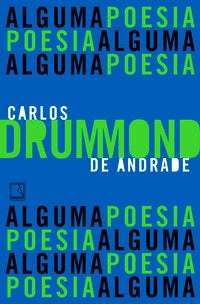
Edition: Record paperback, 2022 · 128 pages · ISBN 9786555874617. Portuguese text.
Drummond’s 1930 debut is the essential first stop because it contains “No meio do caminho” alongside poems such as “Poema de sete faces” and “Quadrilha.” Read for the quick changes of register: mock-heroic language falling into conversation, private embarrassment opening onto a city, a joke revealing loneliness. The book shows how a poet can make a distinct voice out of being out of place.
For poetry inside history: A rosa do povo
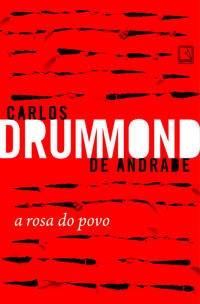
Edition: Record paperback, 2022 · 238 pages · ISBN 9786555875232. Portuguese text.
Published in 1945, this is Drummond at his widest public range. Its fifty-five poems move through war, urban life, political division, love, death and the problem of writing while history is happening. Read it after the debut to see the awkward individual voice becoming answerable to a crowd without pretending that poetry can speak for everyone.
For the difficult later turn: Claro enigma
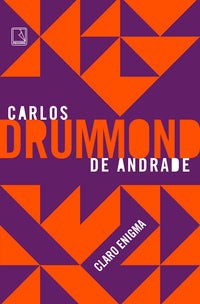
Edition: Record paperback, 2022 · 160 pages · ISBN 9786555874648. Portuguese text.
First published in 1951, Claro enigma returns to sonnets, classical echoes and a more compressed philosophical music. It includes “A máquina do mundo,” Drummond’s encounter with the dream of total knowledge. Read it last to feel how radically a mature writer can change his instruments while continuing to examine time, memory, love and human limitation.
For readers seeking an English entry point: Multitudinous Heart: Selected Poems, translated by Richard Zenith (Farrar, Straus and Giroux, 2015), is a substantial bilingual selection spanning Drummond’s career. The Elizabeth Bishop translation quoted in today’s Resonance card comes from a different translation history; comparing versions can reveal how repetition, plainness and rhythm survive—or change—across English renderings.
Why read Drummond now?
Contemporary writing is often encouraged to remove friction: begin faster, clarify sooner, turn every image into a message. Drummond reminds us that friction may be the work.
The obstacle can organize the poem. Awkwardness can become a perspective. A short newspaper form can train the attention required by a long career. A writer can move from comedy to public grief to metaphysical doubt without forcing those modes into a single brand.
Most of all, Drummond shows that noticing is not passive. To notice the stone is to let the expected route lose its innocence. The road is no longer merely a road after the interruption, and the observer is no longer the person who approached it.
The poem does not promise that every stone can be moved. It makes a more exact claim through its form: some encounters remain, and writing can give their persistence a shape.
Sources and edition notes
- Academy of American Poets: Carlos Drummond de Andrade biography
- Carlos Drummond de Andrade chronology
- Brazilian Chronicle Portal: Drummond’s newspaper career
- Brazilian National Library: Drummond overview
- University of São Paulo, Institute of Brazilian Studies: archive and biography
- Record: Alguma poesia, 2022 edition
- Record: A rosa do povo, 2022 edition
- Record: Claro enigma, 2022 edition
- Macmillan: Multitudinous Heart, bilingual English edition
- The Writer’s Almanac: Elizabeth Bishop translation of “In the Middle of the Road”
The opening is a brief excerpt from Elizabeth Bishop’s translation of “No meio do caminho,” used with attribution for literary commentary. The website cover is DeepCrafter’s original illustrated Resonance card, not an archival photograph. The three book-cover images identify the specific Record editions discussed.