Faithful to Uncertain Clarity: Zbigniew Herbert and the Discipline of Doubt
On Zbigniew Herbert’s birthday, follow Mr. Cogito, the discipline of doubt and three essential paths into his poetry and essays.
Faithful to Uncertain Clarity: Zbigniew Herbert and the Discipline of Doubt
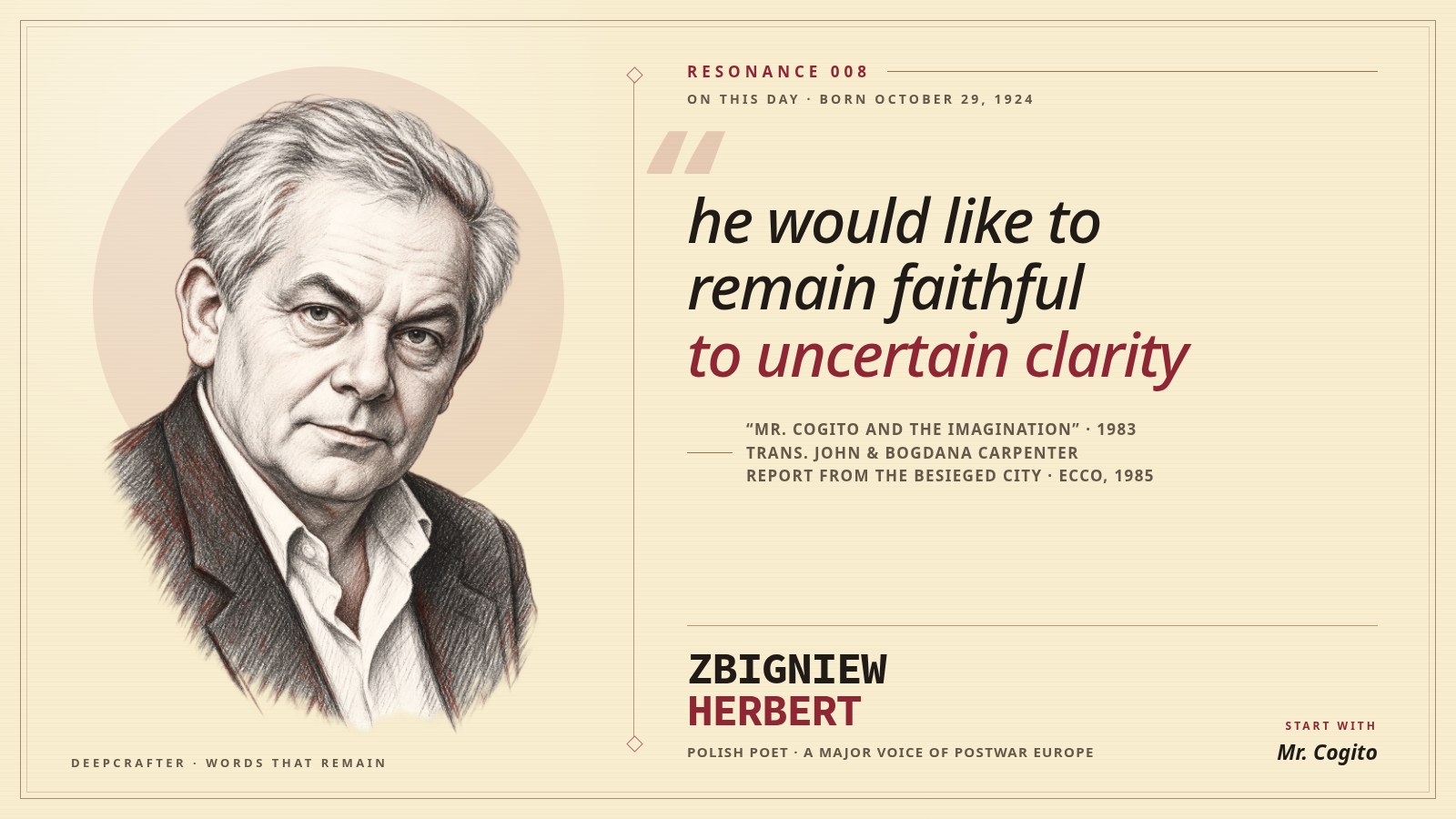
“he would like to remain faithful / to uncertain clarity”
Why we chose Zbigniew Herbert today
Zbigniew Herbert was born on October 29, 1924, in Lwów, then a Polish city and now Lviv in Ukraine. We chose the final movement of “Mr. Cogito and the Imagination” because it refuses an easy bargain. The poem does not ask imagination to produce dazzling effects or absolute certainty. It asks imagination to become an instrument of compassion—and then to remain loyal even when clarity is incomplete.
That tension runs through Herbert’s work. He distrusted slogans, including noble ones. He wrote after Nazi occupation, Stalinism and the remaking of Poland’s borders, yet his poems rarely turn history into a speech. They approach it through a pebble, a chair, a myth, a painting, a joke or the ordinary, fallible figure of Mr. Cogito. The ethical demand remains severe; the voice that makes it is measured, ironic and alert to its own limits.
“Uncertain clarity” is therefore more than a paradox. It names a writing practice: look steadily, resist verbal inflation, admit what cannot be proved, and do not use uncertainty as an excuse to abandon judgment.
A childhood inside historical rupture
Herbert’s early life was shaped by the violent changes of twentieth-century Europe. He grew up in Lwów and continued his education in clandestine classes during the occupations of the Second World War. In 1944, before the Soviet army entered the city again, the Herbert family left for Kraków. The city of his childhood would lie beyond Poland’s postwar border.
He studied widely: economics, law, philosophy and, for a time, art. The combination matters. Economics trained attention on systems and exchange; law on argument and responsibility; philosophy on first principles; drawing on proportion, line and the stubborn presence of objects. Herbert’s mature writing repeatedly moves among these modes without letting any one of them dominate.
The National Library of Poland’s biography records a string of practical jobs during the difficult postwar years. He worked in banking, journalism and cultural organizations, among other occupations. The experience kept him close to the language of institutions while giving him reasons to distrust their official descriptions of themselves.
The refusal that delayed a debut
Herbert wrote early, but his first poetry collection, Struna światła (Chord of Light), did not appear until the political thaw of 1956. During the Stalinist period, publication required forms of ideological conformity he would not accept. Czesław Miłosz later described the choice plainly: Herbert would not pay for publication by renouncing his own taste.
This refusal should not be romanticized into silence without cost. Herbert lived precariously and watched writers who accommodated the system receive material security. But the delay clarified a principle that remained central to his work: language loses moral force when it speaks more confidently than experience allows.
The poems that followed were not manifestos in disguise. Herbert preferred the pressure of example. Instead of declaring that power corrupts language, he might let an interrogator borrow the vocabulary of angels. Instead of praising the classics as a safe inheritance, he would return to Thucydides and ask what responsibility sounds like after defeat.
Mr. Cogito: a conscience with ordinary shoes
Herbert’s best-known persona, Mr. Cogito, takes his name from Descartes but is no disembodied reasoning machine. He reads newspapers, remembers his parents, worries, fails, contradicts himself and walks through the world slightly off balance. That ordinariness is the source of his authority.
Mr. Cogito allows Herbert to divide the speaking voice. Sometimes the persona thinks in the first person; sometimes another voice observes him from outside. The gap creates irony without dissolving responsibility. Readers are not asked to admire a flawless hero. They are asked to watch an imperfect person attempt a viable ethics.
In “Mr. Cogito and the Imagination,” the persona distrusts decorative flights, but he does not reject imagination. He wants to use it to move from one suffering to another, to revive the dead and maintain a covenant with experience. The poem’s ending matters because certainty would be too clean. Compassion must operate before knowledge is complete.
For fiction writers, Mr. Cogito offers a durable lesson: a character can carry moral seriousness without becoming a mouthpiece. Give the character habits, vanities, fears and blind spots. Let the ethical question emerge from what the character can actually do—not from a perfect answer delivered above the scene.
Myth as a lens, not an escape
Herbert’s poetry is crowded with Greek heroes, Roman history, biblical figures and European art. Yet he does not use the past to escape the present. Myth changes the scale of contemporary experience. It reduces the glare of immediate propaganda while exposing recurring structures of pride, cowardice, responsibility and loss.
Achilles, Apollo or an ancient general enters the poem with inherited prestige, then encounters an awkward modern intelligence. The result can be comic. Herbert’s humor is not a retreat from seriousness; it is one of the ways he prevents seriousness from hardening into dogma.
This double movement—toward the classical past and back toward the compromised present—also shapes his essays. Herbert traveled through France, Italy, Greece, the Netherlands and elsewhere, visiting museums, studying architecture, making notes and drawing. A painting was never only an occasion for aesthetic appreciation. It was a material object with patrons, pigments, labor, money, historical violence and a surviving surface.
The plain line and the pressure beneath it
Herbert’s English-language reputation often rests on descriptions such as “direct,” “ironic” and “minimalist.” All are useful, but none means simple.
1. Concrete nouns before abstractions
Objects in Herbert’s poems retain their weight. Stones, chairs, walls and utensils do not disappear into symbols at once. Their resistance keeps the poem honest. An abstraction has to earn its place beside the physical world.
2. A level voice under extreme pressure
He often writes about political terror, war and betrayal without rhetorical shouting. The restraint is not emotional absence. It is a refusal to let the poem imitate the grandiosity of the systems it opposes.
3. Irony without moral neutrality
Herbert questions certainty, but he does not pretend every position is equal. Irony tests the speaker’s confidence; it does not erase the difference between cruelty and courage.
4. Personae that create distance
Mr. Cogito and other invented speakers let Herbert examine judgment from more than one angle. A persona can say something the poet needs to test rather than simply endorse.
5. History carried by small forms
A short poem can hold a civilization because Herbert chooses details that imply systems. A gesture, an official phrase or a museum object becomes the point where private perception meets public history.
Notebooks, drawings and revision
Herbert’s surviving archive complicates the myth of effortless austerity. The National Library of Poland preserves manuscripts, typescripts, notebooks, sketchbooks, correspondence and working materials. Different handwritten versions of the same poems show compression as a result of revision, not the absence of it.
His drawings belong to the same practice of attention. While traveling, he looked, sketched and gathered material. Drawing slows perception: it makes the eye follow an edge, notice proportion and distinguish what is present from what memory wants to add. Herbert’s essays on art repeatedly demonstrate this patient movement from visible evidence toward interpretation.
Three habits emerge from the archive and the work:
- keep the object in view while thinking about what it means;
- draft beyond the final length, then remove language that announces the conclusion too early;
- use a persona or historical lens to test a judgment before claiming it as truth.
Herbert once described writing as a way to make people sober—to keep them awake. Sobriety here does not mean emotional flatness. It means refusing intoxication by one’s own language.
A Herbert exercise for writers
Write a 500-word scene in which a character must make a moral decision with incomplete information.
- Place one ordinary object at the center of the scene.
- Give the character a principle they sincerely believe.
- Introduce one fact that makes the principle difficult to apply.
- Let the character make a limited, practical choice rather than a speech.
- End by describing the object again, altered only by what the reader now knows.
On revision, remove every sentence that tells the reader the character is brave, compromised or afraid. Keep the evidence. The goal is not vagueness; it is clarity that remembers its limits.
Where to start reading
For the original Carpenter translation: Report from the Besieged City and Other Poems
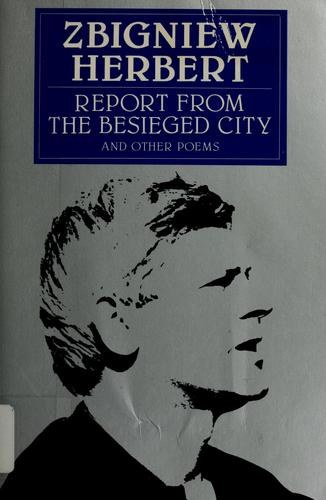
Edition: Ecco paperback, 1986 · translated by John Carpenter and Bogdana Carpenter · ISBN 9780880010948.
Start here to encounter the translation behind today’s quotation and the late Cold War poems that made Herbert’s civic imagination especially visible in English. Notice how the besieged city is both historical and portable: a place under pressure, and a model for the mind resisting occupation by false language.
For the full arc: The Collected Poems 1956–1998
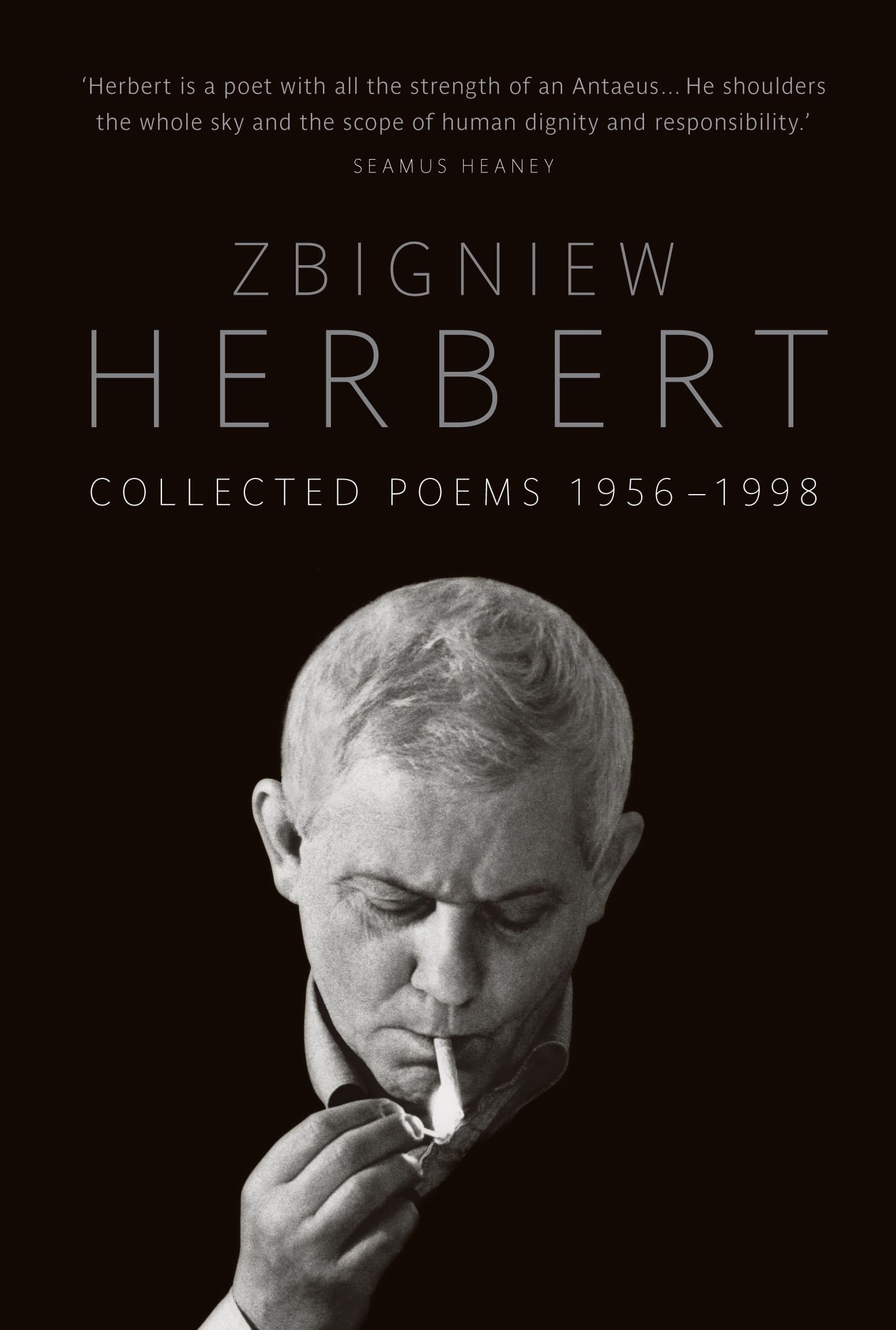
Edition: Atlantic Books paperback, 2009 · translated and edited by Alissa Valles, with additional translations by Czesław Miłosz and Peter Dale Scott · introduction by Adam Zagajewski · ISBN 9781843548836.
Read across the decades rather than only following the famous poems. The collection reveals how Herbert returns to objects, classical figures and moral vocabulary while changing the pressure placed upon them. It also makes translation visible: familiar poems may sound different from the Carpenter versions, and that difference is part of reading poetry across languages.
For the essayist and visual thinker: Still Life with a Bridle
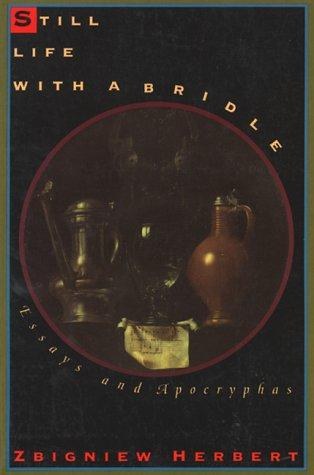
Edition: Ecco Press paperback, 1993 · translated by John Carpenter and Bogdana Carpenter · ISBN 9780880013208.
This is the best entry to Herbert’s way of looking at art. The essays move through Dutch painting, commerce, archives and invention, combining travel writing with historical inquiry. Read them beside the poems to see that his clarity begins not with pronouncement but with sustained attention.
Why read Herbert now?
We live amid systems that reward immediate certainty. Public language arrives already sorted into sides; images are consumed before they are examined; moral positions are often judged by confidence of delivery. Herbert offers a harder discipline.
He does not ask writers to stop judging. He asks them to separate judgment from self-dramatization, to test inherited language against objects and consequences, and to keep doubt from becoming passivity. His restraint is active. It protects the small space in which a person can still notice, compare and choose.
To remain faithful to uncertain clarity is to accept that the work of attention never ends. The writer looks again—not because nothing can be known, but because truth deserves better than haste.
Sources and edition notes
- National Library of Poland: Zbigniew Herbert biography
- National Library of Poland: the Zbigniew Herbert archive
- Poetry Foundation: Zbigniew Herbert biography and critical overview
- The Manhattan Review: John and Bogdana Carpenter’s interview with Herbert
- Atlantic Books: The Collected Poems 1956–1998 edition
- Open Library: Report from the Besieged City Ecco edition
- Open Library: Still Life with a Bridle Ecco edition
The opening is a brief excerpt from “Mr. Cogito and the Imagination,” translated by John and Bogdana Carpenter, used with attribution for literary commentary. The website cover is DeepCrafter’s illustrated Resonance card, not an archival photograph. Book-cover images identify the specific editions discussed.