Nothing Without Reflection: Sor Juana and the Mind That Kept Studying
On Mexico’s National Book Day, follow Sor Juana’s life of attention, Baroque craft, intellectual resistance and a three-book reading path.
Nothing Without Reflection
Sor Juana Inés de la Cruz and the Mind That Kept Studying
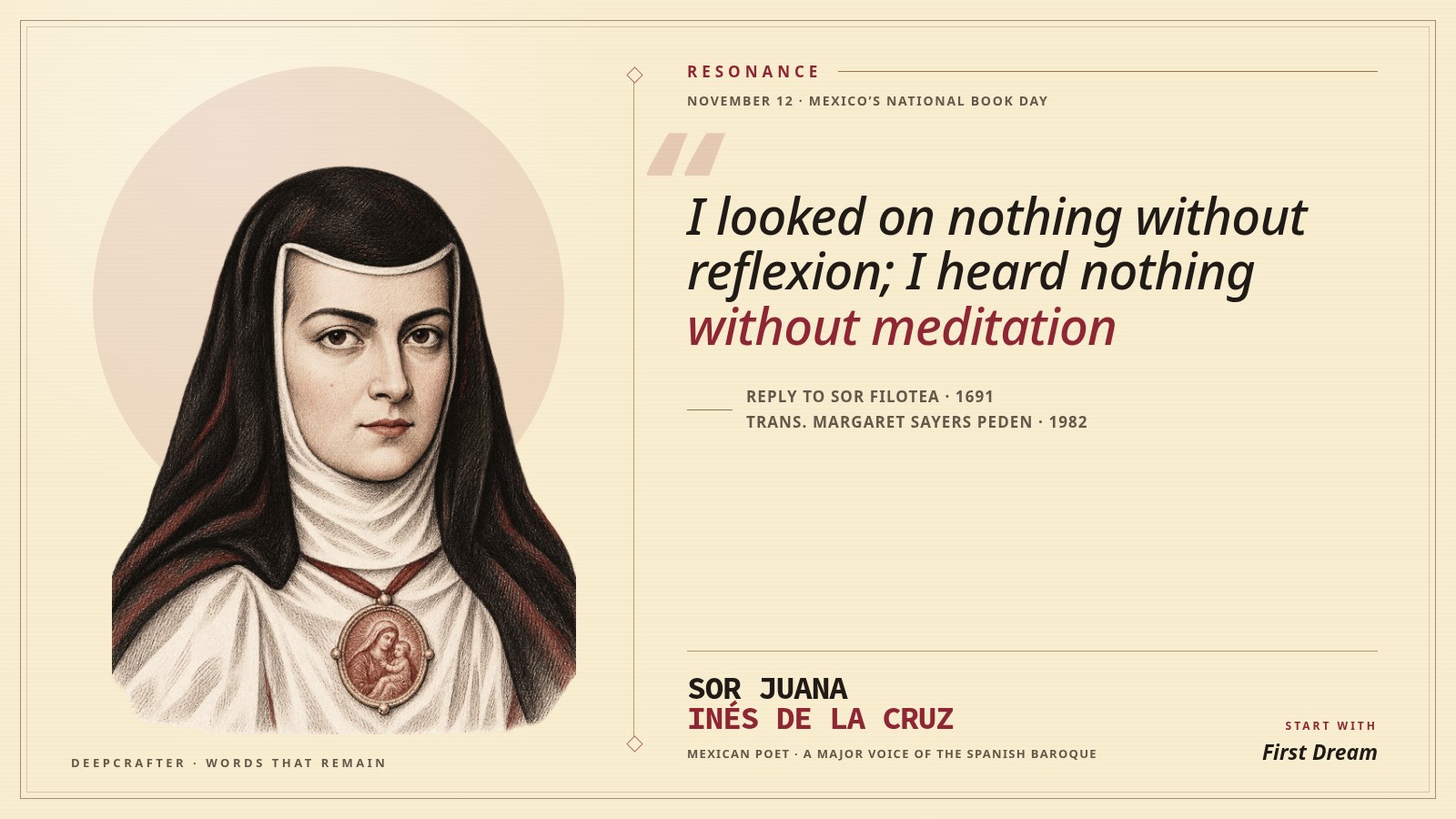
“I looked on nothing without reflexion; I heard nothing without meditation.”
Sor Juana Inés de la Cruz wrote this in the Reply to Sor Filotea of 1691, in the passage where she describes what happened when an abbess ordered her to stop studying books. Margaret Sayers Peden’s 1982 translation preserves the older spelling “reflexion.” The line is not a decorative maxim about mindfulness. It names an intellectual habit that continued when formal study was interrupted: the world itself became material for inquiry.
That is why the line belongs to November 12. Mexico’s National Book Day was established on the date traditionally associated with Sor Juana’s birth. The year remains disputed—1648 and 1651 both appear in institutional accounts—so the occasion is more secure than a single birth-year claim. A day devoted to books becomes, through Sor Juana, a day devoted to the appetite that makes books necessary.
Her work asks a lasting question: what happens when a mind trained to notice is told not to know?
A childhood organized by curiosity
Sor Juana was born in San Miguel Nepantla in colonial New Spain and grew up partly on her maternal grandfather’s estate. In the autobiographical account embedded in the Reply, she describes learning to read as a very young child, seeking Latin instruction and longing for access to the university from which her sex excluded her.
The details have often been turned into a prodigy legend. Their greater value lies in the pattern they reveal. Learning was not one accomplishment among others; it was the structure through which she met the world. The Biblioteca Nacional de España places her among the major writers of the Spanish Baroque and stresses both the variety of her work and the need to read her life within the seventeenth-century viceregal world.
As a young woman, Juana entered the court of the viceroy, where her learning and verbal skill attracted attention. Court life gave her patrons, audiences and an education in ceremony. It also trained the social intelligence visible in her poems: praise can carry wit, decorum can contain rivalry, and an apparently conventional form can become a place of intricate thought.
Choosing a room for the life of the mind
Sor Juana briefly entered the Discalced Carmelites before joining the more permissive Hieronymite convent of Santa Paula in 1669. She later explained her religious choice partly through her desire to avoid marriage and preserve freedom for study. The convent was not freedom in any modern, uncomplicated sense, but it gave her a room, time, books and an intellectual network that would otherwise have been difficult for a woman to possess.
Within that life she served as archivist and accountant, taught, corresponded and assembled a substantial library along with musical and scientific instruments. UNAM’s account emphasizes that her passion extended beyond poetry to knowledge itself.
This matters to writers because her practice was never separated neatly from administration, community and obligation. She did not wait for a pure literary life. She composed within a life crowded by commissions, convent work, correspondence and institutional limits.
The useful lesson is not to romanticize those limits. It is to recognize that an intellectual practice can be distributed across the day. Reading, accounting, conversation, music and observation may all feed the same central attention.
A Baroque art of pressure and reversal
Sor Juana wrote lyric poetry, philosophical poetry, drama, devotional works, courtly pieces and prose argument. Her Baroque style delights in antithesis, paradox, learned reference and turns of logic. Feeling is not opposed to thought; thought is one of feeling’s most intense forms.
In the famous redondilla beginning “Hombres necios que acusáis,” the argument proceeds through reversal. Men accuse women of the conduct that male desire and social power produce. Each turn exposes a contradiction in the previous judgment. The poem’s force comes not from stating an abstract principle once, but from making hypocrisy repeat itself until its logic can no longer hide.
The same habit appears throughout her work. A portrait can become an argument about appearance and mortality. Love can divide the speaker between incompatible truths. Praise can become a display of the mind performing the very authority it has been denied.
For a writer, Sor Juana offers a practical question: where is the pressure inside the form? A sonnet, a letter or a comedy is not merely a container. Its expectations create resistance. Her intelligence becomes visible in the way she bends a received structure without pretending it does not exist.
First Dream: knowledge reaches its limit
Sor Juana singled out the long poem now known as First Dream as the work she wrote for her own pleasure. It follows the soul’s nocturnal attempt to apprehend the order of the universe. The movement is vast: darkness, sleep, anatomy, astronomy, philosophy and the ambition to know gather into a single ascent.
Yet the poem does not end by granting mastery. The mind encounters the scale and complexity of what it seeks. Dawn returns the body to waking. The failure is not a defeat of inquiry; it is the form inquiry takes when the object is larger than the knower.
This is one reason the poem remains modern. It does not choose between wonder and precision. Images carry concepts, and concepts alter the emotional weather of the images. The poem’s difficulty is part of its subject: consciousness testing how much it can hold.
Writers can borrow the structural principle without imitating the surface. Let a character’s attempt to understand something produce the sequence of the scene. Each new perception should enlarge the question rather than merely supply information. The destination may be a more exact limit, not a solved mystery.
The Reply and the right to intellectual life
The circumstances of the Reply to Sor Filotea are essential. In 1690, the bishop of Puebla published Sor Juana’s critique of a famous sermon as the Carta Atenagórica. Under the name “Sor Filotea,” he accompanied it with a letter that praised her intelligence while urging her away from secular and theological study.
Sor Juana’s response is deferential in form and formidable in movement. She narrates her history of learning, marshals examples of learned women, distinguishes the desire to study from the presumption to teach and shows how domestic experience itself can become knowledge. The Biblioteca Virtual Miguel de Cervantes provides the Spanish text within her collected prose.
The opening quotation comes from this self-portrait of an attention that could not be switched off. When books were forbidden, she considered the relations among physical things. Cooking could raise questions of transformation; children’s games could reveal proportion and motion. The kitchen did not replace the library. It exposed the false boundary between authorized learning and the intelligence already at work in ordinary life.
Read this carefully rather than converting Sor Juana into a contemporary slogan. Her argument is shaped by Catholic learning, humility formulas, colonial society and a dangerous hierarchy. Its courage lies partly in how it uses the permitted language of obedience to preserve a record of intellectual authority.
Writing as attention under interruption
Sor Juana’s account of practice is not a modern routine of fixed morning hours. It is a story of continuity under interruption. She describes studying whenever possible, setting demanding tasks for herself and finding intellectual material even when access to books was denied.
Some of her self-discipline was severe: she recalls cutting her hair when she failed to learn quickly enough. That detail belongs to her life; it is not advice worth repeating. The durable method is elsewhere—in the transfer of attention from one setting to another.
A writer can adapt that method through a small observation ledger:
- Record one physical process you saw today without turning it into metaphor.
- Write the question the process raised.
- Connect it to a pressure already present in your story.
- Draft one paragraph in which the character notices the process because of that pressure.
- Remove any sentence that explains the symbolism from outside the character’s attention.
The aim is not to make every object profound. It is to practice the passage from noticing to questioning, and from questioning to form.
Patronage, publication and a public voice
Sor Juana’s writing life depended on relationships as well as solitary study. Viceregal patrons supported her, and her work circulated in New Spain and Spain. Her first major collection, Inundación castálida, appeared in Madrid in 1689. Poems written for ceremonies, religious occasions and powerful figures belonged to systems of patronage; they also gave her occasions to display astonishing technical range.
This complicates the familiar image of the isolated genius. Sor Juana was secluded and public, constrained and celebrated. She wrote from a convent cell into court, church and print culture. Her voice survived because it could move through networks that were never neutral.
For writers, the lesson is relational. A body of work needs conditions of circulation: readers, editors, protectors, correspondents and forms suited to reaching them. Independence does not mean pretending those relations do not exist. It means understanding what each relation makes possible and what it asks in return.
The silence at the end
In the years after the Reply, Sor Juana withdrew from literary life, surrendered books and possessions and renewed her religious vows. The exact combination of spiritual decision, institutional pressure and political change remains debated. The BNE biography appropriately notes the competing interpretations rather than turning the final silence into a simple verdict.
She died in 1695 during an epidemic after caring for other nuns. The end of her writing should not be used to make a tidy martyr story, nor to erase the pressure surrounding her. What remains certain is the scale of the work that preceded the silence and the clarity with which the Reply recorded a woman’s intellectual life from inside the structures that constrained it.
Three books, three ways into Sor Juana
1. Begin with The Answer / La Respuesta
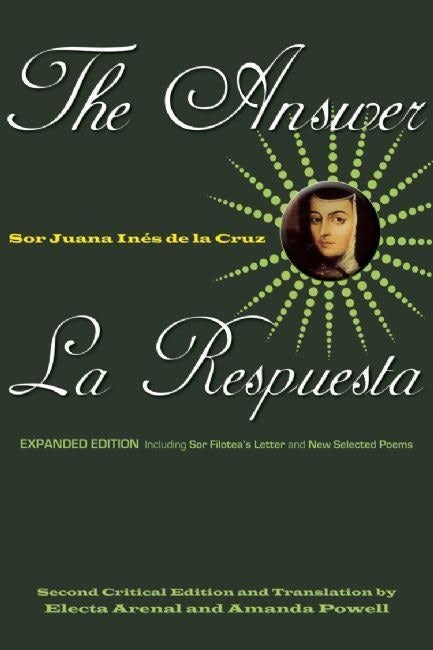
Selected edition: Feminist Press expanded bilingual edition, translated and edited by Electa Arenal and Amanda Powell, paperback, June 1, 2009, ISBN 9781558615984.
Start with the autobiographical argument. Read the Spanish and English side by side if you can, and notice how courtesy, humility and resistance occupy the same sentence.
Notice: every place where Sor Juana converts a restriction into evidence of the mind’s persistence.
2. Continue with Poems, Protest, and a Dream
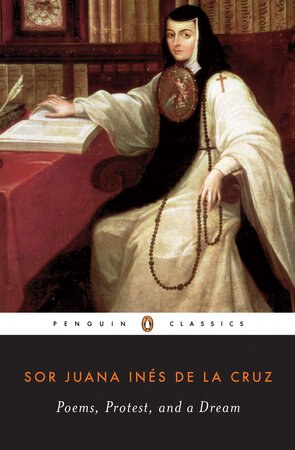
Selected edition: Penguin Classics bilingual edition, translated by Margaret Sayers Peden with an introduction by Ilan Stavans, paperback, March 1, 1997, 304 pages, ISBN 9780140447033.
Move from the prose self-portrait into the range of the poetry: love lyrics, sacred poems, satire and First Dream. This is also the closest current reading route to the translation used on the Resonance card.
Notice: how an argument changes when it is carried by rhyme, paradox and image rather than exposition.
3. End with Sor Juana Inés de la Cruz: Selected Works
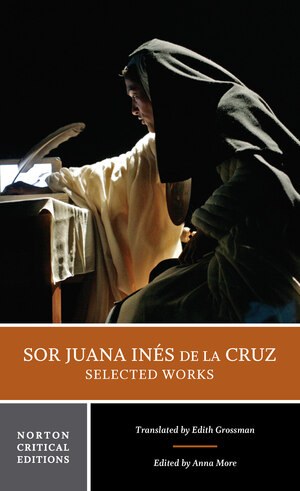
Selected edition: Norton Critical Edition, edited by Anna More and translated by Edith Grossman, first edition, May 7, 2016, paperback, ISBN 9780393920161.
End with a broader critical frame. The selection places major works beside contextual materials and essays, making it useful once you have heard Sor Juana’s voice directly.
Notice: where different editors, translators and critics disagree about the meaning of obedience, authorship and silence.
What to carry into your own writing
Sor Juana’s example is not simply “be curious.” Curiosity becomes literary when it develops a method: observe closely, test relations, let form exert pressure and keep the limits of knowledge visible.
When access is interrupted, change the object of attention without abandoning the practice. When a received form feels restrictive, locate the argument already hidden in its rules. When a character thinks, let thought alter image, rhythm and choice rather than appearing as a detachable speech.
“I looked on nothing without reflexion” names a mind refusing vacancy. Nothing is merely background when attention has learned how to ask.
Sources
- Mexico’s National Human Rights Commission: November 12, National Book Day and Sor Juana
- Biblioteca Nacional de España: Sor Juana Inés de la Cruz
- Biblioteca Virtual Miguel de Cervantes: complete prose, including Respuesta a Sor Filotea
- UNAM Global: Sor Juana, books and the passion for knowledge
- Penguin Classics: Poems, Protest, and a Dream
- Feminist Press: The Answer / La Respuesta
- W. W. Norton: Sor Juana Inés de la Cruz: Selected Works
Image and edition notes
- Website cover: the original illustrated Sor Juana Resonance card published by DeepCrafter; it is visibly illustrative, not an archival photograph.
- The Answer / La Respuesta cover: Feminist Press, expanded bilingual edition, ISBN 9781558615984.
- Poems, Protest, and a Dream cover: Penguin Classics, bilingual edition, ISBN 9780140447033.
- Selected Works cover: W. W. Norton, Norton Critical Edition, ISBN 9780393920161.
- The opening is a brief excerpt from Margaret Sayers Peden’s 1982 English translation for literary commentary; the original Spanish is in the public domain.
Sources
- CNDH: November 12, National Book Day and Sor Juana
- Biblioteca Nacional de España: Sor Juana Inés de la Cruz
- Biblioteca Virtual Miguel de Cervantes: complete prose
- UNAM Global: Sor Juana, books and knowledge
- Penguin Classics: Poems, Protest, and a Dream
- Feminist Press: The Answer / La Respuesta
- W. W. Norton: Selected Works