The Freedom That Begins in Play: Friedrich Schiller and the Whole Human Being
On Friedrich Schiller’s birthday, follow how rebellion, historical drama and aesthetic play became one lifelong inquiry into human freedom.
The Freedom That Begins in Play: Friedrich Schiller and the Whole Human Being
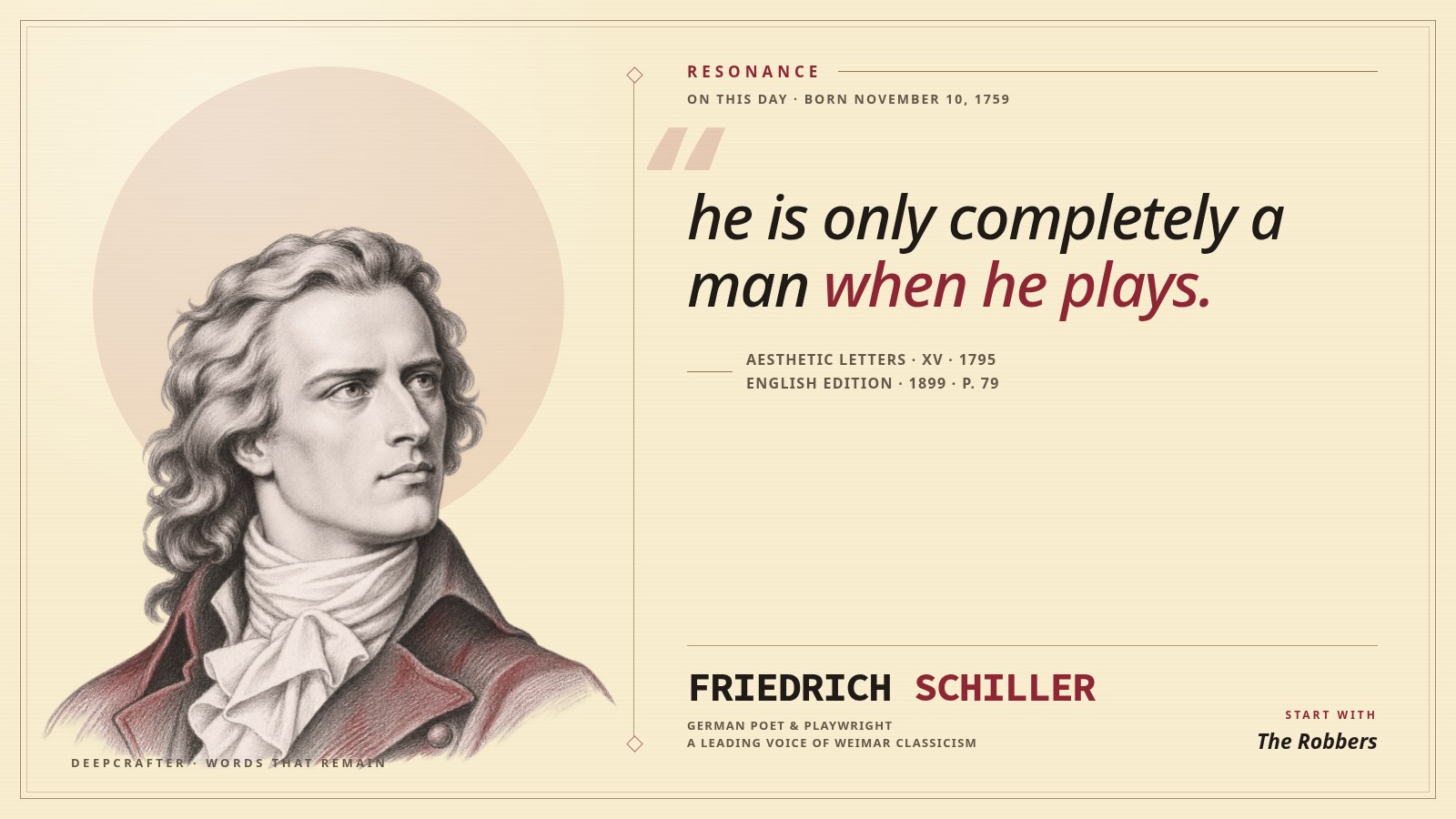
“he is only completely a man when he plays.”
Why we chose Schiller today
Friedrich Schiller was born on November 10, 1759, in Marbach am Neckar. On his birthday, we return to the closing clause of Letter XV in On the Aesthetic Education of Man because it sounds simple and becomes stranger the longer one stays with it.
Schiller does not mean that recreation is the highest human activity, or that seriousness should be escaped. His “play” names a condition in which sensation and reason, impulse and form, freedom and necessity can act together without one crushing the other. The person who plays is not less serious. For a moment, that person is less divided.
That idea grew out of a life spent crossing boundaries: medicine and poetry, rebellion and discipline, philosophy and theatre, private illness and public institutions. Schiller’s plays are full of people who demand freedom and discover that freedom without form can become another kind of compulsion. His criticism asks whether art can give us practice in being whole.
A doctor who wrote against compulsion
Schiller entered Karl Eugen, Duke of Württemberg’s military academy, where he was trained under a strict regime and eventually qualified as a physician. He became an army doctor in 1780, but the drama he was writing in secret was already pulling him elsewhere.
The Robbers was performed in Mannheim in January 1782. Its rivalry between the brothers Karl and Franz Moor turns political anger into family catastrophe. Karl rejects a corrupt order, but the band of outlaws he leads does not remain an instrument of pure liberation. Violence develops its own logic.
The success of the play did not make Schiller free. The Duke punished him for leaving his post to attend a performance and forbade further dramatic work. Schiller fled Württemberg later that year. The biography can look like a clean victory of art over authority, yet the plays resist that simplification. Escape is necessary; what comes after escape remains morally difficult.
This is the first shape of Schiller’s lifelong question: how can freedom become more than refusal?
From rebellion to historical tragedy
Schiller’s early theatre moves with the pressure of youth. Characters speak as though language itself might break the walls around them. But he increasingly turned to history, where motives are constrained by institutions, alliances, inherited roles and consequences no individual can fully control.
In Don Carlos, the desire for political and personal freedom unfolds inside the Spanish court of Philip II. In Wallenstein, the general at the centre of the Thirty Years’ War is powerful enough to imagine another course, but not powerful enough to step outside the forces he has helped create. In Mary Stuart, two queens become mirrors of sovereignty, conscience and performance, even though their great confrontation is Schiller’s invention rather than a historical meeting.
Historical drama gave Schiller a larger instrument. He could place ideals in motion and watch what institutions did to them. The stage became a test: not “Which belief is correct?” but “What does this belief become when a person must act?”
For writers, that is one of his most durable lessons. Ideas become dramatic when they acquire timing, bodies, witnesses and costs.
When revolution made the problem harder
Schiller initially welcomed the emancipatory promise associated with the French Revolution. The Terror made the relation between political freedom and human formation far more troubling. If coercive institutions were removed, why did freedom not reliably follow?
His answer was not to abandon politics for beauty. It was to ask what kind of person could sustain freedom without reproducing domination. Between 1791 and 1796, while illness interrupted his public career, Schiller wrote a concentrated body of philosophical work on tragedy, grace, dignity, beauty and aesthetic education.
The Aesthetic Letters were published in 1795. They argue that modern life fragments human capacities. Specialization develops isolated powers while weakening the person who should hold them together. Abstract reason can become coercive; sensation can become aimless appetite. Political change therefore cannot be separated from the cultivation of perception and feeling.
Art matters because it can suspend the demand to choose too quickly between these halves.
What Schiller means by play
Schiller describes a “sense drive” that binds us to time, change and embodied experience, and a “form drive” that seeks permanence, order and necessity. Neither is the enemy. The problem begins when one rules alone.
The “play drive” brings them into relation. Its object is what Schiller calls “living form”: something sensuous without being merely accidental, formed without becoming lifeless. Beauty can place us in that balanced condition. We remain capable of feeling and capable of form, but are temporarily dominated by neither.
That is why the birthday line is stronger than a slogan about leisure. Schiller’s play is disciplined freedom. It is the capacity to enter possibility without immediately turning possibility into command, appetite or use.
Writers know this state. A draft needs enough impulse to surprise its author and enough form to become legible to another person. Too much control and the work cannot discover. Too little and discovery cannot be carried. The art lives in the movement between them.
The theatre as a laboratory of freedom
Schiller’s philosophy did not replace his drama. It clarified what the theatre had been doing all along.
A stage asks actors to submit to form—meter, blocking, cues, character, duration—while making live choices inside it. An audience knows that an event is made and still responds as though something consequential is happening now. Theatre is both rule and play, distance and feeling.
Schiller returned to dramatic writing with Wallenstein, then produced Mary Stuart, The Maid of Orleans, The Bride of Messina and William Tell in an extraordinarily concentrated late period. These plays do not offer freedom as a possession. They show it being attempted under pressure.
The mature work also trusts structure more deeply. Large historical conflicts are organized through entrances, delays, divided loyalties and scenes in which a public role collides with private need. The characters’ ideals matter, but drama reveals the conditions under which those ideals deform or endure.
Goethe, correspondence and a working friendship
Schiller’s friendship with Johann Wolfgang von Goethe became one of the central collaborations of Weimar Classicism. Beginning in 1794, their exchange developed through frequent letters, shared editorial projects, arguments about nature and form, and close attention to each other’s unfinished work. The surviving correspondence runs to more than a thousand letters.
This partnership matters because it corrects the image of the solitary genius delivering completed works from isolation. Schiller’s practice included invitation, response, disagreement and institutional work. He edited journals, taught history at Jena, researched historical subjects and helped shape theatrical culture with Goethe.
Their temperaments were not identical. That difference was productive. Each became a reader capable of challenging the other’s habits without dissolving the other’s project.
For a writer, collaboration does not require co-authorship. It can mean finding the person who recognizes the form the work is trying to become—and can say where impulse has outrun form, or form has silenced life.
Five lessons for writers from Schiller
1. Put freedom under pressure
A character’s claim to freedom becomes dramatic only when it collides with loyalty, consequence, history or another person’s freedom.
2. Give an idea a body
Do not let a principle remain a speech. Make it determine who enters, who waits, who risks disgrace and who must act before certainty arrives.
3. Let form and impulse correct each other
Draft with enough freedom to discover. Revise with enough structure to share the discovery. Neither stage should impersonate the other.
4. Use history as pressure, not decoration
Historical setting matters when institutions and inherited roles alter what a character can imagine, say and do.
5. Build a serious practice of play
Play is not the absence of standards. It is a protected space in which alternatives can be tried before utility closes them down.
A practical exercise: the play drive scene
Write a scene in which a character faces one rigid rule and one urgent desire.
- Give the rule a legitimate purpose.
- Give the desire a physical expression.
- Let the character imagine three actions that the current order forbids.
- Choose one action that transforms the rule without simply destroying it.
- Make another person pay or benefit from that transformation.
- End with a new possibility, not a complete solution.
On revision, mark every sentence as impulse, form or play. If the scene contains only impulse, add consequence. If it contains only form, add surprise. If “play” appears, ask whether it opens a real choice.
A three-book reading path
1. Begin with The Robbers and Wallenstein
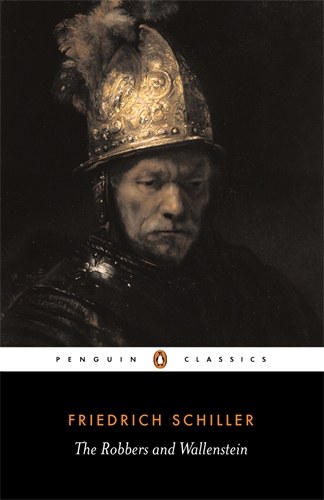
Selected edition: Penguin Classics, translated by F. J. Lamport, 2006 · ISBN 9780140443684.
This volume places Schiller’s first play beside the work Penguin describes as his dramatic masterpiece. The pairing makes a career visible: youthful rebellion in The Robbers; mature historical pressure in Wallenstein.
Read for: how the meaning of freedom changes when a writer moves from brothers and outlaws to armies, courts and a war no single will can master.
2. Continue with Mary Stuart
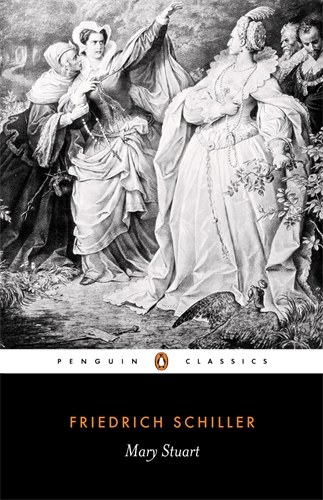
Selected edition: Penguin Classics, translated with an introduction and notes by F. J. Lamport, 1998 · ISBN 9780140447118.
Schiller invents a meeting between Mary, Queen of Scots, and Elizabeth I, using historical impossibility to reveal dramatic truth. Each queen must perform sovereignty before witnesses while confronting the private cost of public power.
Read for: the difference between historical accuracy and dramatic responsibility. An invented scene must illuminate the forces history records, not merely decorate them.
3. End with On the Aesthetic Education of Man
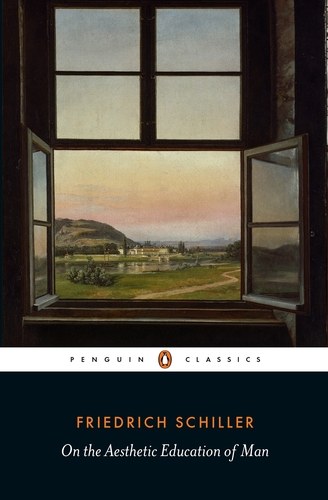
Selected edition: Penguin Classics, translated by Keith Tribe, 2016 · ISBN 9780141396965.
Read the letters after the plays. The philosophical vocabulary—sense drive, form drive, play drive, living form—will feel less abstract once you have watched Schiller stage freedom as a conflict among bodies, institutions and ideals.
Read for: the claim that art does not merely represent freedom. Under the right conditions, aesthetic experience rehearses the inner balance freedom requires.
Why read Schiller now?
We are surrounded by systems that value speed, utility, optimization and immediate declaration. Schiller’s account of play insists that a person also needs spaces where opposing capacities can remain active together long enough for a freer choice to emerge.
That is not an argument against discipline. Schiller was a builder of difficult forms: verse drama, historical tragedy, philosophical letters, journals and sustained correspondence. His point is that form should make life more available, not replace it.
For writers, the challenge is exact. A work must be alive enough to surprise and formed enough to travel. It must resist both shapeless impulse and dead perfection.
On Schiller’s birthday, the line from Letter XV offers a demanding definition of creative freedom. We become more fully human not when every rule disappears, but when sensation and reason can move together—when form becomes a field of possibility.
That is where play begins.
Sources and edition notes
- Stanford Encyclopedia of Philosophy: Friedrich Schiller
- Schillerverein Weimar-Jena: Schiller biography
- Project Gutenberg: Aesthetical and Philosophical Essays, 1899 edition
- Penguin Classics: The Robbers and Wallenstein
- Penguin Classics: Mary Stuart
- Penguin Classics: On the Aesthetic Education of Man
The opening excerpt is the final clause of a longer sentence in Letter XV, checked against Aesthetical and Philosophical Essays (New York: Publishers Plate Renting Co., 1899), p. 79, Project Gutenberg #70669. That edition does not credit a translator, so none is inferred. The website cover is DeepCrafter’s original illustrated Resonance card, not an archival photograph. The three book-cover images are the Penguin Classics editions listed above.