The Door Left Open: Robert Musil and the Sense of Possibility
On Robert Musil’s birthday, follow the engineer of uncertainty from Young Törless to the unfinished modernist world of The Man Without Qualities.
The Door Left Open: Robert Musil and the Sense of Possibility
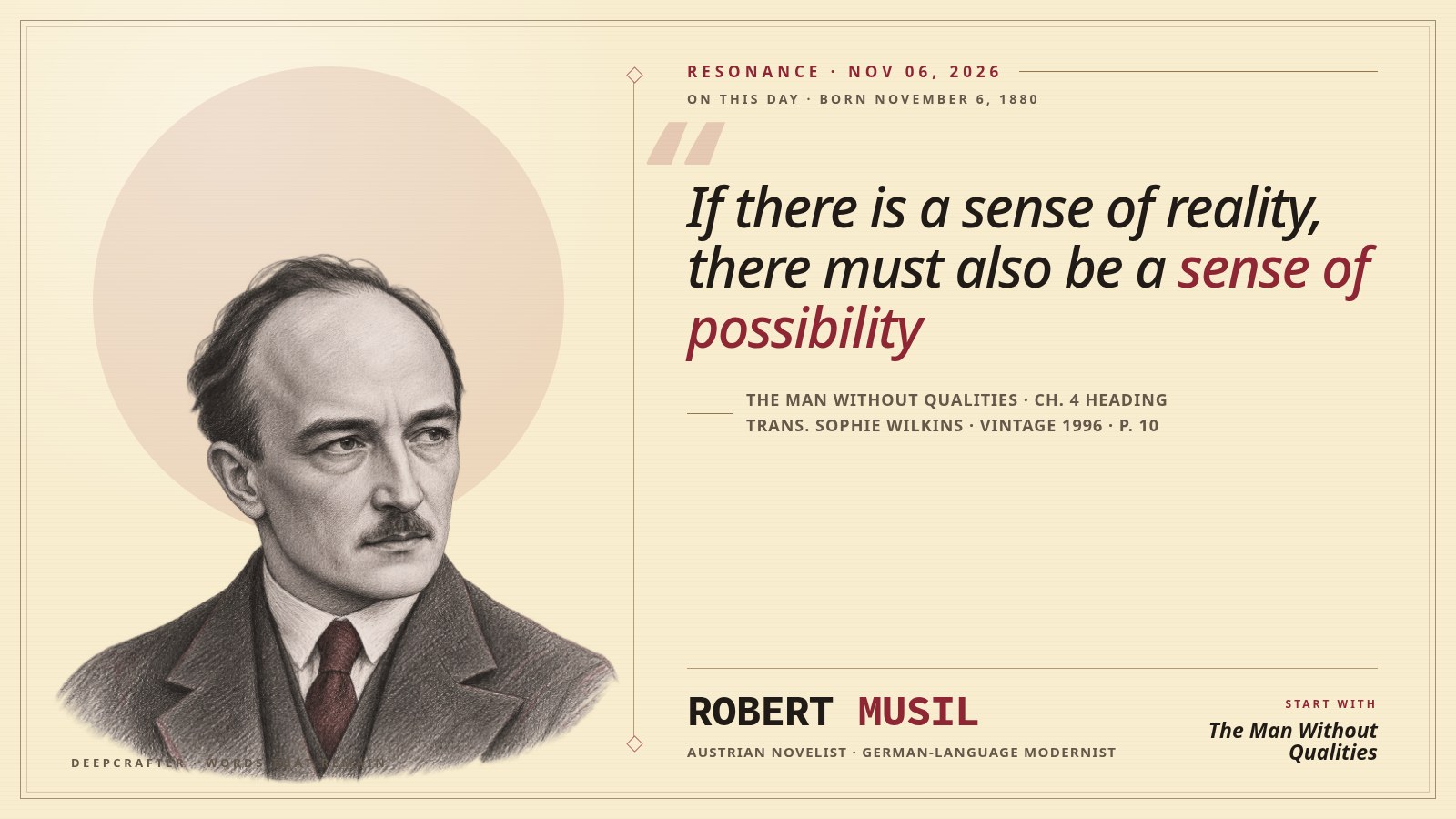
“If there is a sense of reality, there must also be a sense of possibility.”
Why we chose Robert Musil today
Robert Musil was born in Klagenfurt on November 6, 1880. For his birthday, we chose the heading of chapter 4 in The Man Without Qualities: a sentence that places reality beside possibility without asking either one to disappear.
The line matters because it is not an invitation to wishful thinking. In the chapter that follows, Musil’s narrator distinguishes the person who accepts what has happened from the person who can imagine that events might have happened otherwise. Possibility is disciplined counterfactual attention: the power to see that the actual world is only one arrangement among others.
That movement runs through Musil’s work. He trained as an engineer, studied experimental psychology and philosophy, wrote fiction with the patience of an investigator, and spent decades building a novel capacious enough to hold rival explanations at once. His prose can be comic, exact, sensual and abstract within the same paragraph. It distrusts conclusions that arrive before experience has been fully examined.
For writers, Musil offers a demanding freedom. A character need not be reduced to a single trait. An idea can enter a novel without becoming a lecture. A scene can remain open long enough for another moral possibility to appear.
An engineer enters literature
Musil’s route to fiction was unusually technical. After military schools in Eisenstadt and Mährisch-Weisskirchen, he left officer training and studied mechanical engineering in Brno, completing his state examination in 1901. He then worked briefly at the Technical University of Stuttgart before turning to philosophy, physics and experimental psychology in Berlin.
This was not a scientific apprenticeship discarded when he became a novelist. It shaped the way he wrote. Musil wanted the precision of analysis without the false confidence that every human problem could be solved like a machine. His later essays repeatedly return to the relationship between exact thought and the less measurable territory of feeling, ethics and imagination.
In Berlin he designed an apparatus for experiments in colour perception, now known as the Musil colour top, and completed a doctorate in 1908 on the philosophy of Ernst Mach. By then, however, he had already published the book that made his name: The Confusions of Young Törless.
The writer who emerged from this formation did not treat reason and emotion as enemies. He asked what kind of accuracy each domain required. A measurement can be exact, but so can a metaphor when it catches a relation that ordinary explanation misses.
The school as a laboratory: Young Törless
Published in 1906, The Confusions of Young Törless draws on Musil’s years at a military boarding school. Its setting is enclosed: a remote academy, a hierarchy of boys, and a victim subjected to escalating humiliation. But the novel’s real space is the unstable distance between what Törless witnesses, what he desires and what he can explain to himself.
Musil refuses to make intellectual curiosity morally innocent. Törless observes cruelty as if it were an experiment, fascinated by the gap between respectable rules and the violence occurring beside them. His uncertainty is psychologically acute, yet it does not excuse his participation.
This is an early sign of Musil’s mature method. He lets thought move inside compromised experience. Instead of assigning one explanatory label—adolescence, class, sexuality, authority or sadism—he shows these forces crossing and altering one another.
For a fiction writer, the lesson is uncomfortable and useful: interior complexity is not the same as moral goodness. A character may perceive brilliantly and still fail another person. The richer the consciousness, the more precisely the story can show what that consciousness avoids.
A novel made from competing systems
Musil began noting ideas that would grow into The Man Without Qualities as early as 1905. The project occupied him in changing forms for the rest of his life. The first book appeared in 1930, a further installment in 1932, and the novel remained unfinished when he died in 1942.
Set in Vienna in 1913, the novel follows Ulrich, a mathematician and former soldier who takes a “vacation from life.” He is drawn into preparations for a grand patriotic celebration of Emperor Franz Joseph’s coming jubilee—a campaign so full of committees, slogans and incompatible ambitions that its organizing idea continually dissolves.
Musil calls the empire “Kakania,” a comic name for a state whose institutions are elaborate, self-conscious and unable to imagine their approaching end. The satire is historical, but its deeper subject is how societies convert uncertainty into procedure. Everyone possesses a system; no system can contain the whole situation.
The novel’s famous essayistic passages do not interrupt a stable plot from outside. They are part of the action. An analogy changes a character’s choices. A definition reveals an institution’s blindness. A speculative detour creates a path the story may or may not take. Thinking is something that happens to people.
That is why the chapter heading about possibility is more than an aphorism. It names the novel’s architecture. Ulrich’s “sense of possibility” allows him to imagine alternatives, but it can also keep him suspended above commitment. Musil tests both the creative promise and the ethical risk of remaining open.
Precision and soul
Musil’s essays describe a culture divided between specialized knowledge and confused value. He resisted the easy cure of rejecting intellect in favor of feeling. What the age lacked, he argued, was precision in matters of the soul.
His fiction makes that principle visible. Abstract thought is repeatedly brought back to bodies, rooms, social rituals and private embarrassment. Conversely, an apparently ordinary gesture may open into philosophy. The prose moves between scales until neither the idea nor the sensation can pretend to be complete on its own.
This creates Musil’s distinctive tonal mobility. He can examine a moral concept with scientific coolness, then puncture the analysis with comedy; he can describe desire with tenderness, then reveal the vanity concealed inside it. Irony does not eliminate sympathy. It prevents sympathy from hardening into sentimentality.
For contemporary writers, this is a model for handling ideas in fiction. Do not paste a thesis onto a scene. Give the idea a temperament, a social cost and an opposing intelligence. Let it become vulnerable to the world.
How Musil worked: notebooks, dossiers and revision
The surviving archive shows a writing practice built from accumulation and reorganization. Musil began keeping diaries around the turn of the century. They held observations, reading notes, philosophical reflections, plans for stories and plays, character sketches and draft passages. The boundary between notebook and literary work remained porous.
For The Man Without Qualities, he developed a dense system of sigla—labels and cross-references that allowed him to navigate an expanding manuscript. The digital critical edition at MUSIL ONLINE describes study sheets as a central manuscript type: pages used to plan scenes, examine earlier drafts, assign material and test structural decisions. The archive preserves not one straight route toward a finished novel but a network of possible continuations.
This method helps explain both the novel’s extraordinary intelligence and its incompletion. Musil did not merely add incidents. He continually reconsidered the relations among them. Each solution exposed another question; each polished chapter altered the shape of the whole.
Writers need not imitate this scale, but they can borrow the principle. Keep a record of alternatives, not only decisions. When revising, ask which relationship changed—not just which sentence improved. A draft becomes more alive when its possibilities remain visible long enough to be compared.
Short forms at the edge of the impossible book
Musil was not only the author of one enormous novel. Posthumous Papers of a Living Author, first published in German in 1936, gathers exploratory pieces, observations and short stories. Its deliberately paradoxical title reflects the position of a writer who felt both alive and already treated as marginal.
The pieces look closely at small phenomena: a fly struggling on flypaper, the laughter of a horse, monuments, doors, crowds, habits of seeing. Their scale is compact, but their attention is not minor. A detail becomes a testing ground for pity, comedy, violence or abstraction.
Read beside The Man Without Qualities, the collection reveals an important contrast. Musil could pursue a question across thousands of pages, but he could also find a complete pressure system inside one observed object. The essential skill in both forms is not length. It is the ability to keep looking after the first category has failed.
Exile and the unfinished work
After the Nazi seizure of power, Robert and Martha Musil left Berlin for Vienna in 1933. Following Austria’s annexation in 1938, they fled through northern Italy to Switzerland, first Zurich and then Geneva. Musil’s books were banned in Germany and Austria. He continued working on the novel amid financial insecurity, isolation and declining health.
He died in Geneva on April 15, 1942, leaving the work unfinished. In 1943, Martha Musil privately published material from the literary estate and continued advocating for his writing. Later editions restored Musil to the center of European modernism, but the novel’s posthumous history remains inseparable from her labor and from difficult editorial choices about drafts he had not authorized for publication.
The incompletion is not a romantic ornament. It is the material condition of the book we have. Reading Musil responsibly means distinguishing the parts he published from later arrangements of the archive—and recognizing that his pursuit of possibility survived as both method and problem.
Five craft lessons from Robert Musil
1. Treat alternatives as evidence
Before choosing what happens, write down two other plausible courses. The rejected possibility may reveal the pressure shaping the final one.
2. Give ideas consequences
If a character believes something, let that belief alter what they notice, whom they trust and what they cannot admit.
3. Separate complexity from innocence
A self-aware character can still act cruelly. Insight should sharpen responsibility, not automatically erase it.
4. Revise relationships, not only sentences
Track how a change in one scene affects motives, symbols and arguments elsewhere. The unit of revision may be a connection.
5. Use irony to preserve motion
Irony can keep a judgment from closing too soon. Let it expose vanity or contradiction while leaving room for human need.
A possibility exercise for fiction writers
Take a scene in which your protagonist makes an important decision.
- Write the scene as a list of observable facts, without explaining motives.
- Add three interpretations of the same facts: one generous, one suspicious and one the protagonist cannot yet imagine.
- Give each interpretation to a different character or social system.
- Draft two alternative decisions that would remain psychologically plausible.
- Return to your chosen decision and add one detail that keeps the rejected possibility alive.
- Remove any sentence that tells the reader which interpretation is correct before the consequences can test it.
The goal is not permanent ambiguity. It is to make the chosen reality feel shaped by live alternatives rather than by authorial inevitability.
Where to start reading
For the early psychological novel: The Confusions of Young Törless
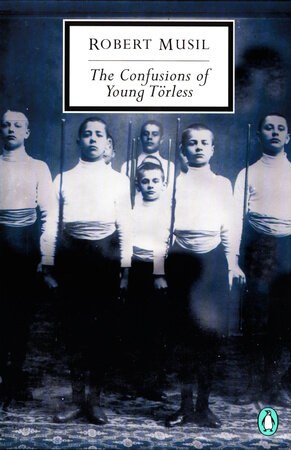
Edition: Penguin Classics paperback, 2001 · translated by Shaun Whiteside · introduction by J. M. Coetzee · 176 pages · ISBN 9780142180006.
Begin here for Musil at his most concentrated. The enclosed school setting makes his central questions immediately visible: how intelligence, desire, authority and cruelty can coexist inside one consciousness.
For the observer of small things: Posthumous Papers of a Living Author
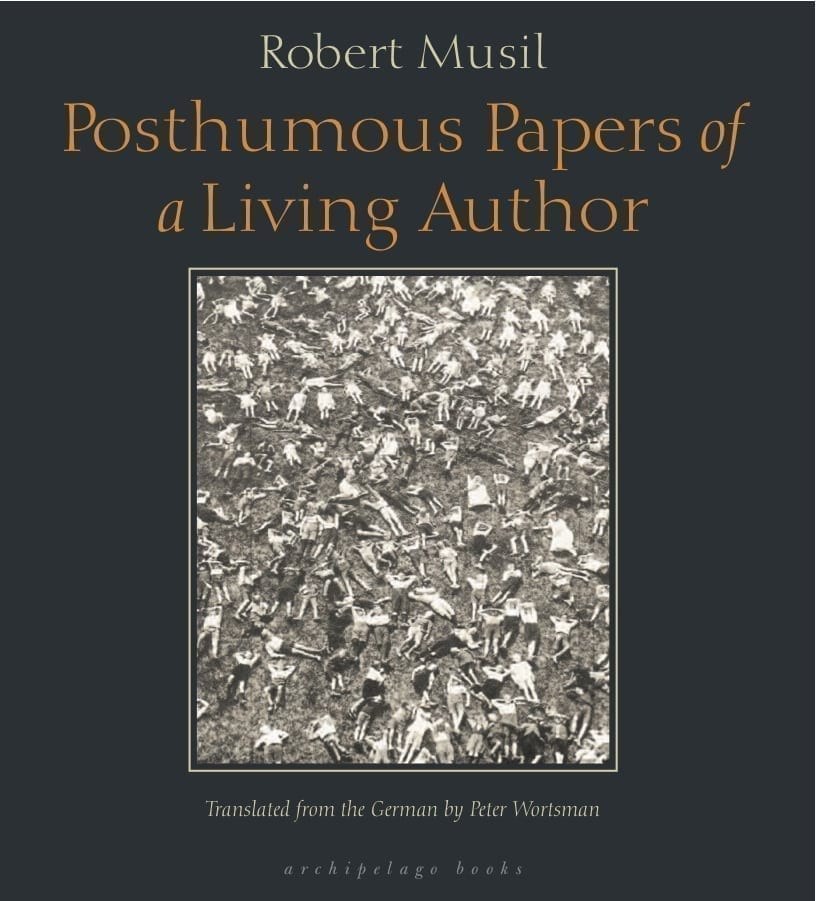
Edition: Archipelago Books paperback, 2006 · translated by Peter Wortsman · ISBN 9780976395041.
Read these short pieces to experience Musil’s precision without the scale of the unfinished novel. Notice how a minute observation opens into an ethical or philosophical problem without losing its physical strangeness.
For the full sense of possibility: The Man Without Qualities, Vol. 1
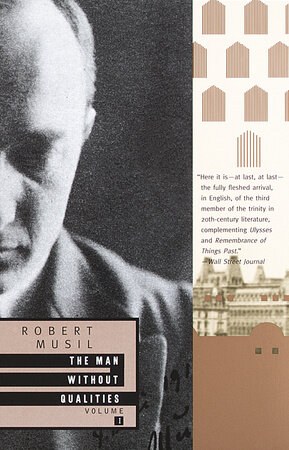
Edition: Vintage paperback, 1996 · translated by Sophie Wilkins · editorial consultant Burton Pike · 752 pages · ISBN 9780679767879.
Enter the major novel after meeting Musil in shorter forms. Read for movement rather than completion: the shifts between scene and essay, the comic collision of systems, and the way each definition creates a new exception.
Why read Musil now?
We live amid systems that reward instant classification: a person becomes a profile, an event becomes a position, a draft becomes a score. Musil does not ask us to abandon judgment. He asks us to delay it long enough to see the alternatives our first description excluded.
His sense of possibility is therefore both literary and civic. It makes room for invention, but it also tests the stories institutions tell about necessity. If reality has been arranged, it can be examined. If it can be examined, perhaps it can be arranged otherwise.
The door Musil leaves open is not an escape from the world. It is a way of returning to the world with more than one future in view.
Sources and edition notes
- Robert Musil Literatur Museum: biography and chronology
- MUSIL ONLINE: scholarly digital edition and archive
- MUSIL ONLINE: edition tutorial and manuscript system
- Penguin Random House: The Confusions of Young Törless
- Archipelago Books: Posthumous Papers of a Living Author
- Penguin Random House: The Man Without Qualities, Vol. 1
- University of Chicago Press: Precision and Soul
The opening quotation is the heading of chapter 4 in The Man Without Qualities, translated by Sophie Wilkins (Vintage, 1996), page 10. The website cover is DeepCrafter’s original illustrated Resonance card, not an archival photograph. The three book-cover images identify the specific editions discussed.
Sources
- Robert Musil Literatur Museum: biography and chronology
- MUSIL ONLINE: scholarly digital edition and archive
- MUSIL ONLINE: edition tutorial and manuscript system
- Penguin Random House: The Confusions of Young Törless
- Archipelago Books: Posthumous Papers of a Living Author
- Penguin Random House: The Man Without Qualities, Vol. 1
- University of Chicago Press: Precision and Soul