Reading Is a Way of Learning to See
Tessa Hadley’s new essay collection prompts a practical reading-to-writing exercise: notice a detail, name its effect, and transfer the craft choice to a new scene.
Reading Is a Way of Learning to See
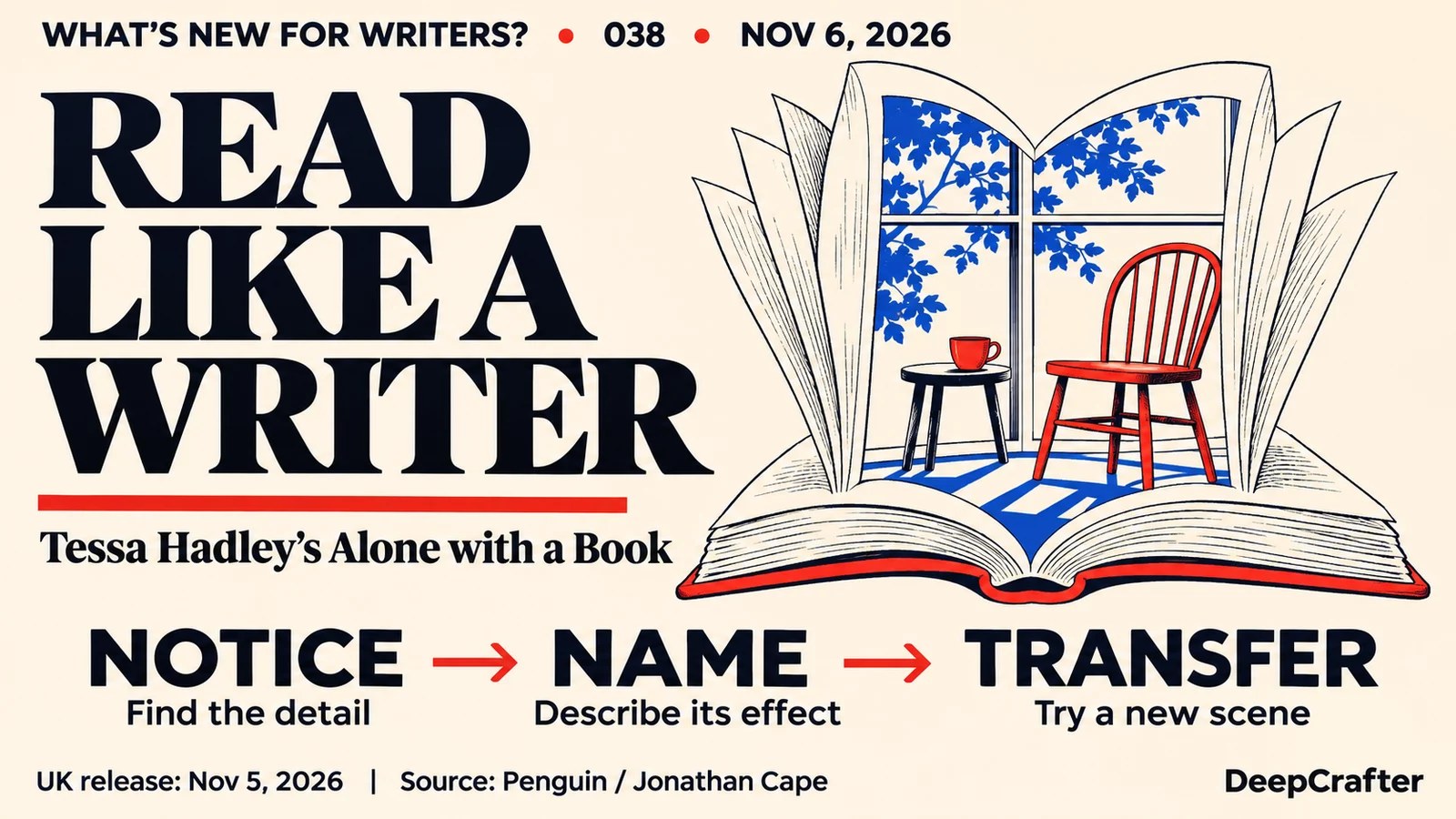
Tessa Hadley’s Alone with a Book: On Reading, Writing and Looking was published in the UK on November 5, 2026. Its arrival offers a timely invitation: spend a little less energy counting the books you finish, and a little more noticing what a page makes you see.
Penguin’s UK listing identifies the Jonathan Cape hardback, ISBN 9781787336797, as a 336-page essay collection. The publisher describes a reading life that develops alongside writing and teaching, and essays engaging with literature and paintings. That is the verified publication signal behind this piece—not a claim that we have reviewed the complete book.
For writers, the useful question is what to do with that invitation. Admiration can remain vague: beautiful prose, convincing characters, an atmosphere that stays with us. Learning begins when we can describe the choices that produced the effect.
A new book, not a universal release date
The territory matters. The US publisher listing schedules its Vintage edition for February 2, 2027. Yesterday’s UK publication should not be presented as a worldwide release.
The US description emphasizes realism and the relationship between art and ordinary experience. Our editorial interpretation is that this makes the publication a useful prompt for a modest practice: look closely at one passage, identify an effect, then test a related craft choice in your own material.
The exercise below is DeepCrafter’s original framework. It is not a method quoted from Hadley or a summary of her essays.
1. Notice: begin with your response
Choose a page you already own or can lawfully access. Read it once for pleasure before analyzing it. Where did your attention sharpen? At what point did you begin to trust—or distrust—a character? Which object became more than scenery?
Mark just one moment. Do not start by collecting every metaphor. Start with a response you genuinely had and trace it to a visible choice.
For example, an invented line:
She set two cups on the table, then returned one to the cupboard.
The sentence does not name loneliness, separation or bereavement. A small adjustment in an ordinary action invites us to infer an absent person. Notice how much remains undecided: we do not yet know who is missing, why, or whether the habit is recent.
A useful notebook entry is specific: “An interrupted routine suggests an absence before the narration explains it.” That gives you something you can test. “Great emotional writing” does not.
2. Name: describe the mechanism without turning it into a law
Separate three things:
- Detail: what is literally on the page?
- Effect: what did it make you anticipate, feel or reconsider?
- Mechanism: how might this choice have produced that effect?
For the cups example: the detail is a corrected place setting; the effect is a question about someone missing; the mechanism is the gap between habitual action and present reality.
Keep the last answer provisional. Another reader might infer a cancelled visitor rather than grief. That is not a reason to abandon close reading. It tells you which effects the sentence supports and which require further context.
This is also where a writer resists collecting universal rules. An unexplained gesture can create curiosity in one scene and confusion in another. Its usefulness depends on what the reader already knows, what the viewpoint character can observe and what the scene needs to change.
3. Transfer: borrow the problem, not the furniture
Do not write another cups sentence with different crockery. Move the underlying problem into a different situation.
Here is a second original example:
At the security gate, Arun held out his old pass before reaching for the visitor badge.
The setting and stakes have changed. The action suggests a difference between a former role and a present one. It might introduce retirement, dismissal or a return after years away. The transferable choice is not the object; it is a body continuing an old routine after circumstances have changed.
Now write 100–150 words of your own. Choose a setting unrelated to the passage you studied. Give someone a familiar action that no longer quite fits. Let a second person respond. The response should change the scene, rather than simply explain the backstory.
A twenty-minute reading-to-draft session
Five minutes: read. Pick one short passage and enjoy it without taking notes on the first pass.
Five minutes: describe. Record a detail, its effect on you and a possible mechanism. Use ordinary language rather than terminology you cannot explain.
Seven minutes: draft. Test the mechanism in an unrelated scene. Change the people, situation and stakes; do not imitate distinctive wording.
Three minutes: compare. Does your scene produce the intended effect? What context does it need? What can be removed without weakening the reader’s understanding?
The result is not a score for the author or proof that you have mastered a technique. It is a small piece of knowledge about your own decisions on the page.
Keep pleasure in the process
There is no obligation to turn every reading hour into professional development. Some books deserve our attention without producing an exercise. A notebook should help you return to the page, not stand between you and it.
The promising connection is simpler: a reading life can train attention, and attention gives fiction material. A changed gesture, a room noticed by someone who no longer belongs there, a sentence whose rhythm delays an admission—these become useful when you can say what they do.
Hadley’s new collection is today’s occasion for that thought. The next step is available whether you buy it now, wait for your local edition or return to a book already on your shelf: read one page closely, then write a different one with greater intention.
Sources and scope
- Penguin / Jonathan Cape: UK edition and publisher description. Publication: November 5, 2026; checked November 6, 2026.
- Penguin Random House / Vintage: US edition. Listed publication: February 2, 2027; checked November 6, 2026.
Publication details and descriptions above come from the publishers. The analysis, exercises and fictional examples are DeepCrafter editorial work, not attributed advice from Hadley.