When Should You Let Someone Read Your Draft?
A three-stage method for matching the draft, reader, question and next decision—without turning feedback into a vote on an unfinished novel.
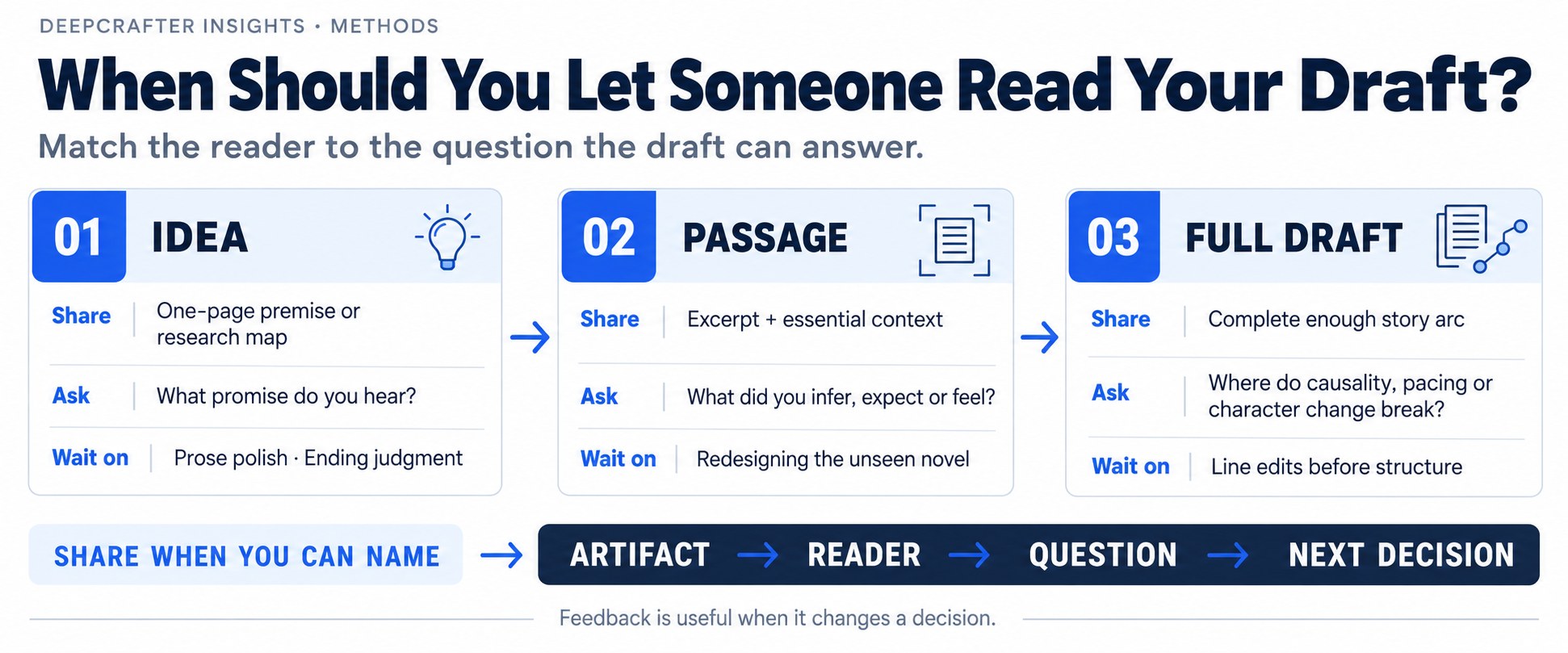
When Should You Let Someone Read Your Draft?
The wrong question is: How early should a writer get feedback?
Early and late are calendar words. They do not tell you what the draft can support, what the reader is meant to notice, or which decision you are prepared to make afterward.
A more useful rule is:
Share the smallest piece of writing that can answer the next real question.
Sometimes that means discussing a premise before you have written a chapter. Sometimes it means showing one scene. Sometimes the right choice is to protect the manuscript until a full draft exists.
The timing depends on the job.
The interview prompt—and its limit
In an October 24, 2026 interview with The Guardian, novelist Marlon James and biographer Nicholas Boggs describe a boundary in their shared writing life. They exchange ideas and research, but generally do not read one another’s manuscripts until the work is finished.
That is interesting because intellectual exchange and manuscript access are not treated as the same thing. A writer can receive energy, facts and questions from another person without opening the prose itself to intervention.
It is one working practice, not a law. The interview does not establish that early feedback is harmful, that finished drafts need no protection, or that every writer should work alone. The framework below is DeepCrafter editorial material built from a separate question: what kind of uncertainty is your draft ready to expose?
Stage 1: Share the idea, not the manuscript
At the beginning, the prose may be too unstable to evaluate. The useful object is often a one-page premise, a research map, a character contradiction or a description of the story’s central pressure.
Give it to
- a trusted craft peer who can hear the story’s promise without trying to write it for you;
- a subject expert who can identify a false assumption in the foundation;
- a potential target reader who can tell you what kind of story the premise appears to offer.
Ask
- What story do you think this premise is promising?
- Which part feels specific, and which part still sounds interchangeable?
- What assumption would you verify before building the plot around it?
- Which choice seems capable of producing consequences rather than only scenes?
Do not ask yet
Do not ask whether the ending works when there is no ending. Do not ask for line edits on sample prose that may disappear. Do not invite five people to pitch a better novel before you know what you are trying to protect.
The risk at this stage is not merely “too much feedback.” It is premature convergence: several plausible suggestions can make an unsettled idea feel decided before the writer has discovered its own pressure.
Stage 2: Share a bounded passage
Once the draft contains a real scene, you can test a reader experience without putting the whole manuscript up for election.
Choose a passage that contains the problem you need to understand. Add only the context required to read it. Then ask questions about what happened in the reader—not whether the passage is “good.”
Give it to
- a reader who resembles the intended audience for this part of the book;
- a craft peer who understands the specific problem you are testing;
- a cultural, professional or technical reader when the scene depends on knowledge you do not possess.
Ask
- At what point did you understand what the character wanted?
- What did you expect the character to do next?
- Which fact did you treat as important, and why?
- Where did your mental picture become uncertain?
- What emotion did you carry out of the scene?
These are observation questions. They let the reader report an experience while leaving the diagnosis and repair with the writer.
Do not ask yet
Do not ask a scene reader to redesign an unseen middle. Do not accept a global verdict on a character from one deliberately misleading chapter. Do not turn “I was confused here” into “the entire premise fails” without locating what information the excerpt withheld.
A local test is useful when the answer can change a local or near-future decision. If the only possible response is “I need the whole book,” move to Stage 3.
Stage 3: Share the complete draft
A full-draft reader can judge relationships that an excerpt cannot reveal: setup and payoff, repeated images, pacing across chapters, character change, causality, and the cost of the ending.
The draft does not need polished sentences. It does need a complete enough arc that the reader can experience the book you currently have rather than imagine the book that might eventually exist.
Give it to
- a small number of beta readers who can finish the whole work and describe their experience;
- a developmental editor when you are ready to make structural decisions;
- a specialist reader when representation, law, medicine, history, safety or another domain requires informed review.
Ask
- Where did the story’s central desire become clear?
- Which turn felt caused by earlier choices, and which felt imposed by the author?
- Where did your attention weaken—and what question were you waiting for the book to answer?
- Which relationship changed most convincingly? Which one stayed static?
- Did the ending resolve the story’s main pressure, change it, or evade it?
Do not ask yet
Do not begin with comma-level corrections if you may remove three chapters. Do not combine eight incompatible reports into a vote. Do not ask every reader every question; a reader who notices pacing may not be the right authority on a historical detail.
Full-draft feedback is most useful when you are prepared to distinguish three things:
- The observation: what the reader experienced.
- The diagnosis: why they believe it happened.
- The prescription: what they think you should change.
The observation is usually the strongest evidence. The diagnosis may be insightful or wrong. The prescription is a proposal.
A decision table for timing feedback
Before sharing, fill in four fields.
| Field | Decision |
|---|---|
| Artifact | Idea brief, scene, chapter sequence or complete draft? |
| Reader | Who has the craft, audience or subject knowledge this question needs? |
| Question | What specific uncertainty can this artifact actually answer? |
| Decision | What will you decide after receiving the response? |
If one field is blank, wait or narrow the request.
This protects both people. The writer does not receive a shapeless pile of opinions. The reader is not asked to solve a manuscript whose purpose has never been stated.
Original example: The Winter Orchard
Imagine a novel about a botanist who inherits an orchard where each fruit contains a forgotten conversation. She wants to recover the last conversation she had with her missing sister, but harvesting it may erase someone else’s memory.
At the idea stage
Share a one-page premise with a speculative-fiction reader and a memory researcher. Ask what promise they hear and which assumptions about memory should remain metaphorical rather than scientific.
Do not ask whether the sister’s final reveal is satisfying. The story has not earned that question yet.
At the passage stage
Share the first scene in which the botanist opens a fruit and hears a stranger’s quarrel. Ask when the reader understands the cost of harvesting and whether curiosity or alarm dominates the scene.
Do not ask the reader to choose the novel’s final moral argument. You are testing legibility and pressure in one encounter.
At the full-draft stage
Share the complete manuscript. Ask whether the protagonist’s final choice follows from the earlier uses of the orchard, whether the sister’s absence changes meaning across the book, and whether the ending pays the cost the premise established.
The same novel needs three different readers because it is asking three different questions.
When this framework does not fit neatly
Some writing situations require earlier or different access.
- Collaboration: co-authors need an agreed boundary for shared material, decision rights and version control.
- Serial publication: later sections may be unwritten when early ones become public; feedback must be separated from promises already made to readers.
- Workshops and courses: deadlines may determine when pages circulate. Narrow the question so the workshop responds to what the pages can support.
- Nonfiction and historical fiction: verify high-consequence facts before elegant prose makes them harder to remove.
- Sensitive or specialized material: seek relevant expertise at the point when the expert can still change the work, not as ceremonial approval after every decision is fixed.
- Contracted projects: editorial milestones may be set in advance. Clarify what kind of revision remains possible at each one.
The point is not to keep the manuscript secret. It is to make access purposeful.
Write a feedback brief
Send this with the material:
Stage: [idea / passage / complete draft]
Artifact: [what I am sharing]
Context: [only what the reader needs]

Questions:
1. [one observable reader-experience question]
2. [one causal or structural question]
3. [one domain question, if relevant]

I am not asking for: [line edits / ending ideas / factual review / full redesign]
Useful response format: [margin notes / short letter / call / tracked questions]
Decision I will make next: [state it]
The final line matters. Feedback without a decision becomes atmosphere.
Use AI to prepare the question—not impersonate the reader
In DeepCrafter’s sidebar Chat, the AI Writing Assistant can help you list plot uncertainties, research needs or competing revision questions before you approach a human reader. For example:
I am sharing chapters 1–3 with a reader. List the assumptions the reader must make about the protagonist’s goal, the story’s central rule and the immediate stakes. Turn those assumptions into five neutral questions. Do not answer them or rewrite the chapters.
Then choose the questions yourself.
An AI assistant can inspect supplied text and propose areas to test. It cannot report the lived response of a reader who encounters the story for the first time. It also cannot replace the situated knowledge of an editor, subject expert or culturally informed reader.
The final test
Before you send the draft, finish this sentence:
I am showing this specific material to this specific person because I need to decide ________.
If you cannot fill the blank, you may be seeking reassurance, permission or momentum. Those needs are real, but they are not the same as feedback. Name the need before you hand someone the manuscript.
Do not ask, “Is it too early?”
Ask whether the draft, the reader, the question and the next decision finally match.
Sources and editorial note
- Emma Loffhagen, “Our third date was at Buckingham Palace: Marlon James and Nicholas Boggs on life as a literary power couple,” The Guardian, October 24, 2026. The interview supplies the current prompt about sharing ideas and research while keeping manuscripts private until completion. It does not supply or endorse the three-stage method above.
- DeepCrafter User Guide, for the documented scope of the AI Writing Assistant.
The framework, decision table, feedback brief and The Winter Orchard example are original DeepCrafter editorial material. Prepared with AI assistance and source checking for DeepCrafter Insights. No reader study or universal timing claim is reported.