One Village, Many Voices: How to Connect Stories Without Repeating Them
A four-part planning method for making linked stories accumulate knowledge, silence and consequence instead of replaying the same event.
One Village, Many Voices: How to Connect Stories Without Repeating Them
A practical method for making linked stories accumulate meaning instead of retelling the same event.
On October 27, Peirene Press published Siân Valvis’s English translation of Dimosthenis Papamarkos’s Gjak in the UK. The publisher presents it as interconnected tales set in an unnamed Arvanite village after the Greco-Turkish War; a review quotation on the same page describes nine monologues. The American publication date is November 10, so this is a UK publication signal—not a claim that the book is already on sale everywhere.
Without pretending to offer a story-by-story reading, the book’s described structure raises a useful craft question: when several narrators share one place and history, what makes each story necessary?
Setting alone is not enough. A recurring inn, surname or war can make pieces feel related, but it cannot prevent them from becoming variations of the same summary. A linked collection becomes cumulative when each new voice changes the reader’s model of what happened, who benefited and what the community has agreed not to say.
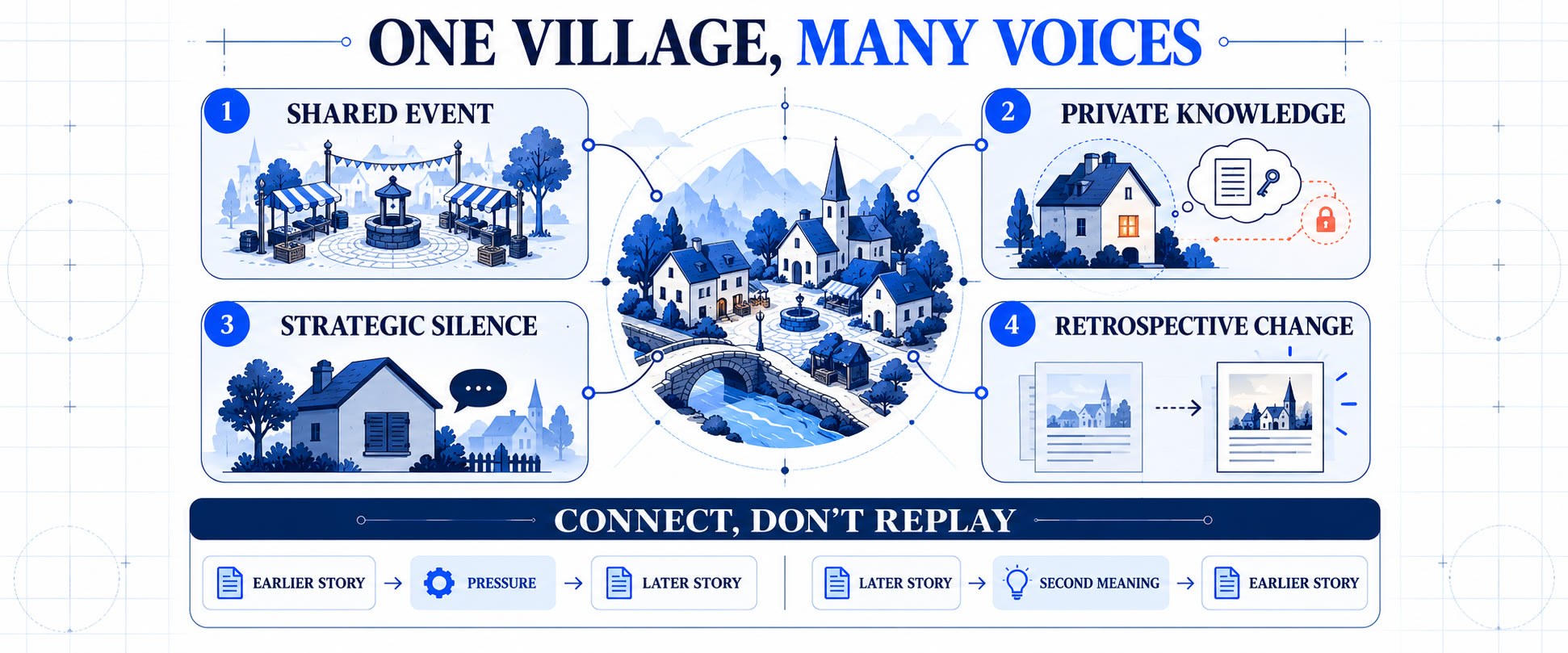
DeepCrafter’s method uses four connections: shared event, private knowledge, strategic silence and retrospective change.
Connection is not repetition
Suppose three stories all mention the night a flood destroyed a footbridge. The first narrator says the storm was unavoidable. The second says the warning bell never rang. The third reveals that the bell rope had been cut.
The event repeats, but its narrative function changes. In Story One, the flood is fate. In Story Two, it becomes a failure. In Story Three, it becomes an act. Each return creates a new causal model.
That is the difference between an echo and a replay:
- Replay: the reader receives the same information from a different mouth.
- Echo: a familiar detail returns with altered meaning.
The goal is not to eliminate overlap. Readers need stable points of recognition. The goal is to make every overlap purchase something new: knowledge, motive, consequence, contradiction or moral pressure.
The four-column connection table
Before drafting, make one row for every narrator and four columns.
| Narrator | Shared event | What only this narrator knows | What this narrator hides | What a later story changes |
|---|---|---|---|---|
| Mara, the ferryman | The bridge collapses during a flood | She saw a cart cross after the road was closed | She accepted money to ferry the driver away | The “natural disaster” begins to look assisted |
| Ivo, the teacher | The warning bell remains silent | A pupil reported seeing someone in the tower | He dismissed the child to protect the mayor | His public decency becomes complicity |
| Niko, the bellmaker’s son | The rope was cut | His father cut it under threat | He blamed the flood to preserve his family name | The suspected villain becomes another coerced witness |
This example is original to DeepCrafter. It is not a synopsis of Gjak.
The table forces four separate decisions. “Different personality” is not enough. Each voice needs a different relationship to evidence and consequence.
1. Choose one event large enough to distribute
A shared event should have more than one kind of consequence. A wedding may redistribute loyalty, property and shame. A factory closure may alter income, status and migration. A disappearance may produce grief for one person, opportunity for another and exposure for a third.
Ask:
- Who experiences the event directly?
- Who knows it only through rumor?
- Who gains from the accepted version?
- Who pays for it without knowing why?
- Which consequence appears only months or years later?
If everyone is affected in the same way, the event may support one strong story rather than a linked set.
2. Give each narrator asymmetric knowledge
Linked stories thrive on unequal access. One person sees the act, another understands the institution around it, and another knows the emotional history that makes it possible.
Divide knowledge into three kinds:
- Observed: what the narrator directly saw or heard.
- Inferred: what the narrator believes those facts mean.
- Inherited: what family or community memory has taught the narrator to assume.
These categories should not align perfectly. A witness can misinterpret what they saw. A latecomer can understand a pattern the witness misses. A child can inherit a false story and still notice the detail adults have normalized.
This is how multiple voices create depth rather than redundancy: no single narrator owns both the whole fact and its whole meaning.
3. Make silence an action
“What does this narrator hide?” is more productive than “What secret do they have?” A secret can sit inert in backstory. Hiding is a present-tense choice.
For every narrator, name:
- the person from whom the truth is withheld;
- the cost of speaking;
- the benefit of silence;
- the visible behavior produced by concealment.
Mara does not merely possess information about the cart. She overexplains the weather, avoids the eastern bank and becomes angry when anyone praises her bravery. The silence shapes scenes.
Different silences also produce different voices. One narrator rushes past the dangerous noun. Another circles it through jokes. Another becomes exact about irrelevant details. Voice emerges partly from the pressure of what cannot be said.
4. Let later stories revise, not erase
A later revelation should not make earlier stories disposable. If Story Three simply announces that Story One was false, the collection becomes a puzzle with obsolete pieces.
Stronger retrospective change works by reclassification:
- an accident becomes negligence;
- a cowardly act becomes coerced protection;
- a generous gesture becomes payment;
- a family legend becomes a coping mechanism;
- a villain remains guilty, but not for the reason the village repeats.
The earlier story should still be true as an experience. Mara genuinely believed she was helping someone escape danger; later information changes the moral context of that choice. The reader retains both truths.
A three-pass drafting method
Pass one: write the story as a complete local world
Each piece needs its own desire, pressure and irreversible change. Do not rely on the collection’s architecture to supply an ending. A reader should feel that something has happened to this narrator even if they have not read the other pieces.
Pass two: mark every shared detail
Highlight recurring people, objects, places, dates and phrases. Beside each one, label its function:
- orientation;
- contradiction;
- escalation;
- emotional echo;
- causal revelation.
If a repeated detail does no new work, cut it or alter its angle.
Pass three: test the sequence
Move the stories. What does the reader assume after each ending? Which question becomes urgent? Which later piece answers too much too quickly?
Order is argument. Placing Ivo before Mara might make institutional failure the starting frame. Placing Mara first might make the collection begin as disaster and slowly acquire human agency. Neither is neutral.
The delete-and-carry test
For every repeated event, delete the paragraph that explains it in the later story. Can the reader carry enough knowledge forward from the earlier piece?
If yes, keep only what the new narrator uniquely notices. If no, restore the minimum orientation needed.
Then run the reverse test: remove the earlier story from the sequence. Does the later revelation lose emotional or moral force? If nothing changes, the earlier piece may be atmospheric rather than structurally necessary.
The ideal relationship is mutual:
- the earlier story gives the later one pressure;
- the later story gives the earlier one a second meaning.
How to avoid four common failures
The tour-guide opening
Every narrator introduces the village, the war and the family tree. Trust accumulated knowledge. Let later narrators begin inside their own problem.
The identical mystery
Every story asks, “Who cut the rope?” Vary the governing question. One story can ask what happened; another asks why no one spoke; another asks whether repair is still possible.
The omniscient final witness
The last narrator explains everything. Preserve remainder. Communities do not become transparent because the collection ends.
The theme delivered as consensus
Every narrator reaches the same conclusion about guilt, exile or belonging. A linked collection gains force from unresolved moral distance. Connection does not require agreement.
A compact planning prompt
Use this before drafting the next linked story:
What shared event enters this narrator’s life, what can only they know, what do they actively conceal, and which belief from an earlier story will this piece complicate without cancelling?
Answer in four sentences. If two narrators produce interchangeable answers, their stories are not yet distinct enough.
Why this matters now
The English publication of Gjak is a timely invitation to notice what interconnected storytelling can do: turn a community from background into a field of competing memory. Peirene’s description is enough to establish the book’s form and context, not enough for invented close reading. The craft method here is DeepCrafter’s response to that structural signal.
Linked stories work when the reader becomes an active keeper of differences. They remember who knew what, who refused which word and how one voice unsettled another. The collection’s unity then comes not from repetition, but from consequence.