Only the Sea: Rafael Alberti and the Art of Return
On the anniversary of Rafael Alberti’s death, trace the sea, painting, exile and living memory across three essential books.
Only the Sea: Rafael Alberti and the Art of Return
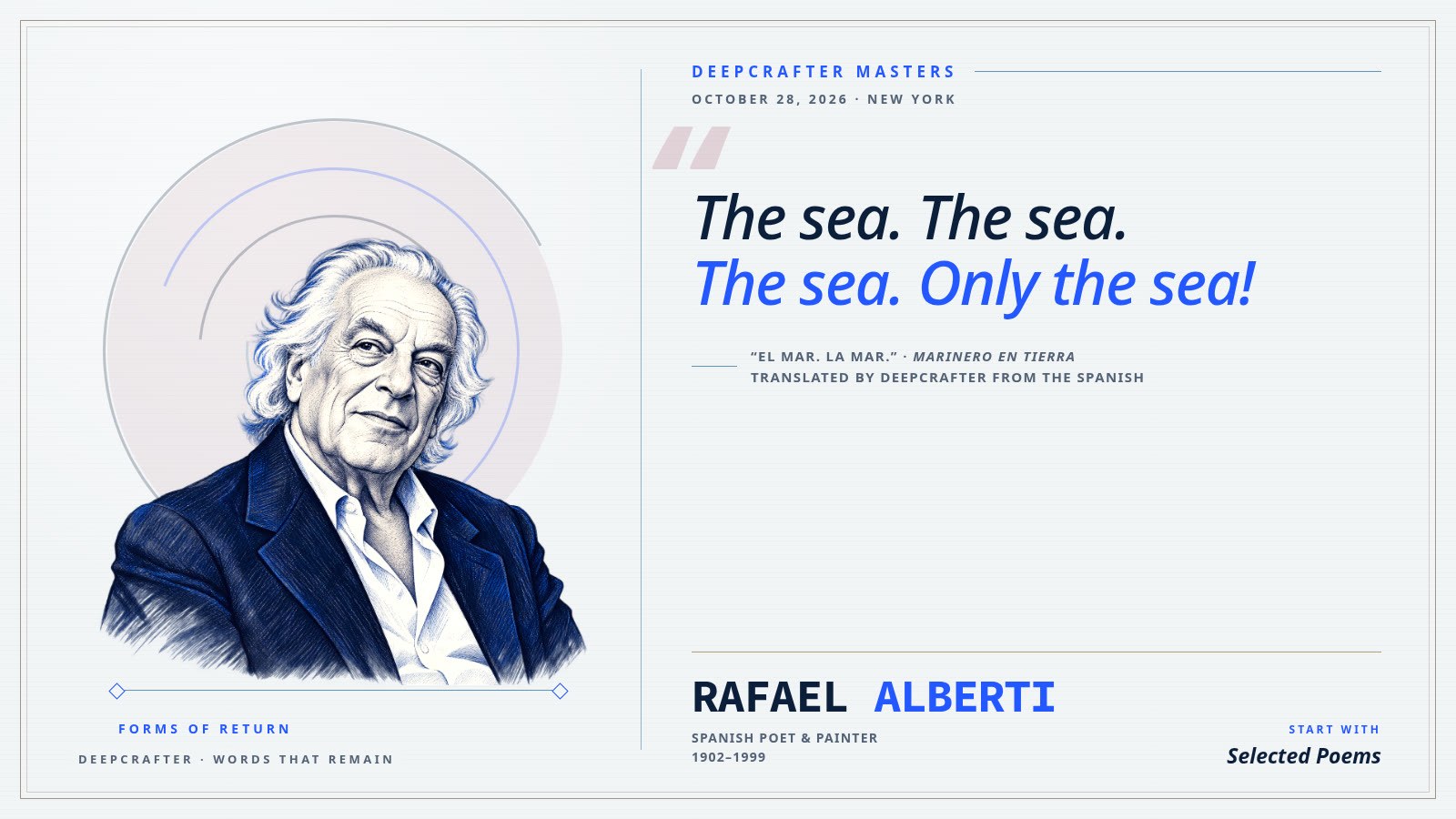
“The sea. The sea. / The sea. Only the sea!”
Why we chose Rafael Alberti today
Rafael Alberti died on October 28, 1999, in El Puerto de Santa María, the Cádiz town where he had been born ninety-six years earlier. The opening lines come from “El mar. La mar,” one of the best-known poems in Marinero en tierra (Sailor on Land). Our English rendering cannot preserve the Spanish movement between masculine el mar and feminine la mar; the article changes while the sea remains. That untranslatable turn is part of the poem’s power.
We chose the line because Alberti’s long career repeatedly returns to distance: the child removed from the coast, the painter separated from painting, the republican driven into exile and the older poet retrieving people and landscapes through language. Return in Alberti is never a simple reversal. What comes back has been changed by rhythm, politics, memory and translation.
A painter before a poet
Alberti was born in 1902 and moved with his family from Cádiz to Madrid in 1917. He left formal schooling and pursued painting, exhibiting work in Madrid while still young. A period of illness took him to the Guadarrama mountains, where he began writing the poems that became Marinero en tierra.
The book received Spain’s National Literature Prize in 1924–25. Its concise songs draw on popular forms, nursery rhythms and the lyric tradition while turning the absent sea into a field of desire. The speaker is “on land” not simply because he lacks water, but because his imagination has become geographic: the body remembers another element.
Painting never disappeared. Color, contour and composition continued to shape Alberti’s poetry, and he returned to visual art throughout his life. Decades later, A la pintura (To Painting) would address pigments, tools and artists from the Prado. He did not move from one art to another so much as make each art remember the other.
The Generation of ’27 and the break in style
Alberti became part of the group later called the Generation of ’27, associated with Federico García Lorca, Luis Cernuda, Jorge Guillén, Vicente Aleixandre and others. The name refers to a 1927 commemoration of the baroque poet Luis de Góngora. For Alberti, popular song and formal inheritance were not opposites to experiment. His early books combine traditional cadence with modern image-making.
Then Sobre los ángeles (Concerning the Angels, 1929) altered the field. Written through spiritual and psychological crisis, its angels are not comforting guardians. They become forces of abandonment, sleeplessness, rage and fractured identity. The familiar musicality remains, but the world it carries has darkened. Surreal images and unstable spaces replace the bright maritime surface of the early work.
The shift is instructive for writers. A recognizable voice does not require a stable palette. Alberti’s continuity lies deeper—in rhythm, visual intelligence and the ability to turn inner condition into a populated symbolic world.
Poetry under political pressure
Alberti joined the Communist Party in 1931 and became an active republican cultural figure. During the Spanish Civil War, he and María Teresa León organized, wrote and worked with the Alliance of Antifascist Intellectuals. Political commitment changed the public function of his poetry. The intimate lyric and the collective voice had to coexist.
When the Republic fell in 1939, Alberti and León left Spain. Exile took them first to Paris, then to Argentina and later Rome. He would remain away for nearly four decades.
It is tempting to reduce an exiled writer to nostalgia. Alberti’s work is more various. Exile produced grief, satire, erotic memory, political address, urban observation and renewed visual art. Rome could be loved and mocked; Buenos Aires could be a present city as well as the place from which Spain was remembered.
Memory as a form of arrival
The poems gathered in Retornos de lo vivo lejano, translated by Carolyn L. Tipton as Returnings: Poems of Love and Distance, were written in Argentina between 1948 and 1952. Alberti described distant Spanish life returning in exact sensory detail—not as dead elegy, but as a living presence.
That distinction explains his art of return. Memory is not a museum display. A remembered beach can recover heat, scent, body and motion. The past arrives as an event in the present tense.
His memoir La arboleda perdida (The Lost Grove) performs a related work in prose. People, movements and literary friendships reappear through the double perspective of experience and exile. Life is not arranged as a straight line toward reputation; it is recovered as a grove of paths, absences and encounters.
Return to Spain
After the restoration of democracy, Alberti returned to Spain in 1977. He briefly served as a Communist deputy, then resigned to continue his artistic work. In 1983 he received the Cervantes Prize, the highest major honor in Spanish-language literature.
The return did not cancel exile. No arrival can restore the exact country, friendships or self that departure interrupted. Alberti’s later public presence—readings, drawings, honors and poems—therefore carried both celebration and temporal distance.
He died where he began, near the sea. The biographical circle is striking, but his work resists a neat closure. The sea at the end is not the sea of childhood; the poet who returned was not the boy who left.
His style: song, image and transformation
1. Popular form without simplicity of thought
Alberti uses refrains, short lines and song structures that feel immediately memorable. Their accessibility can hold exile, erotic longing or political conflict without becoming merely decorative.
2. Visual intelligence
Colors act. Lines, shadows and surfaces organize perception. In To Painting, the poem can think through pigment and brushwork; elsewhere, visual composition gives emotional states a physical arrangement.
3. The recurring object changed by context
Sea, angel, city, hand and bird recur across decades. Repetition does not stabilize them. The sea can be childhood, loss, route, border or return. A writer develops motifs by allowing history to change their charge.
4. Formal migration
Alberti moved among song, sonnet, surreal sequence, political poem, memoir, theatre and visual art. Range did not erase identity because the underlying sensibility—musical, pictorial, restless—remained audible.
5. Public history inside private memory
War and exile are not background dates. They alter love poems, landscapes and syntax. Yet public history never entirely consumes private experience.
A writing practice of crossing media
Alberti’s career suggests a practice built less around one desk-bound routine than around exchange among arts and places. He drew, painted, wrote for performance, composed memoir and read poetry aloud. Visual work could renew verbal work; popular song could carry avant-garde pressure.
Writers can borrow the method without imitating the style:
- sketch the scene before describing it;
- assign one color a verb rather than an adjective;
- rewrite a memory in song form, then in prose;
- let a recurring image change after every historical break;
- preserve the sound of the source language when translation cannot preserve its grammar.
An Alberti exercise: return without restoration
Choose a place you have not seen for ten years.
- Name one element you remember exactly: a stair, tree, harbor light or shop sign.
- Write four lines in the present tense, as if the place has returned to you.
- Introduce one fact that happened after you left.
- Repeat the first image, but change its grammatical role: noun to verb, object to address, setting to witness.
- End without deciding whether the return is joyful or painful.
The exercise is not about accurate reconstruction. It tests whether memory can become a new present rather than a summary of the past.
Where to start reading
For the range: Rafael Alberti: Selected Poems
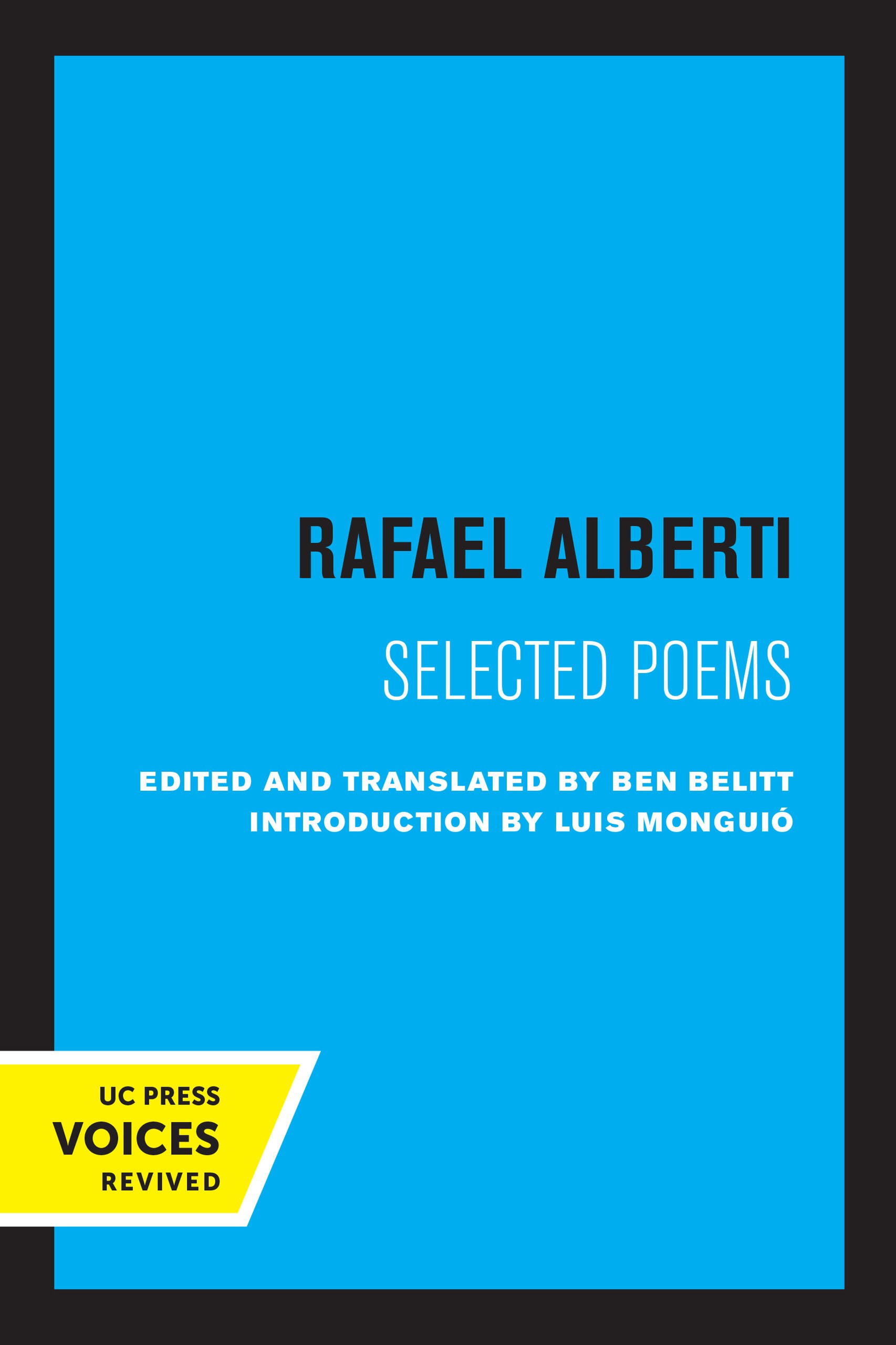
Edition: University of California Press paperback · translated and edited by Ben Belitt, introduction by Luis Monguió · ISBN 9780520307940.
This selection crosses the early maritime lyrics, the darker angel poems and the politically charged work of later decades. Start here to hear how radically Alberti changes register while retaining musical and visual pressure.
For the great rupture: Concerning the Angels
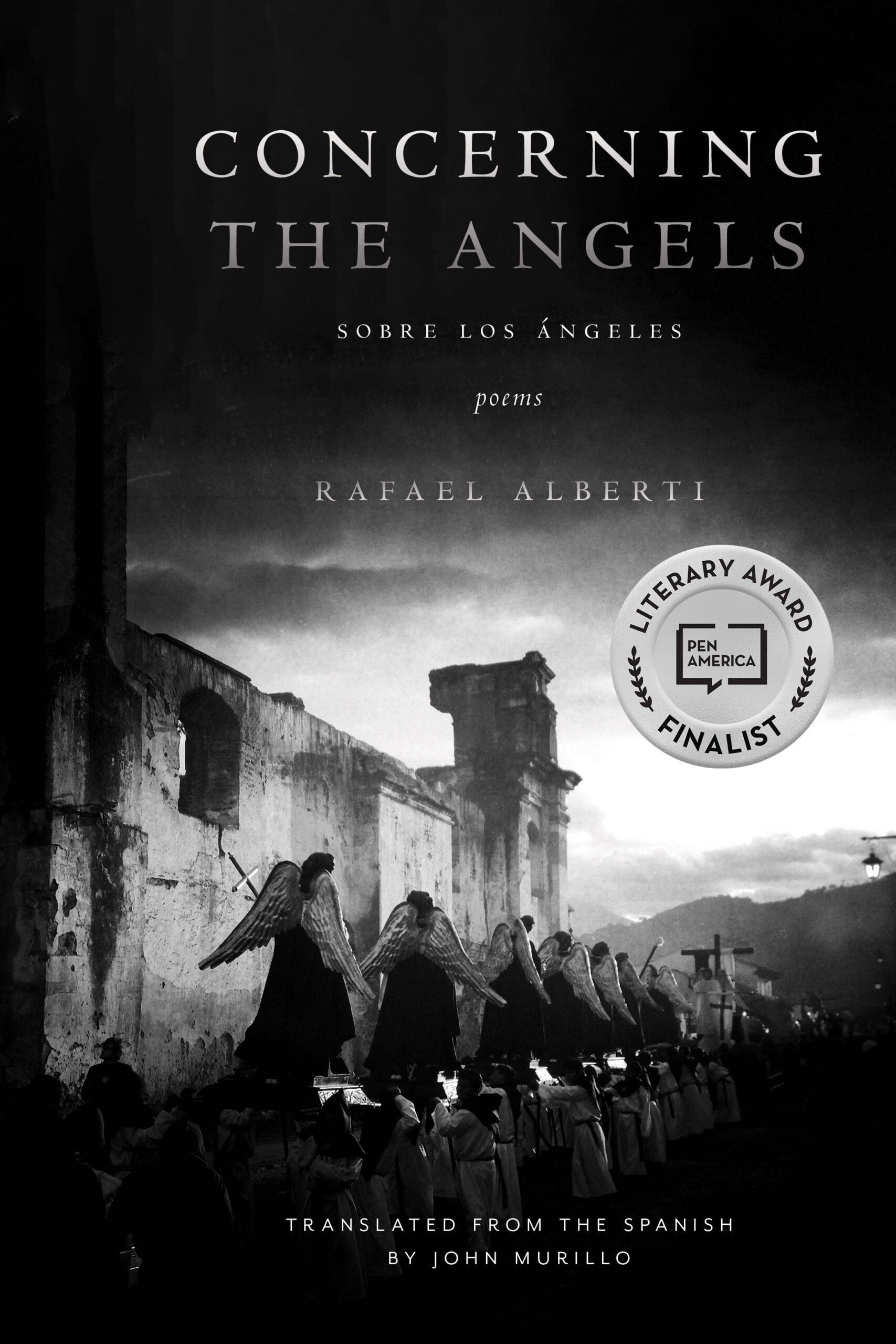
Edition: Four Way Books paperback, 2025 · translated with a foreword by John Murillo · 190 pages · ISBN 9781961897427.
This new translation makes Alberti’s 1929 sequence available as a sustained book rather than a handful of anthology pieces. Read it after several early songs so the break in atmosphere becomes audible.
For exile and living memory: Returnings: Poems of Love and Distance
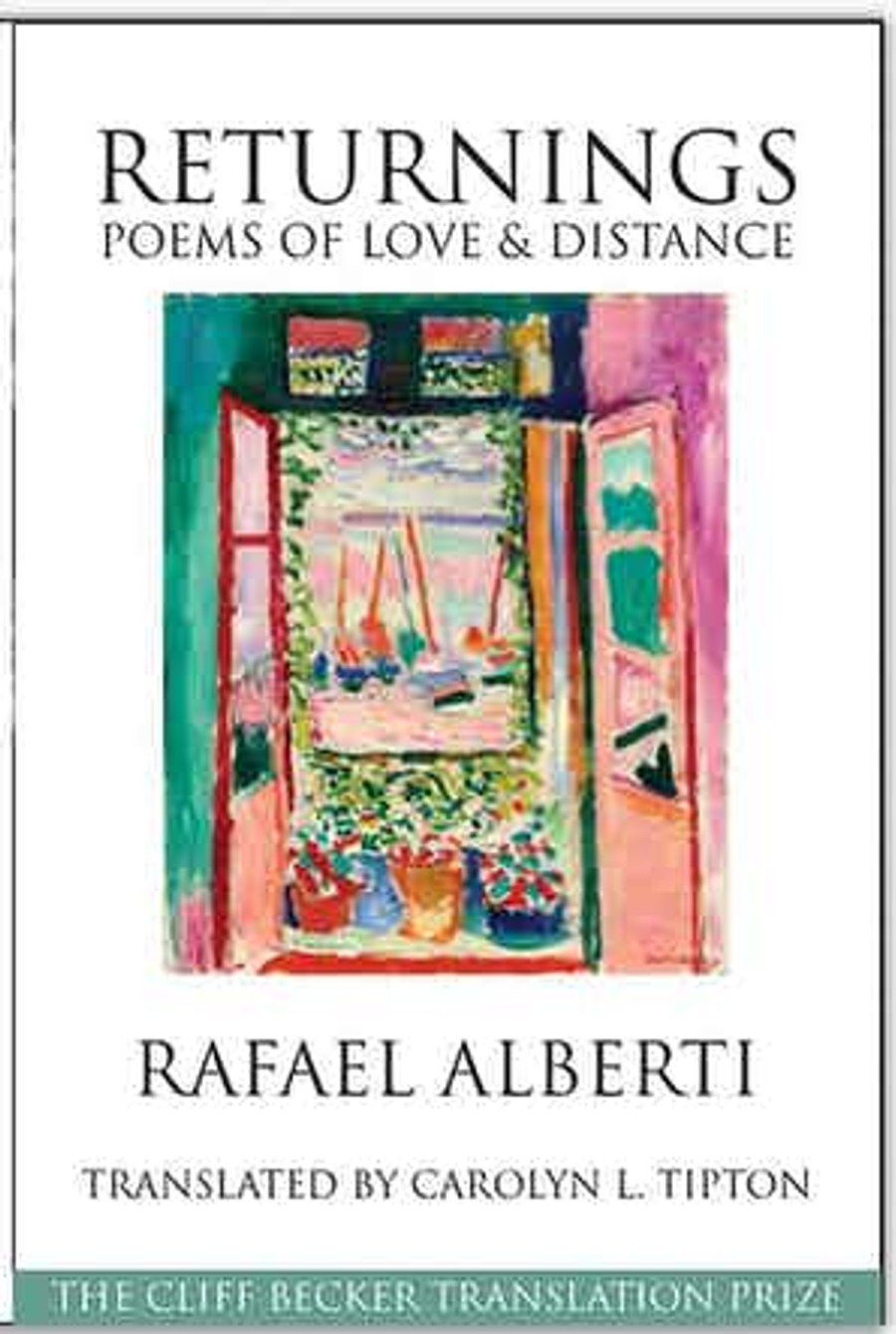
Edition: White Pine Press bilingual paperback, 2016 · translated with an introduction by Carolyn L. Tipton · 160 pages · ISBN 9781935210917.
These poems are the clearest entrance to Alberti’s art of return. Memory does not merely mourn what is gone; it reconstructs color, touch and movement until distance becomes temporarily inhabitable.
Why read Rafael Alberti now?
Alberti offers a model for writers living across media, languages and interrupted geographies. He shows that a voice can change form without losing continuity, and that political history can enter lyric work without eliminating intimacy.
He also gives translation a productive difficulty. “El mar. La mar.” cannot arrive intact in English. The loss should not be hidden. It reminds us that reading across languages means attending to what a translation carries, what it chooses and what it must leave visible as difference.
“The sea. The sea. / The sea. Only the sea!” The insistence sounds simple until we hear everything the sea has become: childhood, separation, art, country and the element to which a life keeps returning without ever arriving in the same form.
Sources and edition notes
- Instituto Cervantes: Rafael Alberti biography
- Centro Virtual Cervantes: Rafael Alberti chronology
- Biblioteca Virtual Miguel de Cervantes: “El mar, la mar,” read by Rafael Alberti
- University of California Press: Rafael Alberti: Selected Poems
- Four Way Books: Concerning the Angels
- White Pine Press: Returnings: Poems of Love and Distance
- Agencia Literaria Carmen Balcells: The Lost Grove
The opening English lines are DeepCrafter’s literal rendering of “El mar. La mar. / El mar. ¡Sólo la mar!” from Marinero en tierra. They are used with the Spanish source and translation status identified for literary commentary. The cover is a DeepCrafter-created illustrated quotation card, not an archival photograph. Book-cover images identify the specific publisher editions discussed.