When Universal Meant Half the World: Olympe de Gouges and the Courage to Rewrite Rights
On the anniversary of Olympe de Gouges’s execution, read the playwright who rewrote revolutionary rights—and learn how form can make exclusion visible.
When Universal Meant Half the World: Olympe de Gouges and the Courage to Rewrite Rights
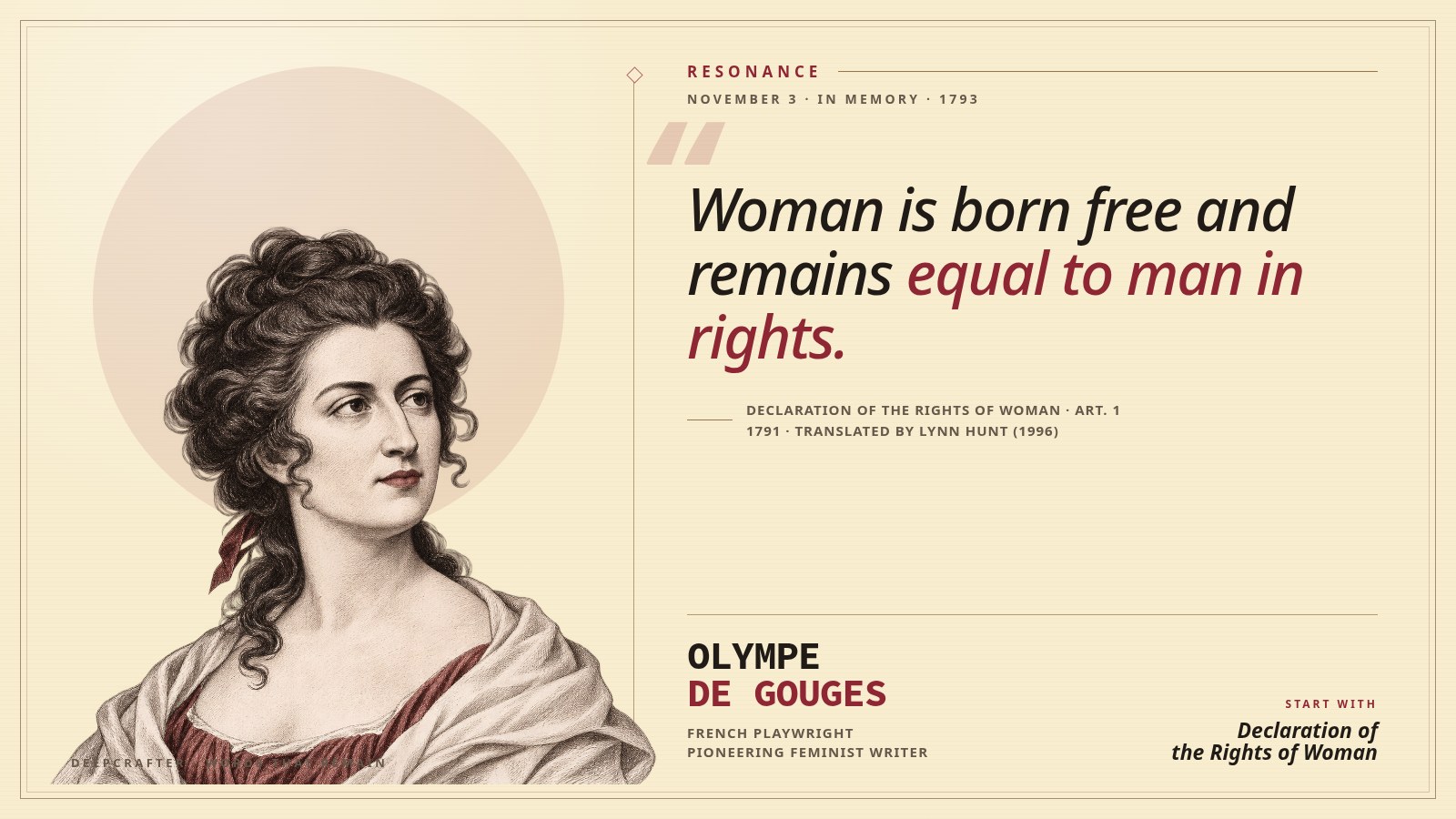
“Woman is born free and remains equal to man in rights.”
Why we chose Olympe de Gouges today
Olympe de Gouges was executed in Paris on November 3, 1793. For the anniversary of her death, we chose the opening of Article 1 from The Declaration of the Rights of Woman (1791), in Lynn Hunt’s translation, because the sentence performs her most characteristic literary act: it takes language that claims to be universal and makes its exclusion visible.
The line sounds almost self-evident now. In revolutionary France, it was an accusation. The Declaration of the Rights of Man and of the Citizen had announced liberty and equality while political citizenship remained male. De Gouges did not answer with a detached essay. She rewrote the authoritative form itself—article by article—so that the missing citizen could no longer remain grammatically invisible.
That is why she matters not only as a political figure but as a writer. She understood that power lives in genres: in declarations, theatre programs, petitions, posters, dedications, preambles and contracts. To challenge an institution, she often entered its language, altered the speaker and forced its promises to answer a new claimant.
Her life ended on the scaffold, but it should not be reduced to a prophecy fulfilled. The line is worth reading because it belongs to a much larger body of plays, pamphlets, public letters and proposals. De Gouges wrote to make abstract principles encounter concrete lives: women without legal power, children without recognized parentage, people enslaved in the colonies, debtors, the poor and political opponents facing death.
From Marie Gouze to a public author
She was born Marie Gouze in Montauban on May 7, 1748. Her first language was Occitan, and her formal education was limited. Married as a teenager and widowed soon afterward, she rejected the institution as she had experienced it, moved to Paris and fashioned a new public identity from her mother’s name: Olympe de Gouges.
The change was more than a pseudonym. It was an act of authorship applied to the self. In a society that assigned women a narrow domestic identity, she created a name capable of appearing on title pages, theatre bills and political placards.
She maintained secretaries during much of her literary career. John R. Cole describes The Rights of Woman as a text likely composed orally in stages; the Internet Encyclopedia of Philosophy notes that French was not her native language and that she worked with secretaries. Her enemies used this collaborative method to question whether she was truly an author. The surviving record points in the opposite direction: a writer answering criticism quickly, revising persistently and sustaining a recognizable argument across dozens of works.
The lesson for writers is useful. Authorship is not identical with solitary handwriting. A voice can be composed through speech, dictation, revision, performance and print. What makes the work hers is not the absence of assistance but the continuity of attention: the same injustices return, the same public courage sharpens, and the same belief in language as civic action keeps changing form.
Theatre before the declaration
De Gouges began with drama. The Internet Encyclopedia of Philosophy credits her with roughly forty plays, twelve of which survive. She published under her own name and chose subjects that the theatrical establishment considered improper for a woman: sexual coercion, imprisonment for debt, women’s agency, colonial slavery and the political limits placed on female speech.
Her antislavery play began as Zamore and Mirza; or, The Happy Shipwreck and was later staged as Black Slavery; or, The Happy Shipwreck. Written years before its performance, it reached the Comédie-Française in 1789 after delays and conflict. It placed enslaved characters at the center of the drama and treated the colonial system as a moral catastrophe rather than exotic scenery.
The production met fierce resistance and closed after only a few performances. De Gouges responded through the press and political channels. This pattern would define her career: when one gate closed, she changed the delivery system. A rejected or sabotaged play became a pamphlet, a public dispute, a demand for institutional reform.
Her theatre also reveals a strength and a limitation. She used melodrama, reversal and direct moral confrontation to make distant suffering emotionally legible to Parisian audiences. At the same time, her antislavery imagination remained shaped by the conventions and paternalism of eighteenth-century European theatre. Reading her seriously means holding both facts together: she challenged a profitable colonial order, and she did so from within forms that did not escape every hierarchy of her world.
Rewriting the universal
In September 1791, the French constitution incorporated the Declaration of the Rights of Man and of the Citizen. Women had participated in the Revolution, but its constitutional citizen remained male. De Gouges answered with The Rights of Woman, a pamphlet far stranger and more ambitious than its most famous quotations suggest.
It includes a dedication to Marie Antoinette, a preamble addressed to men, seventeen articles, a postscript, an episode involving a dispute with a cab driver and a proposed social contract between a man and a woman. The mixture is part of its force. Public law, domestic economics, sexual double standards, illegitimate children and an ordinary quarrel over money occupy the same argumentative space.
The declaration’s method is imitation with pressure applied. De Gouges preserves the cadence and architecture of an authoritative text, then changes who can speak inside it. Her first article exposes the false neutrality of “man.” Later articles insist that women who bear legal punishment must also possess public voice; that free expression includes the right to name a child’s father; and that equality must enter property, inheritance and marriage rather than remain a ceremonial word.
For writers, this is a powerful structural technique. Do not merely criticize a form from outside. Rebuild it with one excluded subject placed at the center. A contract rewritten by the person it disadvantages will reveal assumptions that an explanatory essay may leave abstract. A quest narrated by the person treated as a prize will expose the genre’s hidden economy. A family chronicle retold by the erased child will change what counts as inheritance.
De Gouges’s declaration works because its argument is carried by form. The reader does not only hear that revolutionary universalism is incomplete. The reader watches its sentences become unstable when a woman claims their promises literally.
A writer of proposals, not only protest
It is tempting to remember de Gouges as a voice of refusal. Her writing was equally full of designs. Across pamphlets and plays she argued for protections for unmarried mothers and children, more equitable divorce, public assistance, taxation directed toward social need, jury trials and opposition to the death penalty.
This practical imagination gives her work unusual texture. She did not stop after naming an injustice. She asked what institution, procedure or contract would have to change. Even the postscript to The Rights of Woman moves from declaration toward a proposed agreement governing property and parental responsibility.
The habit matters for fiction as well as political writing. A social system becomes dramatically credible when the writer can imagine its paperwork. Who signs? Who inherits? Who is believed? What happens to a child whose father is legally silent? Who pays when a promise fails? De Gouges repeatedly drags large ideals into the room where property, reputation and survival are negotiated.
Her proposals were not a perfectly consistent political system. She admired Rousseau while revising his gendered assumptions. She could support constitutional monarchy while demanding political equality. She defended Louis XVI against execution without endorsing absolutism. These tensions are not incidental flaws to edit away. They show a writer thinking publicly while events accelerated around her.
Writing at the speed of revolution
The French Revolution transformed her working practice. The stage remained important, but the pamphlet and poster offered speed. Clarissa Palmer’s translation project describes de Gouges freely distributing texts around Paris; the Library of Congress catalogue records a flood of addresses, letters, warnings, testaments and political appeals.
Her public writing often begins by naming an audience directly: the queen, the National Assembly, French women, citizens, political enemies. This gives the prose the pressure of a scene. Someone is being asked to answer. The reader enters not a private meditation but an argument already in motion.
She also understood serial identity. “Olympe de Gouges” became a continuing speaker across media, one text recalling and revising another. Modern writers might recognize the principle: a public voice grows not from repeating one slogan but from returning to a durable set of questions through different forms.
The cost was real. Publication exposed her to ridicule, censorship and danger. Her persistence should not be romanticized as a productivity ritual. She wrote quickly because the political situation changed quickly, and because access to formal power was denied to her. Print was one of the few rostrums she could build herself.
The final political conflict
By 1793, de Gouges opposed the execution of Louis XVI and the concentration of revolutionary power. In The Three Urns, she proposed that voters choose among three forms of government: a republic, a federal system or a constitutional monarchy. The pamphlet was treated as seditious and used in the case against her.
She was arrested, tried by the Revolutionary Tribunal and executed on November 3. It is important to state the history precisely. Her advocacy for women’s rights made her a target of gendered hostility, but The Declaration of the Rights of Woman was not the single legal cause of her death. Her continued political publication, her Girondin sympathies and her challenge to the ruling faction during the Terror formed the immediate context.
That distinction makes her courage clearer, not smaller. She kept writing when the danger was no longer metaphorical. Her defense of free expression included speech she knew would be unwelcome to every stable faction.
Five craft lessons from Olympe de Gouges
1. Let form carry the argument
Choose a genre whose authority your subject needs to challenge—a law, a prayer, a contract, a confession—and alter who is allowed to speak inside it.
2. Make the universal answer a specific life
Abstract equality becomes meaningful only when it reaches inheritance, wages, parentage, safety and voice. Put the principle under material pressure.
3. Change media when a gate closes
De Gouges moved between theatre, pamphlet, poster and public letter. A blocked form does not always mean the idea is finished; it may need a different audience relationship.
4. Address someone who can resist
Her prose gains urgency from direct address. Give the text an addressee with power to refuse, distort or punish the claim.
5. Preserve contradiction where history produced it
De Gouges was radical in some claims and cautious or inconsistent in others. A credible political character should not sound as if every belief was composed at the same moment by the same later consensus.
A de Gouges exercise for fiction writers
Write a 1,000-word document from inside your fictional world.
- Begin with an official text that claims to apply to everyone: a charter, oath, treaty, school rule or inheritance code.
- Give the document to a person excluded by one apparently neutral word.
- Let them rewrite five clauses rather than explain the injustice in summary.
- After each clause, show one concrete consequence involving money, family, movement, bodily safety or public speech.
- Add a postscript in a less formal voice where the writer reveals what the official genre could not contain.
- End with an addressee who must decide whether to acknowledge the rewritten text.
On revision, remove any paragraph that merely announces the theme. Keep the altered language, the material stakes and the conflict between the speaker and the institution.
Where to start reading
For the declaration in full: Between the Queen and the Cabby
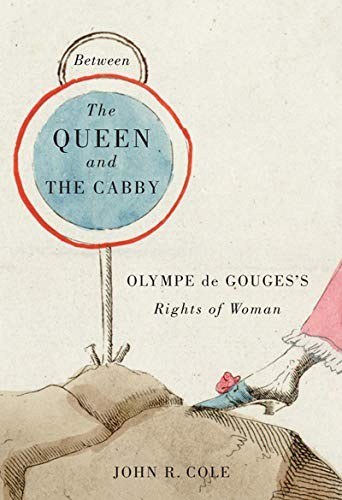
Edition: John R. Cole, McGill-Queen’s University Press hardcover, 2011 · 328 pages · ISBN 9780773538863.
Start here for the first complete English translation of The Rights of Woman alongside sustained commentary. Cole keeps the dedication, declaration, proposed social contract and cab-fare episode together, allowing readers to see a deliberately unruly pamphlet rather than a handful of anthology quotations.
For the revolutionary argument around it: The French Revolution and Human Rights
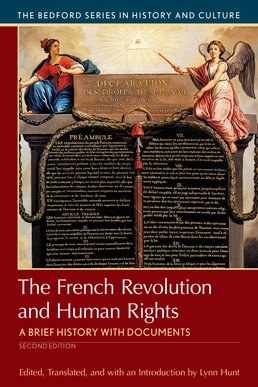
Edition: Lynn Hunt, editor and translator, Bedford/St. Martin’s, 2nd edition, 2016 · paperback ISBN 9781319049034.
Read de Gouges beside the documents that defined, extended and restricted revolutionary rights. Hunt’s collection places her declaration among debates over citizenship, slavery, women’s political activity and national security. It is the best route for understanding why the opening sentence was not merely inspirational language but an intervention in a contested legal vocabulary.
For de Gouges as a philosopher: Olympe de Gouges
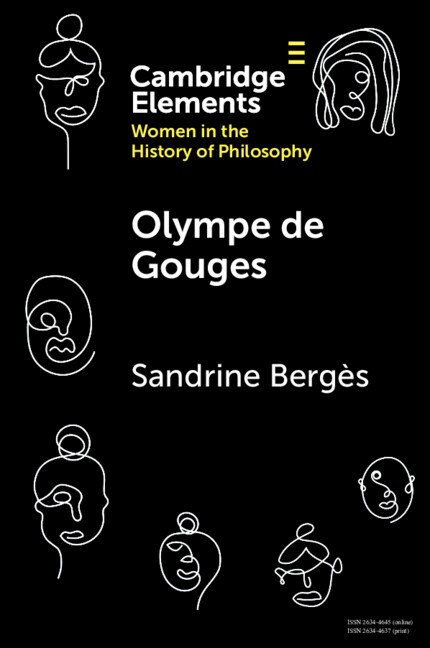
Edition: Sandrine Bergès, Cambridge University Press, 2022 · 76 pages · paperback ISBN 9781009010528.
Use this concise study to move beyond the single famous declaration. Bergès reads the plays, pamphlets and philosophical writing together, asking how genre affects what counts as philosophy. The result is especially useful for writers: it treats theatrical and political form as ways of thinking, not as decoration around an argument.
Why read de Gouges now?
We still live among sentences that call themselves universal while quietly imagining a default person. We still confuse polished neutrality with fairness. And we still underestimate forms that arrive outside the approved venue: the play that carries philosophy, the poster that contains constitutional thought, the postscript that exposes what the official document cannot say.
De Gouges offers a demanding model. She did not simply request inclusion in existing language. She tested that language until its exclusions became audible. She made public principles answer private arrangements and turned literary form into a site of citizenship.
The most useful question her work leaves a writer is not “What do I believe?” It is more structural: what form currently makes my subject invisible, and what happens if the missing person rewrites it from the first line?
Sources and edition notes
- Library of Congress: Olympe de Gouges
- Internet Encyclopedia of Philosophy: Olympe de Gouges
- Clarissa Palmer: Olympe de Gouges — English translations of plays and texts
- George Mason University, Liberty, Equality, Fraternity: The Declaration of the Rights of Woman
- JSTOR: John R. Cole, Between the Queen and the Cabby
- Macmillan Learning: Lynn Hunt, The French Revolution and Human Rights
- Cambridge University Press: Sandrine Bergès, Olympe de Gouges
The opening quotation is from Article 1 of The Declaration of the Rights of Woman (September 1791), translated by Lynn Hunt in The French Revolution and Human Rights: A Brief Documentary History (1996). The website cover is DeepCrafter’s original illustrated Resonance card, not an archival portrait. The three book-cover images identify the specific editions discussed.
Sources
- Library of Congress: Olympe de Gouges
- Internet Encyclopedia of Philosophy: Olympe de Gouges
- Clarissa Palmer: Olympe de Gouges — Plays and Texts
- George Mason University: Declaration of the Rights of Woman
- JSTOR: Between the Queen and the Cabby
- Macmillan Learning: The French Revolution and Human Rights
- Cambridge University Press: Olympe de Gouges