The Sky Beneath the Earth: Methil Radhakrishnan and the Freedom to Make Language Strange
Kerala's highest literary honour returns attention to a Malayalam writer who makes science, poetry and narrative change one another.
The Sky Beneath the Earth: Methil Radhakrishnan and the Freedom to Make Language Strange
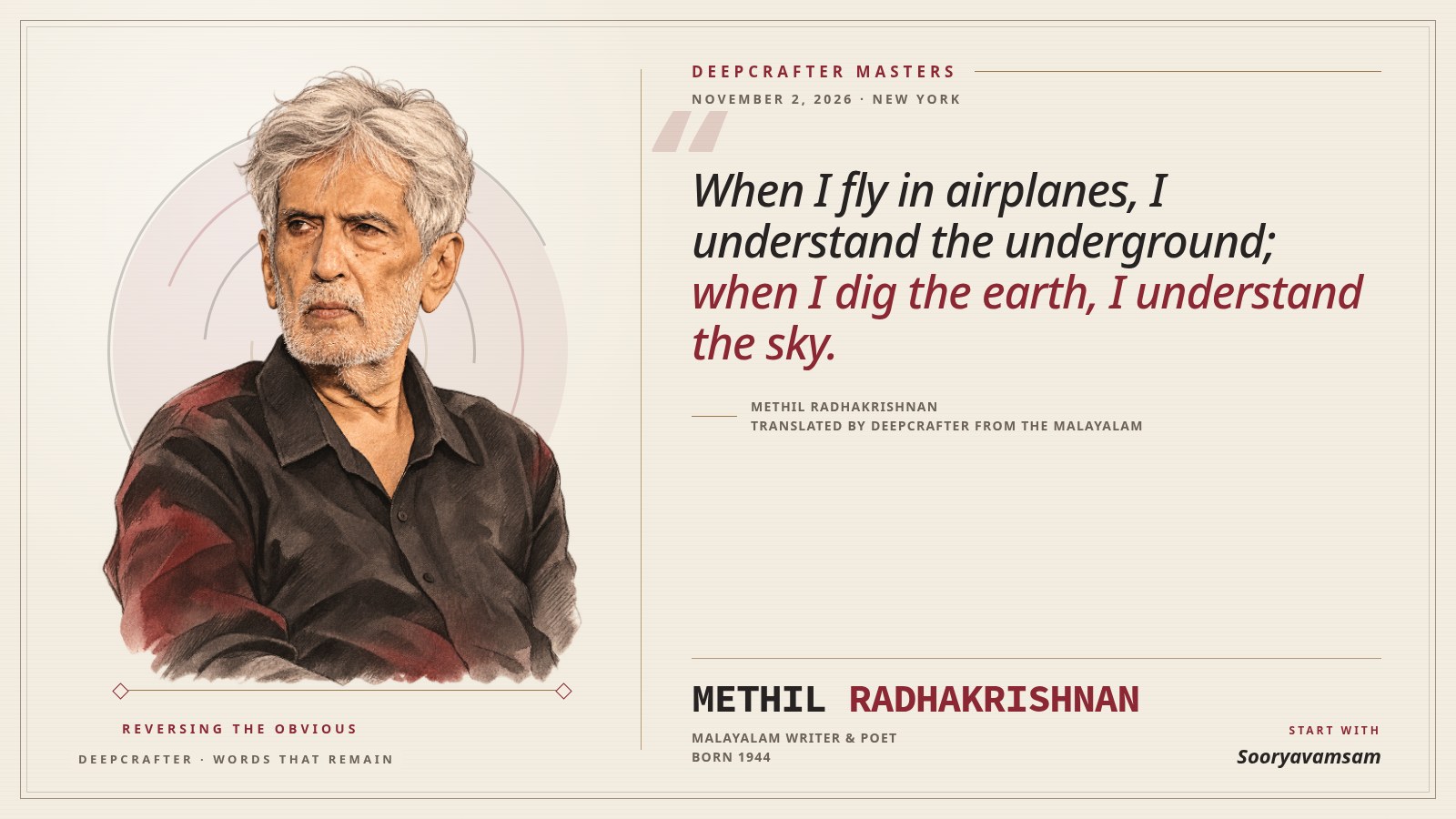
“When I fly in airplanes, I understand the underground; when I dig the earth, I understand the sky.”
Why we chose Methil Radhakrishnan now
On November 1, the Government of Kerala announced that Methil Radhakrishnan had been selected for the 2026 Ezhuthachan Puraskaram, the state’s highest literary honour. The award recognizes a lifetime of work that has moved restlessly among fiction, poetry, essays, science, music, philosophy and the natural world.
The news came with an important complication. In 2016, after the previous year’s Kerala Sahitya Akademi awards were announced, Methil declined an award for overall contribution. He said that he did not accept literary academies. This time, however, he has publicly welcomed the Ezhuthachan honour. He told reporters that he was happy to receive it and discussed the practical possibility of holding the presentation in Kozhikode because long-distance travel is difficult. The award has therefore been accepted in principle; the formal presentation has not yet taken place.
That distinction matters because it prevents a tidy but false story about a rebel finally submitting to recognition. Methil’s response is more particular. One institution was refused; another honour, conferred by the state government, has been welcomed. The writer who distrusts systems has not stopped making distinctions.
For today’s quotation, we chose a line displayed on his Manorama author page: “When I fly in airplanes, I understand the underground; when I dig the earth, I understand the sky.” Our English version is a direct translation from the Malayalam. The sentence turns perspective into a reversible instrument. Height does not merely reveal the earth below, and digging does not merely lead downward. Each position makes its apparent opposite newly visible.
That is an excellent entrance to Methil’s work. His writing repeatedly unsettles the category in front of it. A story can behave like an essay, a scientific observation can generate a metaphor, and an ordinary object can open into a philosophical structure. He does not join distant fields in order to display learning. He places them under pressure until the reader must reconsider what counts as near, obvious or real.
A writer formed against the expected route
Methil Radhakrishnan was born on August 24, 1944, in Puthiyankam near Alathur in Kerala’s Palakkad district. He studied at Government College, Chittur, and Kerala Varma College in Thrissur. His entry into literary life arrived early: while awaiting his tenth-standard examination results, he wrote a critical article on Ponkunnam Varkey’s autobiography. At eighteen, he wrote the story Octopusinte Shavam.
His first novel, Sooryavamsam, was written around 1970 while he was completing his degree. The book became a landmark of experimental Malayalam fiction. It was followed by works including Bra and Chuvanna Vidushakarude Anchampathi, titles that helped establish what readers came to recognize as a distinctly “Methilian” imagination: intellectually mobile, formally disobedient and unwilling to separate the sensual from the conceptual.
The official Ezhuthachan jury described him as a poet in everything he writes—not only in poems, but in stories, novels, essays and brief notes. It singled out the architecture of his short fiction and the unusual range of knowledge entering his prose: world poetry, philosophy, ecology, music, anthropology, history and entomology. That list is revealing. It describes not a collection of topics but a method of attention.
Methil’s metaphors often behave like discoveries. A scientific instrument, an insect, a piece of music or a machine is not decorative evidence that the author has read widely. It changes the logic of the sentence. The unfamiliar comparison becomes a way to test reality rather than a flourish added after reality has already been understood.
The computer expert and the long silence
Methil’s career also resists the romantic image of the writer living entirely inside literature. He led the computer department of a Norwegian shipping company and later worked as a senior technical writer for the Madras branch of NEST Software USA. These were not incidental jobs in the margins of a literary life. Systems, machines and precise explanatory language became part of the intellectual climate from which he wrote.
After his early books, he stopped writing for roughly two decades. The silence is one of the most striking turns in his career. It was not a brief pause between projects or a retreat staged for literary mythology. He worked in computing and remained away from publication before returning in the 1990s with Dylan Thomasinte Panthu.
For writers, the gap is worth considering without turning it into a motivational parable. A long silence may alter the instrument. When Methil returned, he did not have to imitate the younger writer who had made his name in the 1970s. The worlds of software, technical prose, scientific inquiry and changing media had entered the field.
This is one reason his work feels difficult to place on a single literary timeline. The early experimentalist and the later essayist are connected, but not by continuous production. The interruption itself becomes part of the shape of the career.
Science as a way of making form
The Ezhuthachan jury praised Methil for creating new arrangements within Malayalam over decades. “Arrangement” is a useful word. His innovation is not simply a matter of unusual vocabulary. It lies in what different kinds of knowledge are allowed to do beside one another.
In conventional explanatory prose, science supplies facts and literature supplies feeling. Methil’s writing refuses that division. Scientific concepts can reorganize emotion; lyric images can make an argument; an animal or machine can disturb the hierarchy between human observer and observed world.
This produces several recurring pressures in his work:
1. The opposite viewpoint is not secondary
The sky can be approached by digging. The underground can be understood from an airplane. A scene becomes more interesting when the apparent opposite of its setting is allowed to determine its meaning.
2. Knowledge changes the sentence
Research is not pasted onto the surface. A technical or biological idea alters rhythm, comparison and causality. The prose thinks with its material.
3. Genre remains provisional
Methil writes poetry, novels, stories, essays and columns, but the borders are porous. A narrative may pause to investigate an idea; an essay may proceed through image and surprise.
4. Difficulty recruits the reader
The work does not always provide a smooth path or a single authorized interpretation. The reader must complete relations among fragments, references and shifts of scale. Difficulty becomes a form of participation rather than a test of obedience.
Refusing the easy lesson
Methil’s relationship to literary recognition helps clarify the ethics behind this formal resistance. When he refused the Kerala Sahitya Akademi honour announced in 2016, the refusal was reported not as modesty but as distrust of academies. The decision belonged to a long skepticism about institutions that turn writing into rank, consensus or competition.
His acceptance of the Ezhuthachan Puraskaram should not be used to erase that skepticism. Nor should the earlier refusal be used to predict every later choice. The more interesting lesson is his insistence on judging the particular structure in front of him.
He has also resisted the role of literary elder as a universal advice-giver. Responding to the new award, he said that he could not offer advice to younger writers because they live under conditions entirely different from his own. That answer is more generous than a list of rules. It recognizes that craft cannot be separated from the technical, economic and social world in which a writer works.
The practical example of his career is therefore not “write as Methil wrote.” It is: identify which inherited categories no longer describe your conditions, and build a form capable of thinking inside the new ones.
A Methil exercise for writers
Write a 900-word scene in which one physical action reveals its apparent opposite.
- Choose an action with a clear direction: climbing, digging, entering, leaving, enlarging or erasing.
- Give the point-of-view character one field of specialized knowledge—botany, acoustics, coding, astronomy, carpentry or another discipline you can research precisely.
- Let that knowledge alter one metaphor, one decision and the order in which information appears.
- Halfway through, make the action disclose the opposite of what it promised. Climbing may reveal what is buried; erasing may make a pattern legible.
- Do not explain the paradox in abstract language. Let objects, movements and sentence structure perform it.
On revision, underline every sentence that could survive unchanged in a story about a different profession or field of knowledge. Rewrite at least half of them. The research should not be removable decoration; it should change how the scene thinks.
Where to start reading
For the first rupture: Sooryavamsam
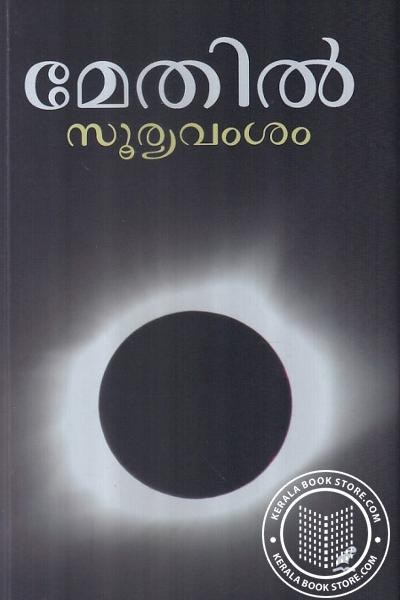
Edition: Mathrubhumi Books paperback, 2022 · 210 pages · ISBN 9789355494689. Malayalam text.
Written around 1970, Methil’s first novel is the clearest place to encounter the early break with familiar narrative order. The current edition marks fifty years since its publication and includes illustrations by Namboothiri. Read it for the way love, time and astronomical scale are made to occupy the same imaginative structure. The novel does not merely tell an unconventional story; it changes the dimensions in which a story can occur.
For the architecture of the stories: Methil Kadhakal
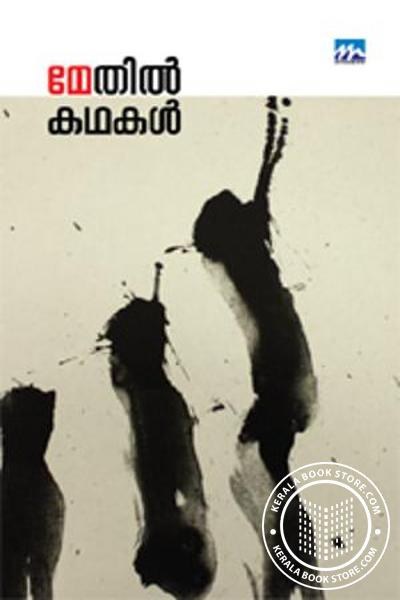
Edition: Mathrubhumi Books paperback, 2013 · 350 pages · ISBN 9788182670532. Malayalam text.
This collection gathers the short fiction through which Methil’s distinctive narrative architecture became most visible. Begin here if you want to see how a story can carry scientific observation, philosophical pressure and moments of wonder without settling into an essay. The official award jury called him an architect of the short story; this volume lets readers test that description across a sustained body of work.
For the poetic instrument: Bhoomiyeyum Maranatheyum Kurichu
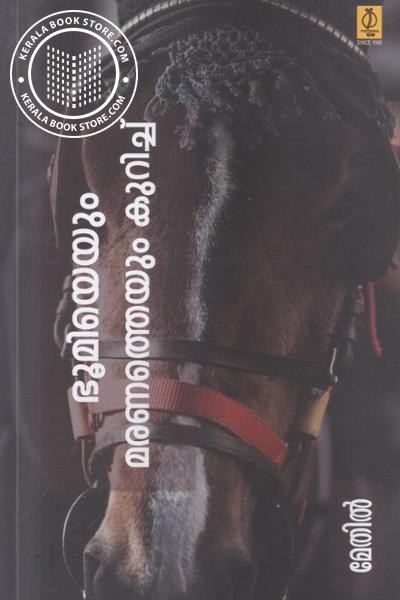
Edition: Poorna Publications paperback, September 2017 · 140 pages · ISBN 9788130019215. Malayalam text.
The title can be rendered as About the Earth and Death. This collection is the best of the three starting points for hearing how Methil’s scientific and ecological imagination behaves under the compression of poetry. Read it after the novel and stories to recognize the same reversals of scale in their most concentrated form: earth and cosmos, organism and observer, material fact and metaphysical question.
These editions are in Malayalam. We did not find a current, verifiable English edition of the three books, so this reading path does not imply English availability.
Why read Methil now?
Contemporary writing is often pushed toward immediate legibility. Categories must be clear, references frictionless and every difficulty quickly translated into a takeaway. Methil Radhakrishnan offers a different model: writing can enlarge a reader’s capacity by changing the arrangement of attention.
His career also challenges the demand for a seamless public identity. He wrote early, stopped for years, worked with computers and technical language, returned, refused one honour and accepted another. None of these turns resolves into a single slogan. Their value lies in the precision of the distinctions.
The quotation on today’s card gives us the method in miniature. To understand what is below, change your height. To understand the sky, work the earth. The writer’s task is not always to move directly toward the named subject. Sometimes it is to find the position from which the subject’s opposite becomes visible.
Sources and edition notes
- Government of Kerala, Information & Public Relations Department: 2026 Ezhuthachan Puraskaram announcement
- The New Indian Express: award announcement and jury details
- Malayali Vartha: Methil’s response to the award
- Manorama Online: report on his refusal of the Kerala Sahitya Akademi honour
- Manorama author page: source of the opening Malayalam quotation
- Kerala Book Store: Sooryavamsam, 2022 edition
- Kerala Book Store: Methil Kadhakal, 2013 edition
- Kerala Book Store: Bhoomiyeyum Maranatheyum Kurichu, 2017 edition
The opening is a brief quotation translated by DeepCrafter from Malayalam for literary commentary. The website cover is DeepCrafter’s original illustrated Masters card, not an archival photograph. The three book-cover images identify the specific editions discussed.
Sources
- Government of Kerala: 2026 Ezhuthachan Puraskaram announcement
- The New Indian Express: award announcement and jury details
- Malayali Vartha: Methil's response to the award
- Manorama Online: refusal of the Kerala Sahitya Akademi honour
- Manorama author page: opening Malayalam quotation
- Kerala Book Store: Sooryavamsam, 2022 edition
- Kerala Book Store: Methil Kadhakal, 2013 edition
- Kerala Book Store: Bhoomiyeyum Maranatheyum Kurichu, 2017 edition