Before Words, the World: John Berger and the Ethics of Attention
On John Berger’s centenary, follow the painter, critic, novelist and storyteller who taught generations to question the frame—and to look with greater care.
Before Words, the World: John Berger and the Ethics of Attention
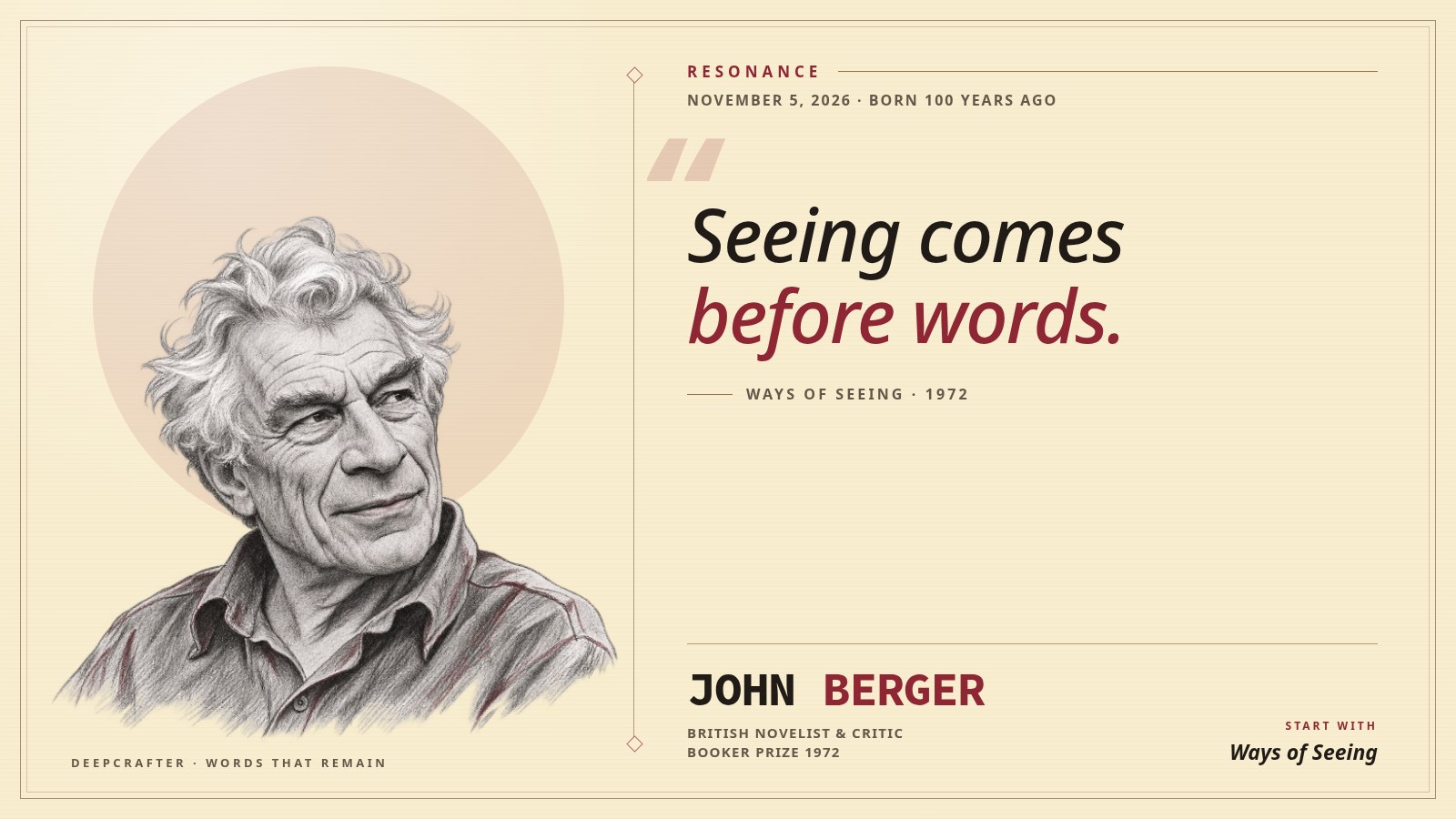
“Seeing comes before words.”
Why we chose John Berger today
John Berger was born in London on November 5, 1926. On the centenary of his birth, we chose the opening sentence of Ways of Seeing because it contains the movement that animates his whole body of work: first attend to what is in front of you; then ask who taught you to see it that way.
The line is memorable because it is simple without being innocent. A child looks before speaking, Berger writes, but every later act of looking is entangled with knowledge, history, ownership and desire. Words explain the world, yet they never fully settle the relation between what we see and what we know.
That tension made Berger an unusual kind of writer. He began as a painter, became a combative art critic, wrote experimental novels, made films and television, collaborated with photographers, and spent decades listening to Alpine farmers, migrant workers, doctors, political prisoners and the displaced. He preferred the word “storyteller” to any single professional label.
For writers, Berger offers more than a theory of images. He offers a practice of attention: look long enough for the official description to become unstable; place private sensation beside public history; and let form change when one medium cannot hold the whole truth.
The painter who turned toward sentences
Berger served in the British Army from 1944 to 1946 and then studied art in London. He exhibited as a painter and taught drawing before criticism became his principal public form. During the 1950s, his essays for the New Statesman argued that a painting could not be separated from the social world that produced it.
He did not abandon the painter’s eye when he moved into prose. His sentences often begin with position, distance, light, gesture or texture. A body leans. A hand crosses a table. A face is looked at from a particular angle. Description is never neutral inventory; it establishes a relation between the observer and the observed.
This is one of Berger’s most useful lessons for fiction. Before explaining what a scene means, decide where the character is standing. What can they see? What is hidden by the frame? What has money, custom or fear trained them not to notice? Point of view is not merely a grammatical choice. It is an arrangement of power.
Ways of Seeing: criticism built by montage
In 1972 Berger presented the four-part BBC television series Ways of Seeing, made with Mike Dibb and a wider collaborative team. The book that followed retained the project’s radical structure. It combines words and images, includes three visual essays without continuous verbal argument, and treats reproduction itself as part of the meaning of art.
Berger’s central move was to remove inherited ceremony from the museum image. A painting reproduced on a television screen, cropped in a book or surrounded by advertising no longer occupies the same place or addresses the same audience. Its meaning travels—and institutions compete to control that journey.
The book also asks who looks and who is made into an object of looking. Berger’s analysis of the European nude distinguishes between being physically unclothed and being arranged for another person’s gaze. The argument helped give generations of readers a vocabulary for discussing gender, spectatorship and representation.
Yet Ways of Seeing remains alive because it does not replace one orthodoxy with another. It teaches a method: compare images, change the sequence, notice the caption, ask who owns the original, and test whether prestige has been mistaken for truth. Its form invites the reader to participate rather than merely receive a verdict.
The novel inside history: G.
The same year brought Berger’s novel G., winner of the 1972 Booker Prize. Set in Europe before the First World War, it follows a modern Don Juan through private encounters while revolutions, imperial conflicts and technological change gather around him.
The novel repeatedly breaks its own surface. The narrator interrupts, reflects, changes distance and reminds us that intimacy does not occur outside history. Bodies are singular, but the languages through which they are desired have been shaped by class, gender and political power.
Berger used the prize ceremony as another literary form. He publicly criticized the commercial history behind the sponsor’s wealth, gave half the prize money to the British Black Panther movement, and used the remainder to support the migrant-worker project that became A Seventh Man. The gesture connected the institutions around a book to the questions inside his work.
For contemporary writers, G. demonstrates that experiment need not cool emotion. Fragmentation can intensify tenderness when each break asks us to reconsider what a scene excludes. A novel may interrupt itself not to display cleverness but to restore the pressure of the world beyond its protagonist.
Collaboration as a way of knowing
Berger’s career unsettles the romantic image of the solitary author. He worked with photographers, filmmakers, designers, translators, actors and political organizers. With the Swiss photographer Jean Mohr, he created books in which image and text do not illustrate one another so much as argue, echo and leave necessary gaps.
A Fortunate Man follows the country doctor John Sassall and the community he serves. A Seventh Man examines migrant labour in Western Europe. In both, the collaboration changes what documentary writing can do. Photographs provide material evidence and resistant detail; Berger’s prose moves through economics, memory, longing and bodily experience. Neither medium claims the last word.
The British Library’s centenary account notes that A Seventh Man was the book of which Berger felt most proud. First published in 1975, it treats migration not as a marginal anomaly but as central to modern European prosperity. Its design, sequences and silences make the reader move between systems and individual lives.
This offers a practical principle: when a subject exceeds your habitual form, do not force it smaller. Invite another medium—or another person—to reveal what your own method cannot see.
From critic to village storyteller
Berger left Britain in 1962 and eventually settled in Quincy, a small farming village in the French Alps. The move altered his scale of attention. He continued to write about paintings and global politics, but daily work, animals, weather, tools, meals, aging and oral memory became central materials.
His trilogy Into Their Labours—Pig Earth, Once in Europa and Lilac and Flag—records the disappearance and migration of European peasant life through stories, poems, essays and testimony. The books do not turn the village into pastoral refuge. They attend to hardship, inheritance, economic displacement and the knowledge held in repeated physical acts.
Berger’s writing practice grew from proximity. He drew, listened, wrote letters, kept notebooks and returned to subjects across decades. He did not treat observation as extraction performed during a brief visit. Attention meant remaining available to correction.
For a writer, this is a demanding ethic. Research is not only collecting facts about people. It is spending enough time with their rhythms that your first category begins to fail. Berger’s best work waits for the person called “worker,” “migrant,” “peasant” or “patient” to exceed the word assigned to them.
Five craft lessons from John Berger
1. Establish the frame before interpreting the scene
Name what is visible, from where, and to whom. Then ask what lies outside the frame and who benefits from its absence.
2. Put images and words in productive tension
Do not make the image repeat the caption. Let each medium contribute evidence the other cannot supply.
3. Interrupt a story when history presses against it
A formal break can reveal the economic, political or remembered world that a seamless scene would conceal.
4. Collaborate without erasing difference
Berger’s strongest collaborations preserve the separate intelligence of photograph, design, testimony and prose. Unity does not require sameness.
5. Let attention revise your categories
Begin with a working description, but stay long enough for the subject to become more specific than the label.
A Berger exercise for fiction writers
Write a 1,200-word scene twice.
- In the first version, describe an ordinary exchange—a purchase, a medical visit, a meal or a departure—from one character’s physical position.
- Mark five details that the character sees but does not yet understand.
- Add one object or image whose ownership changes its meaning.
- In the second version, insert three brief interruptions: a memory, a public fact and a viewpoint outside the room.
- Remove every interruption that merely explains the theme. Keep only those that change the pressure of the scene.
- End with one visible gesture that now means something different because of the larger frame.
The goal is not to imitate Berger’s syntax. It is to test his central question: how does the relation between what we see and what we know remain unsettled?
Where to start reading
For learning to question the frame: Ways of Seeing
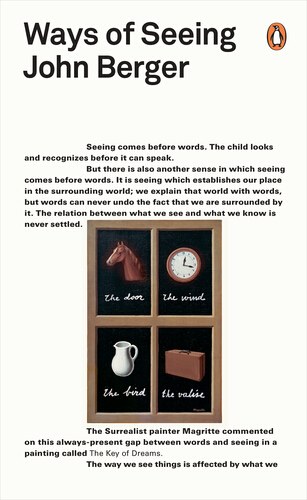
Edition: Penguin Modern Classics paperback, 2008 · 176 pages · ISBN 9780141035796.
Begin here for Berger’s clearest account of reproduction, ownership, advertising and the gendered gaze. Read it slowly enough to notice the sequences of images: the book’s design is part of its argument.
For the experimental novelist: G.
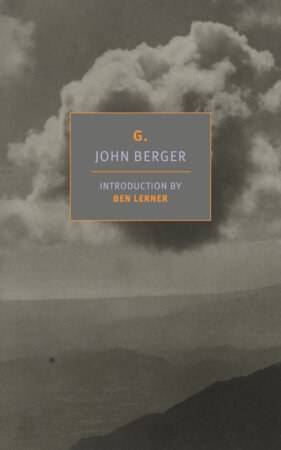
Edition: NYRB Classics paperback, introduction by Ben Lerner, 2026 · 384 pages · ISBN 9798896230557.
Read G. to see Berger place erotic experience inside political history without turning either into background. Its interruptions show how a novel can question its own authority while remaining sensuous and emotionally alert.
For documentary collaboration: A Seventh Man
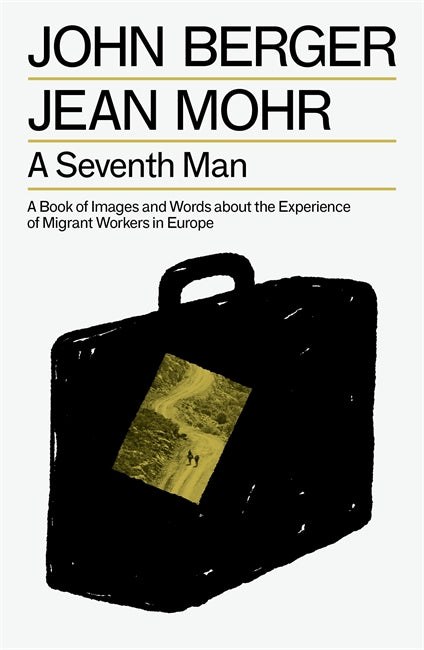
Edition: Verso paperback, 2025 · 256 pages · ISBN 9781804298565 · photographs by Jean Mohr.
Choose this book for Berger’s method at full collaborative strength. Text, photograph and design create a study of migrant labour whose form refuses to reduce people to examples of a system.
Why read Berger now?
We live among more images than Berger could have encountered in 1972, while the forces arranging those images have become harder to see. Crops, captions, recommendation systems and ownership structures still decide what enters the frame. Fluency in images has not made attention automatic.
Berger’s centenary matters because his work joins skepticism to tenderness. He asks who controls the picture, but he also asks what looking can give: recognition, companionship, witness and the possibility of seeing a person beyond an assigned category.
“Seeing comes before words” is not an argument against language. It is a standard for language. The sentence asks whether our words remain answerable to the world they claim to describe.
Sources and edition notes
- British Library: “A Seventh Man” by John Berger and Jean Mohr
- Penguin: Ways of Seeing
- The Booker Prizes: G.
- The Booker Prizes: John Berger’s 1972 acceptance speech
- Verso: A Seventh Man
- Verso: John Berger
- Canongate: A Fortunate Man
The opening quotation is the first sentence of Ways of Seeing (1972). The website cover is DeepCrafter’s original illustrated Resonance card, not an archival photograph. The three book-cover images identify the specific editions discussed.