A Voice Through Hell: Shane McCrae
The 2026 Lenore Marshall Poetry Prize opens a path into Shane McCrae’s writing life, formal practice and three books about memory, history and voice.
A Voice Through Hell: Shane McCrae
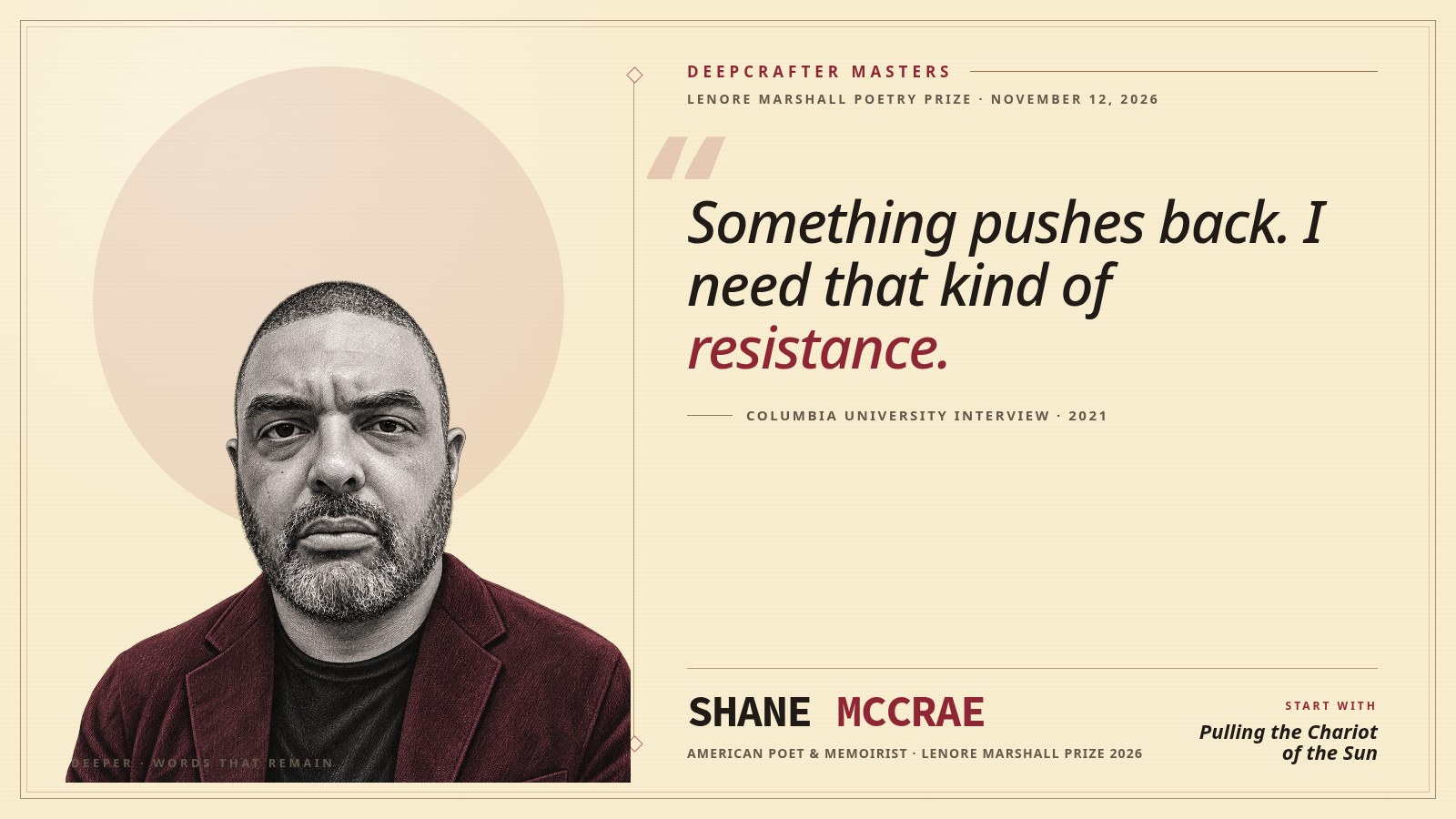
On November 12, 2026, the Academy of American Poets announced Shane McCrae as the winner of the Lenore Marshall Poetry Prize for New and Collected Hell. Published in 2025, the book-length poem has received a new invitation to readers, not a new publication date. The award brings $25,000 and a ten-day residency. The judges praised the coherence and movement of the work as a whole. Official announcement.
That emphasis offers a generous starting point for a writer: a book can grow not only by adding pages, but by discovering the relations between them. What makes accumulated work become a sustained journey? Today's prize opens a path into McCrae's writing life, his attention to sound, and three books that approach voice from different directions.
A future discovered in poetry
In a 2021 Columbia interview, McCrae recalled discovering poetry in tenth grade after hearing Sylvia Plath in a film. He began writing that day. What mattered was not instant accomplishment, but the discovery of a future he could imagine wanting.
His education later took him through community college and a four-year college, followed by graduate study in writing, law and literature. His first poetry collection, Mule, appeared in 2011. In the Language of My Captor became a 2017 National Book Award finalist and won the 2018 Anisfield-Wolf Book Award. He now teaches at Columbia and lives in New York, according to the Academy biography.
The sequence is worth holding onto without turning it into a formula. A writing life can include practical detours, paid work and changes of direction. None of those experiences needs to be edited out of the story of becoming a writer. The encouraging part is the continuing practice, not a promise that practice will produce a prize.
Memory without a false smoothness
McCrae's 2023 memoir, Pulling the Chariot of the Sun, supplies another entrance. In the account presented by the author and his publisher, his white maternal grandparents took him away from his Black father when he was three, concealed his history and raised him within their racism. The memoir follows his effort to reconstruct that history and his relationship with his father. This is an account of his life, not a license to reduce his art to what happened to him. Scribner's book page.
The publisher's reading guide draws attention to naming, fragmented scenes and uncertainty about memory. These features offer a useful question for anyone writing personal material: can the shape of a narrative acknowledge the limits of what its narrator knows?
Our suggested practice is small. In working notes, separate a remembered detail, something learned later from another person, and something still uncertain. Then write a scene without quietly upgrading all three to the same level of certainty. This is an editorial exercise, not McCrae's prescribed method. Its purpose is to make room for a voice that can be precise without pretending to be complete.
Sound gives thought something to work against
In the Columbia interview, McCrae describes meter as a productive resistance: a formal demand can lead him toward ideas he would not otherwise have reached. He also describes poetry through the relationship between sound and meaning. A poem does not communicate only by delivering information; its sounds can reinforce or trouble what its sentences seem to say.
For readers, that makes listening a practical beginning. Read a short passage aloud, first following its syntax and then attending more closely to its line endings. Where does your breath change? Where does the thought seem to turn back on itself? There is no need to solve every difficulty before hearing how the language moves.
For a writer, try giving one paragraph a limited formal task: repeat a sound, return to a phrase with a changed emphasis, or vary sentence length around one moment of hesitation. Ask what the constraint helped you discover. The task is not to imitate McCrae's voice, but to notice how a chosen resistance can create possibilities.
A working life, not a mythical routine
A reliable account of practice is more useful than an invented daily timetable. In Columbia's report of his 2023 memoir conversation, McCrae explained that he committed to shaping the memoir in 2020 and used an overall word-count target to organize the work. The report also records his concern with making uncertainty about memory part of an honest narrative.
There are two different kinds of structure here. One gives the writer a manageable amount of work; the other gives the work a truthful form. A schedule cannot settle an uncertain memory, and a compelling subject cannot finish a manuscript by itself. Keeping those tasks distinct can make both less overwhelming.
You might set a modest weekly word target while keeping a separate list of structural questions. Complete the day's writing before trying to answer all of them. This is our adaptation for readers, not a reconstruction of McCrae's present routine.
From separate poems to a single journey
Farrar, Straus and Giroux presents New and Collected Hell as a contemporary encounter with Dante and a culmination of a long-standing poetic project, bringing new and previous work together. That is the publisher's framing; it helps explain why the title should not be mistaken for a routine retrospective. Publisher's edition page.
The distinction matters beyond poetry. A group of stories may share a setting without yet forming a collection. Several essays may discuss one subject without yet developing an argument. A manuscript becomes more than an inventory when the order changes the reader's experience.
Try this with five existing pieces. Write one sentence naming the question each piece leaves open. Arrange them so that the next piece changes that question rather than merely repeating its topic. A gap may need a bridge; it may also be the pause that gives the sequence its energy. This is a revision exercise inspired by the event, not a claim about how McCrae assembled his book.
Three books, three ways into the voice
This reading path moves from memoir to a poetry collection and then to the award-winning long poem. It is an editorial recommendation, not a claim to have completed an exhaustive close reading. All three are English-language editions; no translator is involved. Dates and ISBNs below identify the linked editions, not automatically the first appearance of the work.
1. Pulling the Chariot of the Sun: A Memoir of a Kidnapping
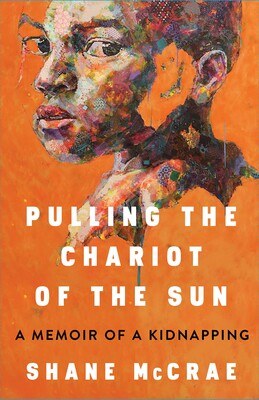
Shane McCrae. Scribner, eBook, August 1, 2023. ISBN 9781668021767. Edition and cover: Simon & Schuster.
Begin with the relationship between remembering and telling. Keep a note of moments where the narrator qualifies what he knows. Ask how that qualification changes your trust, rather than treating uncertainty as a defect to eliminate. The publisher's reading-group guide is a useful companion.
2. In the Language of My Captor
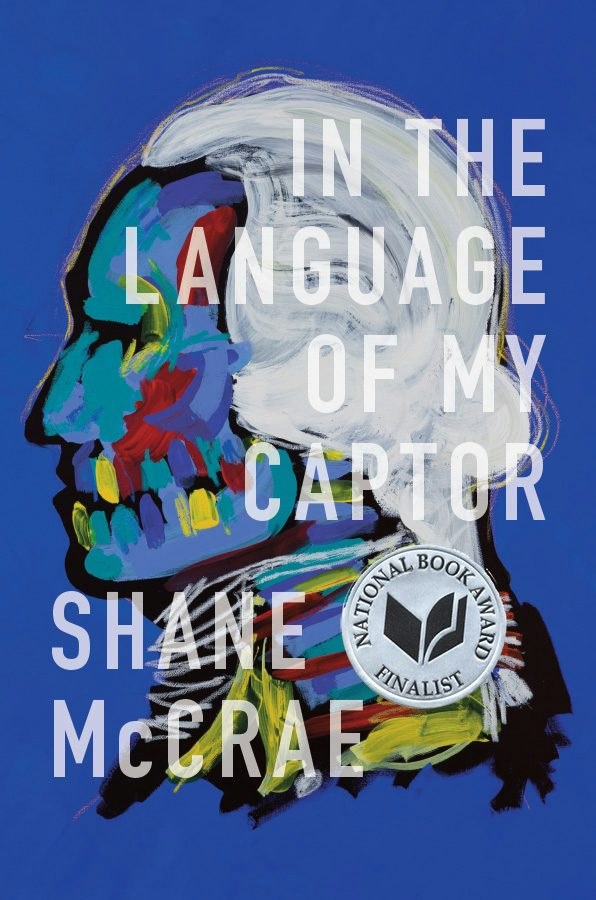
Shane McCrae. Wesleyan University Press, paperback, ISBN 9780819577122; publisher-listed sales date April 6, 2019. The collection first appeared in 2017. Edition and cover: Wesleyan University Press.
The publisher describes historical persona poems surrounding a central prose memoir. Read next for the change in distance between an individual life and public history. Notice who is speaking, what situation permits that speech, and how the prose section alters your approach to the surrounding poems.
3. New and Collected Hell: A Poem
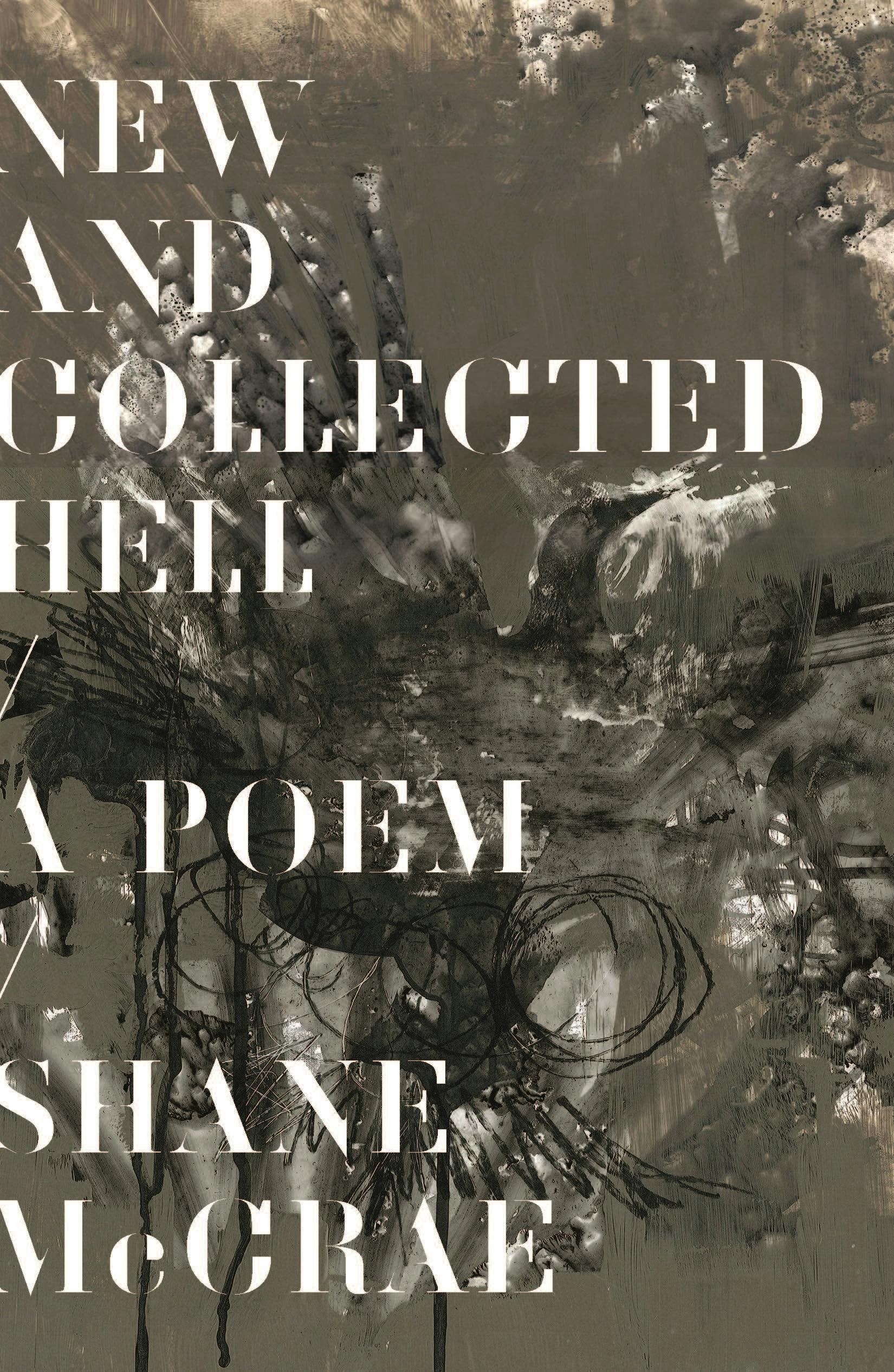
Shane McCrae. Farrar, Straus and Giroux, February 11, 2025, ISBN 9780374615499; 112 pages. Edition and cover: Macmillan / FSG.
Arrive here with an ear for rhythm and a sense of the writer's recurring questions. Read for movement across the whole book: what returns, what changes, and what a pause makes possible. The prize is a reason to open the work; the reading itself can take its own time.
Let the book become more than the stack
McCrae's new award is an occasion to encounter a substantial writing life. Its value for another writer need not be a grand lesson about overcoming everything. It can be something quieter and more usable: keep listening to the sentences, give the work a form, and allow earlier pages to enter new relationships.
Today, take five pages you already have. Find the question that runs between them. You may not need a new beginning so much as a more attentive way of continuing.
Sources and editorial scope
The award event and official reporting date are November 12, 2026; this article is dated November 13. The Academy announcement and biography establish the award and literary record. The two Columbia sources provide reported working practice and interview evidence. The three publisher pages identify editions, covers and their own descriptions of the works. Reading order, exercises and craft interpretations are DeepCrafter editorial suggestions. The cover is an original conceptual illustration, not a portrait or an image from the books. No claim is made that McCrae uses AI.