The Places That Look Back: Lawrence Durrell and the Geography of Memory
On Lawrence Durrell’s death anniversary, follow the writer of Justine and Bitter Lemons through place, memory, viewpoint and the politics of travel.
The Places That Look Back: Lawrence Durrell and the Geography of Memory
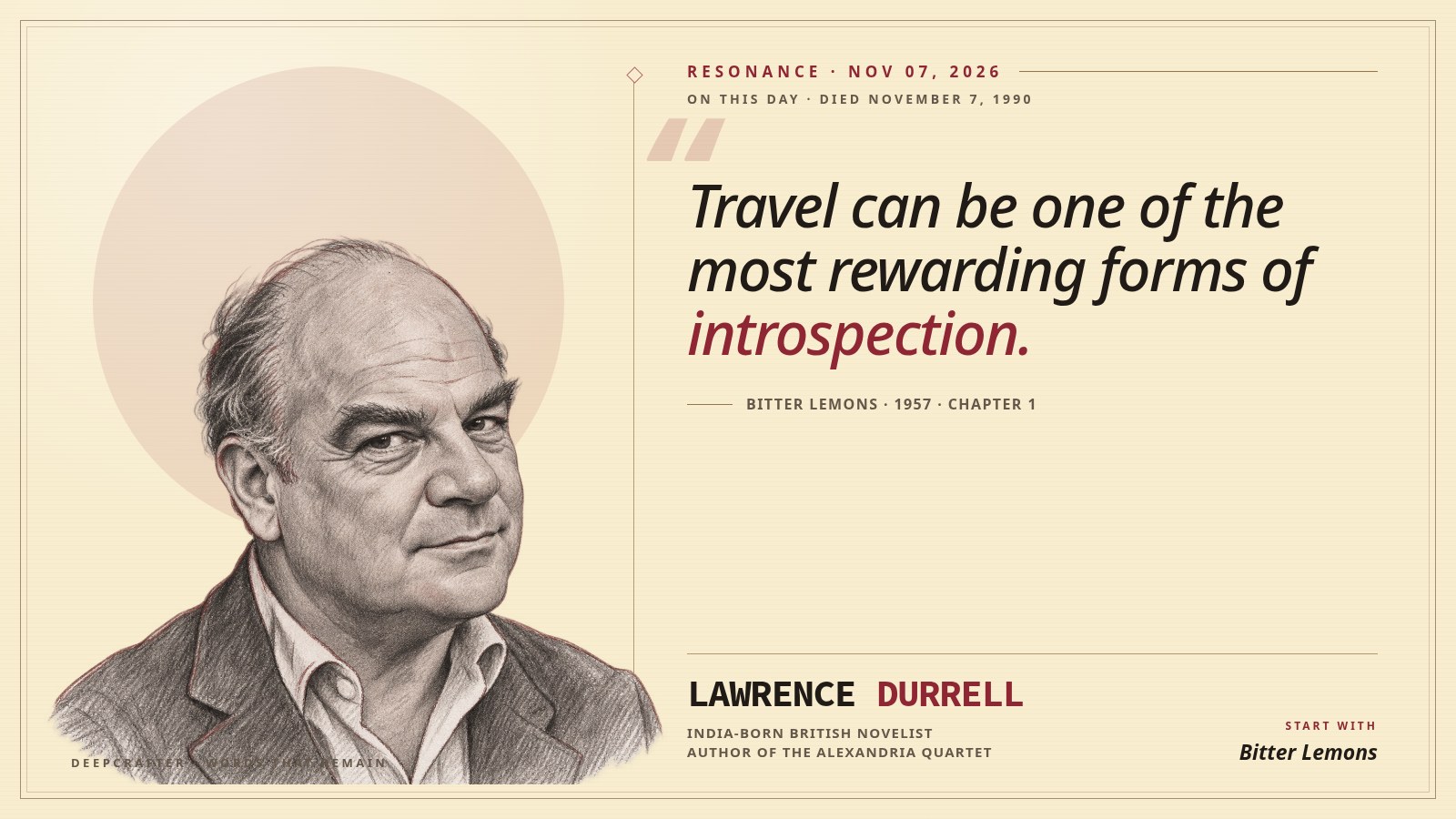
“Travel can be one of the most rewarding forms of introspection.”
Why we chose Lawrence Durrell today
Lawrence Durrell died on November 7, 1990, in Sommières, France. To remember him today, we chose a sentence from the opening chapter of Bitter Lemons: a line that explains why his travel writing never behaves like a catalogue of sights.
For Durrell, travel was not escape from the self. It was a way of discovering how much of the self had been built by climate, language, history and desire. Arrive somewhere new, and the place looks back. It exposes habits the traveler had mistaken for nature.
That idea connects the apparently different parts of his work. In Justine, Alexandria changes according to who remembers it. In Prospero’s Cell, Corfu becomes both an island and a private calendar. In Bitter Lemons, the beauty of Cyprus cannot be separated from a political crisis or from Durrell’s compromised position inside British colonial administration.
For writers, Durrell offers a fertile and difficult example. His prose can make place feel sensuous, intelligent and alive. It can also aestheticize cultures and people from the privileged position of an expatriate observer. Reading him well means learning from the intensity of his attention while asking who gets to describe a place, who is described, and what history the beautiful sentence may leave outside its frame.
Born between empires
Lawrence George Durrell was born on February 27, 1912, in Jullundur—now Jalandhar—in northern India. His parents were British colonial subjects who had themselves been born in India. The family’s relation to “home” was therefore unstable from the beginning: culturally British, geographically Asian, and shaped by the structures of empire.
At eleven, Durrell was sent to England for schooling. He disliked the country’s climate, institutions and social regimentation, and he never settled into the expected educational path. Instead of university, he chose the uncertain life of a writer. His early novels and poems show a young author trying on voices before finding the mixture of lyric intensity, philosophical speculation and formal experiment that would become his signature.
The refusal of England was not merely a preference for sunshine. It became part of Durrell’s imaginative geography. Northern Europe represented constraint; the Mediterranean promised permeability, appetite and reinvention. This contrast could produce luminous writing, but it could also simplify both regions into symbolic opposites. The tension would remain with him.
Corfu and the invention of a life
In 1935, Durrell persuaded his mother and siblings to move with him to Corfu, where living costs were lower and the climate seemed closer to the world he wanted. His younger brother Gerald would later turn the family’s Corfu years into comic natural history. Lawrence used the island differently: as a laboratory for the relation between landscape and consciousness.
On Corfu, Durrell read Henry Miller’s Tropic of Cancer and wrote him a letter. Their friendship and correspondence continued for roughly forty-five years. Miller encouraged the freedom and risk of Durrell’s early writing, while Durrell found in him a model of literary life conducted outside conventional institutions.
Durrell’s The Black Book, published in Paris in 1938, was an early declaration of independence from English respectability. Yet the more enduring Corfu book is Prospero’s Cell, composed from notebooks and published in 1945. It blends diary, portrait, natural history, anecdote and meditation. The island is not a neutral setting. It acts on the writer’s sense of time.
This is one of Durrell’s central craft principles: a place should alter the form used to describe it. Corfu invites fragments, seasons, meals, weather and recurring names. The book does not march through an itinerary because lived place is not remembered that way.
War, diplomacy and Alexandria
The Second World War ended the Corfu period. Durrell left Greece as Axis forces advanced, moving through Cairo and then Alexandria. He worked in British information services and later held diplomatic and cultural posts in Rhodes, Argentina, Yugoslavia and Cyprus.
These jobs placed him inside the machinery of the state while giving him access to a succession of cities and islands. The contradiction matters. Durrell’s prose often celebrates the freedom of the outsider, but his mobility was enabled by imperial and diplomatic networks. He was both restless artist and government employee, observer and participant.
Wartime Alexandria provided the material for the work that made him internationally famous. The city he encountered was multilingual, cosmopolitan and politically charged. Rather than reproducing it as documentary fact, Durrell transformed it into a psychological and formal principle.
Justine: a city made of viewpoints
Published in 1957, Justine is the first novel of The Alexandria Quartet. It follows an unnamed narrator’s recollection of desire, jealousy and entanglement among several figures in prewar Alexandria. The city is not a backdrop to the love story. It is the medium through which the characters misunderstand one another.
Durrell’s prose moves through heat, dust, water, mirrors, perfume, streets and rooms with extraordinary sensual density. But the novel’s real innovation becomes clearer across the Quartet. Balthazar revisits the same events from another perspective; Mountolive shifts toward political and diplomatic narration; Clea moves the sequence forward in time. The result is not one story corrected by a final answer. It is a geometry of partial knowledge.
Durrell called this structure a “relativity” proposition. Whatever we think we know about a character depends on angle, distance and the desires of the observer. A new viewpoint does not simply add information; it reorganizes the meaning of what came before.
For fiction writers, this is more useful than the vague instruction to “use multiple perspectives.” Each perspective should change the causal map. Ask which fact becomes visible, which motive becomes doubtful, and which earlier scene must now be reread.
At the same time, modern readers should notice how the novels turn Alexandria and its inhabitants into an aesthetic system shaped by a European expatriate imagination. The city is brilliantly rendered, but brilliance is not the same as completeness. Durrell’s Alexandria is a powerful literary construction, not an exhaustive account of the city’s social reality.
Cyprus: beauty inside conflict
In 1952, Durrell moved to Cyprus. He bought a house, taught English and later worked as a British government public information officer. The island was moving toward violent conflict over colonial rule, Greek Cypriot demands for union with Greece, Turkish Cypriot concerns, and competing national futures.
Bitter Lemons, published in 1957, narrates Durrell’s Cyprus years through house-buying comedy, village life, friendships, landscape and escalating danger. The book won the Duff Cooper Prize and remains one of his best-known works of place.
Its beauty is inseparable from its problem. Durrell presents himself as a lover of the island caught between communities, but he was not politically neutral. His government role shaped what he could know and how others saw him. The book’s charm can make that position feel more innocent than it was.
This is why the opening quotation rewards careful reading. Travel may produce introspection, but introspection alone does not produce justice. A traveler can examine the self and still misread the power that carries that self through another country.
Writers can learn from both Durrell’s achievement and his blind spots. Let the landscape be vivid, but also map the institutions around the observer. Who owns the house? Who issues the permit? Who can leave when violence begins? Who must remain after the narrator’s departure?
The “spirit of place” as a writing method
Durrell often wrote about the “spirit of place”—the conviction that landscape, architecture, history and climate generate a distinctive pressure on human life. In lesser hands, this becomes mystification: the writer announces that a city has a soul and supplies decorative adjectives.
Durrell’s strongest pages do something more concrete. They accumulate sensory relations. Light changes stone; wind changes conversation; a harbor rearranges distance; a language changes the traveler’s social body. Place emerges from interactions rather than description alone.
His method depended heavily on notebooks and letters. He collected observations, phrases, historical fragments, sketches of people and the rhythms of daily life. Later, he recomposed them. The finished prose feels immediate because the raw noticing was patient.
He also moved material across genres. A landscape might appear in a letter, a travel book, a poem and a novel, altered by each form. This recycling was not simple repetition. It tested what the same place could mean under different narrative pressures.
A writer of cycles and correspondences
After the success of The Alexandria Quartet, Durrell continued to build large fictional structures. The Revolt of Aphrodite joined Tunc and Nunquam. The Avignon Quintet, published between 1974 and 1985, offered another sequence of interlocking books concerned with art, history, sexuality, mysticism and the instability of fiction itself.
These later cycles show Durrell’s attraction to recurrence. Characters, images and situations echo across volumes. A book is less a sealed container than a chamber in a larger design.
His correspondence worked similarly. The long exchange with Henry Miller documents friendship, rivalry, encouragement, practical struggle and literary self-invention. Letters allowed Durrell to develop ideas in motion, before they hardened into public statements.
For contemporary writers, this suggests a useful practice: maintain a living correspondence with the work, even if no one else sees it. Write letters to the draft. Ask what it thinks its subject is, what place it has ignored, and which character would dispute its version of events.
The late home in southern France
Durrell eventually settled in Sommières in the south of France, where he lived for more than three decades. From there he completed the Quartet, wrote the Avignon novels, poetry, travel works, essays and his final meditation on Provence, Caesar’s Vast Ghost.
The settled house did not end his imaginative travel. Places already lived in continued to change inside memory. Alexandria, Corfu, Rhodes and Cyprus returned not as preserved scenes but as structures the older writer kept revising.
His later life included severe private losses, including the death of his wife Claude-Marie and the suicide of his daughter Sappho. He continued writing, but the Mediterranean radiance of the work should never be mistaken for an untroubled life.
Durrell died on November 7, 1990. Caesar’s Vast Ghost had appeared shortly before his death. The final image is fitting: a writer still trying to read a region through its ruins, stories, weather and ghosts.
Five craft lessons from Lawrence Durrell
1. Make place change the sentence
Do not describe a setting in neutral prose and then add local color. Let climate, architecture and social rhythm alter syntax, pacing and attention.
2. Use viewpoint to revise causality
A second perspective should do more than contradict an opinion. It should change what the reader believes caused an event.
3. Keep a notebook of relations
Record not only objects but effects: what the wind does to speech, what a border does to posture, what a room permits one character to conceal.
4. Put the observer inside the power map
Ask what passport, job, money, language or institution makes the narrator’s movement possible. Observation always has a position.
5. Let memory transform, not preserve
When a place returns, change it through the remembering consciousness. The gap between then and now is part of the scene.
A spirit-of-place exercise
Choose a setting your protagonist thinks they understand.
- Describe it through three physical forces: light, sound and movement.
- Add one institution that organizes life there—a school, border office, hotel, port or market.
- Write the scene from the protagonist’s viewpoint.
- Rewrite one paragraph from the viewpoint of someone who cannot leave the place as easily.
- Identify one detail whose meaning changes between the two versions.
- Return to the first draft and revise the causal story, not only the adjectives.
The goal is to make place active without pretending it speaks with a single voice.
Where to start reading
For the city of unstable memory: Justine
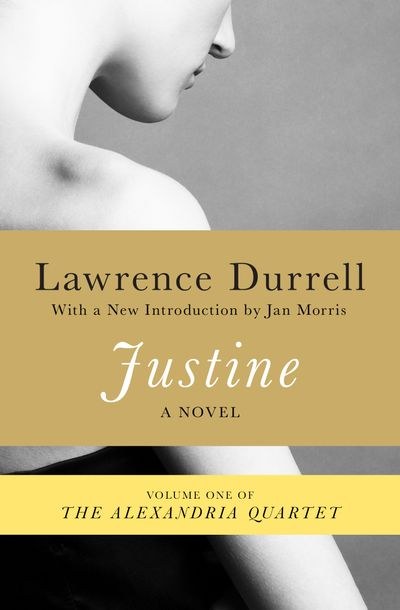
Edition: Open Road Media ebook, 2012 · new introduction by Jan Morris · ISBN 9781453261415.
Begin here for Durrell’s most influential fiction. Read the sensuous surface, then notice how often description reveals the narrator’s desire rather than secure knowledge. Continue to Balthazar if you want to watch the same events change under a second angle.
For beauty under political pressure: Bitter Lemons of Cyprus
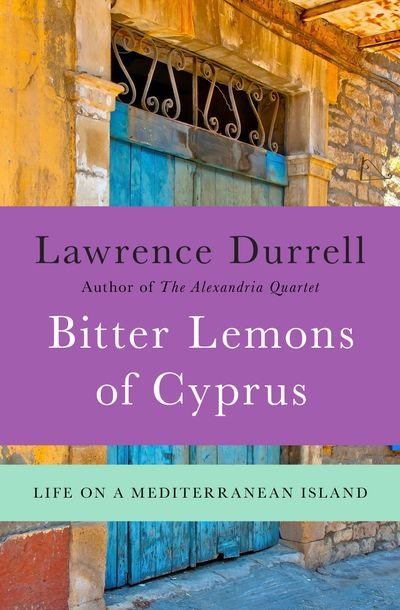
Edition: Open Road Media ebook, 2012 · ISBN 9781453261620.
This is the essential companion to today’s quotation. Read for the comic house-buying scenes, the landscapes and the slow arrival of conflict—but keep Durrell’s British information role visible as part of the narrative situation.
For the island notebook: Prospero’s Cell
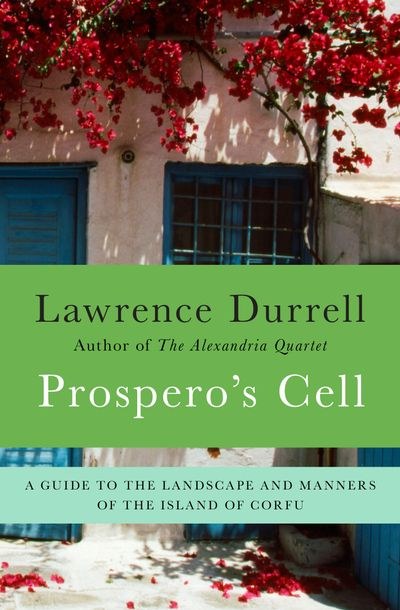
Edition: Open Road Media ebook, 2012 · ISBN 9781453261651.
Come here for Durrell’s early method of place-writing. The dated fragments show how weather, food, friendship, history and impending war can form a portrait without becoming a conventional itinerary.
Why read Durrell now?
We live in an age of frictionless images of place. A city becomes a background, an island becomes a mood, and travel becomes proof that the traveler was there. Durrell reminds us that place can act upon form and identity. He also reminds us—sometimes against his own intentions—that beautiful attention does not cancel political position.
That double lesson is why his work remains alive. Read him for the courage to let setting become structure. Read him critically for the questions his structures leave unresolved.
Travel can reward introspection. The writer’s next task is to move beyond introspection toward relation: to ask how the self was received, what histories made the encounter possible, and how many versions of the place are speaking at once.
Sources and edition notes
- International Lawrence Durrell Society: biography
- Open Road Media: Lawrence Durrell
- Open Road Media: Justine
- Open Road Media: Bitter Lemons of Cyprus
- Open Road Media: Prospero’s Cell
- Penguin Random House: Lawrence Durrell
The opening quotation appears in chapter 1 of Bitter Lemons and was checked against the Open Road Media 2012 edition (ISBN 9781453261620). The website cover is DeepCrafter’s original illustrated Resonance card, not an archival photograph. The three book-cover images identify the specific editions discussed.