A Voice That Could Not Sit Still: John Berryman and the Dream Song
Meet John Berryman through the divided voice, scholarship, dark comedy and formal invention of The Dream Songs—with a critical note on their racial performance.
A Voice That Could Not Sit Still: John Berryman and the Dream Song
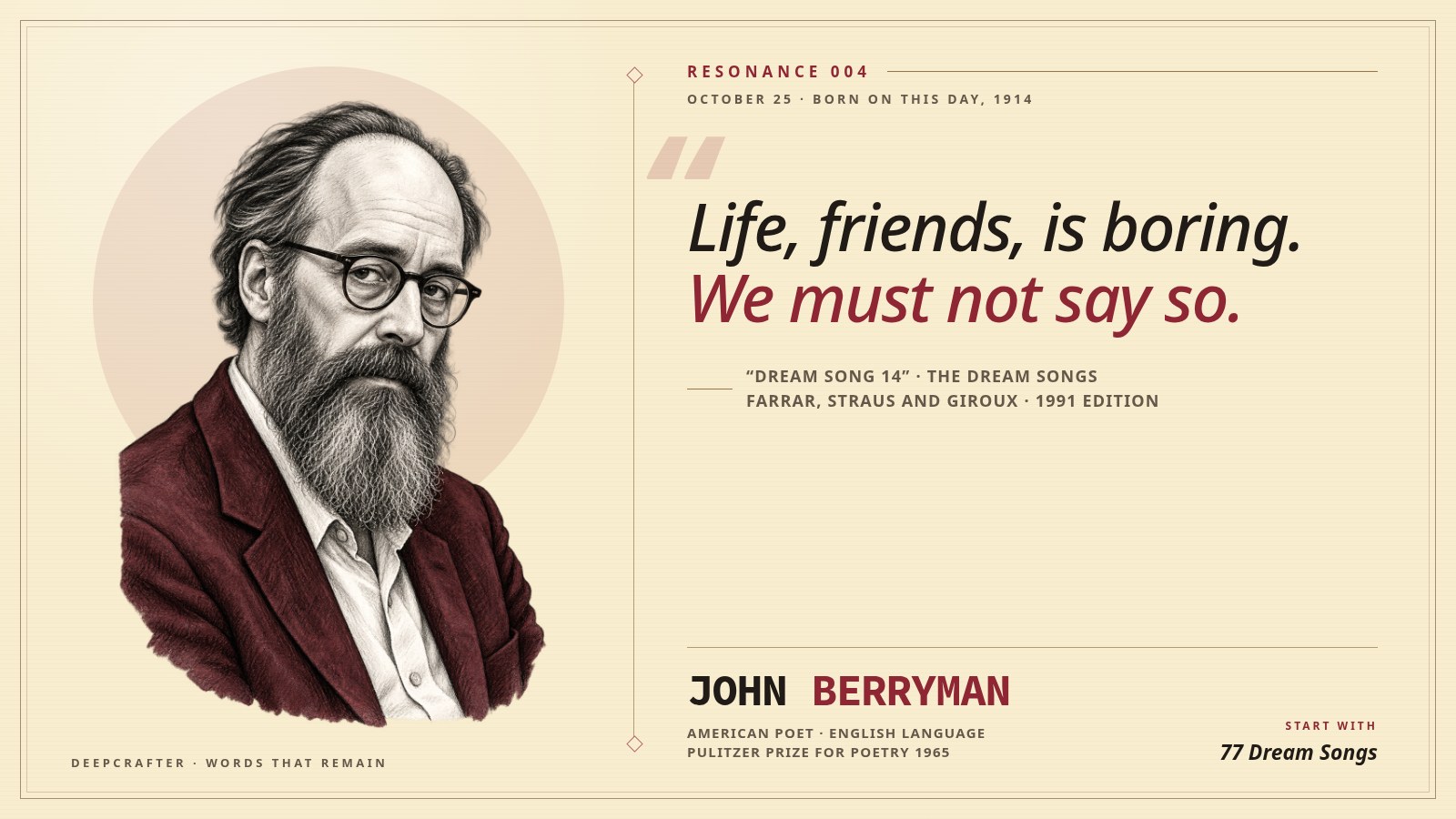
“Life, friends, is boring. We must not say so.”
Why we chose John Berryman that day
We chose John Berryman for October 25, the anniversary of his birth in 1914, and entered his work through the famous first line of “Dream Song 14.” The quotation changes the emotional temperature of the series: after wonder and attentive discovery, it gives us boredom, shame, wit and contradiction in a single breath. We chose it not as advice to suppress distress, but because its immediate self-correction reveals Berryman’s central technique—a voice arguing with itself while comedy and pain occupy the same line.
The opening of “Dream Song 14” behaves like a confession that instantly corrects itself. Boredom is announced, then declared unsayable. The speaker continues anyway, arguing with his mother, himself and the moral shame attached to having nothing inside that seems worth doing.
This divided motion is pure John Berryman. One voice makes a claim; another mocks, interrupts or revises it. High literary allusion collides with slang. Grief becomes comedy and comedy reveals panic. The poem is not advice to hide distress. It is a performance of a mind unable to hold one tone for long.
Berryman’s greatest invention, the Dream Song, gave that instability a repeatable form. Across hundreds of poems, he built a stage on which a character called Henry could complain, boast, mourn, joke, remember and fracture language under pressure.
The wound behind the voice
John Berryman was born John Smith on October 25, 1914, in McAlester, Oklahoma. When he was twelve, his father died by suicide outside the family home. After his mother remarried, John took his stepfather’s surname.
The loss returned throughout his life and writing, but it should not be used as a single explanation for every poem. Berryman was also formed by extraordinary reading, ambition, teaching, friendship, formal experiment and a long engagement with literary history.
He studied at Columbia College, graduating in 1936, then spent two years at Cambridge on a fellowship. His early poetry shows the influence of W. H. Auden, W. B. Yeats, Gerard Manley Hopkins, Hart Crane and others. It is technically controlled, learned and often still searching for a voice that could carry the full disorder of his experience.
The long road to an original form
Berryman published early books and gained respect, but broad recognition came slowly. The Dispossessed appeared in 1948. He also wrote a critical biography of Stephen Crane and taught at several universities.
The breakthrough was Homage to Mistress Bradstreet in 1956. The book-length poem creates a charged dialogue with Anne Bradstreet, the seventeenth-century Puritan poet. Scholarship becomes dramatic intimacy. The historical figure is neither a costume nor an object lesson; she becomes a consciousness speaking across time.
The work shows Berryman discovering a central method: use literary knowledge not as display, but as pressure inside a voice.
In 1955 he joined the University of Minnesota, where he would teach for the rest of his life. By then he had begun keeping extensive records of dreams and analysis. Out of this period emerged the poems that transformed his reputation.
The invention of Henry
77 Dream Songs appeared in 1964 and won the Pulitzer Prize. His Toy, His Dream, His Rest followed in 1968 and won the National Book Award. In 1969 the full sequence was collected as The Dream Songs: 385 poems built from three six-line stanzas each.
The sequence centers on Henry, but Henry is not simply Berryman under another name. He is a persona, mask, actor and emotional instrument. The distance allows intimacy without promising literal autobiography.
Henry’s language can be courtly, childish, scholarly, obscene, comic or broken within a few lines. Syntax bends because the consciousness speaking cannot proceed in a calm, single register.
The form provides two kinds of freedom:
- a stable eighteen-line container;
- an unstable voice that can put almost anything inside it.
That balance—repetition and volatility—is the engine of the project.
A necessary critical note
The Dream Songs also draw on minstrel-show conventions, including racialized dialect and the figure of Mr. Bones. These elements carry the history of blackface performance and racist stereotype. They cannot be neutralized by calling them masks or products of their time.
Modern readers should confront the formal brilliance and the racial damage together. Critical reading does not require pretending the work is uncontaminated. It asks how the poems’ borrowed performance traditions shape who is allowed to speak, what becomes comic and what costs are displaced onto others.
This tension belongs inside any serious introduction to Berryman, not in a footnote added after praise.
His style: a theater of interruption
1. The persona as permission
Henry gives Berryman a voice that is and is not the author. Persona creates room for exaggeration, contradiction and self-accusation. The poem can expose a feeling without presenting it as a stable doctrine.
2. Syntax under emotional pressure
Sentences break, invert and restart. Grammar becomes dramatic action. The reader does not merely learn that Henry is distressed; the difficulty of the sentence makes us experience unstable thought.
3. High and low diction in collision
Shakespeare, theology and psychoanalysis meet jokes, complaint and street speech. The collisions prevent solemnity from settling into prestige.
4. Comedy beside catastrophe
Berryman’s comedy does not erase grief. It often arrives because grief has become unbearable in one register. A ridiculous turn can expose self-pity, then make the pain newly visible.
5. The sequence as an accumulating life
One Dream Song can feel fragmentary. Hundreds of them create recurrence: deaths, friendships, literary heroes, family memories, public events and private failures return with altered force. Meaning accumulates through echo rather than continuous plot.
Scholarship was part of the daily work
Berryman did not separate the poet from the scholar and teacher. In his Paris Review interview, he describes preparing through original texts and multiple works of scholarship. History, classics, theology and literary study became equipment for poetry.
This is a useful correction to the myth that lyric poetry comes only from spontaneous feeling. Berryman’s poems are emotionally volatile, but they are also built from reading.
His working life suggests several durable habits:
- Research beyond immediate need. Material studied for teaching may later become poetic structure, image or argument.
- Use a fixed form as a recurring workspace. The Dream Song’s eighteen lines gave him a place to return even when the emotional material changed.
- Keep records of the mind’s unofficial life. His extensive dream journal did not become the poems directly, but helped create a field of voices, images and associations.
- Write through a project long enough for it to surprise you. He worked on Dream Songs for roughly fifteen years, sometimes producing more than one in a day.
- Protect indifference to praise and blame. Berryman knew both neglect and acclaim; he warned that vanity and self-pity can be equally destructive to writers.
The archive also shows mess rather than serene ritual: books and papers, teaching, illness, coffee, cigarettes, repeated effort. Productivity should not be romanticized apart from the suffering around it. The lesson is the persistence of craft, not imitation of self-destructive conditions.
The brilliant teacher
Berryman taught at Harvard, Princeton and the University of Minnesota, among other institutions. Students remembered his intensity and learning. He preferred teaching literature and the humanities to treating creative writing as a sealed vocational specialty.
That preference reflects his own practice. Shakespeare, Augustine, Anne Bradstreet and Stephen Crane were not academic obligations stored outside the poems. They enlarged the range of what the poems could think about.
For contemporary writers, the point is simple: your subject is not only your life. It is also what your reading lets your life encounter.
Beyond the Dream Songs
Late work reveals other forms of directness. Love & Fame revisits youth, ambition and sexual life with startling candor. Delusions, Etc. contains poems written near the end of his life, including religious questioning and renewed confrontation with his father.
The unfinished prose work Recovery draws on treatment for alcoholism. It should be read as an incomplete literary document, not as a redemptive conclusion the life did not provide.
Berryman died by suicide in Minneapolis on January 7, 1972. Any account of his life should resist turning that death into the inevitable fulfillment of the poems. The work matters because of its formal intelligence and linguistic invention, not because tragedy certifies authenticity.
A Dream Song exercise for writers
Use constraint to make a divided voice audible.
- Choose one feeling your speaker is ashamed to admit.
- Give the poem three six-line stanzas.
- In stanza one, let the speaker state the feeling and immediately contradict it.
- In stanza two, introduce a second voice—a friend, critic, memory or invented persona.
- In stanza three, change diction sharply: let formal language fall into slang, or comedy into prayer.
- Do not resolve the contradiction. End with a turn that changes its pressure.
The goal is not to copy Berryman’s syntax. It is to discover what a stable form permits an unstable voice to do.
Where to start reading
For the essential entrance: 77 Dream Songs
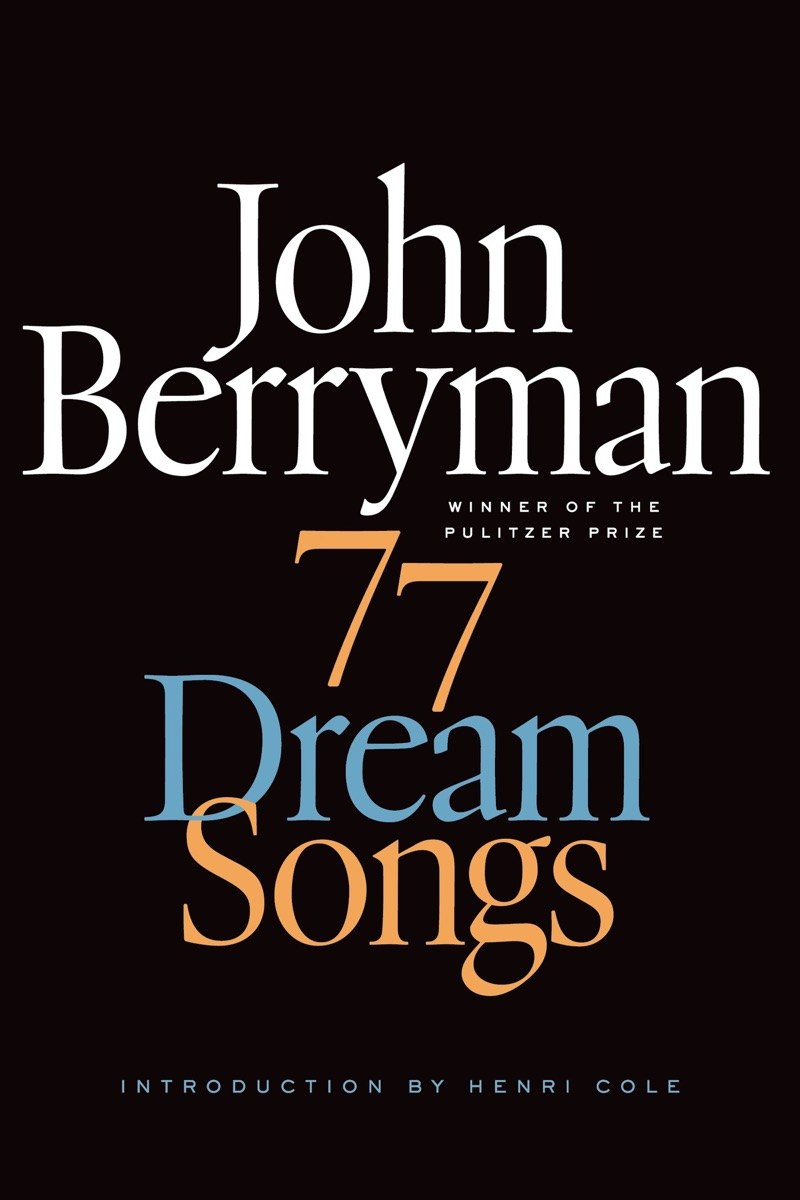
Book information: Poetry · introduction by Henri Cole · FSG Classics digital edition, 2014 · 112 pages · ISBN 9781466879614. The original 1964 collection won the 1965 Pulitzer Prize for Poetry.
Begin with the Pulitzer-winning first sequence. Read several songs together so recurrence and tonal variety can emerge.
For the full architecture: The Dream Songs
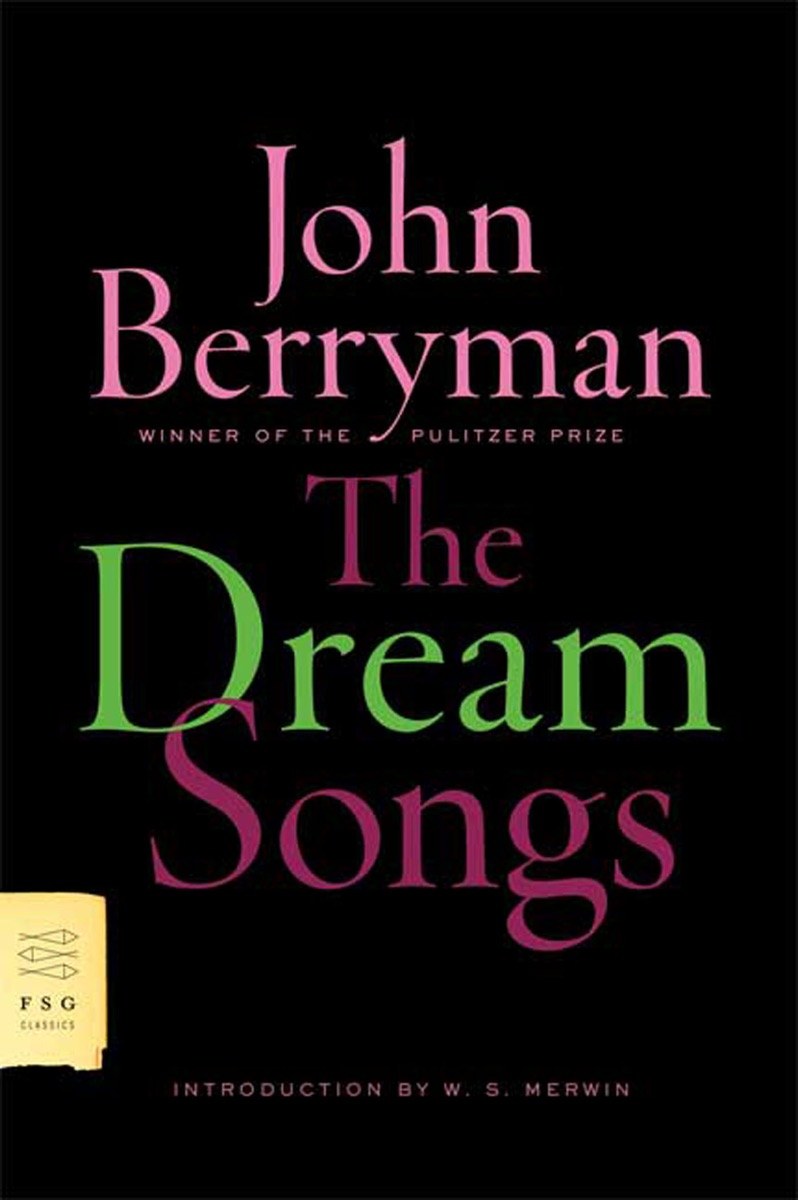
Book information: Poetry · complete 385-song sequence · FSG Classics paperback, 2014 · 464 pages · ISBN 9780374534554.
The complete 385-poem sequence reveals how Henry’s world accumulates across grief, friendship, history and comic self-performance.
For historical imagination: Homage to Mistress Bradstreet
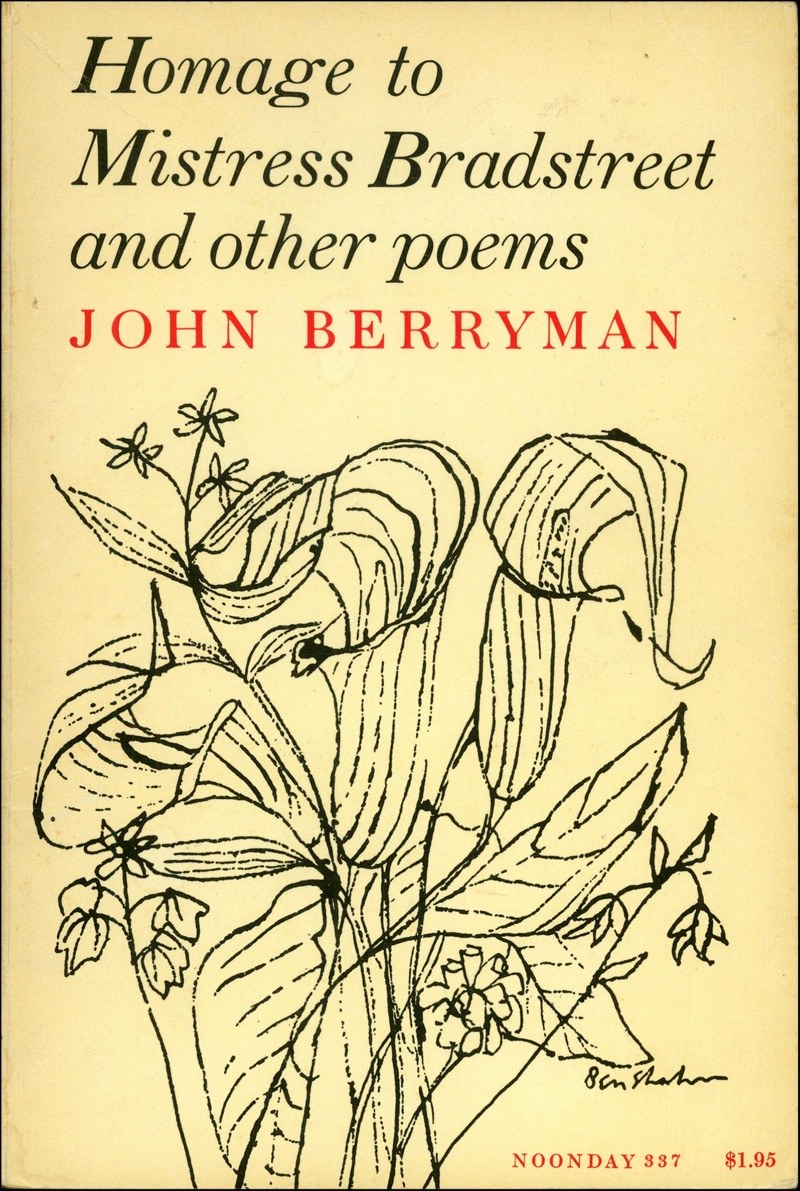
Book information: Long poem and selected earlier poems · Farrar, Straus and Giroux paperback · 112 pages · ISBN 9780374506605.
Choose this to see Berryman’s scholarship and dramatic voice converge before the invention of Henry.
For late autobiographical candor: Love & Fame
Read this after the Dream Songs to encounter a more direct but still constructed relation to memory.
For the final poems: Delusions, Etc.
This collection includes some of Berryman’s most exposed religious and familial reckonings.
New readers can begin with “Dream Song 1,” “Dream Song 14,” “Dream Song 29” and “Dream Song 76,” while remembering that the project’s racial performance requires critical attention as well as admiration.
Why read Berryman now?
Digital speech often rewards a consistent voice: recognizable, repeatable, certain of its tone. Berryman offers the opposite. His poems preserve the argument within the speaker. They show personality as a crowd of impulses rather than a clean brand.
That does not make every impulse innocent. The Dream Songs demonstrate both the artistic power and ethical danger of masks. A persona can free language, and it can borrow histories the writer does not own.
“Life, friends, is boring. We must not say so.” The line remains alive because the poem does say it—and then refuses to let the statement stand alone. Berryman’s gift was the voice that could not sit still long enough to become a slogan.
Sources and edition notes
- Academy of American Poets: John Berryman biography
- Poetry Foundation: John Berryman biography and critical overview
- The Paris Review: John Berryman, “The Art of Poetry No. 16”
- Poetry Foundation: “The Heart Is Strange,” on Berryman and the Dream Songs
- Yale Bollingen Prize: John Berryman
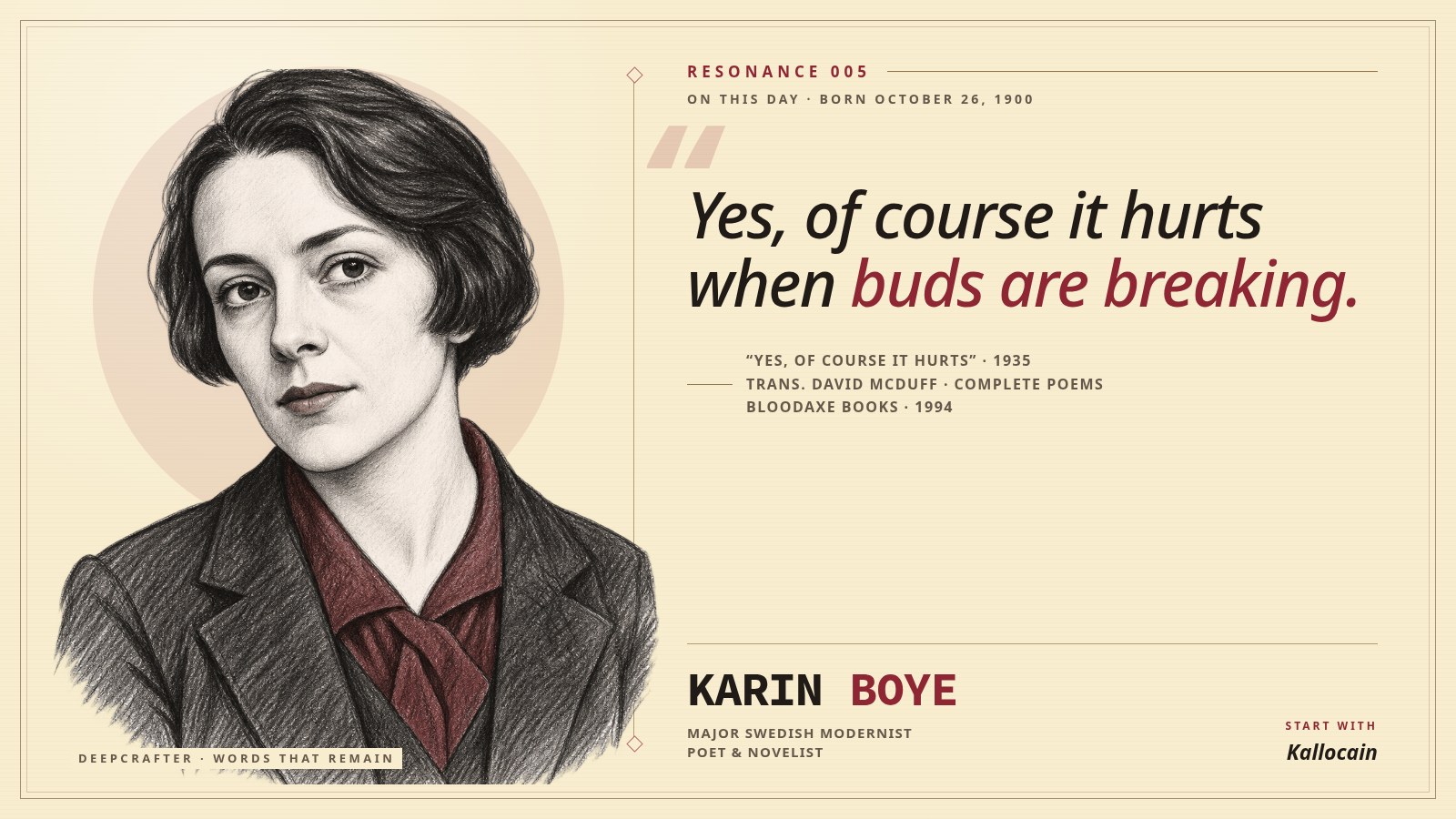
The opening quotation is the first ten words of “Dream Song 14,” collected in The Dream Songs (Farrar, Straus and Giroux, 1991 edition cited by Poetry Foundation). It is a brief attributed excerpt for literary commentary. The accompanying image is the same DeepCrafter-created illustrated quotation card used in the original X Resonance post, not an archival photograph.
If you or someone you know may be at risk of self-harm, contact local emergency services or a crisis line in your country. In the United States and Canada, call or text 988.