Where the Poem Keeps Its Secret: Denise Levertov and the Art of Attention
Trace Denise Levertov’s journey from wartime nurse to major American poet, and discover her organic form, reading-aloud practice and essential books.

Where the Poem Keeps Its Secret: Denise Levertov and the Art of Attention
“Two girls discover / the secret of life / in a sudden line of / poetry.”
Why we chose Denise Levertov that day
We chose Denise Levertov for October 24, the anniversary of her birth in 1923, and selected the opening of “The Secret” from O Taste and See (1964). After a storyteller and a fabulist, Levertov shifted our daily series toward the intimate exchange between poem and reader. These lines mattered because they do not present the poet as the sole owner of meaning: two young readers discover something the writer herself cannot identify for them. That mystery opens directly into Levertov’s lifelong attention to organic form, moral witness and the discipline of seeing.
In Denise Levertov’s poem “The Secret,” two readers tell the poet that a line has revealed something essential to them. The poet cannot remember which line they mean. Instead of treating that uncertainty as a failure, she blesses the discovery. The readers may lose the secret and find it again—in another line, another poem, another life.
The scene offers a key to Levertov’s poetics. A poem is made with discipline, but its meaning is not owned completely by the writer. Form grows from attention. The reader completes an encounter the poet cannot fully predict.
Across more than fifty years, Levertov wrote about leaves, streets, war, marriage, protest, grief, faith and the difficult act of seeing. Her poetry joined precision to moral urgency without allowing either to become merely decorative.
A childhood made of books and many languages
Denise Levertov was born on October 24, 1923, in Ilford, Essex. Her father, Paul Philip Levertoff, had been raised as a Hasidic Jew, converted to Christianity and became an Anglican priest. Her Welsh mother, Beatrice, educated Denise and her sister at home and read nineteenth-century fiction aloud to the family.
Levertov grew up surrounded by books and by conversation across Hebrew, Russian, German and English. She later described knowing from childhood that she wanted to be a writer. At twelve she sent poems to T. S. Eliot, who answered with encouragement and advice. At seventeen she published her first poem.
The story can sound like a legend of early vocation, but its deeper importance lies in the conditions around it: sustained reading, serious response from adults, and the assumption that language deserved close attention.
War work and the first book
During the Second World War, Levertov trained as a nurse and worked in London hospitals through the bombing. She continued to write. Her first collection, The Double Image, appeared in 1946 and reflected the formal, neo-Romantic environment of her early British work.
In 1947 she married the American writer Mitchell Goodman and moved to the United States the following year. The move changed her poetic ear. She encountered the work of William Carlos Williams and developed friendships with poets including Robert Creeley and Robert Duncan. American speech, open form and the Black Mountain conversation helped her move away from inherited meters toward a line shaped by perception and breath.
This was not a simple conversion from British formality to American freedom. Levertov kept revising her understanding of form. She wanted the poem to discover its order rather than receive an external mold.
The American voice emerges
Here and Now and With Eyes at the Back of Our Heads established Levertov as a distinct presence in postwar American poetry. Her poems attend to ordinary things—a flower, a street, a domestic gesture—with an intensity that can turn perception into revelation.
The language is often clear, but not casual. Line breaks direct pace, emphasis and silence. The poem on the page functions like a musical score. A reader should be able to hear how attention moved.
Levertov’s “organic form” is sometimes misunderstood as writing without structure. She meant almost the opposite. The poet listens for the structure inherent in a particular perception. Parts must relate to the whole. The form is discovered, then made exact.
Poetry in public life
During the 1960s, the Vietnam War changed both Levertov’s activism and her writing. She helped found Writers and Artists Protest against the War in Vietnam, took part in demonstrations and acts of civil disobedience, and edited antiwar work.
Books such as The Sorrow Dance carry personal grief and public violence together. Later poems address nuclear weapons, U.S. policy in Central America and the Gulf War. She believed the poet lived in the world and could not treat politics as contamination from which lyric purity must be protected.
This choice brought a formal problem. Political conviction can make a poem predictable if the conclusion arrives before perception. Levertov’s strongest public poems retain image, tension and discovery. They do not merely arrange correct opinions into lines.
Her example is therefore more demanding than “write about politics.” It asks how moral urgency can enter the poem without silencing the poem’s own intelligence.
A later movement toward faith
In the final decades of her life, Levertov’s poetry became increasingly engaged with Christian faith. This was not simply a return to her father’s religion. She described poems themselves as part of the movement: writing certain poems helped bring belief into being.
Collections such as Breathing the Water, A Door in the Hive, Evening Train and Sands of the Well join spiritual attention to the earthly particulars that had always mattered to her. Doubt remains active. Faith enters as encounter, not as the removal of uncertainty.
Levertov taught at many institutions and spent more than a decade at Stanford. She died in Seattle in 1997. By then she had published more than twenty poetry collections as well as essays, criticism and translations.
Her style: the line as an act of perception
1. Organic form
Levertov begins with attention to the thing perceived. The poem’s shape should emerge from the experience rather than be imposed in advance. This does not eliminate revision; it gives revision a direction. The writer clarifies the discovered form.
2. The page as notation
Spacing and line breaks are instructions for voice. A short line may intensify one word. A stanza break may register a turn in consciousness. The poem is not prose chopped into visual units.
3. The ordinary charged by attention
Levertov repeatedly finds mystery in modest material. Her poems do not need to leave the world in order to become spiritual. A landscape, sound or household object becomes strange because it is seen without habitual dullness.
4. The meeting of meditation and action
Her work refuses the idea that contemplation and public responsibility are opposites. Attention can lead toward praise, protest or both.
5. Meaning left partly open
“The Secret” does not reveal the life-changing line. The omission protects the readers’ discovery from being turned into a universal answer. Levertov trusts the poem to continue beyond the poet’s explanation.
The writing habits inside the poems
Levertov’s interviews and essays describe practical habits of listening.
She read drafts aloud—even if only muttering—to hear awkwardness that the inner ear might miss. She treated the written layout as a score and tested whether the voice could follow it. This makes revision physical: breath and sound become evidence.
She also warned against endlessly patching a draft whose source had gone dim. When a poem was not working, she encouraged writers to return to the originating experience in memory and imagination. What was actually seen? What pressure first brought words toward speech?
At the same time, she did not fetishize revision. Some poems arrived nearly complete; the writer’s task was to recognize when further adjustment would damage them. Others needed substantial reshaping. The method was not “always revise” or “trust the first draft.” It was faithful attention to what this poem requires.
Four Levertov habits are especially useful:
- Wait for language, not merely a topic. An experience becomes a poem when words begin to form a necessary movement.
- Read aloud. The mouth finds false rhythm the eye may forgive.
- Return to the source. If repair becomes cosmetic, revisit the experience instead of decorating the draft.
- Let form answer content. Ask what pace, spacing and stanza movement the perception demands.
A practical Levertov exercise
Choose one ordinary object you passed today without noticing.
- Describe it in five factual sentences.
- Read the sentences aloud and underline the phrase whose rhythm feels most alive.
- Remove explanation. Keep the concrete details that changed your attention.
- Break the lines where breath or perception turns—not where the page happens to end.
- Leave one discovery unstated. Let the reader reach it.
The exercise is not an imitation of Levertov’s style. It practices the ethic beneath it: sustained attention before interpretation.
What kind of person appears in the work?
Levertov’s public life suggests intensity, independence and a refusal to separate art from conscience. She could be polemical, but she also revised her own positions. Her long friendship and later rupture with Robert Duncan over political poetry shows how seriously she took the relation between art and public action.
She was equally committed to craft. The activist and the formalist were not different selves. Both believed that attention has consequences.
Her later religious poetry adds another dimension: receptivity. The poem is not only an assertion made by the self. It can be a place where the self listens for something it did not manufacture.
Where to start reading
For the complete arc: The Collected Poems of Denise Levertov
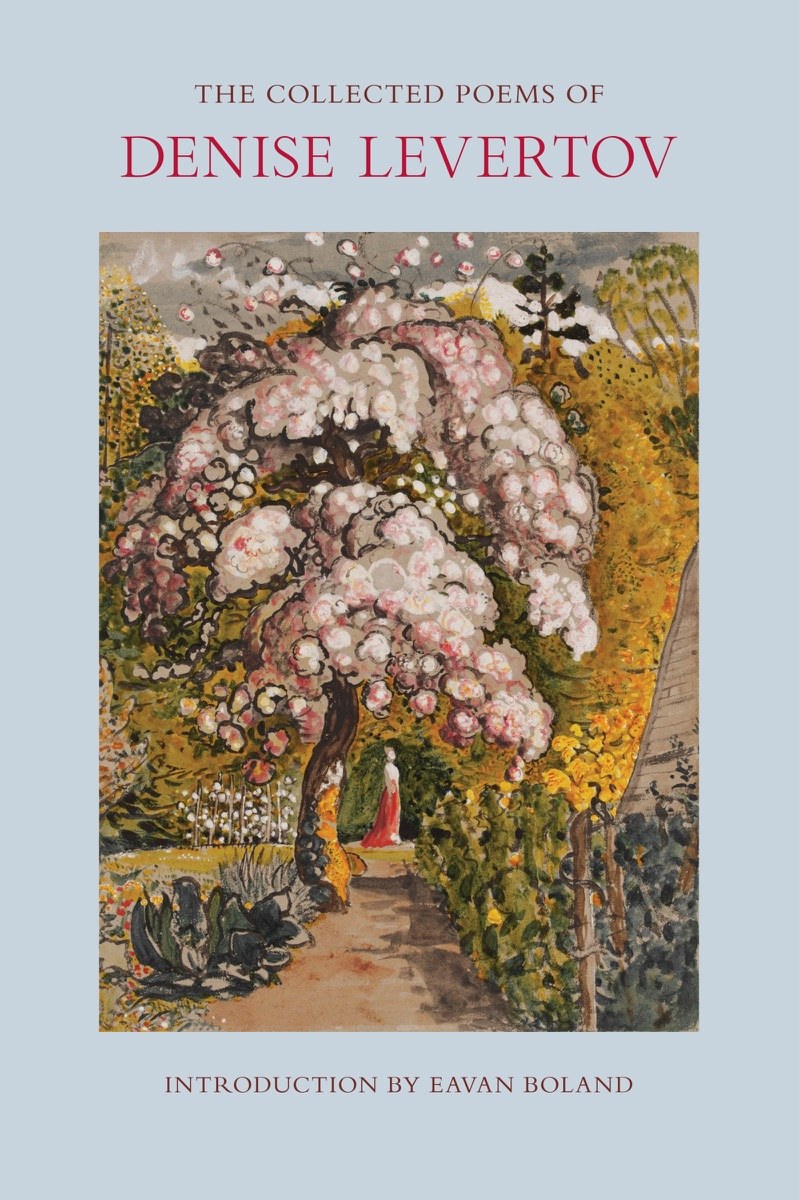
Book information: Poetry · edited by Paul A. Lacey and Anne Dewey · introduction by Eavan Boland · New Directions paperback, 2024 · 1,092 pages · ISBN 9780811237543.
This is the long route rather than the lightest first purchase, but it lets readers follow six decades of formal change, public witness and spiritual attention in chronological order.
For faith moving through doubt: The Stream & the Sapphire
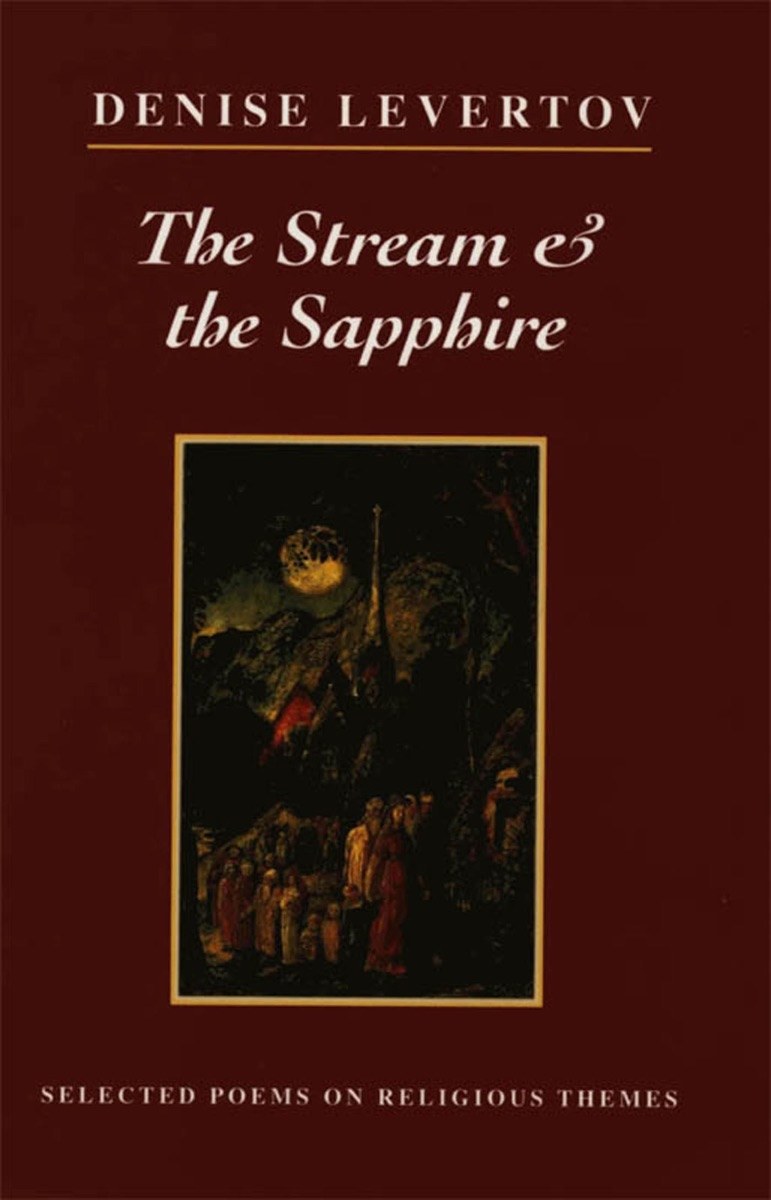
Book information: Selected poetry on religious themes · New Directions paperback, 1997 · 96 pages · ISBN 9780811213547.
Begin here if Levertov’s late spiritual work interests you. The compact selection preserves questioning alongside affirmation.
For the writer thinking about craft: Selected Essays of Denise Levertov
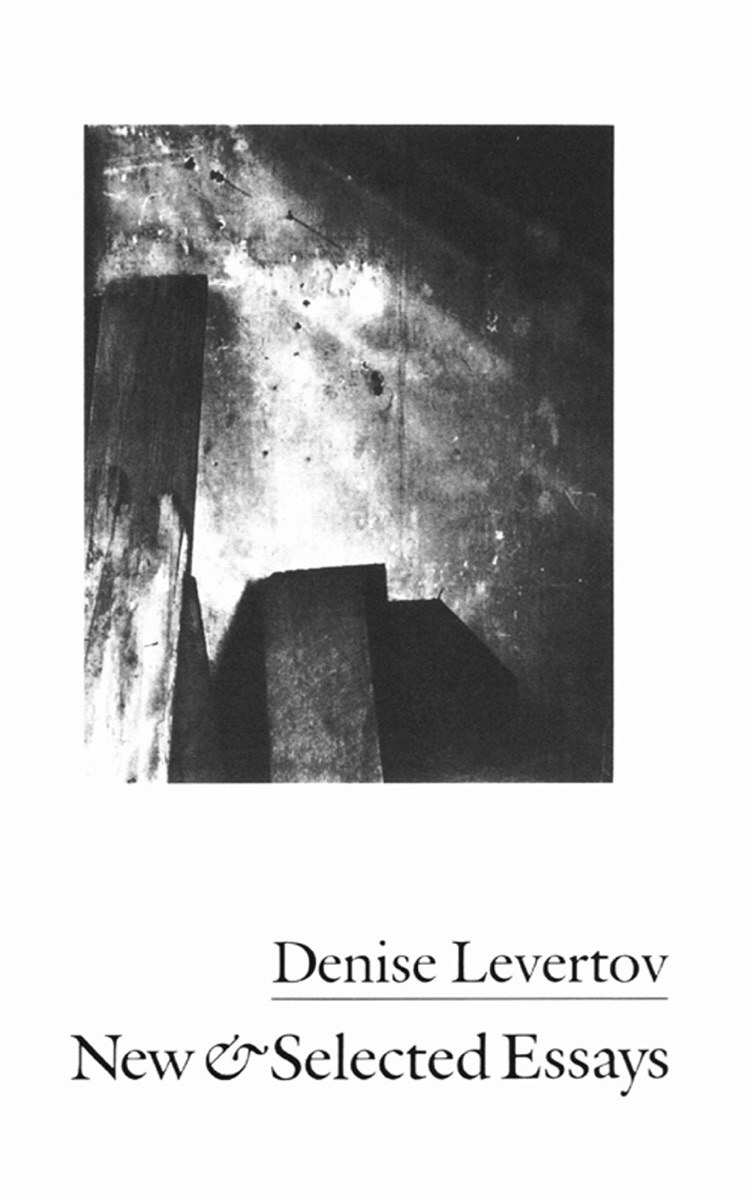
Book information: Essays on poetics, imagination, politics, spirituality and other writers · New Directions paperback, 1992 · ISBN 9780811212182.
This gathers key prose from The Poet in the World and Light Up the Cave. It is the strongest companion for readers who want Levertov’s thinking about organic form, line and vocation.
Further routes through the poetry
For early open-form brilliance: With Eyes at the Back of Our Heads
Begin here to hear the clarity, cadence and alertness that made Levertov central to postwar American poetry.
For grief and political awakening: The Sorrow Dance
This collection joins personal loss to the widening pressure of war and public responsibility.
For a mature range of lyric and public attention: The Freeing of the Dust
Winner of the Lenore Marshall Poetry Prize, it shows Levertov working across intimate, political and meditative registers.
For the spiritual turn: Breathing the Water
Read this for poems in which faith emerges through doubt, image and the process of writing itself.
For the poet thinking about craft: The Poet in the World
Her essays on organic form, line, politics and vocation are invaluable companions to the poems.
Individual readers can begin with “The Secret,” “The Ache of Marriage,” “O Taste and See,” “Life at War” and “Primary Wonder,” then follow the questions that recur.
Why read Levertov now?
We live amid language that arrives already formatted for reaction. Levertov asks for another tempo: look, listen, test the line against the breath, and allow experience to resist the statement prepared for it.
Her poetry also offers a way beyond the false choice between beauty and responsibility. Precision is not retreat. Political urgency need not abandon craft. Spiritual attention need not leave the material world.
The two girls in “The Secret” find something the poet cannot identify for them. That is not the author losing control. It is literature becoming alive in another consciousness.
Sources and edition notes
- Academy of American Poets: Denise Levertov biography
- Poetry Foundation: Denise Levertov biography and critical overview
- Poetry Foundation: “Some Notes on Organic Form”
- New Directions: Denise Levertov author page
- New Directions: The Collected Poems of Denise Levertov
- New Directions: The Stream & the Sapphire
- New Directions: Selected Essays of Denise Levertov
- Modern American Poetry Site: Denise Levertov’s final interview
The opening quotation preserves the first stanza of “The Secret,” first collected in O Taste and See: New Poems (New Directions, 1964). It is a brief attributed excerpt for literary commentary. The accompanying image is the same DeepCrafter-created illustrated quotation card used in the original X Resonance post, not an archival photograph.