What the Heart Cannot Say: Kazuo Ishiguro and the Art of Buried Feeling
On Kazuo Ishiguro’s birthday, trace how memory, restraint and relationships let his quiet narrators communicate what they cannot confess.
What the Heart Cannot Say: Kazuo Ishiguro and the Art of Buried Feeling
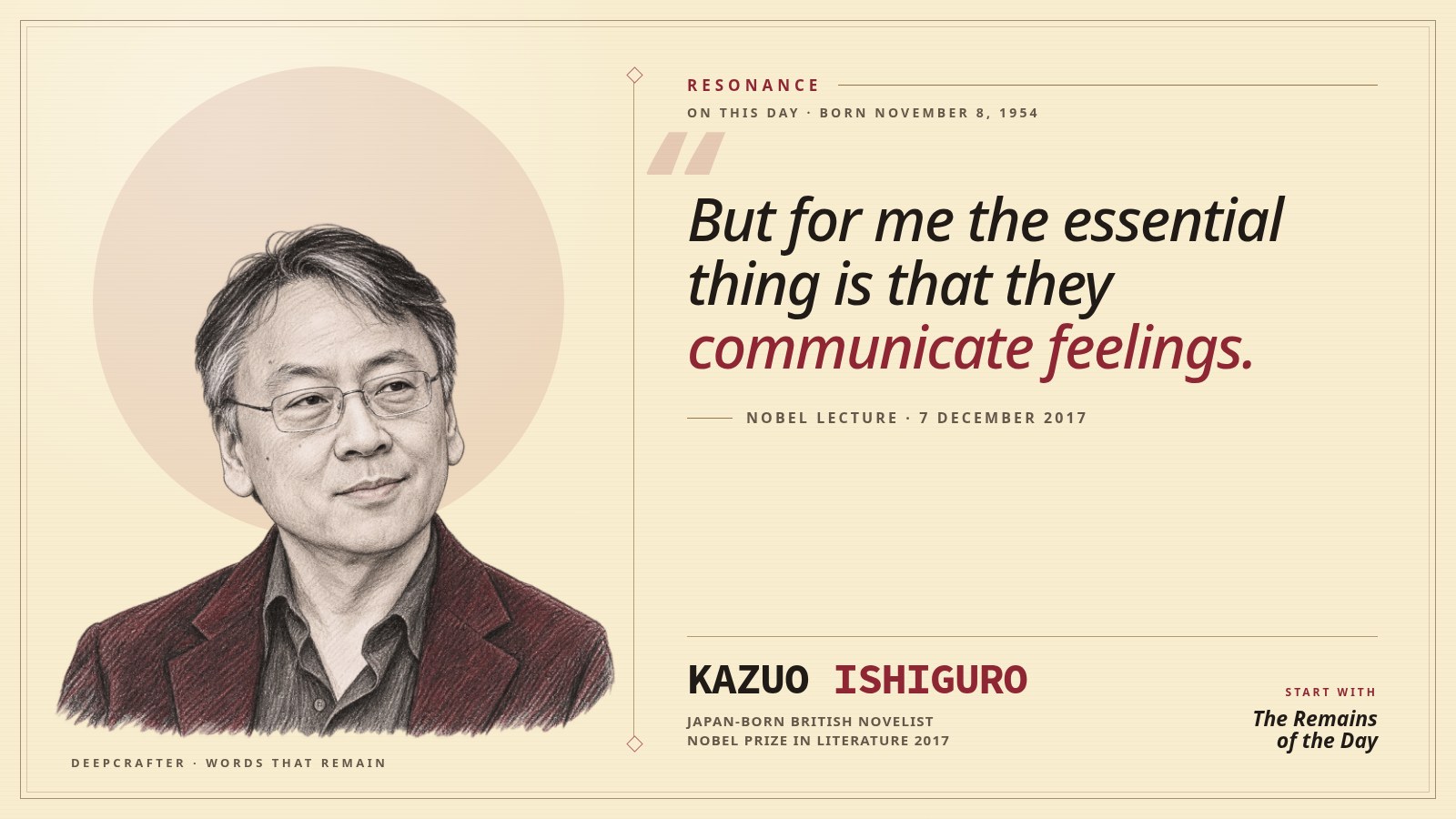
“But for me the essential thing is that they communicate feelings.”
Why we chose Kazuo Ishiguro today
Kazuo Ishiguro was born on November 8, 1954, in Nagasaki. On his birthday, we return to a sentence from his 2017 Nobel Lecture because it names the quiet ambition beneath all his formal control: stories must carry feeling from one private consciousness to another.
The sentence sounds simple. Ishiguro’s novels show how difficult it is to fulfil. His narrators are rarely able to state what hurts them most. They speak carefully, remember selectively and explain themselves with impeccable reason. Yet beneath the orderly surface, an abandoned country, a compromised life, a lost love or a shortened future presses against every sentence.
This is why the quotation matters to writers. Emotional communication does not require a character to confess everything. Often it becomes stronger when the reader can feel what the speaker cannot yet admit. Ishiguro builds that effect through distance, omission and the patient rearrangement of memory.
A childhood divided by distance
Ishiguro was five when his family moved from Nagasaki to Britain for his father’s oceanographic work. The move was initially understood as temporary. Japan remained present through family memories and the expectation of return, even as the child grew up in Guildford and acquired the voice and habits of southern England.
That suspended return shaped his imagination. In his Nobel Lecture, Ishiguro describes the Japan of his early fiction as something preserved from memory, family testimony and speculation. It was not a documentary reconstruction. It was an emotional country assembled by someone who had left before he could know it fully.
The distinction became artistically liberating. Ishiguro learned that fiction need not reproduce a place with journalistic completeness. It could explore the gap between a remembered world and the world that may actually have existed. That gap would become one of his deepest subjects: people do not simply remember the past; they rebuild it into a form they can survive.
From songs to stories
Before he became a novelist, Ishiguro wanted to write songs. He travelled in North America with a guitar, sent demo tapes to music publishers and accumulated rejection. The songwriter’s apprenticeship was not wasted. His fiction still depends on cadence, withheld information and the emotional turn that arrives after a carefully prepared sequence.
After university, he worked with homeless people in west London. In 1979 he entered the University of East Anglia’s creative-writing course, studying with Malcolm Bradbury and receiving crucial encouragement from Angela Carter. There, stories set in Japan unlocked material that had felt inert when placed in the immediate London around him.
His first novel, A Pale View of Hills (1982), emerged from that discovery. An Artist of the Floating World followed in 1986. Both use postwar Japan to examine how private memory edits public guilt. Their narrators do not offer neutral evidence. They circle their own responsibility, revise earlier claims and reveal themselves through the pressure between one version of the past and another.
The dignity of the unreliable narrator
“Unreliable narrator” can sound like a puzzle-box device: hide the truth, plant clues, unveil the trick. Ishiguro uses unreliability more tenderly. His narrators are not merely deceiving the reader. They are trying to preserve a workable picture of themselves.
In The Remains of the Day, Stevens recalls decades of service to an English lord and insists on the professional dignity of the perfect butler. His language is measured, courteous and apparently lucid. Gradually, the reader sees the cost of that composure: political judgment surrendered to a master, intimacy sacrificed to duty, and love recognized only when it can no longer be acted upon.
The emotional force comes from a double awareness. We understand more than Stevens says, but we also understand why he cannot say it. The novel does not invite us to feel cleverer than him. It asks us to witness the moment when a lifelong defence begins to fail.
For writers, this is the central lesson of Ishiguro’s first-person voices: concealment must have an emotional function. A narrator’s omission should protect a value, an identity or a relationship. Once that protection becomes visible, every polite sentence acquires a second life.
The Remains of the Day: the breakthrough of resistance
Published in 1989, The Remains of the Day won the Booker Prize and brought Ishiguro international recognition. It also marked a decisive shift away from Japanese settings toward what he called a deliberately imagined England—one legible to readers beyond Britain.
In the Nobel Lecture, Ishiguro recalls believing the manuscript was technically complete but emotionally lacking. Listening to Tom Waits sing in the voice of a man unaccustomed to exposing his feelings helped him recognize what Stevens needed: not more eloquence, but greater resistance to eloquence. Feeling becomes powerful because it has to cross the entire structure of the character’s restraint.
This is a useful way to revise an emotionally flat scene. Do not ask only, “What does the character feel?” Ask, “What has the character built to prevent this feeling from being spoken?” The stronger the defence, the more meaningful the smallest crack can become.
Risk after mastery
After the apparent perfection of The Remains of the Day, Ishiguro deliberately moved into less secure territory. The Unconsoled (1995) abandons the stable proportions of realism for dream logic: rooms change relation, time expands, strangers behave like intimates, and a concert pianist is endlessly diverted from the performance he has come to give.
The novel divided reviewers, but its risk matters. Ishiguro had mastered one kind of controlled retrospective voice and refused to turn that mastery into a formula. The later books keep changing genre—detective fiction in When We Were Orphans, speculative tragedy in Never Let Me Go, Arthurian journey in The Buried Giant, and artificial-intelligence fable in Klara and the Sun—while returning to memory, responsibility and love.
Genre, in his work, is not decoration. It creates the pressure under which feeling becomes newly visible. The speculative premise of Never Let Me Go compresses mortality; the mist of The Buried Giant turns collective forgetting into landscape; Klara’s nonhuman point of view makes devotion both precise and strange.
Relationships before concepts
Ishiguro’s Nobel Lecture describes another quiet breakthrough: he began to judge stories by the movement of their central relationships. This helped reshape the way he built Never Let Me Go. The novel’s cloning framework is memorable, but its emotional engine is the triangle among Kathy, Ruth and Tommy.
That priority explains why the book does not read like a forecast of biotechnology. Its characters live within an unjust system, but their attention remains intimate: friendship, jealousy, loyalty, art, missed chances and the hope that love might grant more time. The premise matters because it intensifies experiences readers already know.
This offers a practical test for concept-heavy fiction. Remove the premise from your summary and name the relationship that changes. Who wants recognition from whom? Which loyalty becomes impossible to maintain? What feeling can only be understood when time is running out? If the relationship has no movement, the concept may be carrying too much of the story alone.
A writing practice built for discovery
In his 2008 Paris Review interview, Ishiguro described a disciplined but forgiving routine. He generally worked from morning until early evening, delaying email and telephone calls. His drafting began by hand at a writing slope, while a separate computer remained disconnected from the internet.
The rough first draft could be messy and barely legible. Style and coherence were not the priority; new ideas were allowed to enter even when they contradicted earlier pages. Only afterward did he plan the whole work, number sections and move them around. The next draft was written with much greater control, and he usually did not go beyond a third full draft, though individual passages could be rewritten many times.
The method separates invention from judgment. During discovery, contradiction is evidence that the book may be alive. During reconstruction, structure gives that life a shape. Writers often demand both freedoms at once and receive neither: the first draft becomes too cautious, while the revision never becomes decisive.
Ishiguro’s practice suggests a cleaner bargain. Let the early draft embarrass you. Then become exacting between drafts.
Five craft lessons from Kazuo Ishiguro
1. Give every omission a protective purpose
Do not make a narrator vague merely to delay information. Decide what self-image, bond or hope the silence preserves.
2. Let memory change under pressure
A remembered scene should not remain fixed. A later detail, another person’s account or a shift in the narrator’s needs can alter its meaning.
3. Build the relationship before the premise
However bold the world-building, identify the bond whose movement will carry the reader through it.
4. Put feeling against resistance
Emotional intensity often comes from the distance a feeling must travel before it can be acknowledged.
5. Separate discovery from reconstruction
Use the rough draft to find the book. Use the next draft to decide what the book is.
An exercise in buried feeling
Write a scene in which one character needs to tell another something emotionally decisive.
- Give the speaker a role they are proud of: host, employee, parent, expert or caretaker.
- Make that role incompatible with a direct confession.
- Let the character discuss a practical object or task instead.
- Insert one memory whose details shift slightly as the scene continues.
- Allow a single sentence to come closer to the truth than the speaker intended.
- End before the full confession arrives.
On revision, remove any line that explains the emotion more clearly than the character could bear. Then strengthen the physical or social detail that lets the reader feel it anyway.
Where to start reading
For memory that cannot be trusted: A Pale View of Hills

Edition: Vintage paperback, 1990 · ISBN 9780679722670.
Begin with Ishiguro’s debut to see the essential method already present: a woman in England recalls postwar Nagasaki while mourning her daughter. The novel’s power lies in the unstable border between one woman’s story and another’s. Read slowly for pronouns, substitutions and the moments when memory seems to change its owner.
For dignity, duty and belated love: The Remains of the Day
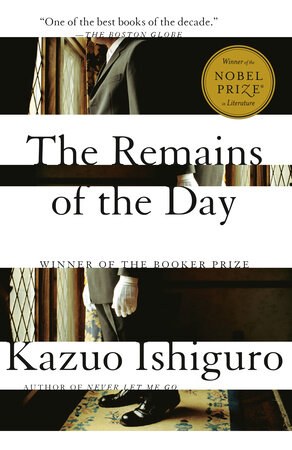
Edition: Vintage paperback, 1990 · ISBN 9780679731726.
This is the clearest entry into Ishiguro’s art of resistance. Stevens’s controlled voice turns professional vocabulary into emotional armour. Notice how the novel lets the reader perceive political and romantic loss without breaking the narrator’s characteristic restraint.
For relationships under a shortened future: Never Let Me Go
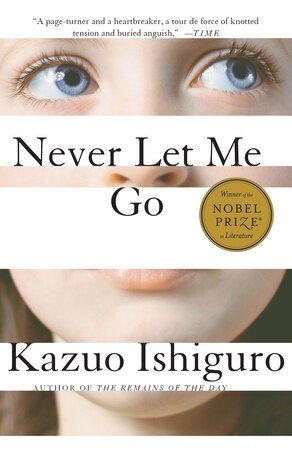
Edition: Vintage paperback, 2006 · ISBN 9781400078776.
Come here for the mature fusion of speculative premise and intimate memory. The novel reveals its world gradually, but the real suspense lies in how Kathy, Ruth and Tommy understand one another too late. It is an exemplary study in making a large ethical question emotionally local.
Why read Ishiguro now?
We are surrounded by language designed to declare, persuade and perform certainty. Ishiguro’s fiction attends to another register: the hesitant language by which people protect themselves from knowledge they already possess.
That does not make his novels evasive. It makes them precise about the human cost of truth. A character can understand an event intellectually and still be unable to reorganize a life around it. A society can call exploitation necessary and remain dependent on not seeing the people it harms. A memory can console and deceive at the same time.
Ishiguro’s great subject is not simply repression. It is the fragile possibility of recognition—between narrator and reader, between two people in a room, between one generation and the next. His stories communicate feeling because they respect how difficult feeling is to communicate.
On his birthday, that is the invitation worth carrying back to the page: do not force the heart to make a speech. Build the conditions in which the reader can hear what it is trying, and failing, to say.
Sources and edition notes
- Kazuo Ishiguro: Nobel Lecture
- Nobel Prize: biographical and bibliographical note
- The Paris Review: The Art of Fiction No. 196
- Royal Society of Literature: Kazuo Ishiguro
- Penguin Random House: A Pale View of Hills
- Penguin Random House: The Remains of the Day
- Penguin Random House: Never Let Me Go
The opening quotation is from Ishiguro’s official Nobel Lecture, delivered on December 7, 2017. The website cover is DeepCrafter’s original illustrated Resonance card, not an archival photograph. The three book-cover images identify the specific Vintage editions listed above.