A Voice That Carries Home: Four Books by Grace Nichols
A four-book route through Grace Nichols’s poetry: historical memory, self-naming, recovered voice and the portable meaning of home.
A Voice That Carries Home: Four Books by Grace Nichols
The Royal Society of Literature has named Grace Nichols the winner of the 2026 RSL Pioneer Prize, a £10,000 award celebrating British women writers who have broken new ground. This year’s prize focuses on poetry.
The award is a good reason to read Nichols now, but not because prizes settle literary value. It matters because the judges have recognised a career that has made poetry hospitable to more than one language, homeland, register and generation of reader.
Born in Guyana and resident in Britain since 1977, Nichols has written across adult and children’s poetry for more than four decades. The RSL describes the reach of a voice that combines Caribbean heritage with modern Britain; Nichols herself describes the poet as a pioneer finding a path through “the forest of the imagination” toward an essential voice and vision.
Where should a new reader begin?
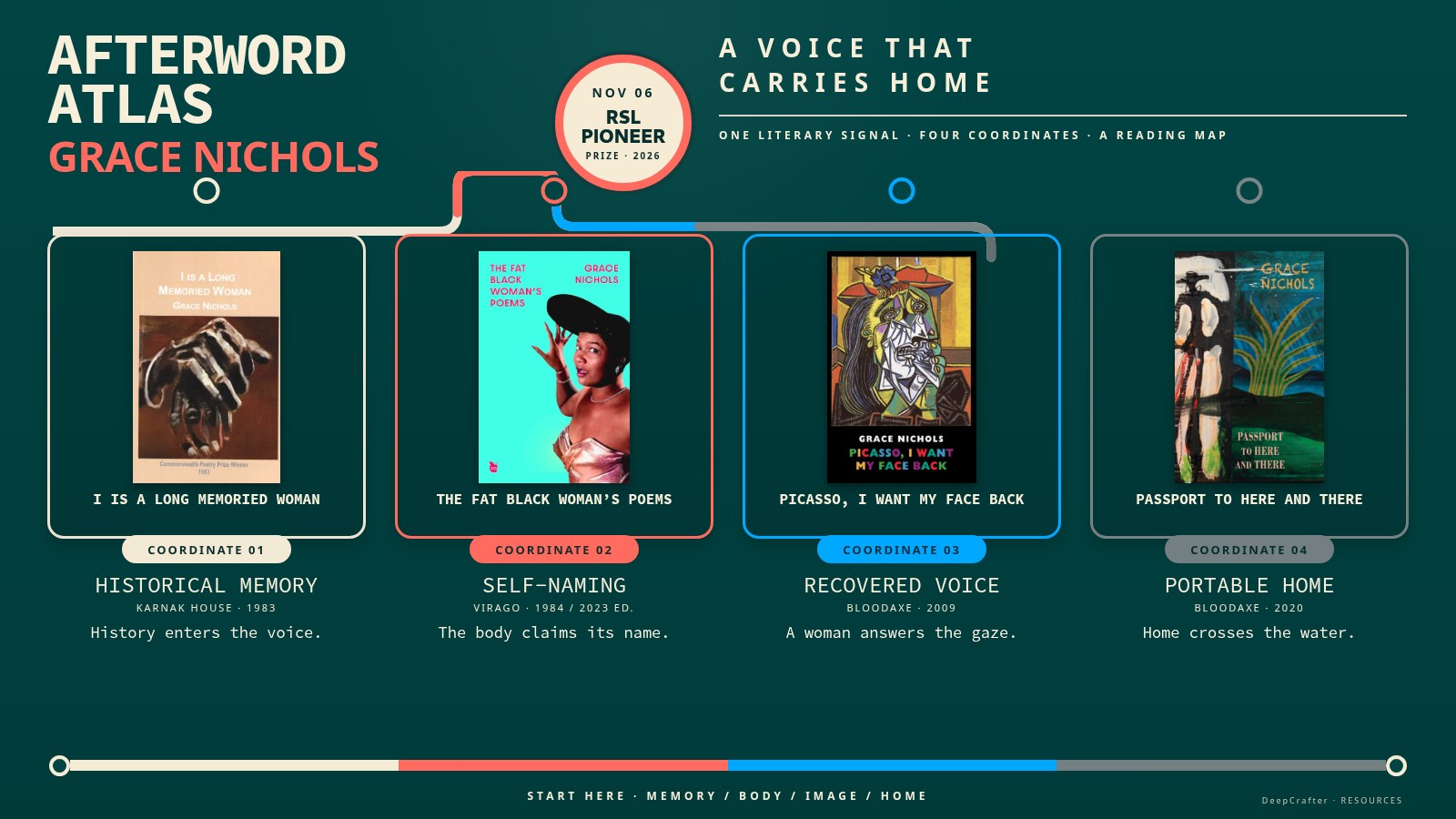
This four-book route is not a ranking or a complete survey. It moves through four coordinates that illuminate Nichols’s work: historical memory, self-naming, recovered voice and portable home.
Coordinate 1 · Historical memory
I Is a Long Memoried Woman (1983; Karnak House)
Begin here if you want to understand why memory in Nichols is never merely private.
Her first collection traces the emotional and spiritual development of an unnamed African-Caribbean woman through the histories and afterlives of enslavement. The book gives lyric form to violence, complicity, survival, motherhood, sensuality and the recovery of purpose. It won the 1983 Commonwealth Poetry Prize; Karnak House notes that Nichols was the first Caribbean woman poet to win it.
The title’s grammar matters. Standard English is not treated as the only vessel for intelligence or authority. Voice becomes historical evidence and an act of self-possession.
Read for: the way a sequence of poems can carry collective memory without flattening a speaker into a symbol.
Notice: how ritual, repetition, bodily knowledge and Caribbean speech patterns create continuity across rupture.
Edition used for the map: Karnak House paperback, ISBN 9780907015673. The work first appeared in 1983; the selected current publisher listing and cover correspond to the Karnak House edition.
Coordinate 2 · The body names itself
The Fat Black Woman’s Poems (1984; Virago Five Gold Reads edition, 2023)
Read this next for Nichols’s range of wit, defiance, pleasure and vulnerability.
The central figure refuses the narrow roles imposed by politicians, suitors, fashion and the social gaze. She does not ask to be made respectable before she can take up space. Nichols’s language is sensuous and economical: humour can be an instrument of critique, and self-delight can be a serious form of resistance.
Placed after I Is a Long Memoried Woman, the collection reveals a crucial movement. Historical memory does not remain in the past; it enters the contemporary body, the domestic world and the right to name oneself.
Read for: poems in which the body is not an object waiting for approval but a source of appetite, judgment and style.
Notice: how comedy changes the balance of power. The poems can expose an insult without letting the insult control their music.
Edition used for the map: Virago Five Gold Reads paperback, ISBN 9780349017402, published June 15, 2023. This reissue celebrates an iconic work in Virago’s history.
Coordinate 3 · A face reclaimed from the frame
Picasso, I Want My Face Back (2009; Bloodaxe Books)
The book opens with a long poem spoken in the voice of Dora Maar, the artist and photographer whose face became widely recognised through Picasso’s Weeping Woman.
Nichols does not merely describe a painting. She gives the represented woman a shifting interior voice and a journey of self-reclamation. Bloodaxe notes that the poem’s interlocking reflections echo Cubist surfaces while allowing the reader to enter Dora Maar’s mind.
This is a useful third coordinate because it shows Nichols moving beyond autobiographical identity without abandoning her central concern: who controls a woman’s image, language and memory?
Read for: a sustained act of persona in which looking becomes an argument about possession.
Notice: how form answers subject. Fragmentation is not simply damage; it becomes a way for the speaker to look back at the frame that has contained her.
Edition used for the map: Bloodaxe paperback, published October 22, 2009, ISBN 9781852248505.
Coordinate 4 · Home carried between places
Passport to Here and There (2020; Bloodaxe Books)
End here for Nichols’s mature poetry of return, migration and double belonging.
The collection moves from memories of a Guyanese childhood to life in Britain and the Sussex landscape. Its title refuses the idea that a passport must resolve identity into one destination. Home can be recalled, revisited, argued with and made present through ordinary things.
Bloodaxe describes a book of connections and reconnections, moving between personal and public history. Its “Back-homing” sequence grew from a return to Guyana; elsewhere, English landscapes and contemporary events enter the same field of attention.
Read for: the gains and losses of living between countries without reducing migration to either nostalgia or triumph.
Notice: how weather, food, plants, streets and spoken rhythms carry place. Landscape is not background; it is a form of memory.
Edition used for the map: Bloodaxe paperback, published June 25, 2020, ISBN 9781780375328. The book received a Poetry Book Society Special Commendation.
The reading route
Read the four books in this order if you want to follow a widening movement:
- History enters voice — I Is a Long Memoried Woman.
- The body claims its own name — The Fat Black Woman’s Poems.
- A represented woman answers the gaze — Picasso, I Want My Face Back.
- Home becomes portable and plural — Passport to Here and There.
If you want only one book:
- choose The Fat Black Woman’s Poems for the most immediate encounter with Nichols’s wit, sensuality and self-naming;
- choose I Is a Long Memoried Woman for the historical foundation of her career;
- choose Passport to Here and There for migration, memory and mature retrospection.
What writers can learn from Nichols
A voice can hold more than one English
Nichols’s work shows that rhythm, syntax and idiom are not cosmetic markers added after meaning. They are part of how a poem knows what it knows. Writers working across languages or dialects do not have to flatten every register into a single neutral voice.
Seriousness does not require one emotional temperature
Her poems move between grief, sensuality, wit, anger, tenderness and play. Humour does not weaken history; it can keep a speaker’s freedom alive inside it.
Place becomes vivid through ordinary carriers
Home travels through weather, food, flora, family speech and the remembered texture of streets. Abstract belonging gains force when attached to things the senses can recover.
Persona can return agency to the represented
In Picasso, I Want My Face Back, the dramatic voice does more than animate a historical figure. It changes the direction of the gaze. Writers using real lives should ask not only “How can I portray this person?” but “What has the familiar portrayal prevented us from hearing?”
A note on the forthcoming collection
Nichols’s tenth adult collection, The Tracks of My Name, is scheduled for publication by Bloodaxe on November 19, 2026. Because it was not yet published when this map was prepared, it is not presented here as a read or used as one of the four coordinates.
The distinction matters. A forthcoming book can be anticipated; it cannot be honestly folded into an already-read recommendation.
Why read Grace Nichols today
The Pioneer Prize recognises a writer who made room: for Caribbean cadences inside British poetry, for women who refuse the gaze imposed on them, for children who hear poetry as sound and play, and for readers whose idea of home has more than one coast.
Start with the coordinate you need. Then follow the voice as it carries history, body, image and home into the same living language.
Sources and edition notes
- Royal Society of Literature: Grace Nichols wins the 2026 RSL Pioneer Prize
- Karnak House: I Is a Long Memoried Woman
- Virago: The Fat Black Woman’s Poems
- Bloodaxe: Grace Nichols bibliography
- Bloodaxe: Picasso, I Want My Face Back
- Bloodaxe: Passport to Here and There
The accompanying Afterword Atlas uses authentic, upright and uncropped covers from the official publisher pages above. Cover sources were verified November 6, 2026.