The Wrong Door into Wonder: Gianni Rodari and the Grammar of Imagination
Teacher, journalist and fabulist Gianni Rodari turned errors, wordplay and impossible pairings into a practical art of storytelling.
The Wrong Door into Wonder: Gianni Rodari and the Grammar of Imagination
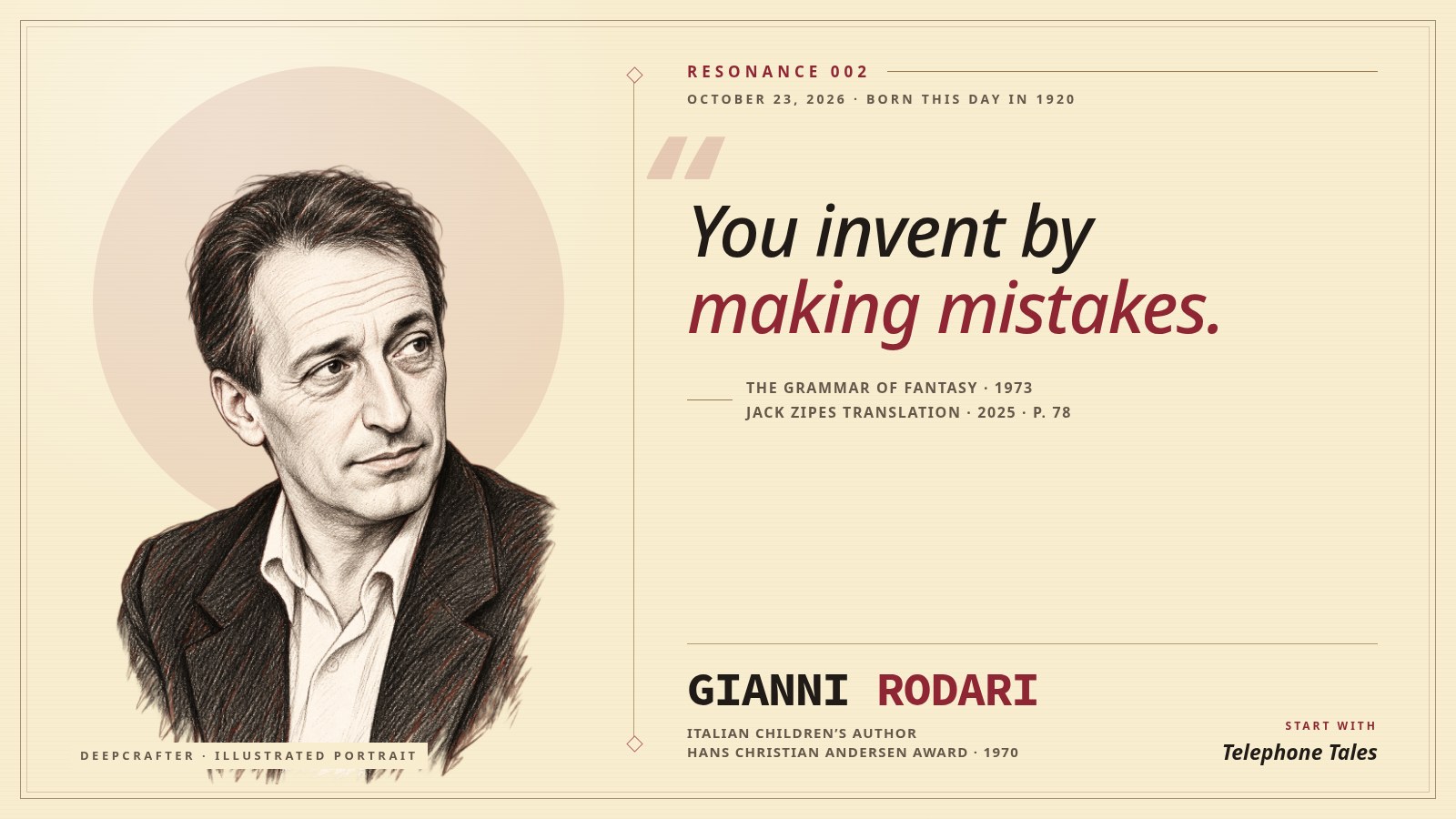
“You invent by making mistakes.”
Why we chose Gianni Rodari that day
We chose Gianni Rodari for October 23, the anniversary of his birth in 1920, to move our daily literary portrait into the world of Italian children’s literature and radical pedagogy. The line “You invent by making mistakes” is small enough to remember and large enough to contain his method: error as invitation, language as play and imagination as a democratic capacity rather than a rare talent. It also leads naturally to The Grammar of Fantasy and to the life of the only Italian writer to receive the Hans Christian Andersen Award for Writing.
The line is only five words long, but it opens a door into Gianni Rodari’s entire world. A misspelling is not always rubbish to be swept away. A word placed beside the wrong neighbour may begin to move. A familiar tale turned upside down may reveal a hidden assumption. For Rodari, imagination was not a rare gift bestowed on a lucky few. It was a human faculty that could be invited, exercised and shared.
Born on October 23, 1920, Rodari became Italy’s most internationally influential twentieth-century writer for children. He was also a teacher, journalist, poet, political intellectual and a restless student of how stories begin. In 1970, he received the Hans Christian Andersen Award for Writing, the highest international recognition for a children’s author’s lasting body of work.
Yet awards can make a writer appear more solemn than he was. Rodari’s books are full of runaway buildings, edible planets, rebellious punctuation, impossible countries and ordinary objects that suddenly refuse their assigned roles. Underneath the comedy lies a serious proposition: fantasy does not help us escape reality so much as look at it from a freer angle.
A quiet child who learned to listen to words
Gianni Rodari was born in Omegna, a town on Lake Orta in northern Italy. His father, Giuseppe, was a baker. After his father died when Gianni was nine, the family moved to Gavirate, in Lombardy. Biographical accounts describe him as a shy, inward-looking child and a voracious reader. He also studied the violin, an early encounter with rhythm that seems at home beside the musical precision of his later rhymes.
Rodari trained as an elementary-school teacher and began teaching before the Second World War. The war changed the direction of his life. By 1944, he had joined the Italian Communist Party and taken part in the Resistance. After the war, he moved into journalism, writing for L’Unità and later working with publications including Il Pioniere and Paese Sera.
Writing for newspapers trained him to be direct. Teaching trained him to listen. Politics sharpened his attention to power, labour, poverty and the claims adults make on behalf of children. These strands did not remain separate. They converged in a literature that could be light without being trivial and socially alert without turning children into an audience for lectures.
Rodari did not write down to children. He trusted them with contradiction, absurdity and unfinished questions.
How a journalist became a fabulist
Rodari’s early children’s writing appeared in newspapers and magazines. Rhymes, short tales and serialized adventures allowed him to test ideas in forms that were quick, memorable and open to response. His breakthrough was not a retreat from journalism into a sealed world of fantasy. It was a discovery that fantasy could become a form of inquiry.
In The Adventures of Cipollino, a community of fruit and vegetable characters confronts an unjust social order. In Gelsomino in the Land of Liars, a boy with an extraordinarily powerful voice enters a country where truth has been outlawed. In Telephone Tales, a travelling salesman calls his daughter every night and tells her a story before his telephone time runs out. The premise turns a limit—the expensive, brief call—into a formal engine: each tale must be compact enough to cross the distance before the connection ends.
This is one reason Rodari still feels modern. He understood constraint as a creative partner. A short column, a rhyme, a child’s question or an accidental word could become the rule that gives a story its shape.
The books that map his imagination
The Adventures of Cipollino (1951)
Rodari’s onion-headed hero belongs to a world of edible citizens and absurd authority. The playful cast makes hierarchy visible without reducing the story to a lesson. Read it for Rodari’s ability to turn political structure into comic action.
Gelsomino in the Land of Liars (1958)
In a country where everyone must lie, language itself becomes political. Gelsomino’s voice can shatter walls, but the deeper conflict concerns what happens when a society forces words to mean their opposite. Read it for Rodari’s faith that linguistic play can expose real systems of power.
Telephone Tales (1962)
This is the best first book for many readers. The stories are brief, strange and emotionally exact. Their premises arrive with the speed of jokes, but they often leave behind melancholy, tenderness or moral unease. Read it to see how little space a complete imaginative transformation can require.
The Cake in the Sky (1966)
A mysterious circular object appears over Rome and adults assume danger; children approach it with curiosity. Rodari uses a science-fiction premise to contrast fear, militarized thinking and open-ended investigation. Read it for the way wonder rearranges authority.
The Grammar of Fantasy (1973)
Rodari’s only major theoretical book grew from years of notes, classroom encounters and workshops. It is neither a rigid manual nor a mystical celebration of inspiration. It is a generous collection of provocations: ways to make words collide, bend rules, disturb clichés and invite children into the making of stories. Teachers and writers can read it as pedagogy, poetics or a box of creative tools.
What kind of person was Rodari?
The public image is often cheerful: the writer of jokes, rhymes and marvellous nonsense. The fuller figure was more complex.
Rodari was playful, but not complacent. His humour repeatedly sides with people who have less power. He distrusted authoritarian education and the idea that children should merely memorize the world adults hand them. He was politically committed, yet his best work does not ask fantasy to march in a straight line. Imagination remains unruly enough to surprise the writer too.
He was also methodical about play. That combination matters. Rodari did not treat spontaneity as the opposite of craft. He collected possibilities, studied folktales, tested games with children, observed how a wrong word could generate a chain of images and then reflected on why the process worked. His writing personality joins moral seriousness to comic agility: a conviction that language can be both a toy and an instrument of liberation.
Most importantly, he regarded children as collaborators in meaning. A story could be changed, questioned or continued. The word “End” did not have to close every door.
Five Rodari methods writers can still use
1. Let two distant words meet
Rodari’s best-known technique is the fantastic binomial: choose two words whose relationship is not already obvious, then force them into the same imaginative space.
“Dog” and “horse” are too close; the mind connects them without effort. “Dog” and “wardrobe” create more friction. Is there a dog inside the wardrobe? A wardrobe that follows its owner like a dog? A city where wardrobes must be walked every morning?
The point is not randomness for its own sake. Distance makes the imagination build a bridge. That bridge is the beginning of a story.
Try it: Pick one concrete noun from your current scene and one from a different domain. Do not explain the connection. Write the first consequence of their coexistence.
2. Ask what would happen if the rule changed
The fantastic hypothesis begins with a simple disturbance: What would happen if…?
What if an elevator refused to stop at the top floor? What if every lie became physically visible? What if a town’s shadows went on strike?
A strong hypothesis changes more than the decoration of the world. It produces consequences. Who benefits from the new rule? Who is frightened? What institution tries to control it? Which ordinary habit becomes impossible?
Try it: Change one rule of reality, then list five consequences before inventing a protagonist. Let the world pressure create the character’s problem.
3. Treat errors as doors, not verdicts
The Daily Resonance line—“You invent by making mistakes”—appears in Rodari’s discussion of errors that generate unexpected meanings. He is not arguing that accuracy has no value. He is noticing that language sometimes offers a second possibility at the moment it fails to obey the first.
A typo may name a creature. A misheard phrase may imply a hidden custom. A child’s “wrong” answer may contain a metaphor that correctness would erase.
Try it: Take one sentence you deleted because it was wrong. Underline the wrongest word. Assume the word is exact and the world is mistaken. What must be true for the sentence to make sense?
4. Break a familiar tale on purpose
Rodari often works with stories readers already know. Change a role, interrupt the sequence or insert an alien element. Little Red Riding Hood meets a giraffe. Cinderella refuses the invitation. The wolf asks for legal counsel.
The altered detail exposes the machinery of the original. We notice what we had accepted without seeing: who is allowed to act, which event counts as inevitable, and what moral the plot quietly rewards.
Try it: Summarize a familiar tale in six beats. Replace the third beat with something that belongs to another genre. Follow the consequences without restoring the original ending.
5. Give children—and readers—room to answer back
Rodari’s methods are social. A prompt is not simply a way for an author to extract material; it can become an invitation to collective invention. One person offers a word, another complicates it, and the story grows through response.
For a solitary writer, the equivalent is to leave genuine openness in the drafting process. Do not decide every meaning before the scene exists. Let a character resist the role you assigned. Let an image return with a different significance. Let the ending answer a better question than the one you began with.
Try it: At the end of a draft, write three questions a curious child might ask that the story cannot yet answer. Choose the question that most destabilizes your plan and write one new scene toward it.
His writing habit was attention
Rodari’s career does not offer the romantic image of an isolated genius waiting for inspiration. His materials came from teaching, journalism, politics, reading, conversation and close attention to how people use language. He kept notes on what he called the “fantastic,” returned to them years later and transformed accumulated experiments into The Grammar of Fantasy.
The practical lesson is larger than any single exercise. Build a life in which story material can be noticed. Keep strange errors. Record children’s questions without correcting them into adult language. Save pairs of words that resist each other. Listen for clichés, because a cliché is often a rule waiting to be reversed.
Rodari’s discipline was not the elimination of play. It was the patient preparation of conditions in which play could become fruitful.
Why read Rodari now?
Contemporary writers work amid systems that reward speed, predictability and frictionless completion. Rodari offers a useful counter-pressure. Imagination needs friction. A story often begins when something does not fit: two words, a rule and its exception, an adult explanation and a child’s refusal to accept it.
He also reminds us that writing craft is never only mechanical. Who gets to imagine alternatives is a political question. A child asked only to repeat the correct answer is being trained for a different world from a child invited to transform the question.
Rodari’s fantasy is not an escape hatch from responsibility. It is a rehearsal space for possibility.
Where to start
For the most welcoming entrance: Telephone Tales
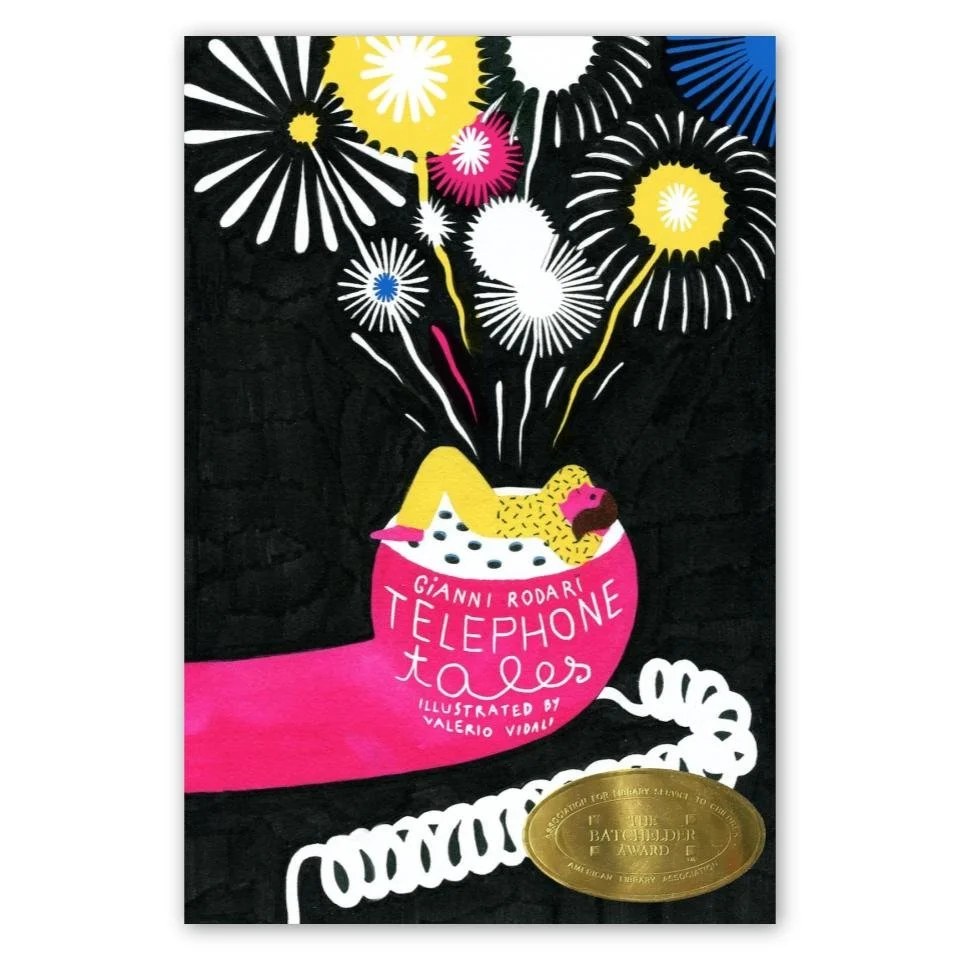
Book information: Short stories · translated by Antony Shugaar · illustrated by Valerio Vidali · Enchanted Lion Books, 2020 · 212 pages · ISBN 9781592702848 · ages 10–14. Winner of the 2021 Mildred L. Batchelder Award.
Start here for brief, surprising tales whose playful premises often leave behind tenderness or moral unease.
For writers and teachers: The Grammar of Fantasy
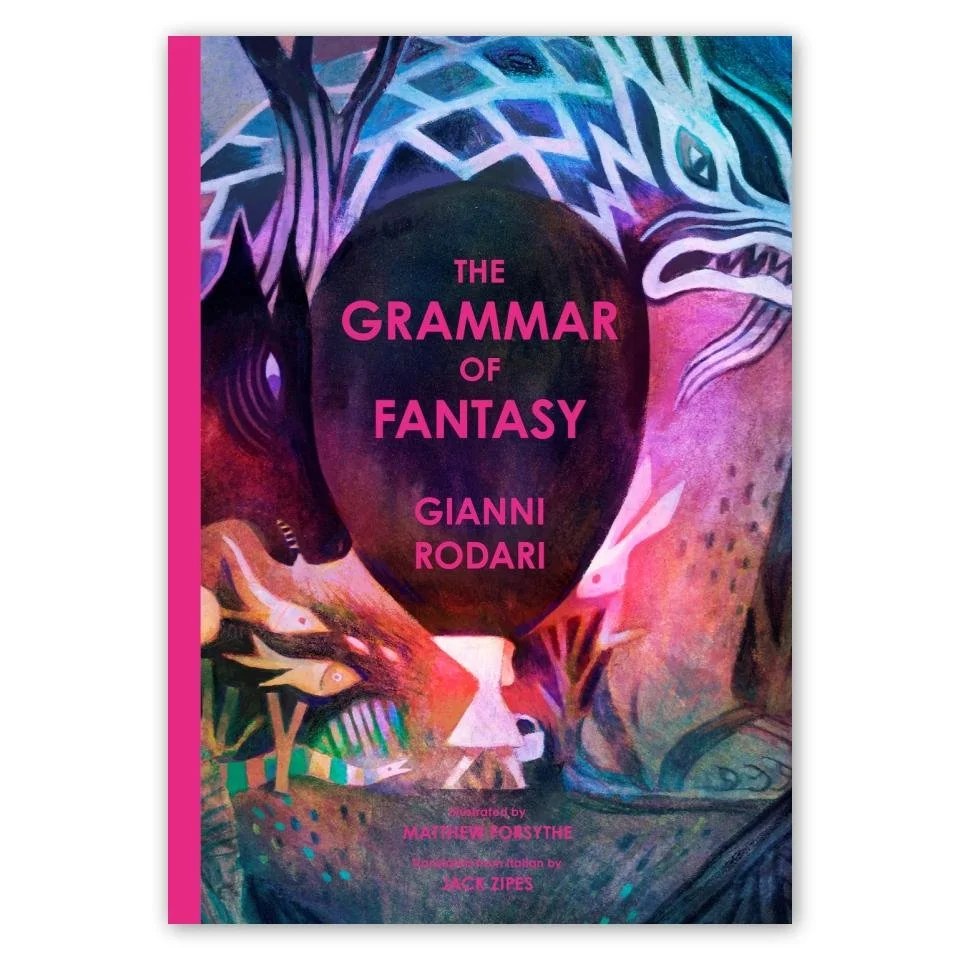
Book information: Creative pedagogy and poetics · translated by Jack Zipes · illustrated by Matthew Forsythe · Enchanted Lion Books, 2025 · 316 pages · ISBN 9781592703050 · for teens and adults.
Choose this for Rodari’s practical methods: the fantastic binomial, productive error, altered rules and other ways to make language generate possibility.
For comic political adventure: The Adventures of Cipollino
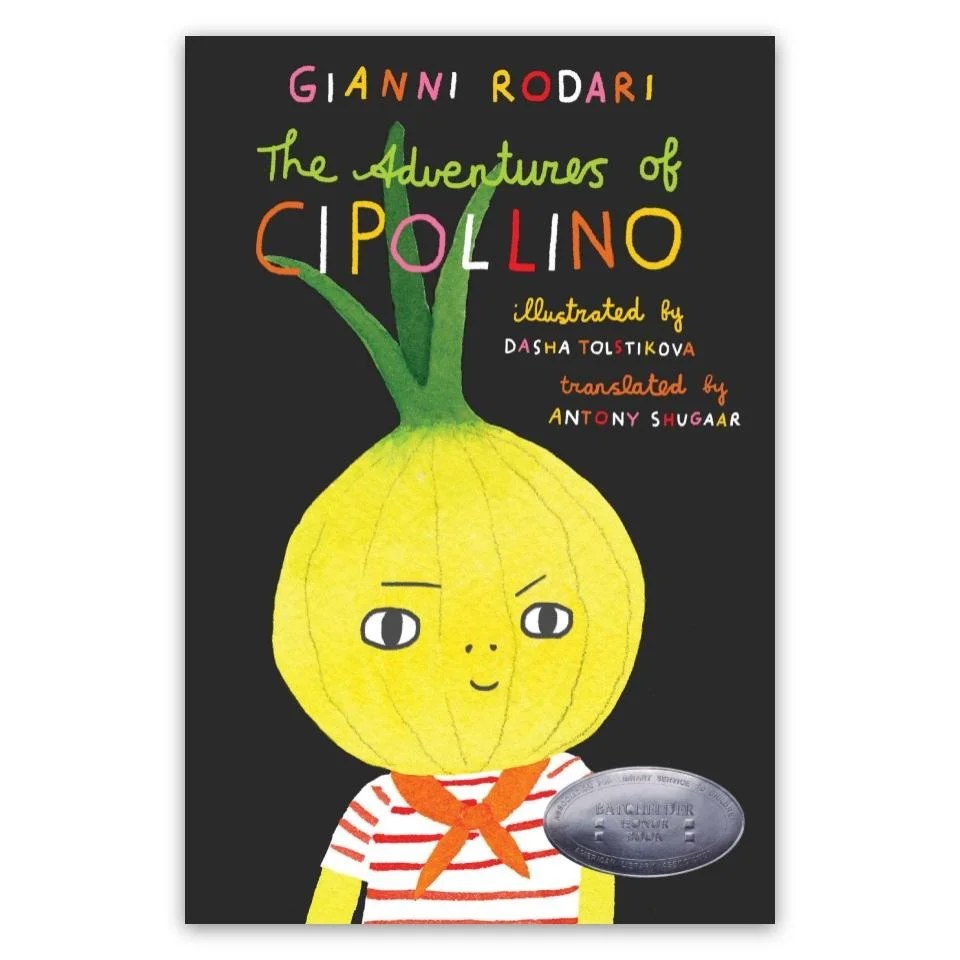
Book information: Children’s novel · translated by Antony Shugaar · illustrated by Dasha Tolstikova · Enchanted Lion Books, 2025 · 248 pages · ISBN 9781592704163 · ages 10–14.
Read it for a young onion’s rebellion against ridiculous authority—and for the way comedy makes hierarchy visible to younger readers.
For a story about language and power, continue with Gelsomino in the Land of Liars. For a one-session writing experiment, begin with a fantastic binomial, then let one mistake become canon.
Start small: two unrelated words, one altered rule, one error you decide not to erase. Rodari’s great insight was that imagination does not always announce itself with grandeur. Sometimes it enters through the wrong door—and discovers that the room is larger from that side.
Sources and edition notes
- Treccani: Gianni Rodari, Enciclopedia Italiana
- Treccani: Gianni Rodari, Dizionario Biografico degli Italiani
- IBBY: Hans Christian Andersen Award
- Enchanted Lion Books: The Grammar of Fantasy, translated by Jack Zipes (2025)
- Enchanted Lion Books: Telephone Tales
- Enchanted Lion Books: The Adventures of Cipollino
- 100 Gianni Rodari: Centenary biography and works
Quotation source: Gianni Rodari, The Grammar of Fantasy: An Introduction to the Art of Inventing Stories, translated by Jack Zipes, illustrated by Matthew Forsythe, Enchanted Lion Books, 2025, p. 78. The original Italian work was published in 1973.
The accompanying image is the same DeepCrafter-created illustrated quotation card used in the original X Resonance post, not an archival photograph.