Making Life Less Difficult: George Eliot and the Art of Attention
On George Eliot’s birthday, follow her path from translation and editing to the interwoven lives of Middlemarch—and begin with three novels that enlarge sympathy.
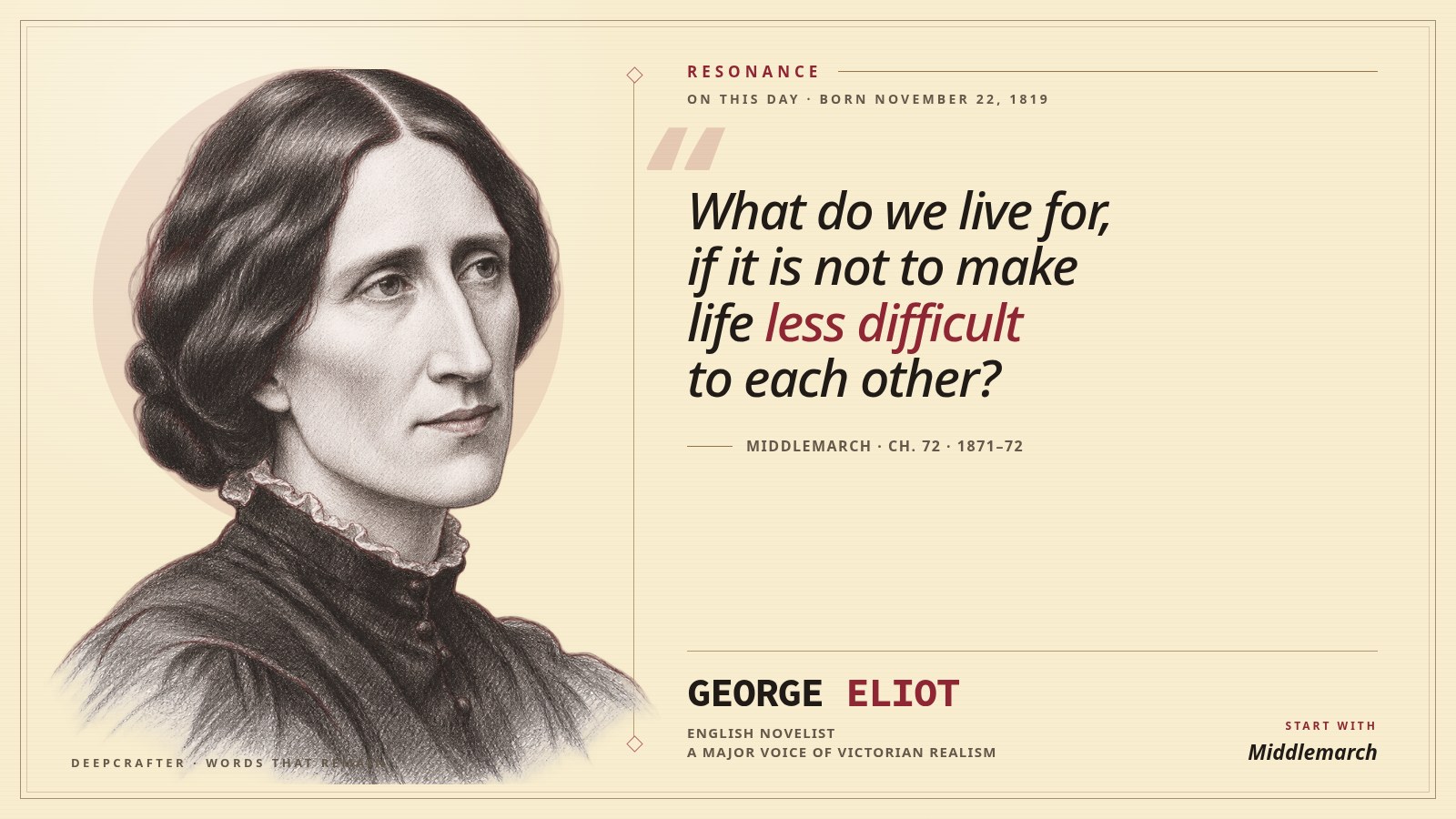
“What do we live for, if it is not to make life less difficult to each other?”
Dorothea asks the question in Chapter 72 of Middlemarch. It arrives not as a polished maxim delivered from above, but inside a difficult encounter between two women who have misunderstood one another. One of George Eliot’s great gifts is to let moral insight emerge through the pressure of relationship: a person sees differently because another person has become real.
November 22 marks Eliot’s birth in 1819. We chose this passage for her birthday because it gathers so much of her fiction into one question. How can people with partial knowledge, mixed motives and private disappointments still become less harmful—and sometimes genuinely helpful—to one another?
That question made her one of the defining novelists of the nineteenth century. It also gives writers a practical way into her work: pay attention not only to what a character intends, but to the web of consequences around that intention.
Before the novels: translation, argument and editorial work
George Eliot was born Mary Anne Evans in Warwickshire. Her father managed estates, and the rural Midlands she knew in childhood later supplied both the social texture and the changing landscapes of her fiction. She had no university education, but she read widely and gained access to the library at Arbury Hall.
Long before she published a novel, she had built a formidable intellectual life. She translated major works of German theology, including David Friedrich Strauss’s The Life of Jesus, Critically Examined and Ludwig Feuerbach’s The Essence of Christianity. She also translated Spinoza’s Ethics, although that translation was not published in her lifetime.
In London she became closely involved with the Westminster Review. Officially its assistant editor, she performed much of the work of editing: commissioning, corresponding, revising and writing essays and reviews. The role placed her inside the arguments of her time—about religion, politics, education, art and social reform—while teaching her how ideas change when they must survive contact with a reader.
This long apprenticeship matters. Eliot did not arrive at fiction as a young prodigy. She began publishing stories in her late thirties, after years spent translating difficult thought, editing other writers and testing her own critical voice. Her career is a useful answer to the fear that a writer has started too late. Work done beside fiction may already be training the novelist’s attention.
Becoming George Eliot
The name “George Eliot” first appeared with the stories later collected as Scenes of Clerical Life. A pen name helped separate the fiction from public judgment about her life and from condescending assumptions attached to women novelists. It also allowed the work to meet readers before biography settled the verdict.
By then, she had formed a lifelong partnership with the critic and philosopher George Henry Lewes. Their union could not be legally regularized because Lewes remained married, and the couple lived with social disapproval. Lewes encouraged her fiction and helped manage relations with publishers, but Eliot’s achievement was not produced by encouragement alone. The years of reading, translation and editorial labor had already given her an unusual range of reference and a disciplined seriousness about form.
Her first full novel, Adam Bede, appeared in 1859 and established her reputation. The Mill on the Floss followed in 1860, then Silas Marner, Romola, Felix Holt, Middlemarch and Daniel Deronda. Across seven novels, she kept enlarging the question of how private choices meet inherited institutions, economic pressures, religious beliefs and other people’s needs.
Realism as an expansion of attention
Eliot’s realism is sometimes mistaken for the patient accumulation of ordinary detail. Detail matters, but its moral use matters more. A provincial town, a mill, a drawing room or a household budget becomes a system in which no life is fully separate.
Her narrators can move from one consciousness to another, revealing how the same event acquires different meanings. A sharp remark may feel defensive to the speaker and cruel to the listener. A marriage can look like fulfillment from outside and gradually become a structure of confinement. An ambitious professional decision can be altered by debt, reputation and domestic pressure.
This movement does not ask readers to excuse every action. It asks them to understand before judging. Sympathy, in Eliot, is not softness. It is an enlargement of the available evidence.
Writers can learn from the distinction. When a scene feels morally simple, move the point of attention. What does the antagonist believe is at stake? What material fact has the idealist failed to notice? Who will live with the consequence after the person making the decision has left the room? Complexity begins when another life cannot be treated as scenery.
How Middlemarch learned to hold a town
Middlemarch was published in eight parts in 1871 and 1872, but its large design grew from separate beginnings. Eliot had worked on a story centered on the doctor Tertius Lydgate and another centered on Dorothea Brooke. Bringing the strands together changed the scale of the book. Neither character’s disappointed ambition would stand alone; each would become legible inside the social field of the town.
The result is not a single hero’s journey but an interdependent structure. Medicine touches money. Money touches marriage. Marriage touches reputation. Reform meets habit. Even people who rarely speak can alter one another’s futures through gossip, credit, inheritance or silence.
The form makes an argument that the narrator never needs to reduce to a formula: lives become meaningful in relation. The novel’s famous breadth is built from consequences crossing between plots.
For a contemporary writer, the method can be tested on a smaller scale. Take two storylines that currently feel separate and ask what institution they share: a family business, a school, a hospital, a building, a debt. Then let one person’s apparently private choice change the conditions of the other plot. A world becomes convincing when its characters do not merely occupy the same map.
A working life of mornings, records and revision
We should be cautious about turning a life into a productivity routine. Eliot’s surviving journals were not a continuous daily log; recent scholarship describes them as records she often used to take stock retrospectively. They preserve beginnings, interruptions, travel, reading and the emotional weather around work rather than a clean schedule anyone could copy.
A posthumous life assembled by her husband, J. W. Cross, describes a later routine in which mornings until lunch were devoted to writing, followed by walks or drives with Lewes. The account is useful as a glimpse, not a universal recipe. What matters more is the alternation it reveals: concentrated work, movement, conversation, music and reading all belonged to the life around the books.
Her manuscripts and journals also resist the myth of effortless omniscience. Middlemarch did not appear whole. Separate projects were reconsidered and joined. Eliot researched historical settings, worked through philosophical questions and revised the relation between parts.
The practical lesson is generous. A stalled fragment may not be a failed book. It may be waiting for the other story that gives it pressure and proportion. Revision can mean changing the architecture, not only improving the sentences.
Three books, three enlargements of sympathy
1. Begin with The Mill on the Floss

Selected edition: Penguin English Library paperback, published April 26, 2012, 624 pages, ISBN 9780141198910.
Begin with the emotional immediacy of Maggie Tulliver’s childhood, intelligence and conflict with the limits placed around her. The novel makes family love inseparable from rivalry, memory and obligation.
Notice: how often Maggie and Tom believe they already know what the other person feels. Track the gap between love and accurate understanding.
2. Continue with Middlemarch

Selected edition: Penguin Clothbound Classics hardback, introduced by Rosemary Ashton, published June 2, 2011, 880 pages, ISBN 9780141196893.
Continue with Eliot’s widest social canvas. Read one plot at a time if the cast first feels large, then watch for the points where money, work, marriage and reputation carry effects between households.
Notice: who gets to revise a first judgment. The deepest changes often begin when a character discovers that another person’s inner life is larger than the role assigned to them.
3. End with Daniel Deronda
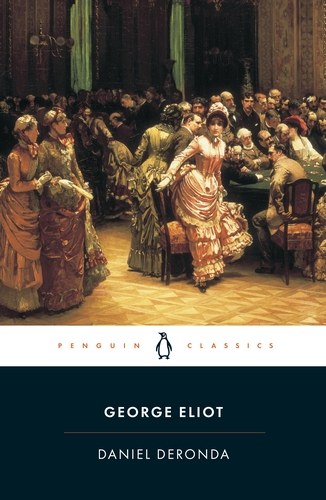
Selected edition: Penguin Classics paperback, edited with an introduction and notes by Terence Cave, published February 1, 1996, 896 pages, ISBN 9780140434279.
Finish with Eliot’s last novel, where Gwendolen Harleth’s moral awakening is set beside Daniel’s search for family, Jewish identity and purpose. The book asks readers to hold together stories that many early readers wanted to separate.
Notice: how listening changes the direction of a life. Compare the moments when a character treats another person as an audience with the moments when they recognize that person as a source of knowledge.
What writers can carry forward
Let consequences cross plot lines. A choice gains weight when it changes conditions for someone outside the choosing character’s immediate scene.
Treat sympathy as investigation. Understanding a motive does not erase harm. It gives the story more accurate material from which judgment can grow.
Use institutions as active forces. Money, marriage, law, religion and reputation do not need to become lectures. Show how they alter what a character can risk today.
Keep fragments available. Two incomplete stories may reveal a larger design when placed in relation. Revision can discover the book’s social architecture.
Write the ordinary act that carries the moral change. Recognition becomes dramatic when it changes a visit, a letter, a payment, an apology or a refusal.
The difficulty we can lessen
George Eliot’s birthday invites admiration, but her fiction asks for something more active than admiration. It asks us to notice the lives our first explanations leave out.
Dorothea’s question in Chapter 72 does not claim that people can remove every difficulty from one another’s lives. Eliot knew too much about error, disappointment and social constraint for that. The sentence chooses a smaller and more demanding measure: whether our presence makes another life harder or less hard.
For the next scene you write, find the character who is currently being understood only from the outside. Give that person one fact the viewpoint character does not know. Then let the fact alter a concrete action before the scene ends.
The moral imagination of a novel grows one revised attention at a time.
Sources
- Stanford Encyclopedia of Philosophy: George Eliot
- George Eliot Archive
- Victorian Women Writers Project: George Eliot, by Mathilde Blind
- Oxford Handbook of George Eliot: “George Eliot’s Journals”
- Standard Ebooks: Middlemarch, Chapter 72
- Penguin Classics: The Mill on the Floss
- Penguin Classics: Middlemarch
- Penguin Classics: Daniel Deronda
Image and edition notes
- Website cover: the original illustrated George Eliot Resonance card published by DeepCrafter; it is an editorial illustration, not an archival photograph.
- The Mill on the Floss cover: Penguin English Library paperback, ISBN 9780141198910; cover and edition metadata from Penguin.
- Middlemarch cover: Penguin Clothbound Classics hardback, ISBN 9780141196893; cover and edition metadata from Penguin.
- Daniel Deronda cover: Penguin Classics paperback, edited by Terence Cave, ISBN 9780140434279; cover and edition metadata from Penguin Random House.
- The opening quotation follows the Standard Ebooks English text of Middlemarch, Book VIII, Chapter 72.
Sources
- Stanford Encyclopedia of Philosophy: George Eliot
- George Eliot Archive
- Victorian Women Writers Project: George Eliot
- Oxford Handbook of George Eliot: George Eliot’s Journals
- Standard Ebooks: Middlemarch, Chapter 72
- Penguin Classics: The Mill on the Floss
- Penguin Classics: Middlemarch
- Penguin Classics: Daniel Deronda