The Fire Inside the Story: Doris Lessing and the Imagination That Survives
From colonial Southern Africa to The Golden Notebook and speculative fiction, follow Doris Lessing’s restless career, working life and enduring belief in the storyteller.
The Fire Inside the Story: Doris Lessing and the Imagination That Survives
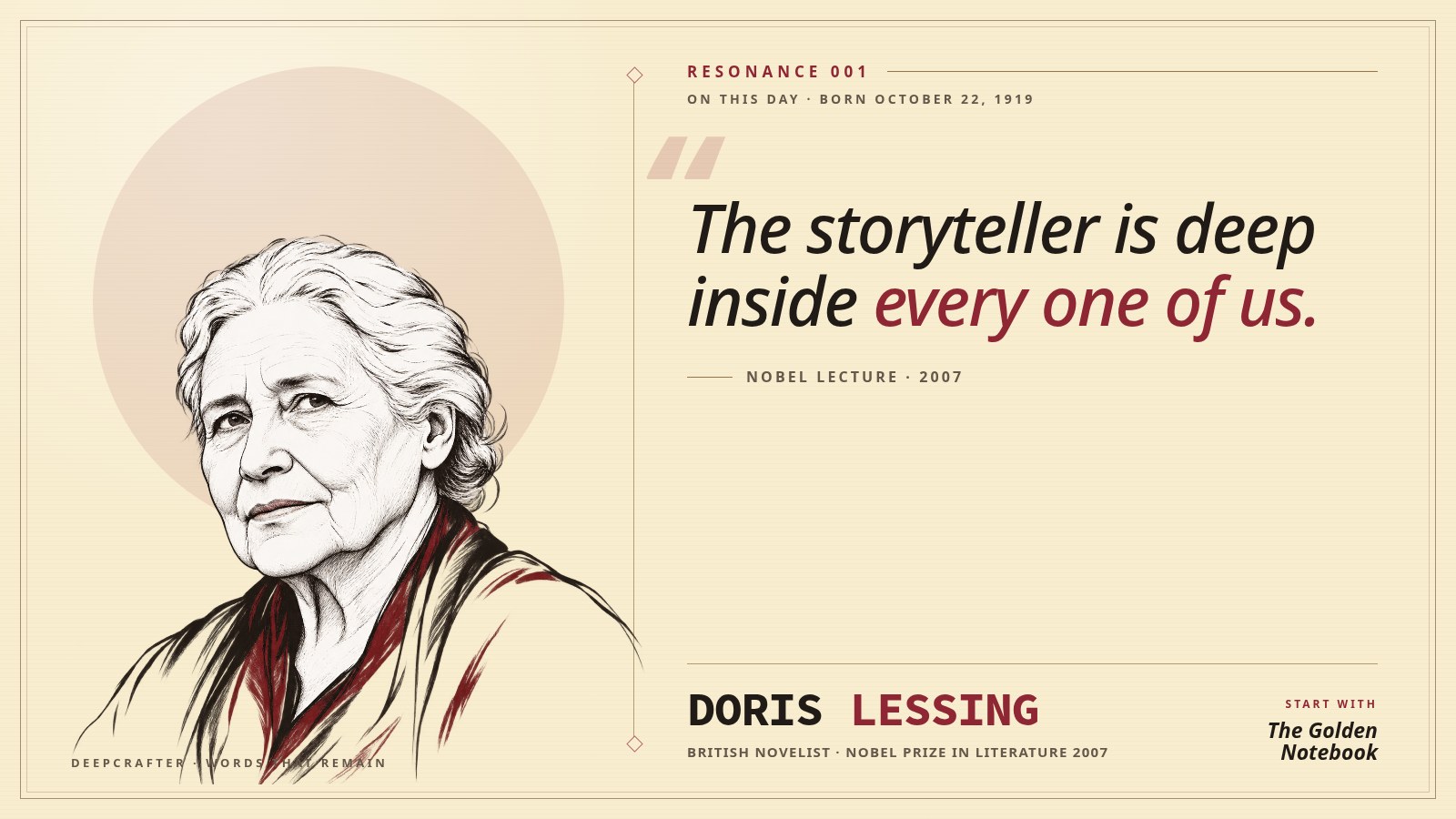
“The storyteller is deep inside every one of us.”
Why we chose Doris Lessing that day
We chose Doris Lessing for October 22 because it was the anniversary of her birth in 1919—and because this line from her Nobel lecture offered a fitting beginning for our Daily Resonance series. It does more than celebrate the imagination. It places storytelling inside the conditions Lessing cared about throughout her life: unequal access to books, political pressure, displacement and the stubborn human need to make meaning. The day gave us the occasion; the quotation gave us the doorway into a writer whose career kept asking what stories can preserve when systems fail.
Doris Lessing offered that line near the end of her 2007 Nobel lecture. It sounds like a celebration of creative instinct, but the lecture around it is tougher than a slogan. Lessing speaks about books in places marked by poverty, censorship and political failure; about writers who struggle to find education, paper, publishers and the quiet in which language can arrive. The storyteller survives, she suggests, not because storytelling is easy, but because human beings keep remaking experience into meaning.
That conviction runs through a career that resisted every comfortable label. Lessing wrote realist novels about colonial Southern Africa, formally adventurous accounts of women’s inner lives, political fiction, speculative histories of civilizations and intimate studies of families under pressure. She was praised as a feminist icon and argued with feminism; joined communism and broke with it; won the Nobel Prize and distrusted the ceremonial image of the great writer.
To read Lessing is to enter a body of work that keeps changing its method whenever the old method can no longer tell the truth.
A childhood between empire, landscape and books
Doris May Taylor was born on October 22, 1919, in Kermanshah, then in Persia and now Iran, to British parents. Her father had been badly wounded in the First World War. Her mother had served as a nurse. In 1925 the family moved to a farm in Southern Rhodesia, now Zimbabwe, drawn by the imperial promise of prosperity.
The farm did not bring the future her parents imagined. It did, however, give Lessing the landscape, racial order and family tensions that would feed decades of writing. She grew up inside colonial privilege while learning to see its violence and absurdity. Her mother tried to reproduce an English social world; her father carried the war and his disappointments into the household.
Lessing left formal school at fourteen. She educated herself through reading and a succession of jobs—as a nanny, telephone operator, office worker, stenographer and journalist. The house of her childhood, she later recalled in her Nobel lecture, was physically rough but full of books. Parcels arrived from England. Reading joined a remote farm to a much larger intellectual tradition.
That combination matters: Lessing was self-educated, but never anti-intellectual. She treated books as an inheritance that had to be entered, tested and passed on.
From Salisbury to London
As a young woman in Salisbury, now Harare, Lessing became involved in left-wing political circles and debates about race. She married twice, had three children, and in 1949 left Southern Rhodesia for London with her youngest son and the manuscript that became The Grass Is Singing.
Published in 1950, the novel established her immediately. Its story of Mary Turner, a white farmer’s wife, and Moses, a Black servant, makes private breakdown inseparable from colonial power. Lessing did not treat the farm as an exotic backdrop. The social system enters the characters’ speech, fear, desire and self-deception.
In Britain she joined the Communist Party, then left it in 1956 after growing disillusioned with Soviet communism and ideological certainty. Her criticism of white minority rule led to bans on her entering South Africa and Southern Rhodesia for decades.
Political commitment remained central to her work, but so did suspicion of any system that claims to explain the whole person. She kept asking what collective ideas illuminate—and what they erase.
The long apprenticeship of Martha Quest
The five-volume Children of Violence sequence follows Martha Quest from adolescence in colonial Africa into adulthood, politics, marriage and a future shadowed by social collapse. The books gave Lessing room to examine how a personality forms inside history.
Martha wants freedom, yet carries the habits of the world she rejects. Political groups promise clarity, but reproduce vanity and coercion. Private life is not outside politics; it is one of the places where political language is exposed.
Read the sequence for Lessing’s scale. She can move from a room, a marriage or an argument into the pressure of an era without pretending that history makes the individual simple.
The Golden Notebook: fragmentation as method
Published in 1962, The Golden Notebook became Lessing’s most famous novel. Its protagonist, Anna Wulf, separates her experience into different notebooks: political life, African material, fiction, personal memory. A fifth notebook attempts to bring the fragments together.
The structure is not a puzzle designed to display cleverness. It gives form to a mind under pressure from competing identities and public narratives. What happens when political belief, sexuality, motherhood, work and mental breakdown refuse to become one clean story?
The novel was embraced as a landmark of feminist literature. Lessing resisted reducing it to a single movement or message. That resistance is part of the book’s continuing value. It asks readers to experience contradiction before resolving it.
Refusing the shelf that success built
After becoming famous for social realism, Lessing moved further into speculative fiction. The Canopus in Argos: Archives sequence imagines human history from the perspective of competing galactic civilizations. Critics who wanted another Golden Notebook were baffled or hostile.
Lessing continued anyway.
The shift reveals one of her strongest traits as a writer: she did not protect a successful identity at the expense of curiosity. Science fiction gave her another scale for questions already present in her realist work—how civilizations educate perception, how ideologies colonize thought, and how individuals understand forces larger than themselves.
Later books such as The Fifth Child return to the family with almost mythic severity. A couple’s dream of a large, happy household is overturned by a child who does not fit the family’s moral or emotional expectations. Lessing makes domestic safety feel contingent and fragile.
Her style: lucid surfaces, unstable certainties
Lessing’s prose is often clear, direct and apparently traditional. The disturbance lies in the movement of attention.
She repeatedly uses several methods:
1. The room as a political instrument
A kitchen, party, committee meeting or bedroom becomes a field of power. Who is heard? Who performs certainty? Who is expected to care for everyone else? Lessing lets social structure become visible through ordinary arrangements.
2. The self that watches itself
Her characters often divide between participation and observation. One part acts; another notices the performance. This double awareness can become freedom, exhaustion or breakdown.
3. Ideology tested by personality
Lessing does not refute systems only through argument. She watches what believers do with them: how vanity enters a noble cause, how loneliness seeks certainty, how a group punishes ambiguity.
4. A willingness to change scale
One book may stay close to a woman’s consciousness; another may view humanity across centuries. The subject determines the lens. Genre is a tool, not a loyalty oath.
5. Contradiction without immediate repair
Lessing allows people to be perceptive and blind, generous and domineering, politically courageous and privately cruel. She does not hurry to make the contradictions comfortable.
What Lessing’s working life teaches
Lessing’s Nobel lecture describes writing as requiring an “empty space”: a form of listening and attention in which characters’ words and ideas can arrive. The phrase does not mean a perfect studio or freedom from responsibility. Much of her early career was built amid work, politics, family and financial limits.
The practical habit was the protection of mental space.
She also read widely and refused the idea that talent appears from nowhere. Books connected her childhood to literary tradition; later she argued that writers need access to that inheritance. Her work moved across realism, memoir, fable, science fiction and essay because reading had made more than one form available to her.
Her daily practice can be understood through four habits:
- Keep an observing mind inside ordinary life. Lessing’s fiction turns domestic and political encounters into laboratories of motive.
- Read beyond the genre that made you successful. New forms permit new scales of thought.
- Protect attention, not a romantic ritual. The essential condition is the imaginative space in which the work can be heard.
- Permit the next book to contradict the last. A career can be an argument with its earlier certainties.
The personality behind the public figure
Interviews show Lessing as amused, impatient with fashion and resistant to reverence. She disliked being turned into a monument or representative symbol. That independence could feel bracing or combative.
Her convictions changed, but her distrust of coercive thought remained. She knew firsthand how political groups can offer fellowship and flatten complexity. She was equally alert to the stories families tell in order to preserve their image.
This does not make her a neutral observer. Her work has strong judgments. But those judgments often emerge from sustained attention rather than a prefabricated moral.
Five places to begin reading
For colonial power made intimate: The Grass Is Singing
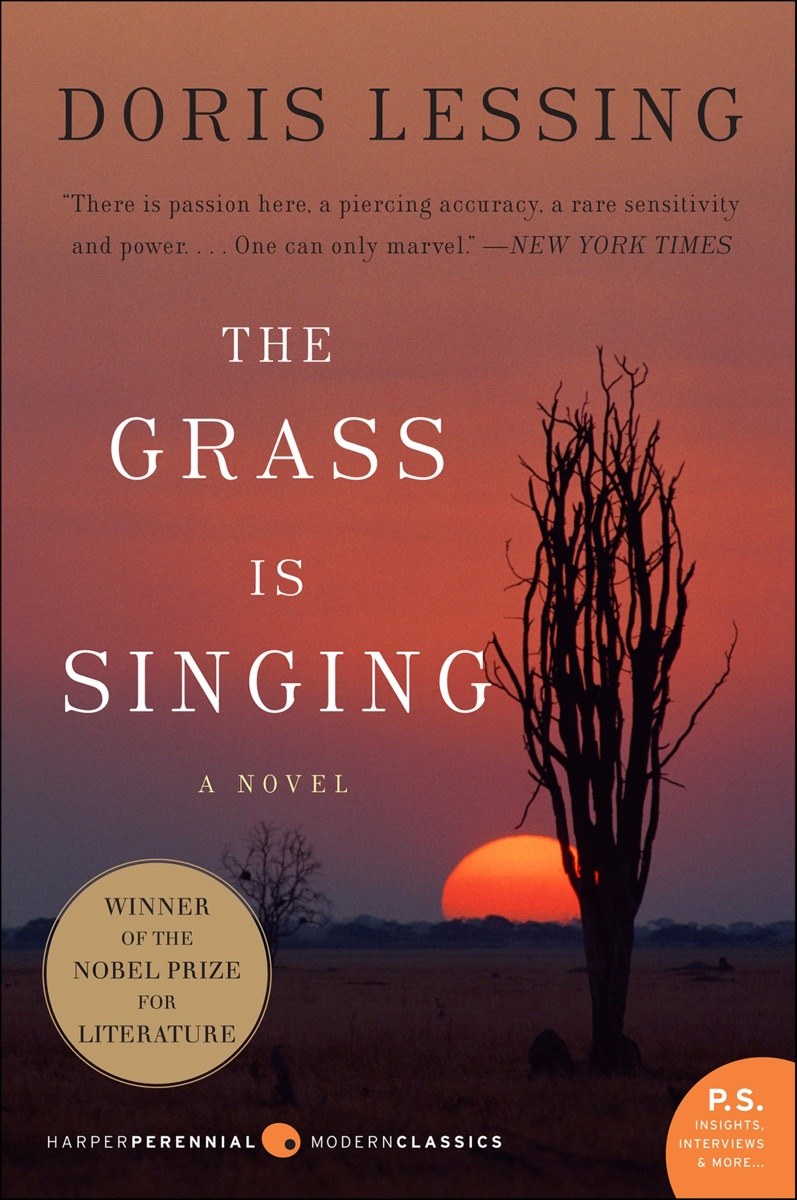
Book information: Novel · first published 1950 · selected cover: Harper Perennial Modern Classics.
Begin here for a compact, unsettling novel in which race, class, gender and isolation become inseparable from psychological collapse.
For the divided modern self: The Golden Notebook
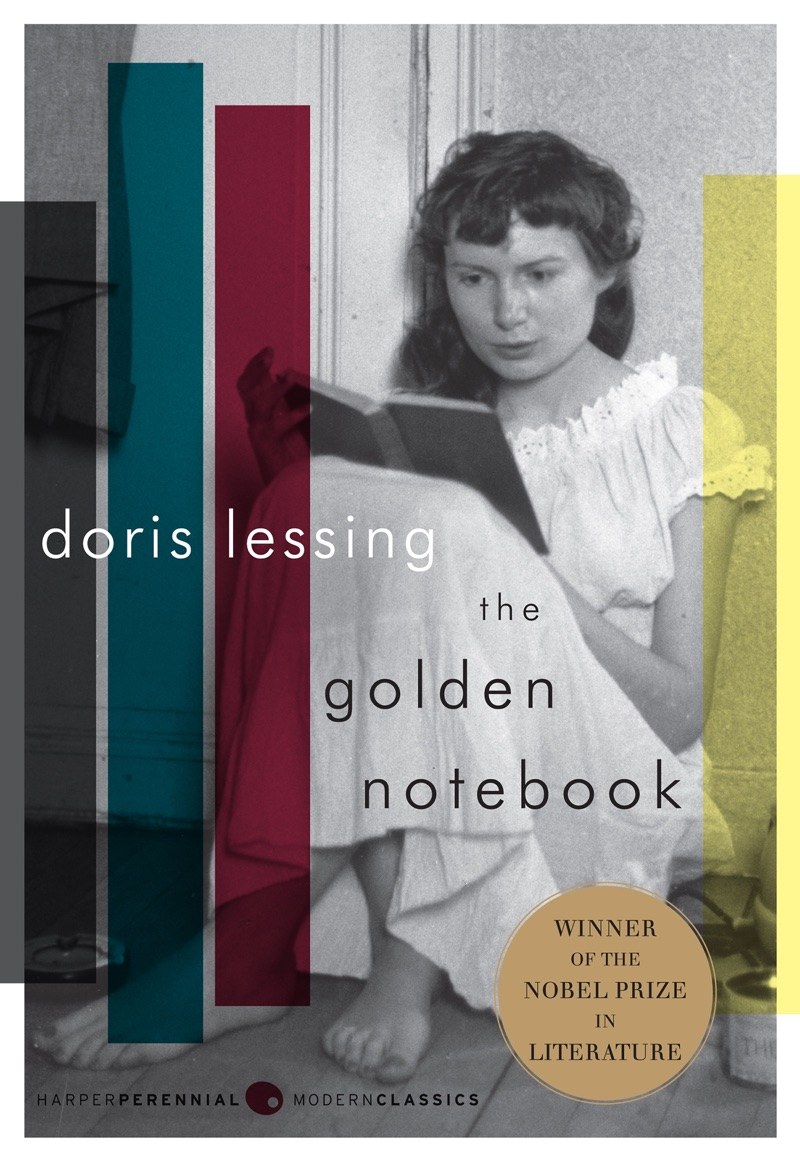
Book information: Novel · first published 1962 · Fourth Estate paperback, 2013 · 576 pages · ISBN 9780007498772.
Choose this if you want the central Lessing experience: ideas, work, love and identity refusing to fit one continuous narrative.
For a life unfolding inside history: Martha Quest
The first Children of Violence novel is the entrance to Lessing’s large-scale portrait of political and personal formation.
For the domestic uncanny: The Fifth Child
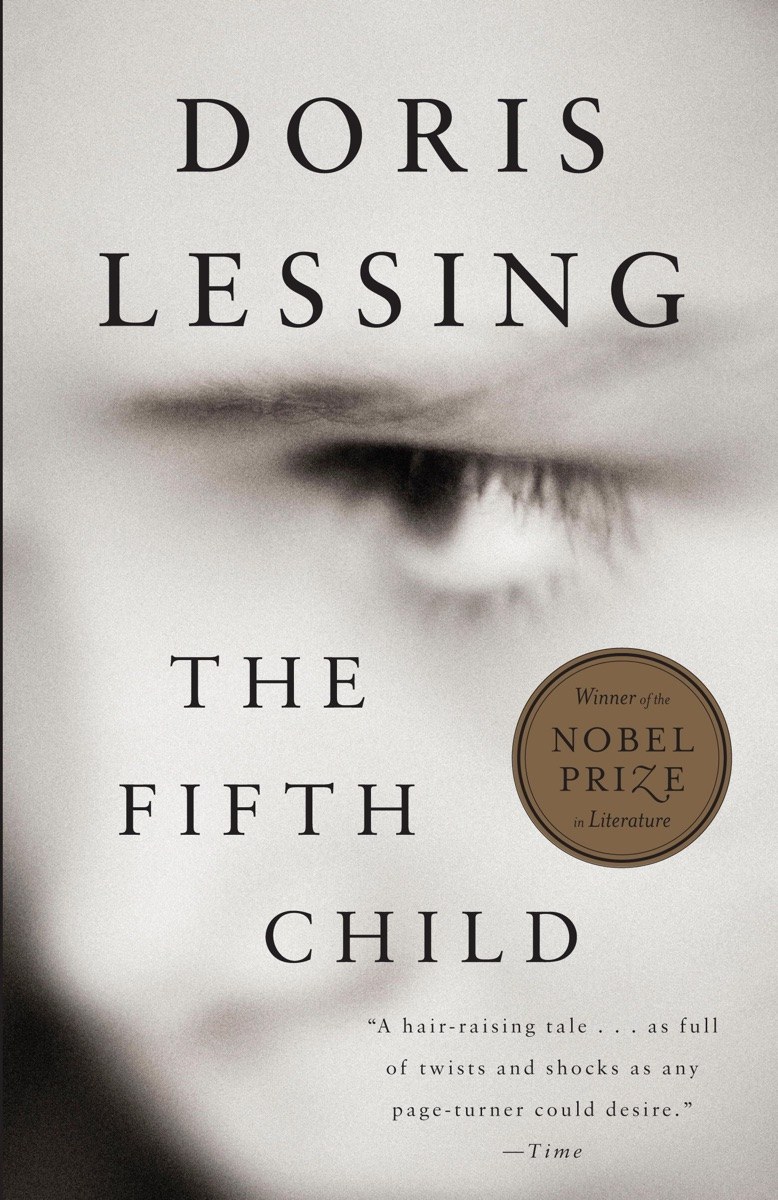
Book information: Novel · first published 1988 · Vintage paperback, 1989 · 144 pages · ISBN 9780679721826.
This short, fierce book is an accessible route into Lessing’s interest in family myths, belonging and the violence hidden inside ideas of normality.
For the writer in her own historical landscape: Under My Skin
The first volume of her autobiography gives essential context for the farm, colonial society, reading life and political awakening behind the fiction.
Readers curious about her speculative turn can then try Shikasta, the opening volume of Canopus in Argos.
Why read her now?
Lessing is useful whenever public language becomes too smooth. She shows how movements, families and individuals build stories that protect them from contradiction. She also shows that changing one’s mind can be part of intellectual honesty rather than evidence of failure.
Her work is not a set of positions to inherit. It is training in watching positions harden.
Return, then, to the Nobel line: “The storyteller is deep inside every one of us.” Lessing’s career adds a demanding second thought. The storyteller is powerful, but stories can liberate or imprison. The writer’s responsibility is not merely to produce them. It is to notice what they allow us to see—and what they persuade us not to see.
Sources and edition notes
- Nobel Prize: Doris Lessing, biographical and bibliographical notes
- Nobel Prize: “On Not Winning the Nobel Prize,” Nobel Lecture, 2007
- Fourth Estate: The Golden Notebook, selected edition
- Vintage: The Fifth Child, selected edition
- The Paris Review: Doris Lessing, “The Art of Fiction No. 102”
- Nobel Prize facts: Doris Lessing
The opening quotation is a brief excerpt from Lessing’s 2007 Nobel lecture. The accompanying image is the same DeepCrafter-created illustrated quotation card used in the original X Resonance post, not an archival photograph.