Continue the Story, Not the Summary — Experiment 04 Proposal
A practical continuation workflow: correct the story analysis, choose a consequential direction and review a new passage without restaging what already happened.
Continue the Story, Not the Summary — Experiment 04 Proposal
A story can stop at exactly the right moment and still be difficult to continue. The writer knows the names, the setting and the danger. What remains uncertain is which action will make those things matter next.
The unhelpful response is another account of what has already happened. The useful response changes the situation: someone makes a choice, a relationship shifts, a resource becomes unavailable, or a clock begins to cost something.
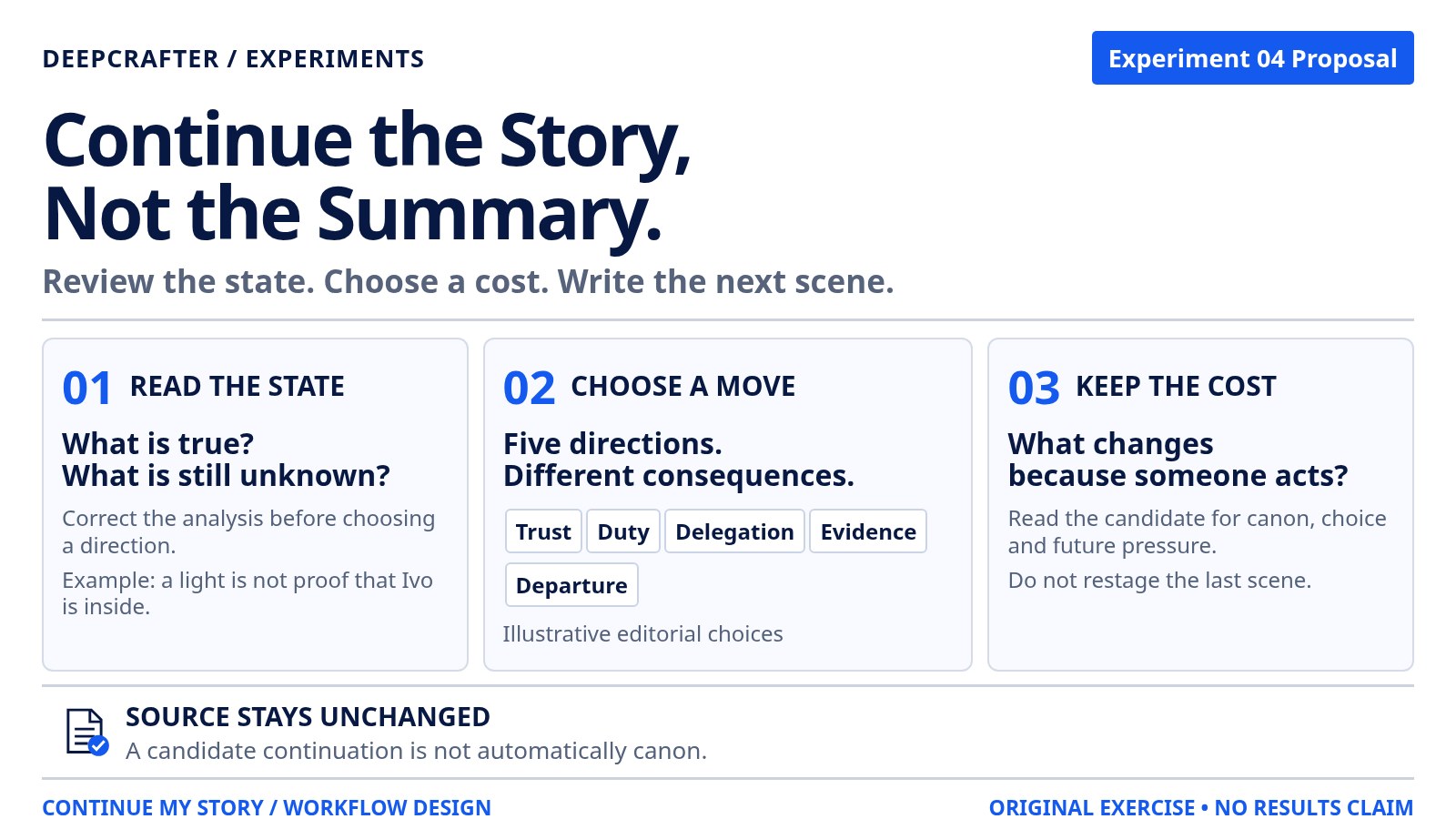
Experiment 04 Proposal explores a practical route through that problem: inspect the story's understood state, repair that understanding, choose a consequential direction, and treat the next passage as a candidate rather than canon. This is a documented-capability workflow and an original exercise, not a matched-results report; no product winner or measured improvement is claimed.
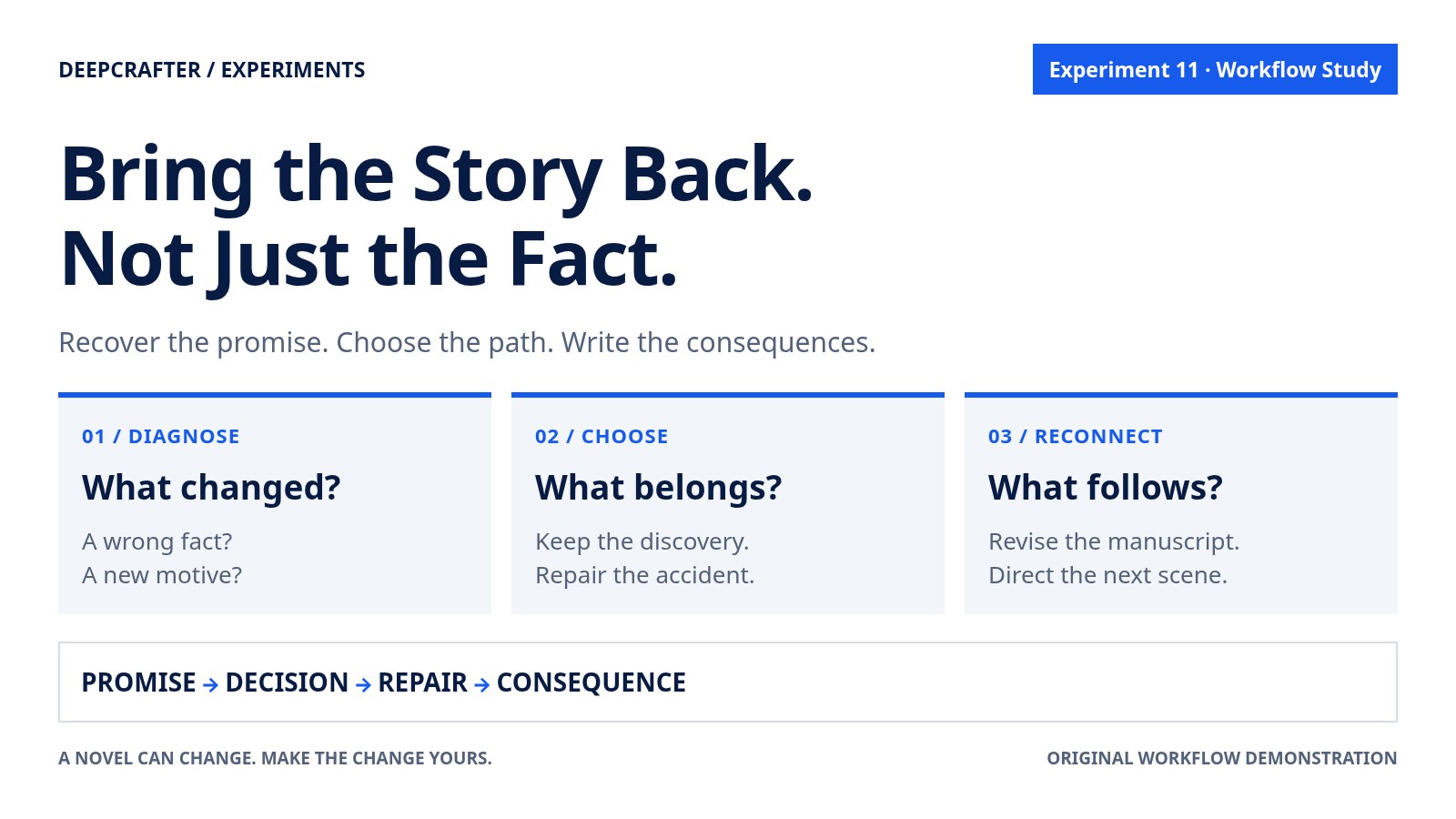
The distinction: recognition is not movement
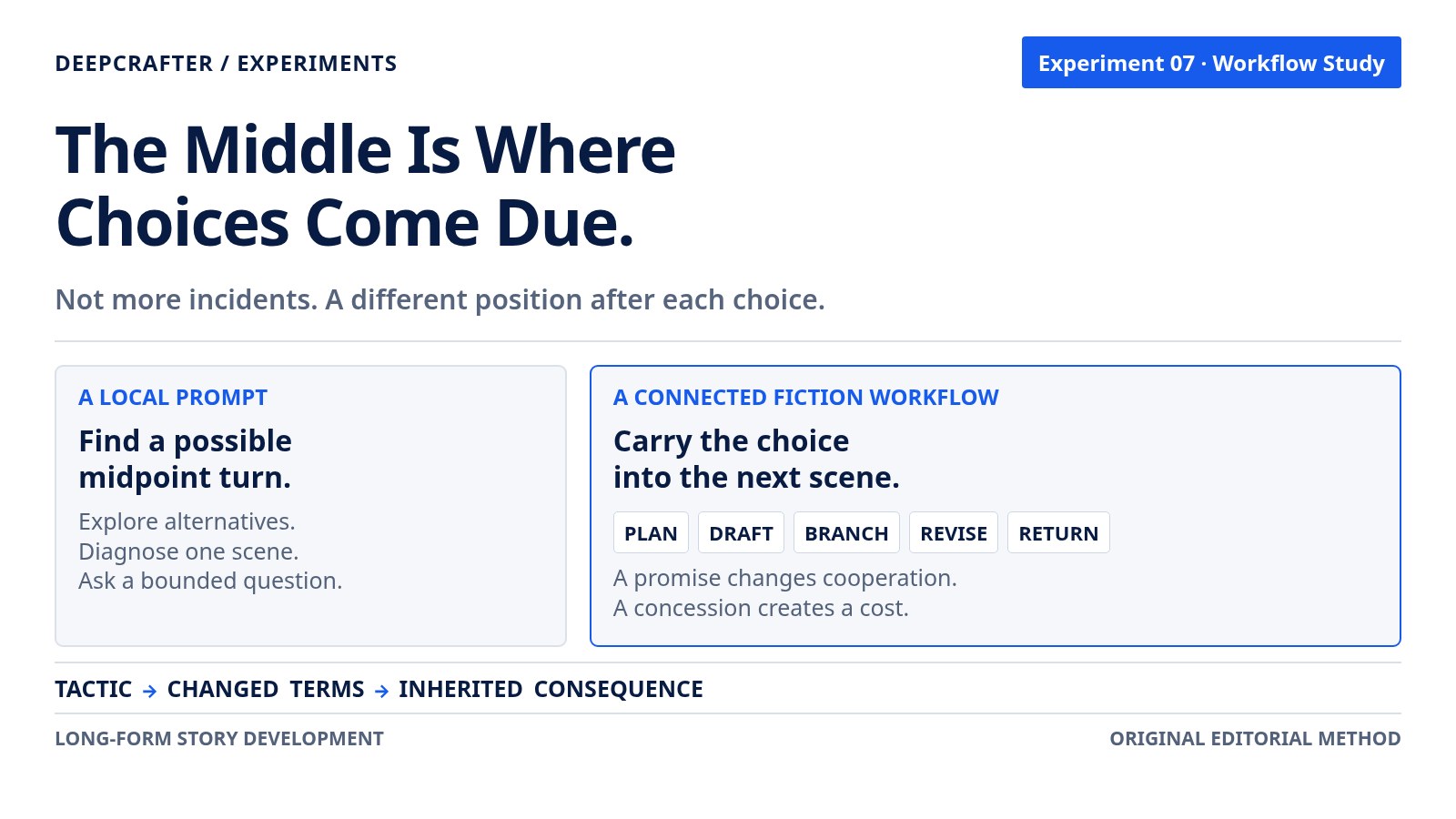
Recalling that Mara operates a ferry is recognition. Making Mara choose whether to risk the last crossing is movement. Repeating that her brother is missing may maintain the subject, but it does not necessarily create a new event.
Our working hypothesis is that a corrected account of the current situation plus a deliberately chosen next action can make continuation more purposeful. That is an editorial hypothesis, not a promise about generated prose. It is useful even when writing the next passage by hand.
We propose three questions before asking for more words:
- What is already settled and should not be staged again?
- What pressure has not yet produced its consequence?
- What choice would make the next scene different from the last one?
A reminder can still be good fiction. A repeated image may change meaning; a fact may need restating because another character finally hears it. The problem is repetition that leaves knowledge, access, allegiance and action unchanged.
What the public tools actually document
DeepCrafter's Continue My Story page presents a sequence of text input, editable story analysis, five possible directions and a candidate continuation. Its visible input guidance is a minimum of 250 words and a maximum of 20,000 characters. The page states that the original text is unchanged. Continuation requires sign-in and confirmation; this proposal does not claim an authenticated generation was performed.
The User Guide separately documents AI Create custom directions, branching, AI Rewrite and Manual Editing. Those are useful later in a larger writing project. We do not infer that a Continue My Story candidate automatically transfers its analysis, constraints or history into the main story editor.
For the ChatGPT route, OpenAI's Projects documentation describes organizing files, chats and project instructions, and branching conversations while preserving the original thread. A fair workflow can therefore include a source file and standing constraints. It need not be an unsupported one-line prompt in an empty chat.
These are documented affordances. Whether either system follows every constraint on a particular passage remains a reading question. The method below is our editorial design, not an additional built-in product feature.
The original exercise: The Last Dry Crossing
Mara has eight ferry passengers, a closing flood gate and a missing brother. A light is on at the bell house beyond an unsafe path. The departure sheet is wrong. Nell, a passenger who denied having a key, finally places one on Mara's board. The rescue boat is still behind a locked shed elsewhere.
The excerpt ends with Mara's hand on the throttle and her other hand on the mooring rope. It does not establish that her brother is in the house. It does not establish what the key opens beyond its association with the house, or why Nell kept it. Those gaps are not mistakes to fill with confident invented backstory.
The complete 3,111-word excerpt is supplied below as an original public exercise. It uses short, concrete prose so that a continuation can be tested for more than plot novelty: will it keep the restrained voice while something actually happens?
The input itself is 14,570 characters including its six section headings and newlines. This leaves room beneath the currently displayed 20,000-character ceiling; do not paste this whole article into that field. Copy only the excerpt, from “1. The gauge” through the last sentence of “6. The call.”
Step 1: Make a stopping-point card
Before submitting anything, write a small record of the final state. This is an author-maintained note, not an assumed DeepCrafter card type.
- Present: 06:58 at the dock; eight passengers; the boat is still tied up.
- Known: Nell has produced a blue-tagged key after previously saying she had none.
- Uncertain: Ivo's location, Nell's reason, the lock the key will operate, and whether a gate hold will be granted.
- Unavailable: the submerged walking path; an instantly ready rescue boat; a reliable boat clock.
- Live pressure: gate closure, passenger safety, and Mara's relationship to Nell.
- Not yet decided: whether Mara departs, asks for a hold, or takes another defensible action.
The card prevents an easy but false solution. A continuation in which Ivo simply steps aboard explains the disappearance by removing it. A continuation in which Mara uses the flooded path ignores the constraint that made her choice difficult.
Step 2: Check the analysis before choosing a direction
Paste the excerpt into Continue My Story. Read the analysis as an interpretation to approve or amend, not as a verdict on your manuscript. Use the visible Edit control if an uncertainty has become a false certainty.
For this exercise, a useful correction would be: “Ivo may be at the bell house; no one has confirmed seeing him there.” Another would be: “The blue-tagged key has just appeared; its exact lock has not been demonstrated.” These are proposed corrections to watch for, not quotations from a generated analysis.
The creative value lies in protecting what the scene has earned. Ambiguity is sometimes the engine. Correcting it does not mean explaining it away. If the account is broadly accurate, preserve its useful parts rather than replacing everything with a longer synopsis.
Step 3: Read five directions as five kinds of consequence
Review the five directions the tool offers. We do not assume they will match the five illustrative possibilities below. Our examples are author-written planning notes, not product output:
- Trust: Mara asks Nell to explain the key while keeping the passengers aboard; the answer changes whom she trusts with a task.
- Duty: Mara calls for a gate hold using the wrong departure sheet as evidence; a named official must make a decision.
- Delegation: Mara gives someone else a bounded job while she remains responsible for the boat; the division exposes a conflict.
- Evidence: Mara asks Nell what the key can prove without using the submerged path; a verifiable detail changes the next action.
- Departure: Mara begins a lawful crossing while requiring the hall to keep the search active; leaving creates a cost rather than ending the brother's story.
These directions are distinct because they reorganize responsibility, not because each uses a different adjective. None requires new magical equipment, a safe path appearing under the water, or a second working rescue boat.
A direction can also be rejected. If all available choices dissolve the central difficulty, try another set or revise the analysis. Choosing deliberately includes deciding that the proposed next move is not yet good enough.
Step 4: Choose one move and keep its cost
For a concrete working brief, choose the duty direction: Mara asks the hall for a definite answer about the gate, while the passengers hear Nell account for the key. The goal is not to resolve the flood. It is to force a public decision that the next scene must live with.
Use the exact selected direction as part of the record. Do not claim the dedicated tool accepts an extra instruction box unless one is actually available. If a displayed direction does not support this brief, record that mismatch rather than silently substituting another product workflow.
For a manual continuation or a general chat prompt, the instruction could be:
Continue directly from the final sentence for 650–850 words. Keep close third person with Mara, past tense and restrained concrete prose. Begin with a new action, not a recap. Keep Ivo's location unconfirmed. Do not use the submerged path or make the rescue boat instantly available. Let Mara seek a definite gate decision and require Nell to account for the key in front of the passengers. End after a choice changes what someone can do next, not after a complete rescue.
The instruction is an original creative brief. It expresses a desired scene, not an account of anything a system has already generated.
Step 5: Read the candidate at three levels
First, check the boundary. Did the passage begin after the excerpt, or did it replay Nell setting down the key? A short bridge may be harmless; a second version of the last scene is not forward motion.
Second, check causality. What does Mara do that forces another person to act? What changes because of that response? If the passage could be removed without altering the next scene's situation, it may be connective prose rather than a continuation with a purpose.
Third, check the contract. Who knows what? Where are the people and objects? What remains uncertain? A beautiful sentence does not repair a boat teleporting to the wrong bank.
Use revision at the size of the problem. A wrong name can be fixed locally. A passage that solves the danger by inventing equipment needs a different direction. Preserve the original excerpt separately and label accepted candidate versions. When moving into the main DeepCrafter editor, explicitly transfer only the text and setup you intend to use; inspect what carried over instead of assuming an automatic handoff.
The ChatGPT route: a strong alternative setup
Create a Project containing the identical excerpt and a separate stopping-point card. Add the same voice and continuity constraints as project instructions. Ask for an analysis that distinguishes known facts from guesses, correct it, request five causal directions, then select one and ask for the next passage. Branch the conversation if you want to preserve alternatives.
This is a viable author-directed workflow. The author is explicitly constructing its stages and keeping the source materials organized. DeepCrafter's dedicated entry point visibly supplies the analysis-to-directions sequence; that interface distinction is not evidence that its candidate prose must be better.
Avoid changing both the brief and the tool at once. If a comparison is ever commissioned, feed both systems the same final source and the same accepted constraints, while recording any interface differences that prevent literal parity.
A reusable check, not a scoreboard
For your own reading, annotate these five questions with a passage citation and a short note:
- Canon: is a settled fact contradicted or an uncertainty falsely resolved?
- Movement: which new action changes access, knowledge or obligation?
- Choice: whose decision produces the change, and what does it cost?
- Repetition: which backward-looking lines earn their place through a changed meaning?
- Future pressure: what unresolved consequence now pulls the reader onward?
There is no need to invent a single quality number. Different writers may reasonably prefer different outcomes. The reproducible protocol in the appendix records source, prompts, selection and revisions if someone chooses to examine the workflow more formally; this article does not promise a future benchmark or results release.
Which workflow fits which need?
Choose the dedicated DeepCrafter route when you have an excerpt and want a visible sequence for reviewing its interpretation, considering directions and receiving a separate candidate. It is especially relevant when “what happens next?” is the immediate bottleneck, provided your input fits the displayed limit.
Choose the ChatGPT Project route when you already organize the work there, want to construct your own analytic steps, or need a flexible discussion around several reference files. Keep the brief and canon record explicit rather than assuming that any memory feature guarantees consistency.
Continue manually when the precise choice is clear and writing it yourself is the fastest way to discover its cost. These routes are not exclusive: a proposed direction can help an author write a scene without accepting generated prose.
The practical conclusion of Experiment 04 Proposal is a workflow choice, not a winner: understand the stopping point, choose a consequential move, and review the next passage as something new. Continue the story's pressure, not its summary.
Sources and scope
Public capability checks: 9 November 2026. Documentation describes available controls, not observed generation quality. The original excerpt, state card, five illustrative directions, prompt and reading checklist are DeepCrafter Editorial's own exercise materials.
- Continue My Story: live public entry point and input limits
- DeepCrafter User Guide: AI Create, branching and revision
- OpenAI Help Center: Projects in ChatGPT
Explore the documented workflow: Continue My Story.
Appendix A — Original source material
Original source pack: The Last Dry Crossing
Editorial fiction written for Experiment 04 Proposal. It is not product-generated evidence, a user manuscript or a quotation. The six sections below form the complete input excerpt; section headings are part of the input.
1. The gauge
At six, Mara found a fish in the road. It lay by the white line with its mouth still moving. She put it in her boot and took it down to the dock. The river was three steps below the stone lip. In the old days there had been seven steps. Her dad had cut a notch in the wall at each spring flood. This year the water hid all but two. The fish slid from the boot, went pale side up, then turned and was gone. Mara shook out the boot. A small stone fell from it. She left the stone where it lay.
Her boat was tied to the red post. There were twelve seats and a space at the back for a chair with wheels. The sign on the roof said KEEP THE AISLE CLEAR. A crate of green cups sat in the aisle. Her brother had left them there for the feast which, the town had said at noon the day before, would not be held. She set the crate on the bank. She checked the fuel, the ropes and the lights. The left lamp had a crack but it worked. The right lamp was whole but dead. She put a bit of tape on its switch.
At seven the gate would close. At eight the bank crew would cut the west road to make a drain. No one could say when a road would be built there again. Mara had the last ferry run. A list of names was clipped to her board. Nine names, nine small boxes, nine neat ticks from the desk at the hall. Below the list her brother had drawn a cup and a line of steam. He had not come home that night. His coat hung on the peg by her door. In one sleeve was a damp wool glove.
She rang the desk. A man she did not know said the list was right. She asked if he had seen Ivo. He asked if she had a name to add. She said no. She could hear a spoon tap a mug at his end. Then he read her the rule: one run, no freight, no pets, no use of the old path. The old path was the strip of stone below the west wall. At low water it led to the bell house. Now it was a dark line under the brown flow.
Mara put the phone down and watched a branch go past. It caught on the gauge, held, then broke in two. She had used that path as a girl with a sack of bread for the man who kept the bells. Her dad had made her swear not to use it when she could not see the first stone. She could not see the first stone now. She could see the top of a blue door at the house. It was shut. A thin line of light showed at its side. She took the boat key from her neck and turned the engine on.
2. The names
The first to come was Nell with a case tied with string. She put her hand on the red post but did not step down. She asked where the cups had gone. Mara showed her the crate. Nell said she had washed them all by hand. Her nails were blue at the tips. She had worked at the hall till dawn. On the board her name had a tick like all the rest. Mara put a second mark by it in pen. The pen would not write on the wet page, so she pressed till it tore the top of the box.
Two men came next, then a child with a man who held her wrist. The child had a tin boat. She dragged it on a string through each pool on the road. The man asked if she could bring it on board. Mara said yes. He asked if there was a place to put his bike. She said no. He looked at the crate of cups. Mara said those were not on the boat. He let go of the bike. It fell with a small click of gears. The child set her tin boat in its front wheel and pulled it out once more.
By half past six there were eight at the dock. The ninth name was Ada Venn. Mara knew the name but not the face. Nell said Ada had lived at the bend where the road had split. Her house had been the first one cleared. A bus had taken her to the hill school the night before. The hall knew this. Nell had told the man at the desk. He had said the list could not be changed till the next shift. Nell took off her glasses and wiped them with the hem of her coat. She asked if the boat could go with eight.
Mara said it could. She drew a line through Ada's box, then wrote HILL SCHOOL in the space. The phone rang. This time it was the gate crew. They wanted a count. She said eight here, one moved last night. The voice said the sheet showed nine. She said the sheet was old. He asked her to call when all nine were on the boat. She looked at the torn box by Nell's name. The damp page curled round the clip. She said she would call with the true count and hung up.
Nell asked if Mara had heard from Ivo. She spoke low, but the man with the bike looked up. Mara said his coat was at home. Nell said he had been at the hall when the lights went out. He had asked for the keys to the bell house. Nell had told him she had no keys. Then he had gone out the side door. The man with the bike asked if the bell house still had power. Nell said it had a cell on the roof. He asked if that was safe in a flood. No one gave him an answer.
3. The lamp
The light by the blue door went out. Mara watched the gap. She counted to ten, then to ten once more. The light came back. It was not bright. From the dock it was a pale thread, less than the shine on a wet nail. She went to the edge of the bank and raised one arm. The light did not change. The child asked who was in the house. Mara said she did not know. This was true. It did not feel true when she said it, so she took the list and checked each face once more.
Ivo had worked on the roof cell in May. He had said it could keep one lamp lit for a week with no sun. He had not fixed the bell motor. That had been a fault in a board he could not get. The bells had been tied with cloth for two years. On feast days Nell had played a tape through a small black box. The tape had a cough in it, just before the third bell. Mara could hear that cough in her head now. It had once made Ivo laugh so hard he had to lean on the wall.
She called his phone. It rang in her ear. In the house no shape crossed the gap. The voice mail came on, then the beep. She said, 'I am at the dock. We go at seven.' She stopped there. She did not ask where he was. If he was at the house, he could see her boat. If he was not, she did not want the last thing he heard to be a charge. She put the phone in the dry pouch with the spare key. The spare key was not for the house. It was the key to the fuel box.
The two men asked to board. One had a sore knee. Mara set the ramp. She took his bag so that he could hold both rails. The child went next and chose a seat by the back. Her dad sat by her. The rest came in slow steps, each with one bag. Nell stayed on the dock. She touched the crate of cups with her shoe. She said it was a shame. Mara told her to take one. Nell said that was not what she meant. She took a cup all the same and put it in her case.
Mara had not seen her brother cross the path. She told herself that as she coiled the rope. She had not seen him with the house key. She had not seen him since dusk. There were good reasons for a lamp to go out and come on. A loose wire, a low cell, a bird at the frame. She could name them all. None of them had his face. At six forty she called the hall again. This time the line was busy. She let it ring till the screen went dark, then put the phone face down on the board.
4. The slip
Nell held out a slip of paper. It had been folded twice and kept in the case with her clean shirts. At the top was the date. Below it was a list of things left in the bell house: two chairs, a box of maps, six wool rugs, a chest with brass feet. At the foot was Ivo's name. He had signed for the loan of a hand cart. The cart should have been back by five the day before. A red stamp said RETURN DUE. Mara read the list once, then held it closer to the lamp on the boat.
She asked when Nell had found it. Nell said just now. Mara asked why she had brought the whole case of hall forms. Nell said it was not the whole case, it was one thin file. She had had no time to sort her own things from the town's. The case had clothes in one half and forms in the other. She had kept the forms dry. Mara felt the slip. It was crisp, not damp like the list on her board. She wanted to ask why the forms had been worth more care than the names. She gave the slip back.
The man with the bike leaned from his seat. He said there was no cart at the house. He had passed it at five on his way to the hall. The door had been open. He had seen the empty hook where the cart was kept. Mara asked if he had seen a man. He said he had seen no one. Nell said Ivo might have taken the maps to the hill school. The man said the road to the hill had been shut by five. Nell said there were other roads. He said not for a cart. The child put her boat in her lap.
Mara opened the dry pouch. On the last message from Ivo there was no time shown till she tapped it. It had come at four ten. It said, 'Need you at the house before the gate.' She had read it while she was at the fuel pump. She had thought he meant before the gate shut that night. Then the hall had sent the new sheet and she had gone to bed. There was no day in the note, no word for now or next. She had sent back a thumb. She looked at the small blue hand on the screen.
Nell said there had been no need to keep the rugs. They had been wet for years. Mara said the note did not say he went for rugs. Nell folded the slip on its old lines. The man with the bike asked how much time was left. Mara said twelve minutes. He held up his own phone. It said six forty six. Hers said six forty eight. The boat clock had stopped in June. She had meant to fix it. The gate used the hall clock. Mara called the hall again. The line was still busy. She could hear the engine through the soles of her boots.
5. The rope
At six fifty the west gate horn gave one short sound. It was a test, not the last call. Mara knew this. She had heard it each day for a week. Still, the man with the sore knee gripped the rail. Nell said there would be one long sound at seven. Mara nodded. The child asked how a horn could know the time. Her dad said a man pressed a switch. The child asked if he could press it late. Her dad told her to hold her boat. She laid both palms flat on it, as if to keep it from drifting out of her lap.
Mara took a long rope from the box by the engine. It had a loop at one end and a worn spot halfway down. She could throw the loop from the path if she could reach the first bend. There was a rail at the house, or there had been one last year. She laid the rope on the dock. Then she put it back. The first stone was under water. She had eight people on the boat. She had the rule in the voice of a man she did not know. She could not use a rope to make the path safe just by wanting it to be safe.
Nell said, 'You are not your dad.' Mara shut the box. She had not been thinking of him, though his notches were on the wall. Nell said he had gone out in worse. Mara asked which of the two things Nell meant. Nell looked at the red post. She had one hand on the case and one hand in the pocket of her coat. She took out the cup and put it on the roof of the boat. It made no sound. The roof was wet. Nell said she would sit down now. Mara held the rail for her but Nell did not take it.
The light at the house went out once more. This time Mara did not count. She went to the red post and looked straight at the blue door. The water had reached the lower edge of its top pane. A dark thing moved by the wall. It might have been the cart. It might have been a bin. It turned in the flow and showed a pale strip. Mara called Ivo's name. The child looked round. The light came back. Mara called once more. The engine took the end of the word. She went to the controls and put it in idle.
For a breath the dock was still. She heard rain on the cups in the crate and the loose flap of the sign at the gate. She heard the child drag a nail along the seam of the tin boat. She did not hear her brother. The man with the bike said they should go. He did not say it hard. He said it like a man who had waited for a bus and could see it at last. Mara put her hand on the rope which still held them to the post. The knot was one her dad had taught her. Ivo tied it the same way.
6. The call
The hall rang at six fifty six. Mara turned the sound low before she took it. A woman said she was the new shift. She had a note about a count that did not match. Mara gave the eight names. The woman read them back, slow and clear. She said Ada was on the hill list. Mara could cross her out. Mara said she had done that. The woman asked why she had not left yet. Mara said the gate shut at seven. The woman said yes, but that was the gate time, not the boat time. The boat should have left at six fifty.
Mara looked at the line on her sheet. It said DEPART BY GATE CLOSE. She read it out. The woman was quiet. Then she asked if there was a way to take a picture and send it. Mara said there was. The woman gave a number. While Mara typed it, the man with the sore knee got up and sat down again. Nell held her case against her shins. The child asked for a drink. Her dad took a flask from his bag and shook it. There was not much in it. Mara sent the picture and watched the bar crawl across the screen.
The woman called back. She said the sheet was wrong. She would tell the gate crew to hold. Mara asked how long. The woman said she could ask for five minutes. She could not promise five minutes. Mara looked at the blue door. The lamp was on. She told the woman there might be a person in the bell house. The woman asked if she had seen him. Mara said she had seen a light. The woman asked if she had a name. Mara gave it. She spelled Ivo, though there was no other way she had ever seen it spelled.
The woman said she would call the rescue crew. Mara asked where they were. The woman said on the north bank. Mara asked if they had a boat. The woman said she would find out. Mara kept the line open. She could hear keys, a chair scrape, a door open at the hall. The man with the bike said it was four minutes to seven. Mara said she knew. He said he could help with the rope. She said not yet. He stood by the ramp with his hands at his sides. The child set the tin boat on the seat where he had been.
At six fifty eight the woman came back. The rescue boat was on a trailer behind a locked shed. The driver was at the west gate. She had asked him to get the key. Mara watched the strip of light at the door. Then Nell rose and put a key on the board. It was small, with a blue tag. She said, 'I had this all night.' Mara looked at the key, at Nell, at the eight names on the wet sheet. On the phone the woman asked if Mara was still there. Mara put one hand on the throttle and left the other on the rope.
Appendix B — Method and predeclared reading rubric
Experiment 04 Proposal — Reproducible workflow protocol
This appendix is an optional test design, not a promise to run a benchmark. No execution or matched results are represented here. Workflow preparation does not require measured outcomes.
Frozen material
Use the original six-section excerpt in source-pack.md, including its headings but excluding the editorial preface. Input: 3,111 whitespace-delimited words and 14,570 Unicode characters. Keep a plain UTF-8 copy, byte count and SHA-256 with the record. Both systems receive that exact excerpt. Maintain the same stopping-point card and desired creative brief. Do not silently truncate to fit an interface.
Ten invariants
- Mara is the ferry operator and viewpoint character; close third person, past tense.
- At the final beat it is 06:58, and eight passengers are aboard the still-moored ferry.
- Ada was moved to the hill school; she is not a missing ninth passenger.
- The gate's announced closing time is 07:00; a requested hold is not yet granted.
- The walking path is submerged and not a safe rescue route.
- Ivo's location is unconfirmed; a lamp is evidence of a light, not proof of his presence.
- Nell has just produced a blue-tagged key after denying she had keys; the exact lock and her motive are not established.
- The rescue boat was reported on a trailer behind a locked shed; it is not ready at the dock.
- Mara's phone is working; the boat clock has stopped, and her phone differed from another passenger's.
- The next passage must not retell the excerpt as its main action or conclude the whole rescue.
Fixed prompts for the Project route or manual use
P1 — Analysis: “Read the complete excerpt. Separate established facts, character knowledge, uncertainties and current pressures. Stop at the final sentence. Do not continue or turn an inference into canon.”
P2 — Correction: “Apply the ten invariants in this protocol to your analysis. Preserve all uncertainty they specify. Return the corrected account only.”
P3 — Directions: “Propose five genuinely different next directions. For each, give the protagonist's action, who must respond, what changes and what remains unresolved. No unsafe path solution, instant rescue boat or confirmed Ivo location.”
P4 — Selection: “Use the duty direction if available: Mara asks the hall for a definite gate decision while Nell must account for the key in front of the passengers. If that is absent, identify the closest direction and state the mismatch before proceeding.”
P5 — Continuation: use the 650–850-word brief printed in the website article verbatim.
DeepCrafter procedure
Paste the frozen excerpt into Continue My Story. Retain the analysis exactly as presented, then record every manual correction with the invariant that justified it. Request the documented five directions; save all five and the selected one. Use the continuation confirmation only in a separately authorized interactive run. Preserve the candidate and the unchanged original.
Do not force unsupported controls. The public page does not establish a dedicated extra-prompt or word-count field at every stage. If P3–P5 cannot be entered literally, record the actual available controls and stop calling the setup prompt-identical. The dedicated-workflow condition and the prompt-controlled condition are different conditions, not a hidden product advantage or defect.
Optional future matched study
Only if separately commissioned, collect at least three fresh runs per system in identical scene order: interpretation, correction, direction selection, first continuation, then one follow-on scene. Freeze material and rubric before viewing outputs. Record the visible model selection for ChatGPT if available; do not infer or name DeepCrafter's internal model routing. Record date, available controls, exact text, selected direction, output length, manual edits and every corrective intervention. Do not reroll a weak run away.
For a prompt-identical comparison, use interfaces that actually accept the same prompts and label any departure. Otherwise report only the dedicated workflow comparison. Do not collapse them into one result. Any later reader evaluation should use anonymized passages and reviewers who have not seen product labels; disagreement belongs in the record. No such review has been conducted for this package.
Predeclared qualitative rubric
Annotate each dimension as supported, mixed or unsupported, citing specific lines; these are proposed categories, not current scores.
- Canon/uncertainty: supported means every invariant is retained; mixed means an ambiguous wording needs review; unsupported means an actual contradiction or unjustified resolution.
- Causal movement: supported means a new action changes a concrete resource, knowledge boundary or obligation; mixed means movement with weak consequences; unsupported means essentially a recap.
- Character choice: supported means Mara's decision forces a response and a cost; mixed means action without an articulated consequence; unsupported means a convenient external rescue substitutes for her choice.
- Repetition: supported means reminders alter understanding or motivate action; mixed means some redundant material; unsupported means the preceding scene is substantially restaged.
- Future pressure: supported means the ending establishes a specific unresolved consequence; mixed means a general danger persists; unsupported means the problem is closed without earned development.
Keep voice notes separate from canon findings. Short sentences alone do not establish style fidelity. Quote only the minimum necessary and retain raw passages privately with the study record.
Stopping and reporting rules
Stop a run if input does not fit, the available controls cannot support the declared condition, or an unexpected external action would be needed. Report the boundary rather than filling gaps with invented data. Do not publish a winner from these materials. The only current evidence is public documentation; the exercise and protocol are editorial proposals.