The Instant That Learns to Sing: Cecília Meireles and the Music of Passage
On Cecília Meireles’s birthday, follow the Brazilian poet, teacher and journalist from fleeting lyric to historical chorus and public education.
The Instant That Learns to Sing: Cecília Meireles and the Music of Passage
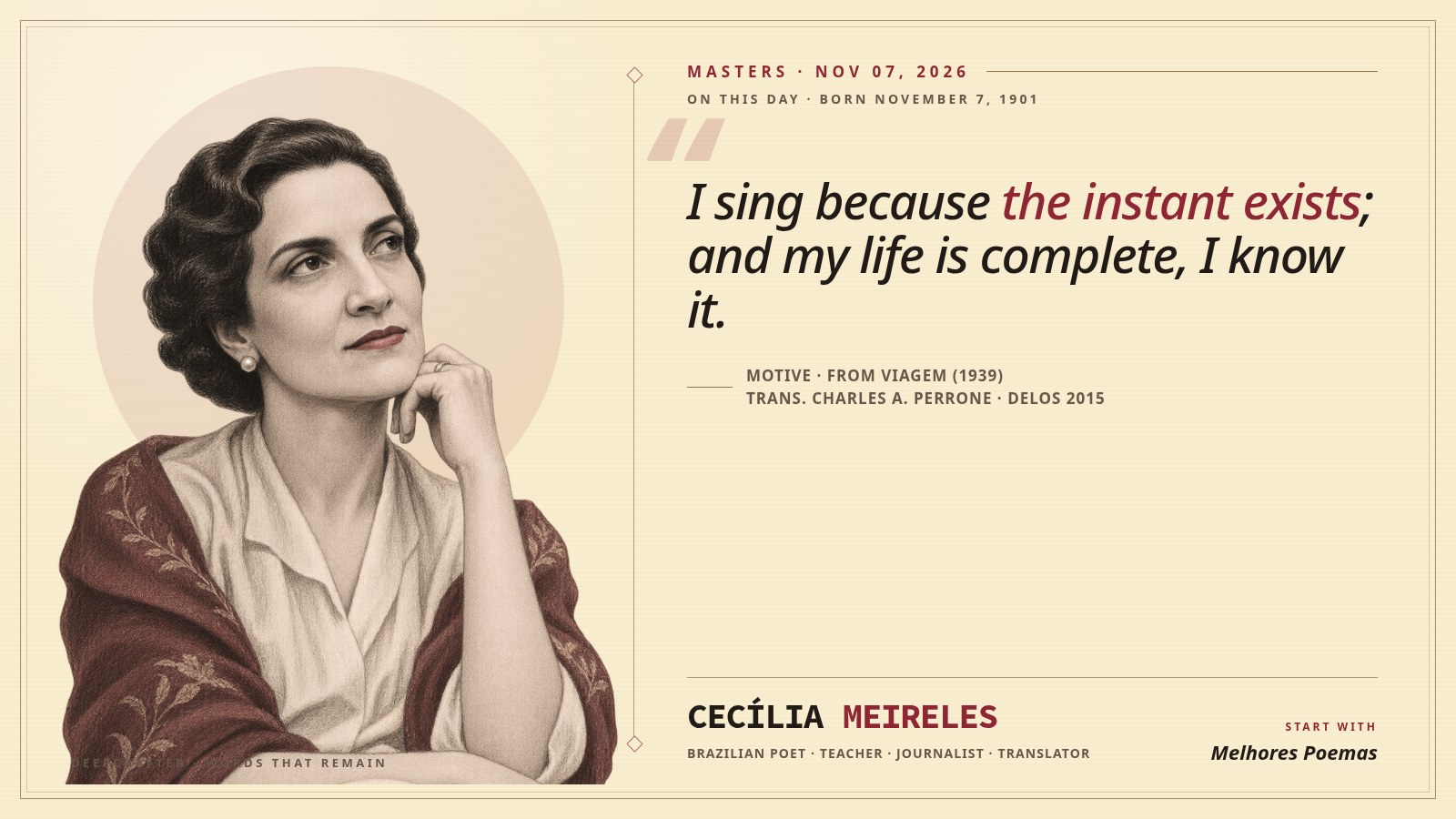
“I sing because the instant exists; and my life is complete, I know it.”
Why we chose Cecília Meireles today
Cecília Meireles was born in Rio de Janeiro on November 7, 1901. For her birthday, we chose two lines from “Motivo”—“Motive”—in Viagem, the 1939 collection that established her mature poetic voice. The English wording comes from Charles A. Perrone’s published translation.
The lines begin with a reason for song, but not the kind of reason that promises permanence. The instant exists; therefore the poet sings. Life becomes complete not by defeating time, but by attending fully to what time is already carrying away.
That sense of passage runs through Meireles’s poetry: water, wind, mirrors, music, shadow, travel, childhood and death. Yet it would be a mistake to reduce her to a private lyric voice floating beyond history. She was also a teacher, education journalist, public lecturer, traveler, translator and scholar. Her writing moves from the inward music of a moment to the many voices of colonial history and the practical future of schools.
For writers, Meireles offers a rare combination. She demonstrates how sound can think; how a fleeting image can acquire philosophical weight; how archival research can become chorus rather than lecture; and how public commitment can coexist with artistic delicacy.
A life formed in the presence of absence
Meireles’s father died before she was born, and her mother died before Cecília turned three. Her maternal grandmother, Jacinta Garcia Benevides, raised her. Loss entered early—not as a literary pose, but as the atmosphere of childhood.
The solitude of those years did not produce a narrow imagination. It encouraged attention. Meireles later recalled a childhood receptive to stories, songs and the mysterious life of objects. Her grandmother connected her to the Azorean heritage of the family; oral tradition, memory and distant geographies would remain important to her sense of language.
She trained as a teacher at the Escola Normal in Rio and began teaching in 1917. Two years later, at seventeen, she published her first book of poetry, Espectros. The early work bears the marks of Symbolism, but her mature style would become more mobile: formally musical, visually lucid and resistant to fixed schools.
Orphanhood is often invoked to explain the atmosphere of transience in her poems. The connection is meaningful, but it should not become a closed diagnosis. Meireles transformed private absence through craft. Repetition, refrain, vowel music, shifting pronouns and delicate images make impermanence something a reader can hear—not merely a biographical fact to be decoded.
The teacher in the newsroom
Education was not a side career. It was one of Meireles’s central public commitments. She taught children, wrote about teaching and helped shape debates over modern education in Brazil. From 1930 to 1933, she directed a daily education page in the newspaper Diário de Notícias, using journalism to argue for reform, cultural access and respect for the child’s developing intelligence.
Her educational writing belongs to a wider movement that challenged rote learning and authoritarian classrooms. Meireles defended libraries, literature, teacher preparation and a more humane understanding of childhood. In 1934, she and her husband, the artist Fernando Correia Dias, helped establish a children’s library in Rio—an innovative space that joined books with art, music and cultural activity.
The project was short-lived, but the principle endured: children deserved not simplified culture, but meaningful encounters with it. This conviction helps explain the clarity of her prose for younger readers and the seriousness with which she approached folklore and oral tradition.
For writers, the education columns reveal another side of her method. The poet of evanescence could also write toward institutions, policies and daily practice. Lyric sensitivity did not remove her from public life. It trained her to notice what systems do to attention.
Viagem: when music becomes knowledge
Published in 1939, Viagem brought Meireles major recognition. The title means “Journey,” but the movement is not only geographical. Poems pass among states of being: presence and absence, body and reflection, voice and silence, arrival and vanishing.
“Motivo” states a poetics in deceptively simple terms. The speaker does not identify as happy or sad; she is a poet. Song proceeds because the instant exists. This is not indifference to emotion. It is a refusal to let one mood define the whole consciousness.
Meireles’s music depends on formal intelligence. Repeated consonants and vowels, balanced phrases, internal echoes and subtle metrical turns create the impression that thought is discovering itself through sound. The poem’s meaning cannot be separated from its pace.
This offers a precise lesson for prose as well as poetry: rhythm is not decoration added after meaning. Syntax determines what the mind can notice. A sentence that circles, pauses or returns creates a different moral and emotional relation to its subject than a sentence that marches directly forward.
Meireles often uses elemental images—sea, moon, wind, sand—but their recurrence prevents them from becoming generic. Each return changes the pattern. Water can be freedom, memory, separation or the medium through which all forms pass. The image becomes philosophical because it remains sensuous.
Travel without possession
Meireles traveled widely in Latin America, Europe, the United States, India and elsewhere, lecturing on Brazilian literature and culture. Travel deepened rather than dispersed her poetic concerns. She observed architecture, ritual, landscape and art while remaining alert to the problem of how a visitor looks.
Her engagement with India was especially important. She studied Indian thought and literature, wrote poems connected to her journey, and translated or introduced readers to writers across languages. Translation formed part of her broader literary work, alongside journalism and teaching.
The traveler in her poems is rarely a conqueror collecting scenes. Travel exposes the instability of the self. The person who departs, the person who arrives and the person who remembers are not identical. Place becomes a relation rather than a possession.
Writers can borrow this stance. A setting is not vivid because the author lists its unusual objects. It becomes alive when the observer’s position is visible—what they know, what they misunderstand, what they desire from the place, and how the place refuses that desire.
Romanceiro da Inconfidência: history becomes a choir
Meireles’s long poetic sequence Romanceiro da Inconfidência, first published in 1953, turns to the eighteenth-century Inconfidência Mineira, the failed anticolonial conspiracy associated with Tiradentes and the mining region of Minas Gerais.
The work grew from sustained historical research and travel through the region. But Meireles did not simply versify a chronology. She used the Iberian romance tradition, lyric interludes and shifting speakers to create a field of voices. The famous and the anonymous, conspirators and witnesses, lovers, prisoners, officials and ghosts enter the poem’s historical weather.
This polyphonic structure changes the ethics of historical writing. No single narrator owns the past. Rumor, desire, fear and retrospective myth complicate official fact. Gold circulates as material, symbol and corrupting force; freedom appears as aspiration and as a word vulnerable to appropriation.
The sequence shows how research can generate form. Meireles did not place historical information behind a fictional protagonist and call the setting complete. She asked what kind of poem could hold the uneven survival of voices. The answer was a chorus with gaps.
For contemporary writers of historical fiction, that is a powerful model. Archive what is known, but also map the distribution of silence. Ask who produced the record, whose speech was preserved, and what formal device might acknowledge what cannot be recovered.
The visual artist inside the poem
Meireles was closely connected to the visual arts. Her first husband, Fernando Correia Dias, was an illustrator and designer; she herself drew and painted, and later exhibitions revealed a substantial visual practice. Her poems often work through placement: an image appears against emptiness, changes scale, then disappears.
This visual intelligence helps explain the clarity of even her most metaphysical writing. The reader is given a line, a bird, a window, a wave, a face in a mirror. The abstract question arrives through composition.
Her sound and image therefore perform complementary work. Music carries continuity; the image gives the passing moment an edge. One flows, the other frames. The tension between them produces the particular stillness of her poems.
A writer can imitate the principle without imitating the imagery. In a lyrical passage, choose one visual anchor and one sonic pattern. Let the anchor keep the language from dissolving; let the pattern keep the image from becoming static.
A public life larger than one genre
Across her career, Meireles wrote poetry, chronicles, essays, children’s literature, travel writing and educational commentary. She lectured, translated and represented Brazilian literature abroad. The range is not evidence of distraction. Each form answered a different relation between voice and audience.
The newspaper chronicle could move from an everyday observation toward reflection without pretending to be a treatise. The classroom essay could argue directly. The historical poem could distribute knowledge among voices. The lyric could concentrate experience until a few lines carried a whole philosophy of time.
This flexibility is one reason Meireles remains instructive for creators working across media. A writer’s voice is not a single surface style repeated everywhere. It is a set of attentional values that can be recomposed for different forms.
Five craft lessons from Cecília Meireles
1. Let rhythm discover the thought
Read a paragraph aloud and mark where the breath wants to turn. Revise the syntax so the movement of the sentence participates in its meaning.
2. Return to an image with a difference
Repetition gains power when the context changes. Bring back an object or element after the character’s knowledge has shifted.
3. Make transience concrete
Do not announce that everything passes. Show the wet footprint fading, the echo shortening, or the light leaving one wall.
4. Build historical chorus, not historical wallpaper
When writing the past, identify who speaks, who records and who remains unheard. Let form reveal the unequal archive.
5. Change form without abandoning attention
The same subject may need a lyric, a scene, an essay or a letter. Preserve the quality of looking, not one habitual container.
A music-of-passage exercise
Choose an ordinary moment that lasts less than one minute: a train door closing, tea being poured, a child crossing a room.
- Write six lines describing only what changes.
- Select one concrete image to repeat three times.
- Change one word around the image each time so its meaning moves.
- Introduce a sound that continues after the image has disappeared.
- Add one sentence connecting the moment to a public or historical fact.
- Remove any abstract noun already carried by image or rhythm.
- Read the passage aloud and revise for breath.
The goal is to make a small instant open outward without losing its scale.
Where to start reading
The three editions below are Portuguese-language editions. They are recommended as a path through Meireles’s lyric, historical and public writing; they are not presented as English translations.
For the lyric voice: Melhores Poemas — Cecília Meireles
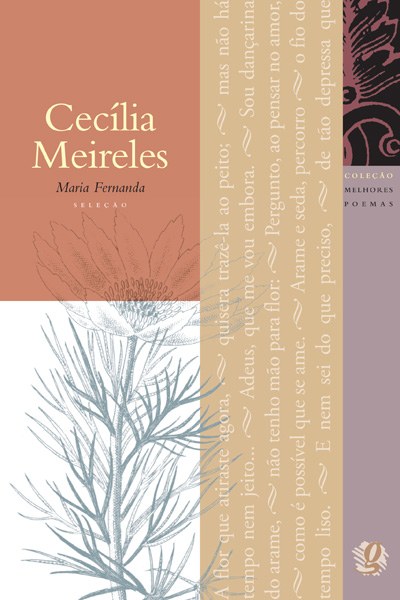
Edition: Global Editora, 15th edition · Portuguese · 192 pages · ISBN 9788526002944.
Begin with a selected-poems volume to hear the range within Meireles’s musical style. Read recurring images across several decades rather than treating one anthology poem as the whole voice.
For the historical chorus: Romanceiro da Inconfidência

Edition: L&PM Pocket, 2008 · Portuguese · 224 pages · ISBN 9788525417411.
Read this for Meireles at her most architecturally ambitious. Follow how short lyrics, romances, speeches and atmospheric passages distribute historical knowledge among many positions.
For the public educator: Crônicas de Educação

Edition: Global Editora, 2nd edition · Portuguese · organized by Leodegário A. de Azevedo Filho · 1,152 pages · ISBN 9788526023789.
This substantial collection reveals the teacher and journalist behind the lyric poet. Read selectively for her arguments about children, schools, books and cultural life—and for the way close attention becomes public advocacy.
Why read Meireles now?
Contemporary attention is often treated as a resource to capture. Meireles offers another model: attention as a form of relation. The instant matters because it exists, not because it can be stored, optimized or turned into proof of the self.
Her work also dissolves a false choice between inwardness and engagement. Musical poetry, historical research and education journalism belong to the same life because each asks how language meets another person across time.
For writers, her invitation is exacting. Listen before naming. Let form carry thought. Give the past more than one voice. Treat a child reader as capable of wonder and difficulty. Allow an image to vanish without making it meaningless.
The instant does not stay. The song is not a way to stop it. The song is how attention accompanies it as it goes.
Sources and edition notes
- Brazilian Academy of Letters: Cecília Meireles — “Deusa e poeta”
- Brazilian Academy of Letters: Meireles’s work revisited
- Global Editora: author biography
- Delos: Charles A. Perrone on translating Cecília Meireles
- Brazilian Dictionary of Translators: Cecília Meireles
- Global Editora: Melhores Poemas — Cecília Meireles
- L&PM: Romanceiro da Inconfidência
- Global Editora: Crônicas de Educação
The opening quotation is from “Motive,” Charles A. Perrone’s English translation of “Motivo” from Viagem. The website cover is DeepCrafter’s original illustrated Resonance card, not an archival photograph. The three book-cover images identify the Portuguese-language editions discussed.
Sources
- Brazilian Academy of Letters: Cecília Meireles — Deusa e poeta
- Brazilian Academy of Letters: Meireles’s work revisited
- Global Editora: author biography
- Delos: Charles A. Perrone on translating Cecília Meireles
- Brazilian Dictionary of Translators: Cecília Meireles
- Global Editora: Melhores Poemas — Cecília Meireles
- L&PM: Romanceiro da Inconfidência
- Global Editora: Crônicas de Educação