Where Great Things Begin: Astrid Lindgren and the Freedom of Imagination
On Astrid Lindgren’s birthday, follow a life of play, editorial discipline and moral courage through three books that make imagination consequential.
Where Great Things Begin
Astrid Lindgren and the Freedom of Imagination
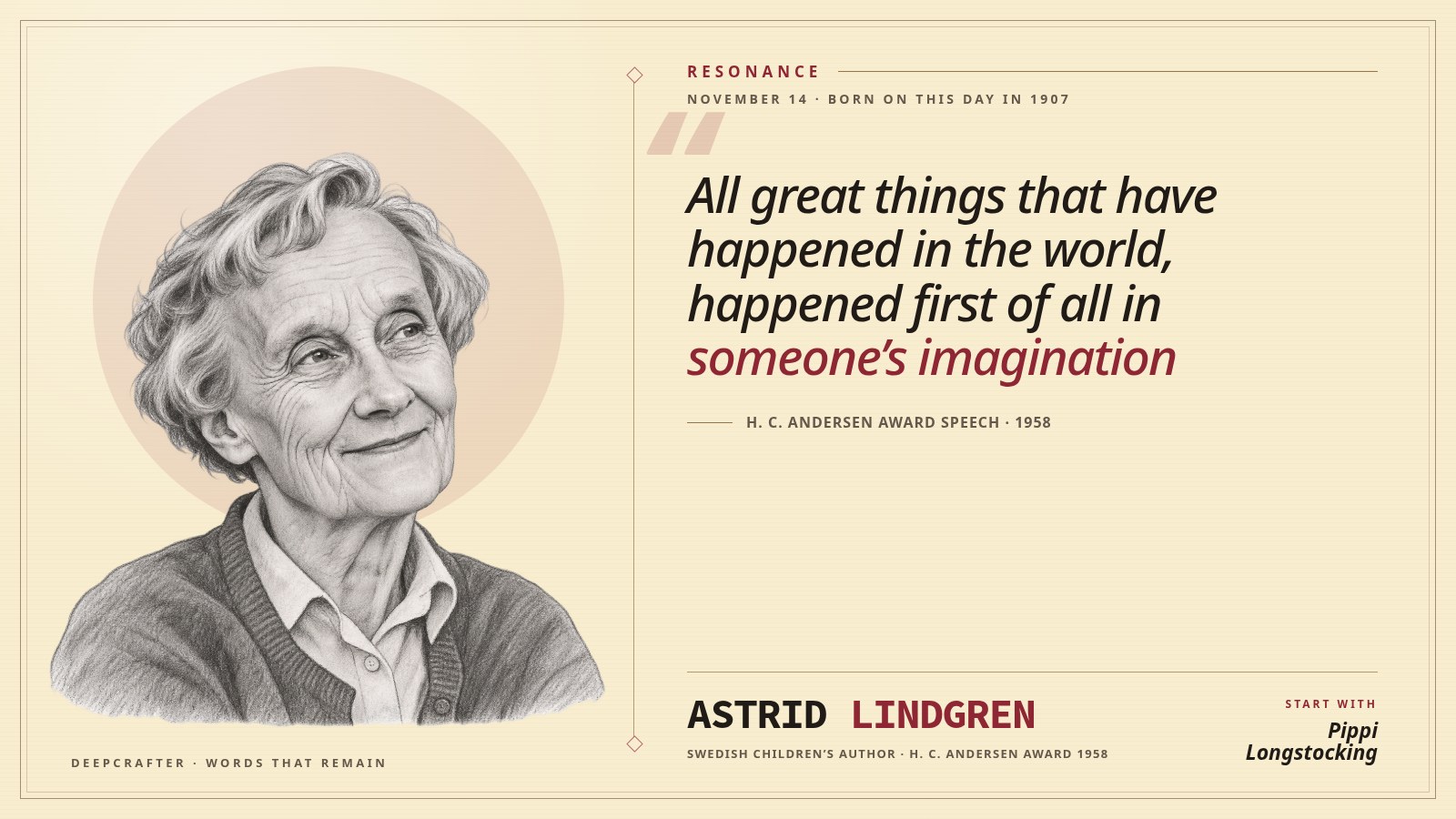
“All great things that have happened in the world, happened first of all in someone’s imagination.”
Astrid Lindgren offered this thought in her 1958 acceptance speech for the Hans Christian Andersen Medal. It is easy to receive it as a graceful defense of fantasy. In the life and work behind the sentence, imagination is more active than escape. It lets a child test the rules of the adult world, enter danger without surrendering play, and picture a form of freedom before anyone agrees that it is possible.
That is why the line belongs to November 14, Lindgren’s birthday. She was born in 1907 at Näs, outside Vimmerby in the Swedish province of Småland. The date offers a reason to return not only to Pippi Longstocking, but to a writing life that moved between comic rebellion, domestic warmth, political courage, grief and the dark edge of the fairy tale.
Lindgren became one of the world’s most widely read children’s writers. The official Astrid Lindgren Company records roughly 200 million books sold and translations into more than one hundred languages. Those numbers establish reach, but they do not explain endurance. For that, it helps to begin where Lindgren did: with children playing beyond the immediate supervision of adults.
Security and freedom at Näs
Lindgren described her childhood through two conditions: security and freedom. Her parents’ affection gave the children a dependable home, while the farm and surrounding country gave them room to roam. She and her siblings worked, listened to stories, invented games and explored without having every experience organized for them.
The official account of her childhood also emphasizes the oral culture around the farm. Stories, songs, anecdotes and tall tales passed among adults and children during meals, work and evenings. Long before Lindgren became a published writer, she learned that narrative could belong to ordinary speech. A character might begin in a local eccentricity, an exaggerated boast or the rhythm of somebody telling a story for pleasure.
This combination—safety at the edge of risk—runs through her fiction. Her children are often allowed farther into the world than a cautious adult would permit. Yet freedom is not presented as weightlessness. Friendship, loyalty, hunger, fear and home remain real. The imagined world becomes convincing because play has consequences.
For a writer, this suggests a useful distinction. A child-centered story does not need to remove danger. It needs to understand where the child’s sense of safety comes from, how far it can stretch and what happens when it fails.
Pippi arrives before the manuscript
Pippi Longstocking began as a name. In 1941, Lindgren’s daughter Karin was ill and asked for a story about “Pippi Longstocking,” a character she had just invented by naming her. Lindgren told Pippi stories to Karin and her friends. In 1944 she wrote them down as a tenth-birthday gift for her daughter.
Bonniers rejected the first manuscript. Lindgren revised it, entered a Rabén & Sjögren competition and won first prize. Pippi Longstocking appeared in November 1945 and quickly became a success.
The sequence matters. Pippi was first tested in a relationship between teller and listeners. Her strength is not only a premise—the strongest girl in the world, living without parents at Villa Villekulla—but a speaking presence. She exaggerates, reverses expectations and treats adult certainty as material for improvisation.
Lindgren does not make Pippi powerful by making everyone else irrelevant. Tommy and Annika supply curiosity, hesitation and companionship. Policemen, teachers and respectable visitors bring systems of order into contact with a child who will not automatically recognize their authority. Comedy arises from that contact, but so does a serious question: which rules protect children, and which exist mainly to make them manageable?
The writing lesson is not “make the child win.” It is to give the child a logic strong enough to alter the scene. Pippi does not merely refuse the adult world; she exposes its assumptions by answering from another set of values.
A writer in the morning, an editor in the afternoon
In 1946, after Pippi’s success, Lindgren took responsibility for children’s publishing at Rabén & Sjögren. For the next twenty-four years she lived a double working life. The Astrid Lindgren Company describes the rhythm plainly: she wrote in the mornings and worked as an editor in the afternoons.
She often drafted or transcribed at home in bed, ate a quick lunch, then walked briskly to the publishing office. Her shorthand and typing skills were practical foundations of the routine. As an editor she read other writers, helped shape a children’s list and participated in the growth of a small firm into a leading Nordic publisher.
This is more revealing than a romantic picture of inspiration. Lindgren’s imagination had an administrative life around it: manuscripts, deadlines, correspondence, revisions and decisions about other people’s books. The work of writing and the work of editing were not opposites. Each trained attention in a different direction.
Her account that a book could feel finished before she began transcribing it should not become a rule for other writers. What can travel is the division of labor. Generating, recording and editing are different mental acts. A writer may benefit from giving each a time and a task instead of demanding that every sentence be invented and perfected at once.
Writing from the child’s side of the room
Lindgren said that she wrote the book she herself would want if she were a child. The statement identifies a position rather than a market category. She did not stand over childhood explaining it to adults. She wrote from inside its appetite for play, its sensitivity to humiliation and its ability to recognize power before it has the language to analyze power.
That perspective helps explain her tonal range. Pippi Longstocking is comic and unruly. The Brothers Lionheart begins with illness and death, then enters a world of tyranny, resistance and brotherly courage. Ronia, the Robber’s Daughter places independence inside a conflict inherited from two families. The books differ, but each gives young characters moral experience rather than merely moral instruction.
Adults are not uniformly foolish or cruel. They can provide love, memory and refuge. But adulthood does not automatically make a person correct. Lindgren allows children to judge what they encounter, make consequential choices and discover that loyalty may require disobedience.
Writers can test a scene by asking: what does the child understand that the adult has stopped noticing? The answer should not turn the child into a miniature philosopher. It may appear through an action, a literal question, a refusal to accept a euphemism or a game that reveals the rule everybody else has agreed not to name.
The dark is part of the freedom
Lindgren’s imaginative freedom is sometimes reduced to cheerful rebellion. Her later fantasy shows something larger. The Brothers Lionheart, published in 1973, provoked debate because it confronted death so directly. Yet the novel does not treat darkness as a violation of childhood. It gives fear a landscape and courage a relationship.
Ten years later, Ronia, the Robber’s Daughter built another moral world out of wilderness, danger and inherited conflict. Ronia and Birk do not resolve the feud between their parents by delivering an abstract lesson. Their friendship changes where they can live, whom they can obey and what they are willing to lose.
In both books, fantasy makes an ethical pressure visible. The invented setting is not decoration around a message. Nangijala’s valleys, forests and fortresses organize choices in The Brothers Lionheart. The divided castle and living forest of Ronia turn family conflict into space the children must cross.
This offers a craft principle: if a fantastic place matters, let it distribute freedom and danger. Ask who may cross a border, who controls shelter, where two people can meet and what the landscape makes them risk. A world becomes dramatic when its geography enters a decision.
A public voice against violence
Lindgren’s concern with power did not remain inside fiction. Her 1978 German Booksellers’ Peace Prize speech, later known as “Never Violence!”, argued against corporal punishment and connected the treatment of children to the future of society. She also entered Swedish public debates about taxation, nuclear power and the treatment of farm animals.
These interventions should not be used to flatten the novels into policy statements. They do clarify a continuity: Lindgren took children seriously as people shaped by the uses and abuses of adult power. The playfulness of the fiction and the seriousness of the public voice came from the same refusal to treat the vulnerable as lesser beings.
For writers, conviction works best when it changes the conditions of a story rather than arriving only as commentary. Give power a gesture, a rule, a room and a consequence. Then let characters reveal what they believe through what they permit, resist or protect.
Three books, three ways into Astrid Lindgren
1. Begin with Pippi Longstocking
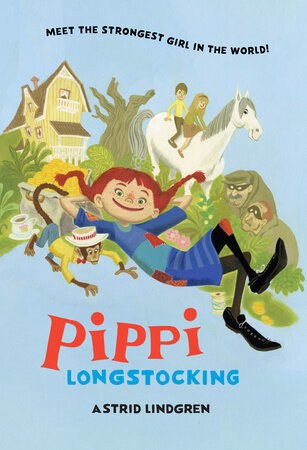
Selected edition: Viking Books for Young Readers hardcover, translated by Susan Beard and illustrated by Ingrid Vang Nyman, August 18, 2020, 144 pages, ISBN 9780593117811.
Begin with comic freedom. Watch how Pippi changes the rules of an encounter through language before she uses her extraordinary strength. Notice how Tommy and Annika keep the fantasy socially grounded.
Notice: which adult assumptions become visible only after Pippi declines to share them.
2. Continue with The Brothers Lionheart
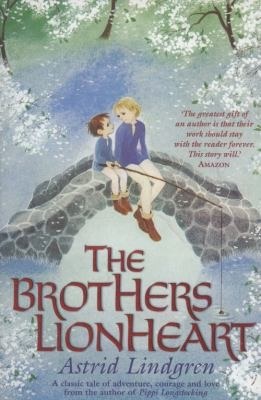
Selected edition: Oxford University Press edition, translated by Joan Tate and illustrated by Ilon Wikland, July 2, 2009, 188 pages, ISBN 9780192729040.
Continue into Lindgren’s darker register. Read for the bond between Karl and Jonathan, and for the way fear changes when it is shared. The novel allows courage to include terror rather than requiring its absence.
Notice: how each new region of Nangijala changes what the brothers can do for one another.
3. End with Ronia, the Robber’s Daughter
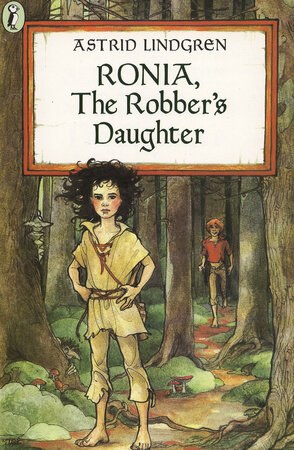
Selected edition: Puffin Books paperback, translated by Patricia Crampton, February 5, 1985, 176 pages, ISBN 9780140317206.
End with a story in which freedom must become a life rather than a gesture. Ronia and Birk inherit an enemy before they choose a friend. Their decisions reshape family, shelter and belonging.
Notice: how the forest moves between terror, testing ground and home.
Let imagination change the next choice
Lindgren’s imagination does not ask readers to stop caring about reality. It creates another arrangement of reality so that power, fear, loyalty and freedom can be felt anew.
For your next scene, give a young character one rule the adults consider self-evident. Let the character misunderstand it, question it or invent a game around it. Then resist the urge to explain the lesson. Follow the new choice the disruption makes possible.
Great things may begin in imagination, but in a story they become real when imagination changes what someone does next.
Sources
- Astrid Lindgren’s Näs: biography and the 1958 speech excerpt
- Astrid Lindgren Company: milestones
- Astrid Lindgren Company: childhood
- Astrid Lindgren Company: the years at Rabén & Sjögren
- Astrid Lindgren Company: about Astrid Lindgren
- ALMA: Astrid Lindgren and the award
- Penguin Random House: Pippi Longstocking
- Oxford University Press: The Brothers Lionheart
- Penguin Random House: Ronia, the Robber’s Daughter
Image and edition notes
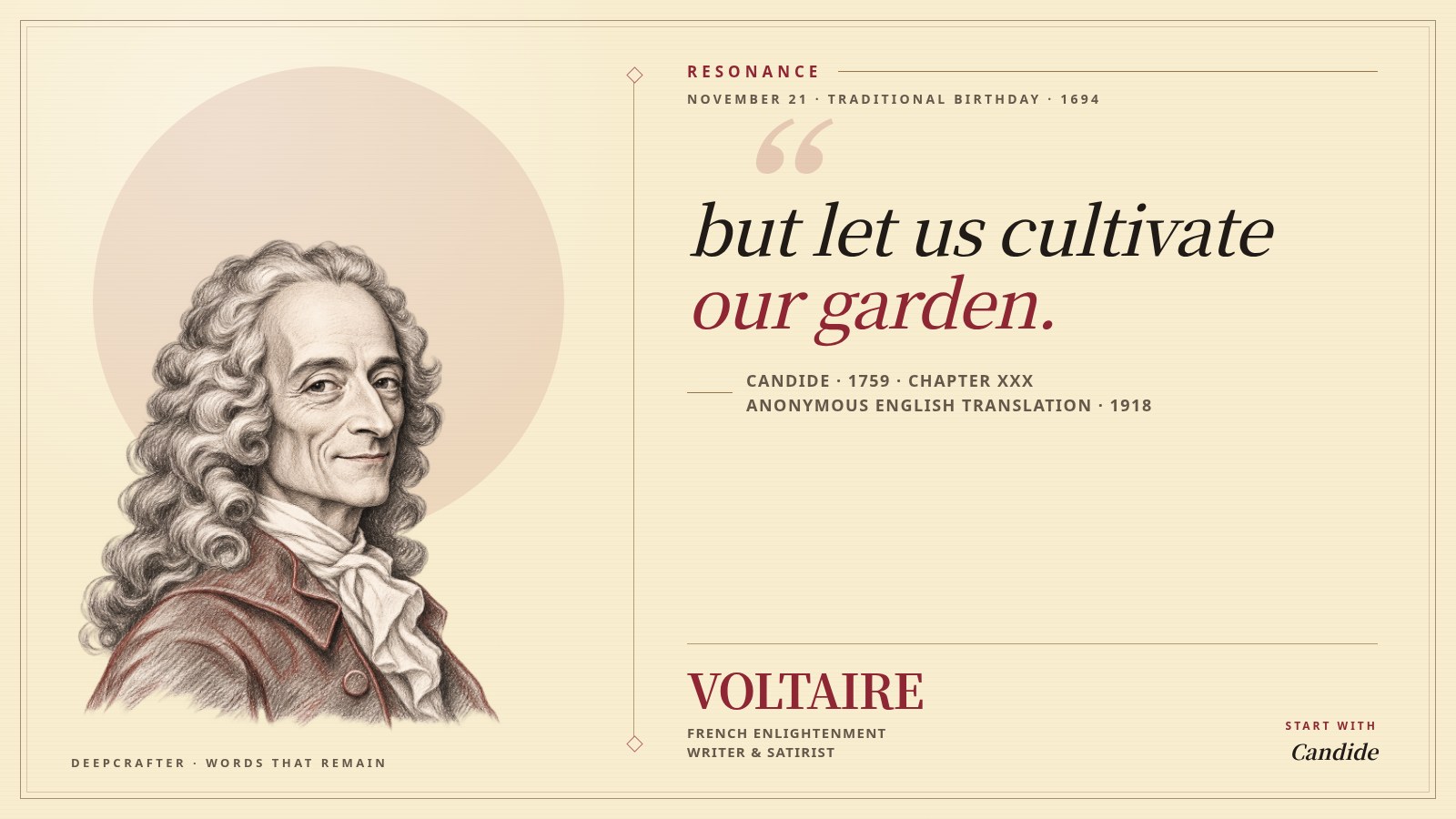
- Website cover: the original illustrated Astrid Lindgren Resonance card published by DeepCrafter; it is an illustration, not an archival photograph.
- Pippi Longstocking cover: Viking Books for Young Readers, ISBN 9780593117811; cover image from Penguin Random House.
- The Brothers Lionheart cover: Oxford University Press, ISBN 9780192729040; edition metadata from OUP and cover image matched by ISBN through Open Library.
- Ronia, the Robber’s Daughter cover: Puffin Books, ISBN 9780140317206; cover image from Penguin Random House.
- The opening is a brief excerpt reproduced by Astrid Lindgren’s Näs from Lindgren’s 1958 Hans Christian Andersen Medal acceptance speech.
Sources
- Astrid Lindgren’s Näs: About Astrid Lindgren
- Astrid Lindgren Company: Milestones
- Astrid Lindgren Company: Childhood
- Astrid Lindgren Company: The years at Rabén & Sjögren
- Astrid Lindgren Company: About Astrid Lindgren
- ALMA: Astrid Lindgren and the award
- Penguin Random House: Pippi Longstocking
- Oxford University Press: The Brothers Lionheart
- Penguin Random House: Ronia, the Robber’s Daughter