The Morning That Must Be Shared: Anne Sexton and the Art of Speaking Joy
On Anne Sexton’s birthday, follow how private experience becomes public form—and why ordinary joy must be spoken to survive.
The Morning That Must Be Shared: Anne Sexton and the Art of Speaking Joy
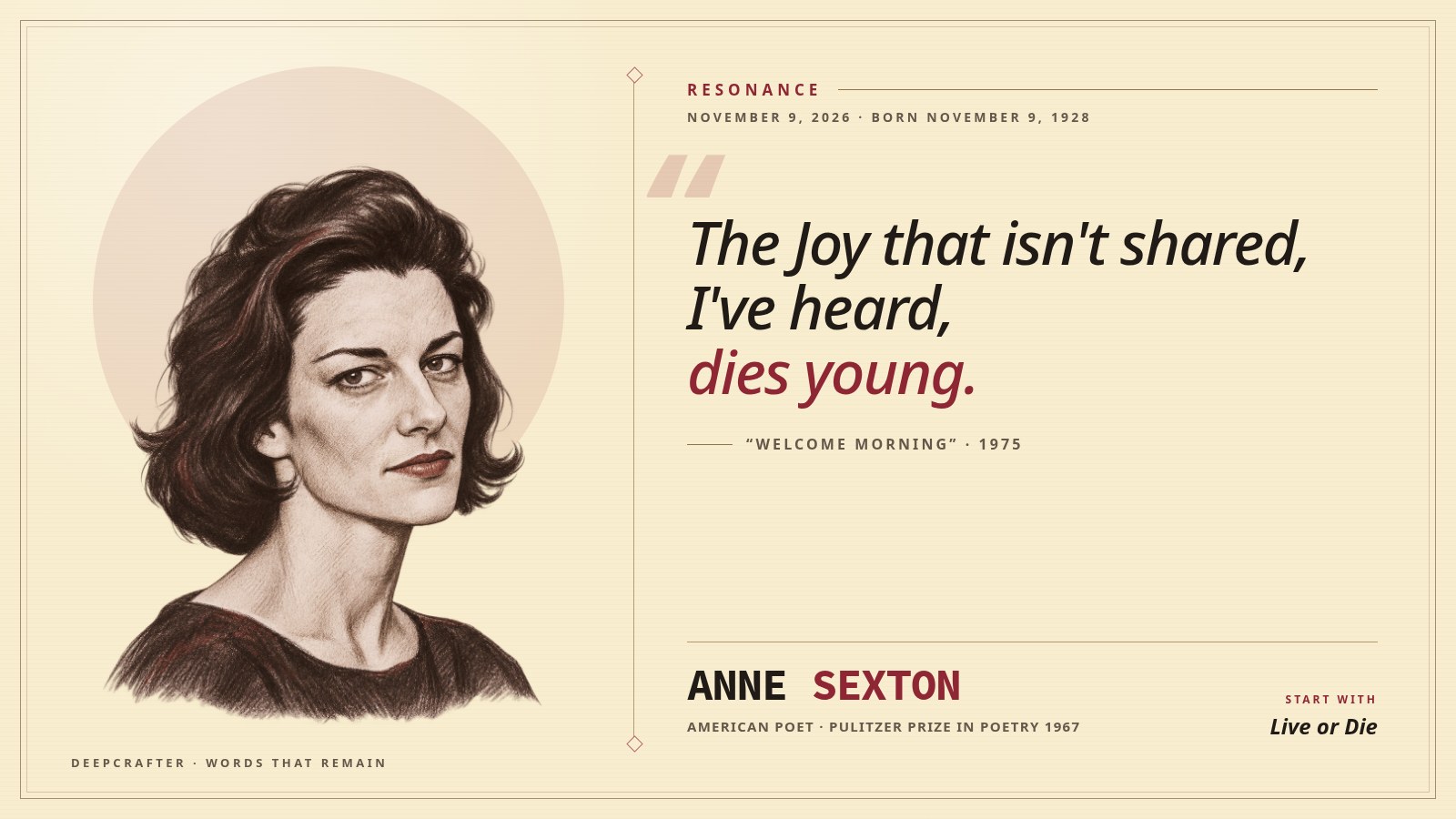
“The Joy that isn't shared, I've heard, / dies young.”
Why we chose Anne Sexton today
Anne Sexton was born on November 9, 1928, in Newton, Massachusetts. On her birthday, we return to the final two lines of “Welcome Morning” because they reveal a side of her work that the usual shorthand can hide.
Sexton is often introduced through illness, taboo and the label confessional. Those facts matter, but they can make a life’s work sound narrower than it is. “Welcome Morning” turns toward gratitude. It finds sacred intensity in brushed hair, a clean towel, eggs, coffee, a spoon, a chair and birds at the kitchen window. The poem does not deny darkness. It asks what happens when ordinary joy is noticed, named and offered to someone else.
The qualification inside the quotation matters: I've heard. Sexton does not issue a maxim from above. She passes on something provisional, almost conversational. The voice is intimate without pretending to certainty. That tension—between declaration and hesitation, exposure and performance—is central to her art.
A beginning that came after interruption
Sexton wrote poems in school, then stopped for roughly a decade. The archive at the Harry Ransom Center records that she returned to poetry in the 1950s amid severe mental illness and treatment. Her doctor encouraged the work, and in 1957 she entered Boston writing groups where she encountered Maxine Kumin, Robert Lowell and Sylvia Plath.
That chronology can tempt readers into a simple origin story: suffering produced poems, and poems reported suffering. Sexton’s development was far more deliberate. She entered workshops, read intensely, learned forms, revised, submitted work and built a professional practice. The speed of her emergence was extraordinary, but it was not effortless transcription.
Her first collection, To Bedlam and Part Way Back, appeared from Houghton Mifflin in 1960. All My Pretty Ones followed in 1962. By the time Live or Die won the 1967 Pulitzer Prize in Poetry, Sexton had become one of the most visible American poets of her generation.
Confession is not the same as evidence
The word confessional remains useful if it identifies a historical opening: Sexton and several contemporaries brought subjects previously excluded from respectable poetry into a public literary form. Mental illness, motherhood, the body, desire, family conflict and death could become material for art without being disguised as somebody else’s myth.
But the label becomes misleading when it trains us to read every poem as a deposition. A poem has speakers, scenes, tonal choices, repetitions, masks and arranged revelations. Even when a biographical fact stands behind it, the poem decides how that fact will move in language.
Sexton understood writing as performance. In her 1971 Paris Review interview, she compared the act of confession to something enacted through the body and attempted through words. The important word is act: the poem does not merely uncover a private self; it constructs an encounter with an audience.
For writers, this distinction protects both craft and truth. Personal material is not finished because it happened. It becomes literature when selection, rhythm, image and address give another person an experience they can enter.
The public voice inside the private poem
Sexton’s poems often feel as though they are speaking directly to one reader, but their intimacy is theatrical. She uses apostrophe, repeated phrases, abrupt tonal turns and the pressure of spoken cadence. The voice may confess, joke, accuse, pray or perform a spell. Its closeness is made, not merely found.
That is one reason her work crossed from the page into performance so naturally. She gave readings and later performed with the chamber-rock group Anne Sexton and Her Kind. The music was not an escape from poetry; it made visible what the poems already knew about breath, timing and audience.
The lesson is not that every poem should sound dramatic. It is that private feeling needs a route outward. Ask not only, “What happened to the speaker?” Ask, “Who is being addressed, and what change does the speaker want the act of telling to produce?”
Maxine Kumin and the practice of being answered
Sexton’s long friendship with Maxine Kumin was both personal and literary. They met through the Boston workshop world, wrote children’s books together and became essential readers of one another’s work.
This collaboration complicates the myth of the solitary confessional poet. Sexton’s voice may sound radically private, yet it developed in conversation—with teachers, peers, editors, audiences and poems by other writers. A trusted reader does more than correct lines. That reader tests whether the private urgency has acquired a public form.
“Welcome Morning” makes the principle explicit. Joy that remains unshared is endangered. The poem itself becomes the sharing: a domestic inventory transformed into an offering.
For a writer, the practical question is simple. Who can answer the draft without asking it to become safer or more conventional? And whom can you answer with the same seriousness? Sustained artistic exchange is not an accessory to the work. It can be one of the structures that allows the work to continue.
From crisis language to formal control
Sexton’s poems are remembered for extremity, but their force depends on control. She could organize a poem through refrain, catalogue, fairy-tale structure, prayer, dramatic monologue or a sequence of startling transformations. The voice may feel impulsive while the poem’s architecture is exact.
In Live or Die, poems written across several years form an emotional and formal trajectory rather than a heap of disclosures. In Transformations, the Grimm tales become occasions for wit, anger, social observation and a deliberately contemporary witch’s voice. In The Awful Rowing Toward God, religious language enters kitchens, bodies and ordinary objects.
The recurring move is translation: an experience that appears unsayable is given a structure through which it can be heard. Sexton does not remove contradiction. She creates a form capable of holding it.
This offers a strong revision test. When a draft announces intense feeling, look for the form that can resist and shape it. A refrain can make obsession audible. A catalogue can turn scattered detail into accumulation. A borrowed tale can give private conflict enough distance to reveal its pattern.
The risk of reading only the darkness
Sexton died in 1974, and knowledge of her death inevitably affects the reception of her work. Yet reading every poem as a step toward that ending flattens the range of the poetry and turns a complex practice into a single retrospective plot.
Her work contains despair, but also comedy, appetite, fury, tenderness, irreverence and craft pleasure. It includes the strangeness of fairy tales, the social theater of family life and moments when household objects become radiant. “Welcome Morning” belongs to that fuller field.
The poem’s joy is not naïve. Its speaker says she often forgets to give thanks. Gratitude is presented as an action that must be renewed, not a stable personality trait. The poem notices a morning, builds a ritual from it and speaks before the recognition disappears.
That may be the most useful way to approach difficult autobiographical material: refuse the single ending. A life is not one argument, and a body of work should not be reduced to the fact that most readily becomes legend.
Five craft lessons from Anne Sexton
1. Give private material a public shape
Experience supplies urgency. Form decides whether another person can enter it.
2. Let address create pressure
Know who the speaker is talking to—even if that listener never appears by name. Address turns monologue into relationship.
3. Use repetition as transformation
A repeated phrase should not merely return. Each recurrence can accumulate, contradict or revise what the phrase meant before.
4. Find the sacred scale of ordinary objects
Do not wait for a grand symbol. A towel, kettle or spoon can carry metaphysical weight when the poem earns the change in scale.
5. Keep the qualifier that makes the voice human
The small phrase I've heard prevents the closing claim from becoming doctrine. Certainty is not always stronger than vulnerability.
An exercise in shared attention
Write a poem or short prose scene about an ordinary morning.
- List seven objects touched before noon.
- Give each object a verb it does not literally possess.
- Choose one repeated phrase to return three times.
- Let the speaker nearly overlook the meaning of the scene.
- Address one absent person without naming them.
- End with a claim, then add a brief qualification that makes the claim more intimate.
On revision, remove the most abstract sentence. Replace it with one physical action that lets the reader reach the same recognition.
A three-book reading path
1. Begin with To Bedlam and Part Way Back
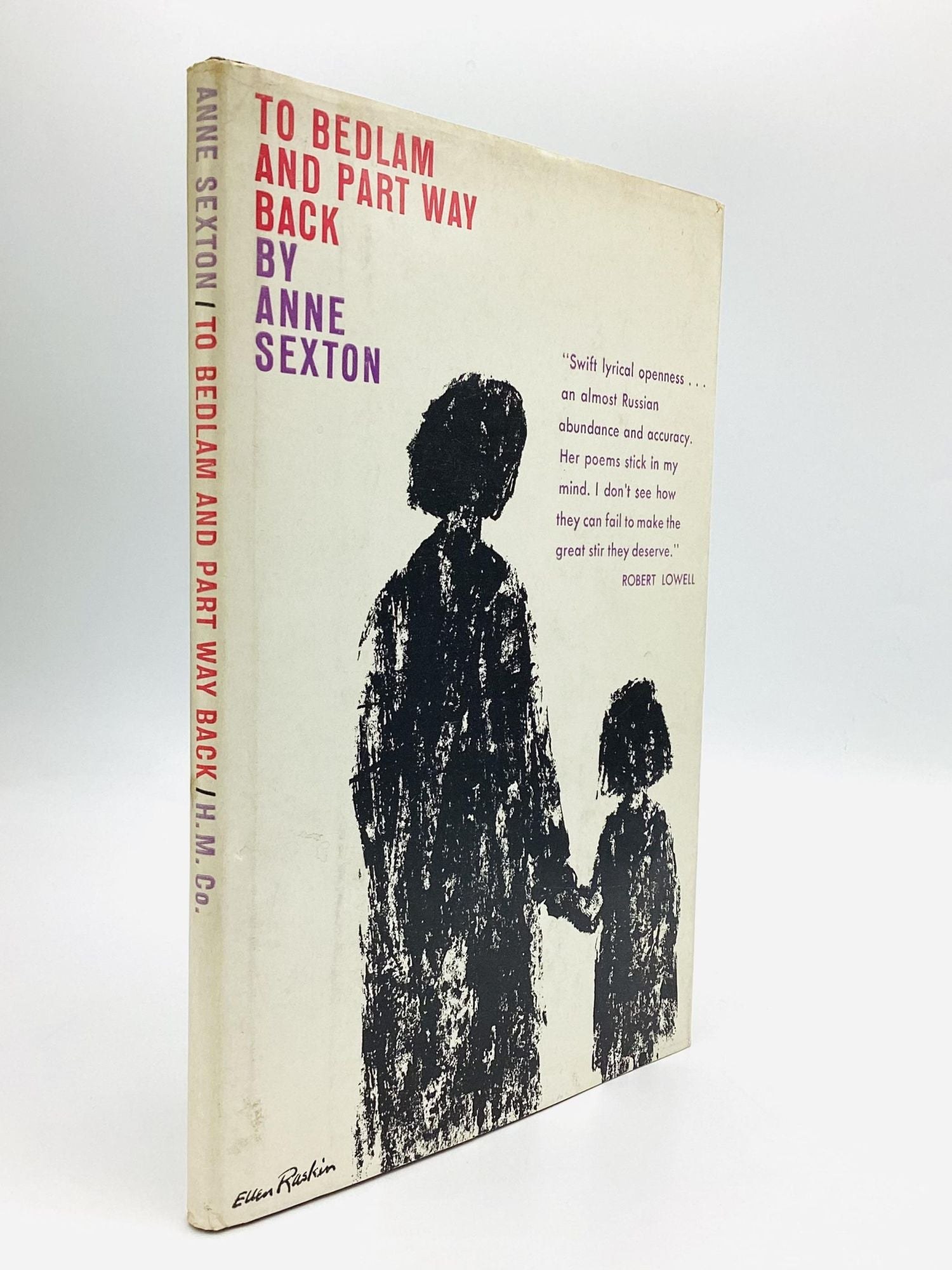
Selected edition: Houghton Mifflin, 1960, first edition.
Begin with the debut to hear Sexton discovering how personal crisis can become public form. Read beyond the biographical subjects. Notice the control of voice, the repeated figures and the way a speaker can be both exposed and self-inventing.
Notice: where the poem transforms testimony into scene, rhythm or mask.
2. Continue with Live or Die
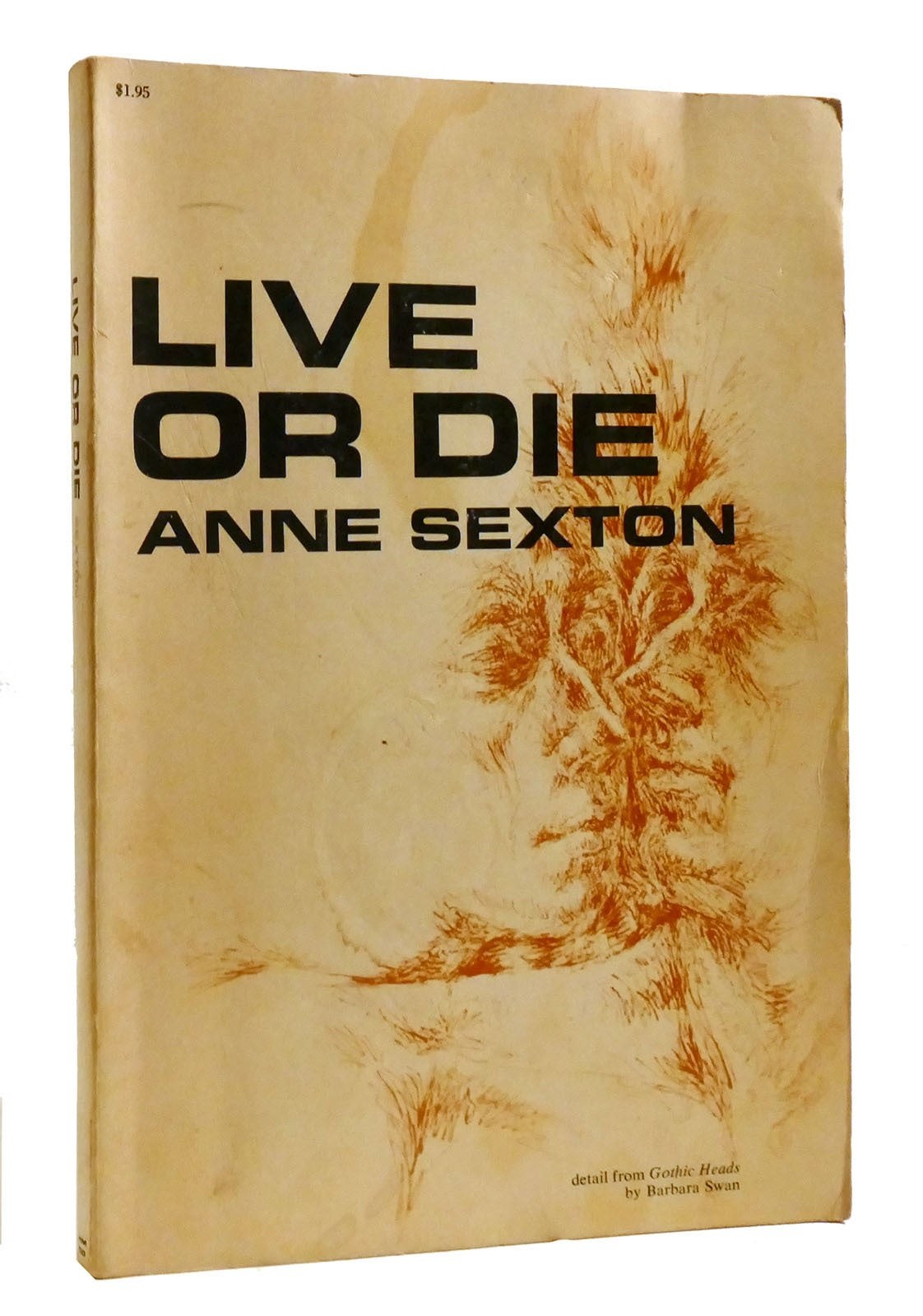
Selected edition: Houghton Mifflin, 1966 · ISBN 9780395081808.
This Pulitzer-winning collection is the central book for Sexton’s range. Its title names an absolute choice, but the poems are full of unstable movement between poles: comedy and terror, body and spirit, confession and performance.
Notice: how sequence changes the meaning of an individual poem, and how formal control intensifies rather than diminishes emotional risk.
3. End with The Awful Rowing Toward God
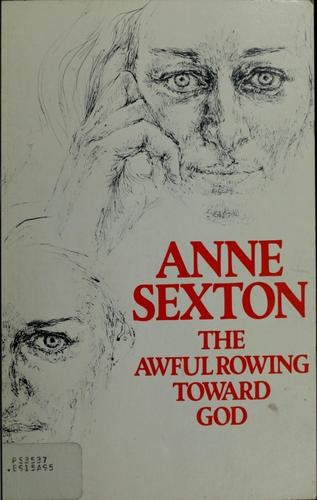
Selected edition: Houghton Mifflin, 1975 · ISBN 9780395203651.
Published after Sexton’s death, this is the collection that contains “Welcome Morning.” End here to encounter a late religious imagination that is bodily, domestic, argumentative and grateful by turns. The book does not present faith as a settled answer; it stages the act of reaching.
Notice: how spiritual language enters household detail, and how prayer can sound like conversation rather than certainty.
Why read Anne Sexton now?
We live in a culture that encourages disclosure while often rewarding the most immediately legible version of a self. Sexton’s work reminds writers that saying more is not the same as making art, and that vulnerability is not the absence of construction.
Her poems ask what language can do after secrecy: not simply reveal, but shape, address, test and share. They also ask what happens when the ordinary world receives the full pressure of attention. A kitchen can become a chapel without ceasing to be a kitchen.
On her birthday, the closing thought of “Welcome Morning” offers more than encouragement to feel grateful. It proposes a poetics. Recognition has to travel. The poem is the vessel in which a private moment crosses into another life.
Joy does not become less true when it is crafted. It becomes shareable.
Sources and edition notes
- Academy of American Poets: Anne Sexton
- Harry Ransom Center: Anne Sexton Papers
- The Paris Review, Issue 52: Anne Sexton interview
- The Writer’s Almanac archive: “Welcome Morning”
- Open Library: The Awful Rowing Toward God, 1975 Houghton Mifflin edition
- Harry Ransom Center: Anne Sexton collection overview and manuscripts
The opening excerpt is the final ten words of “Welcome Morning,” as reprinted with permission in The Writer’s Almanac from The Complete Poems of Anne Sexton (Mariner Books, 1999). The website cover is DeepCrafter’s original illustrated Resonance card, not an archival photograph. The three book-cover images identify the Houghton Mifflin editions listed above.