Good Stories Need a Place to Grow
The inaugural Stylus Prize recognizes the organizations behind literary work. Build a practical map of the support your own writing needs next.
Good Stories Need a Place to Grow
A story may begin with one person alone. Its life usually depends on more than solitude: a place to return to the page, someone who reads closely, and a route to people who might care.
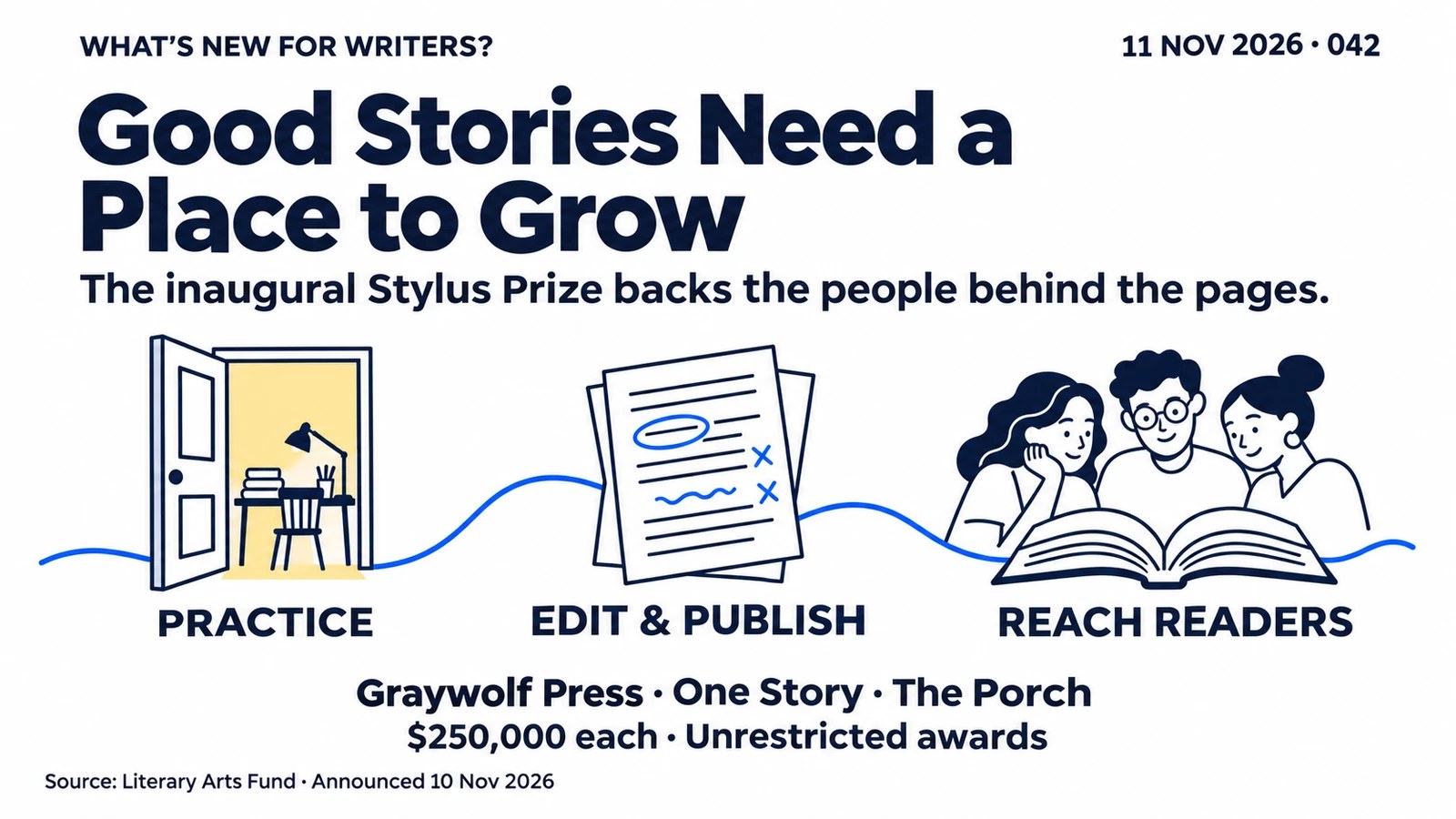
On November 10, 2026, the Literary Arts Fund announced the inaugural Stylus Prize recipients: Graywolf Press, One Story and The Porch Writers’ Collective. Each is to receive an unrestricted award of $250,000. The $750,000 announcement recognizes literary nonprofits, rather than individual books or authors. Writers nominated organizations anonymously; the fund made the final selections.
That shift in attention is worth keeping. Instead of asking only which manuscript deserves a prize, it asks what helps manuscripts come into being—and remain in circulation. For writers, the useful response is not to wait for recognition. It is to notice which kinds of support their current work needs.
The work behind the finished work
The three recipients make different parts of literary life visible. Graywolf publishes poetry, fiction, nonfiction and literature in translation. One Story combines short-fiction publication with education and mentoring. The Porch, based in Nashville, offers writing classes and community activities, alongside its literary journal, SWING. These are overlapping practices, not three isolated steps in a conveyor belt.
The award is unrestricted: it is not tied to one prescribed project. One Story's own announcement describes an intention to strengthen staffing, infrastructure and organizational capacity. Those plans illustrate why operational support matters. A dependable institution needs the means to keep doing ordinary work, not only the means to launch something new.
Our editorial reading of this event is simple: the conditions around a writer are part of the creative process. A recurring meeting can help a draft survive a difficult month. A careful response can reveal a scene's real problem. A publication can put an unfamiliar voice in front of a reader. None guarantees a successful book; each creates an opportunity to keep working.
Draw a writing-support map
The news suggests a practical exercise: make a small map of the support your next piece actually needs. This is our framework, not a program announced by the prize recipients.
Start with one work in progress. Avoid making a map of your entire imagined career. Name the next obstacle, then look for a setting or relationship that can help you address it.
1. Practice: where will you return?
If the obstacle is starting or continuing, look for a repeatable appointment. It might be a library write-in, an online group, a class or a quiet exchange with one friend. The important feature is a realistic rhythm you can sustain.
Write a concrete commitment: “For the next three Wednesdays, I will bring one unfinished scene to a forty-minute writing session.” That is more usable than “find a writing community.” A group need not offer prestigious access to help you put words on the page.
Before paying for a course, inspect the current format, cost and access arrangements. Ask whether it includes the kind of practice you need. A lecture, a workshop and a co-writing session do different jobs.
2. Revision: who can describe the reading experience?
If the draft exists but feels inert, seek a response to a specific question. Instead of asking whether a story is good, ask where the reader first understood what the character wanted, or where their attention drifted.
For example, imagine an original story about a night-shift cleaner who finds a child's drawing in an office scheduled for closure. The writer wants the discovery to change the cleaner's decision about leaving. A useful reader might say, “I understood the loss of the office, but I could not see why this drawing mattered to her.” That response gives the writer a revision task without prescribing a replacement plot.
Agree on the size of the exchange and when it will happen. A reliable reader of five pages can be more useful right now than an ambitious critique arrangement nobody has time to maintain.
3. Publication and readers: where does this piece belong?
If the piece is ready to leave your desk, read a small number of potential venues before submitting. Notice their forms, voices and audiences. Check current submission windows, eligibility, fees, rights and payment terms on the venue's own site. This article does not imply that any prize recipient is currently open to your manuscript.
Keep publication and readership related but distinct. Getting accepted is one event; helping an appropriate reader encounter the work is another. A reading group, a local event or a thoughtful recommendation can extend a story's life without turning every interaction into promotion.
For translators, the same map may include an attentive bilingual reader, an editor receptive to the work, and a way to introduce its context. The aim is a continuous path of understanding, not simply a completed file.
A map you can fill in today
Copy these prompts into a notebook. Keep each answer short enough to act on this week.
| Need | My next step | Person or place | When I will check back |
|---|---|---|---|
| Keep writing | Book one realistic writing session | ___ | ___ |
| Understand a draft | Ask one reader one focused question | ___ | ___ |
| Find a suitable venue | Read two recent pieces and current guidelines | ___ | ___ |
| Meet readers | Attend or contribute to one relevant conversation | ___ | ___ |
Choose the row that matches your present bottleneck. You do not need to complete all four at once. After the next session or exchange, record what changed: a finished scene, a clearer question, a venue you now understand—or a setting that turned out not to fit.
Participation can also be reciprocal. Read someone else's pages with the attention you hope to receive. Subscribe to a journal you genuinely want to read when your budget allows. Show up for another writer's reading. These are small, specific contributions to the conditions that sustain literary work.
A room that stays lit
The Stylus Prize brings welcome attention to the organizations around the page. It does not establish that the wider funding environment has recovered, and announced support is not evidence of completed improvements. It does make a constructive question newly visible: what would help the people who sustain writing keep doing their work?
For an individual writer, a useful answer can be modest. Find the next place you can return to, the next reader who can help you see, and the next route by which a story might reach someone. Good stories need imagination. They also need somewhere to grow.
Sources and scope
- Literary Arts Fund: inaugural Stylus Prize announcement, November 10, 2026. Primary source for recipients, award amounts, unrestricted status, selection process and organizational descriptions.
- One Story: recipient statement, November 10, 2026. Primary source for its intended use of the award; intentions are not reported here as achieved results.
Event date and report date: November 10, 2026. This article was prepared November 11. Award disbursement was not independently verified. The support map, fictional example and suggested actions are DeepCrafter editorial contributions, not research findings or endorsements from the organizations.
More insights on AI creative writing: https://deepcrafter.ai/insights