How Was This Book Made?
An Irish AI hearing raises a practical distinction: transparency about a model’s materials is not the same as an account of a book’s creative process. Here is how to describe both clearly.
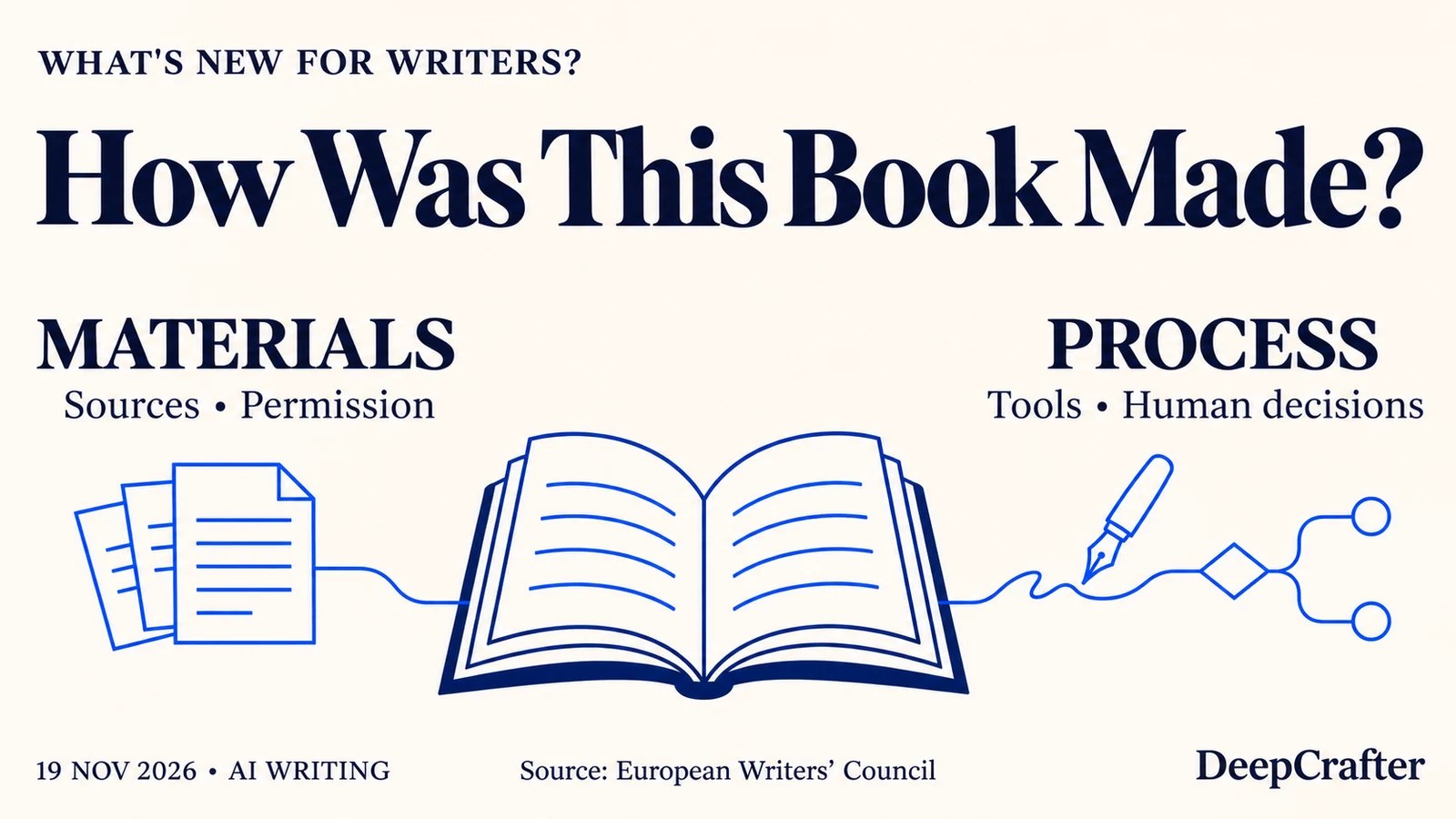
How Was This Book Made?
A reader asking whether a book used AI may be asking several different questions. Where did its materials come from? Was generated language included in the finished text? Who checked the research, chose the words and took responsibility for the result?
A single yes-or-no label cannot answer all of them. The useful next step is to separate the questions before trying to compress the answers.
A hearing brings transparency back to the page
In a statement dated November 18, 2026, the European Writers’ Council reports that Conor Kostick represented the Irish Writers’ Union and EWC at Ireland’s Oireachtas Joint Committee on Artificial Intelligence on November 17. His intervention called for authorisation, remuneration and transparency, including stronger disclosure of both AI training inputs and generated outputs. He used food labelling as an analogy for the information people should receive about generated material. Read the EWC statement and intervention.
This is a policy demand, not an adopted book-labelling standard. Nor is the metaphor new this week: EWC had already discussed a full-value-chain “Nutri-Score” in its October 16 conference account. The current event is the November hearing and the following day’s account.
The constructive opening for writers is a distinction, not a verdict: transparency about a model’s materials and transparency about a particular book’s making are related, but neither can substitute for the other. That distinction is our editorial interpretation of the questions raised by the intervention.
Two kinds of information, two different jobs
On the materials side, the questions concern the works used to develop or operate a system: their provenance, the permissions governing their use and the information available to people whose work may be involved. An individual novelist’s process note cannot establish these facts about a provider’s entire training corpus. A writer should identify the basis for a claim rather than turn a provider’s assurance into a personal certification.
On the manuscript side, the questions concern what happened during this project. Was a tool used to organise notes, propose alternatives, translate a passage, produce prose or generate a cover? Did that material enter the published work? Who verified factual claims and made final choices?
A provider’s claim about licensed training materials does not describe how a particular author used its tool. Equally, an author’s statement that no generated sentences entered a novel does not resolve the provider-side provenance question. Keeping these levels distinct makes both conversations more informative.
There is no need to make a disclosure carry a judgment it cannot support. A process account is not, by itself, a measure of literary quality. It gives readers, editors and collaborators information with which to understand the work.
Describe the action, not just the tool
“AI-assisted” names a broad category. It does not tell an editor whether the assistance was a conversation about a character’s motivation or the generation of a chapter subsequently revised into the final book.
A more useful account names the task and what survived. Start with the verbs: organised, suggested, translated, generated, checked, selected, rewrote. Then identify the object of the action. “Suggested alternative scene orders” is clearer than “helped with writing.” “Generated a first-pass translation” is different from “compared two translations I had already written.”
This is not an invitation to publish a transcript of every working session. A short account can be precise if the writer has retained enough private records to support it. The following examples are invented editorial illustrations, not statements about real books, hearing requirements or DeepCrafter interface features.
Example 1: research organisation
I used an AI tool to group my interview notes by topic. I checked the groupings against the original recordings and selected all quotations myself. No generated interview material was included in the book.
The value is in the boundary. A reader learns what the tool did, what the writer checked and what did not become evidence. The writer still needs to handle interview permissions and confidential material appropriately; the note does not replace those arrangements.
Example 2: testing a scene
I used an AI tool to suggest different orders for three scenes. I chose and revised the final sequence; no generated prose was retained in the published text.
This describes structural assistance without implying that the tool authored the sentences. If generated prose was retained, that last clause would need to change. Accuracy matters more than choosing a reassuring formula.
Example 3: translation assistance
I used an AI-generated first-pass translation as working material. I checked each passage against the source text and revised the translation throughout. I am responsible for the final wording.
This identifies a more substantial role. It does not establish permission to translate the source, settle contractual obligations or claim that the checking was successful. A translator and publisher can use it as a starting point for a specific conversation about expectations and review.
Keep a private record before writing a public note
Begin with one project, not an abstract policy covering everything you might ever write. Keep a compact record alongside its drafts:
- Task: What did you ask a tool to do?
- Material: What did you give it, and what is the basis for using that material?
- Outcome: Did the response enter the finished work, remain a reference or get discarded?
- Judgment: What did you verify, change and decide yourself?
Save meaningful versions when the role changes. A project may begin with brainstorming and later incorporate generated prose. An early description should not quietly become the account of a different final manuscript.
Then write for the intended reader. An editor may need a fuller internal account than belongs in an acknowledgments page. A collaborator may need to know about translation or cover production separately from the prose. Check the actual publisher, prize or platform rules rather than assuming one generic note meets every requirement.
Make room for an honest “I don’t know”
A useful description can distinguish what the author knows from what a provider states. If a model’s training provenance is not available to you, do not imply you audited it. If you did not retain enough process history to make a precise claim about a draft, review the surviving versions before announcing certainty.
The aim is not an expanding catalogue of disclaimers. It is a few accurate sentences supported by ordinary working records. That can make a conversation about authorship more concrete: here is the assistance, here is the material that remained, and here are the decisions for which I take responsibility.
The Irish hearing matters because it connects public demands for transparency to the information people need about cultural work. Writers do not have to wait for a universal label to practise clearer description. They can begin with their next manuscript—and keep the questions about a system’s inputs separate from the account of their own creative labour.
Sources and evidence boundaries
- EWC statement and Kostick intervention, November 18, 2026; hearing date November 17. This is the participating organisation’s account. Its claims about industry compliance and economic harm are advocacy claims; this article does not present them as independently established findings or use its quoted research statistics.
- EWC conference account, October 16, 2026; establishes that the labelling analogy predates this hearing.
The official hearing video was not independently reviewed for this article. The distinctions, practical record and fictional examples above are DeepCrafter editorial contributions, not legislation, legal advice or an adopted disclosure scheme.
More insights on AI creative writing: https://deepcrafter.ai/insights