Before You Approve the Book Cover, Agree on How It Will Be Made
Tor’s cover replacement for an Ilona Andrews novel opens a practical conversation: how authors and designers can agree on production methods, checkpoints and handover.
Before You Approve the Book Cover, Agree on How It Will Be Made
You love the first sketch. The colours fit your novel; the type looks right at thumbnail size. Before you approve it, there is another conversation worth having: what are you actually commissioning, and what will arrive with the finished picture?
That question became unusually concrete this week when Tor announced that it would replace the revealed cover of Ilona Andrews’ This Crown Will Not Rule Me. For an author preparing to commission a cover, the useful lesson is not to become an amateur image detective. It is to make the working agreement easier to understand and check.
What happened—and what did not
In a November 20, 2026 post on the authors’ website, Ilona Andrews published Tor’s statement confirming that generative AI had been used in the cover’s creation without either party’s knowledge. Tor said it was withdrawing the design and would not use it on completed books, accepted responsibility for its review failure, and promised stronger checks.
The authors said their contract and Tor’s art contracts already prohibited AI use. They also explained that a sketch had been provided to the art department, and discussed reviewing project files in future commissions. They asked readers not to harass the artist.
These are the parties’ public accounts, not an independent technical investigation by DeepCrafter. This is a cover replacement, not evidence that the novel’s text was AI-written or that the book itself was withdrawn. The source does not disclose the full contracts or the precise tools and proportions involved.
Our practical suggestions below are editorial guidance for a clearer collaboration, not Tor’s announced procedure or legal advice.
Start with the result and the route
“An original cover” can mean different things to different collaborators. One author may expect a newly painted illustration. Another may welcome a designer’s arrangement of licensed photographs. A third may explicitly permit generated elements. Those are different briefs, even when the final images might all look attractive.
Describe the desired result, then name the production methods that are acceptable for your project. If you want human-drawn illustration without generative elements, say so plainly. If stock imagery is allowed, ask how it will be selected and documented. If AI use is allowed within limits, describe those limits and what disclosure you expect. Avoid assuming that a broad label such as “digital art” answers any of these questions.
This conversation is not an accusation. It lets a designer decide whether the commission fits their practice before either of you invests substantial time.
Put one process question beside each visual checkpoint
Authors often know when they want to see a sketch, a colour study and the final layout. A small addition makes those milestones more useful: agree what information should accompany each one.
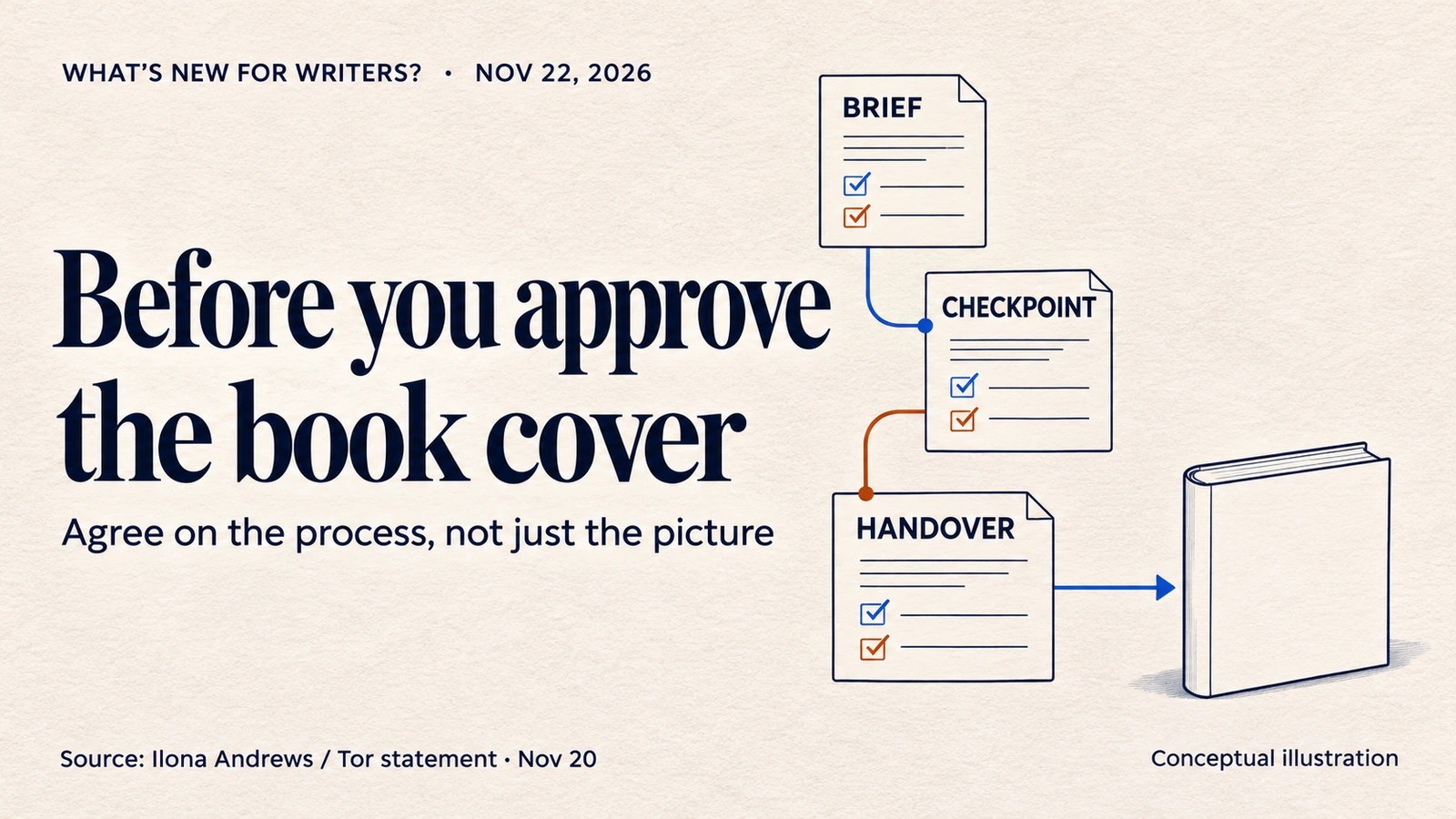
At the briefing stage, establish who is making the work and whether anyone else or any external asset supplier will contribute. At a sketch review, discuss the proposed composition and the materials or methods behind it. At final handover, check that the agreed source notes and deliverable files are present alongside the image.
A sketch is useful for creative discussion; it is not a certificate of how every later element was produced. Likewise, a layered file may help explain a workflow without establishing the provenance of every imported element. Ask for materials that answer your actual commissioning requirements, rather than accumulating files because more files feel reassuring.
Be proportionate. Discuss review materials before work starts, including what the designer can share without exposing unrelated client work or private resources. A process requirement sprung on someone at the end can become a new dispute rather than a solution.
A sample email you can adapt
Imagine a self-publishing novelist commissioning a painted coastal scene. The following is an invented example, not language from the Andrews or Tor contracts:
I’d like a newly drawn illustration, with no generative-AI imagery. Could you confirm whether that fits your workflow? Before we begin, let’s agree on the sketch and colour-review stages, any outside materials you expect to use, and the process notes and files included in handover. I also need to know which uses the final agreement covers, including ebook, print and promotion. If the plan or materials change, please tell me before incorporating the change.
The point is the conversation this starts. A designer might explain that a reference photograph is for visual research rather than inclusion, that a typeface has separate licensing terms, or that editable files are not part of the quoted fee. You can resolve those differences while there is still time to change the brief.
Specific rights and contractual wording require advice appropriate to your project and jurisdiction. A friendly email does not replace that work.
Decide who can approve the public reveal
The first public cover reveal is a real deadline. Treat it as a handover decision, not merely a social-media appointment.
If you work with a publisher, ask whom to contact about production questions and who has authority over approval. Do not assume that an author has the same control as a self-publisher commissioning directly. Within the arrangement available to you, make sure unresolved questions have a named person to go to before publicity starts.
For a small independent project, that might mean keeping one short approval note: the visual version accepted, the agreed production information received, the uses checked, and any question still open. You need enough clarity to make the decision, not an elaborate compliance department.
Also agree who will pause a reveal if a credible concern appears. Preparing that route while everyone is on good terms can make a later correction less chaotic.
If someone raises a concern, investigate without a pile-on
An odd-looking detail can justify a question. It does not, on its own, establish which tool was used or who knew about it. Keep the concern specific, preserve the relevant correspondence and version, and ask the commissioning contact for an explanation grounded in the working materials.
Do not turn uncertainty into a public accusation against an individual. The constructive outcome is a reliable account and, where needed, a corrected deliverable—not a contest to identify suspicious pixels.
Nor should a production dispute automatically become a claim about the author’s manuscript. Separate the artwork, its commissioning process and the text. Clear distinctions help readers understand what is actually being corrected.
One useful step before your next commission
Open your cover brief and add a short section titled How we will work. Write down the methods you are commissioning, the review points, the information included in handover, and the person who can approve release or resolve a concern. Invite the designer to correct anything unrealistic or unclear.
You are not trying to eliminate trust. You are giving trust something concrete to work with: shared expectations, a manageable way to check them, and a clear route when the work needs to change.
Source and illustration note
The event and original statement date is November 20, 2026; this article was prepared November 22 within an extended 72-hour news window. The factual account comes from Ilona Andrews’ original post, including Tor’s statement. The sample email and workflow suggestions are DeepCrafter editorial contributions. The cover illustration is AI-generated and conceptual; it does not depict or reproduce the withdrawn book cover.
More insights on AI creative writing: https://deepcrafter.ai/insights