AI Can Make Sentences. Who Makes the Work?
First Encounters with AI brings writers’ experiences into the discussion. A practical distinction between producing material, selecting it and shaping a work.
AI Can Make Sentences. Who Makes the Work?
A page of fluent prose can arrive before a writer knows what the page is for. That is not the end of writing. It is an invitation to make a more deliberate kind of choice.
The publication of First Encounters with AI: Writers on Writing, edited by Nina Beguš, offers a timely way into that question. The University of Michigan Press lists the collection for November 2026; the editor identifies November 17 as the bookstore delivery date. Its contents bring together different approaches to generative text, including contributions by Ted Chiang, Ken Liu, Qiufan Chen and Sheila Heti. This is a publication milestone, not the first appearance of every essay. Publisher’s catalogue · Editor’s project page.
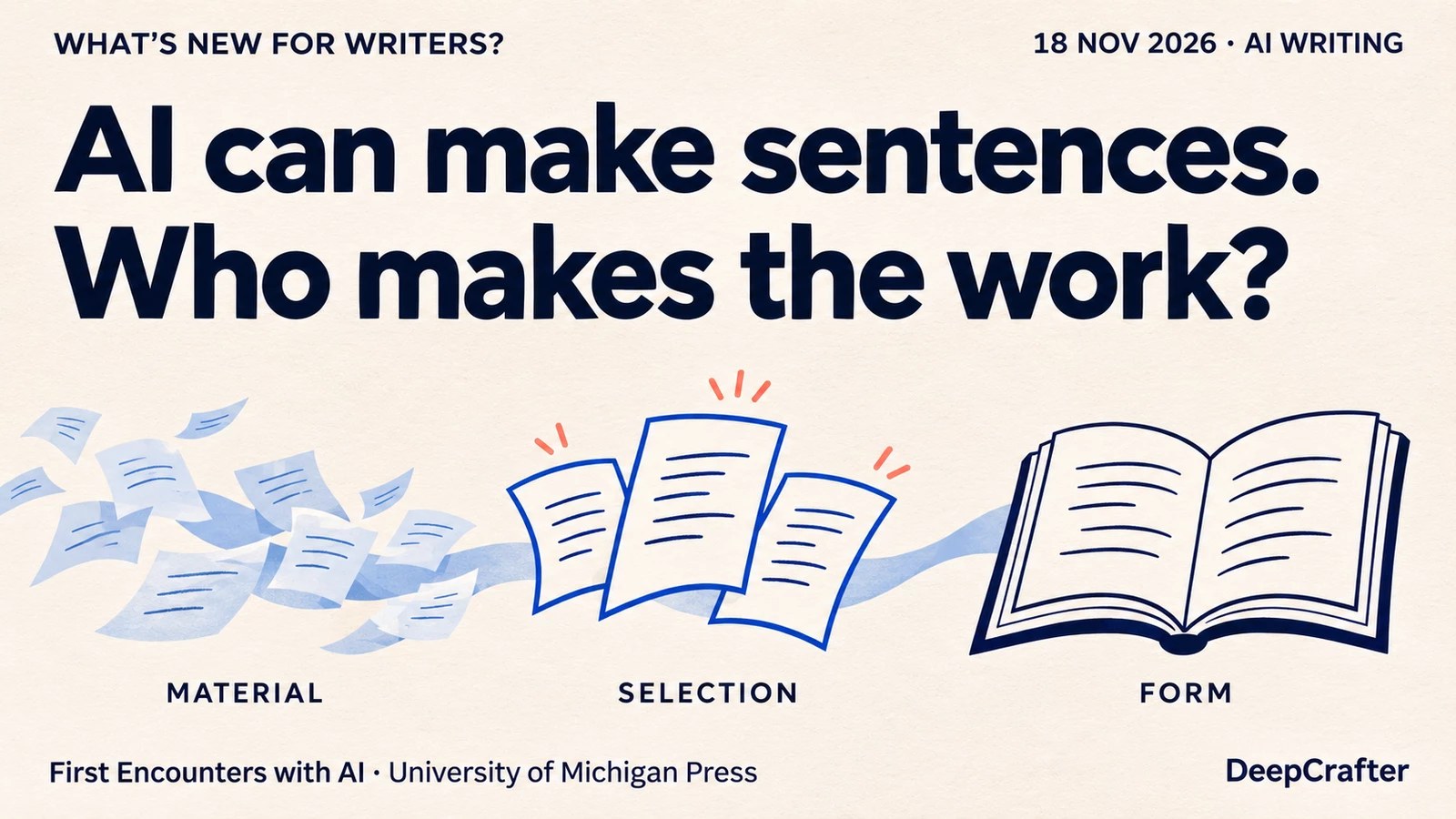
For a writer, a useful starting point is neither a verdict on AI nor a promise that a tool will solve a manuscript. It is a distinction: producing material, selecting material and making a work are different activities. That is our editorial lens, not a summary of agreement among the contributors.
An encounter is not yet a form
One contribution can already be read independently. In “Chasing Alice,” published by The Yale Review, Heti describes conversations with a chatbot that began in 2022. She saved exchanges, published selections and gradually recognized that these conversations might become the material for a book. Meanwhile, the system changed, and the voice she had wanted to revisit became unfamiliar. The essay is a personal account, not an experiment establishing machine consciousness.
What makes this useful to another writer is the relationship between attention and form. The material that catches your interest may not initially resemble the project you thought you were making. Preserving it gives you something to return to; deciding what to do with it remains another task.
That insight does not depend on using AI. Interview notes, remembered conversations and abandoned scenes can all become more interesting than the outline that originally justified collecting them. A writer can recognize a different project without treating the earlier work as wasted.
Put the debate beside the draft
Ken Liu supplies another entry point. In his September 1 newsletter, he says that “The Art of Copying” was written for this collection and appeared in the Los Angeles Review of Books ahead of the book. He frames its questions around human imitation, machine copying and the history of mechanized craft.
That historical scale is valuable alongside an immediate question about a draft: what, exactly, are you trying to learn or make? It becomes easier to discuss a tool when its role is specific. An unexpected line, a competing arrangement and a passage ready for publication are not interchangeable accomplishments.
We have not read the entire collection. The following exercise is our own practical extension of these questions, not a procedure prescribed by its contributors.
A small record of creative decisions
Choose one scene that matters to you. It can be a fully human-written draft or a passage developed with a tool. Instead of asking whether it is generally “good,” give it a concrete job: make a reunion uncomfortable, let a character conceal a request, or turn a familiar place strange.
1. Keep the material separate from the decision
Save the version you began with. Put alternatives somewhere else, whether they came from your own revision, a workshop suggestion or an AI response. Do not let a convenient replacement erase the possibility of comparison.
An invented example: a daughter asks her father to help clear an empty house. One version explains that he feels guilty. Another has him polish a cup that is already clean. Both communicate something, but they ask the reader to participate differently.
2. Name the reason for keeping a detail
Write one sentence about the choice you make. “The cup gives him something to do while he avoids answering” is more useful than “the second version is better.” It identifies the effect you want to preserve when the scene changes again.
You might keep a plain line because it breaks a character’s usual formality. You might reject an elegant description because it distracts from a dangerous silence. The aim is not to build a universal scoring system. It is to make your own intention available to your future self.
3. Read for the shape of the whole
A successful detail still has to belong. Read the revised scene beside the scene before it and the scene after it. Does the avoidance develop? Does the reader learn something too soon? Have three individually attractive passages repeated the same emotional turn?
This is where selection becomes composition. Keeping the strongest isolated sentences is not always the same as making the strongest work. A quiet sentence can create room for a later one; a deletion can allow an image to acquire force.
4. Leave yourself a usable note
Finish with three short lines:
- Kept: the detail or structural change you want to carry forward.
- Reason: the experience it creates for the reader.
- Next: the question the following revision should answer.
You now have more than a revised passage. You have a trace of your judgment. That trace can help you continue after a long interruption, explain a choice to a collaborator, or discover that your original intention has changed.
Read for differences, not a collective verdict
The anthology’s table of contents is an invitation to encounter distinct writers, not a substitute for reading their arguments. A sensible route is to begin with an available essay, note the problem its author is actually addressing, and then read another contributor without assuming that a shared book implies a shared position.
The encouraging possibility is that attention to process can make the conversation less abstract. Whatever tools you choose, you can keep asking what a passage is doing, what you are selecting and what kind of whole you want to make. Fluency gives you sentences. A continuing practice of choices gives those sentences a place.
Sources and dates
- University of Michigan Press: First Encounters with AI: bibliographic details and contents; November 2026 publication listing.
- Nina Beguš: book project page: November 17 bookstore delivery statement, not independent confirmation of stock in every channel.
- Sheila Heti: Chasing Alice: previously published personal account, June 8, 2026; not newly released reporting.
- Ken Liu: Book Launch, New Story, New Essay: September 1, 2026; confirms the essay’s relationship to the anthology.
Event date: November 17, 2026, as identified by the editor’s bookstore-delivery statement. This article: November 18. The three-part lens, invented scene and decision-record exercise are DeepCrafter editorial contributions; no measured writing outcomes are claimed.
More insights on AI creative writing: https://deepcrafter.ai/insights