Stories Need a Route to New Readers
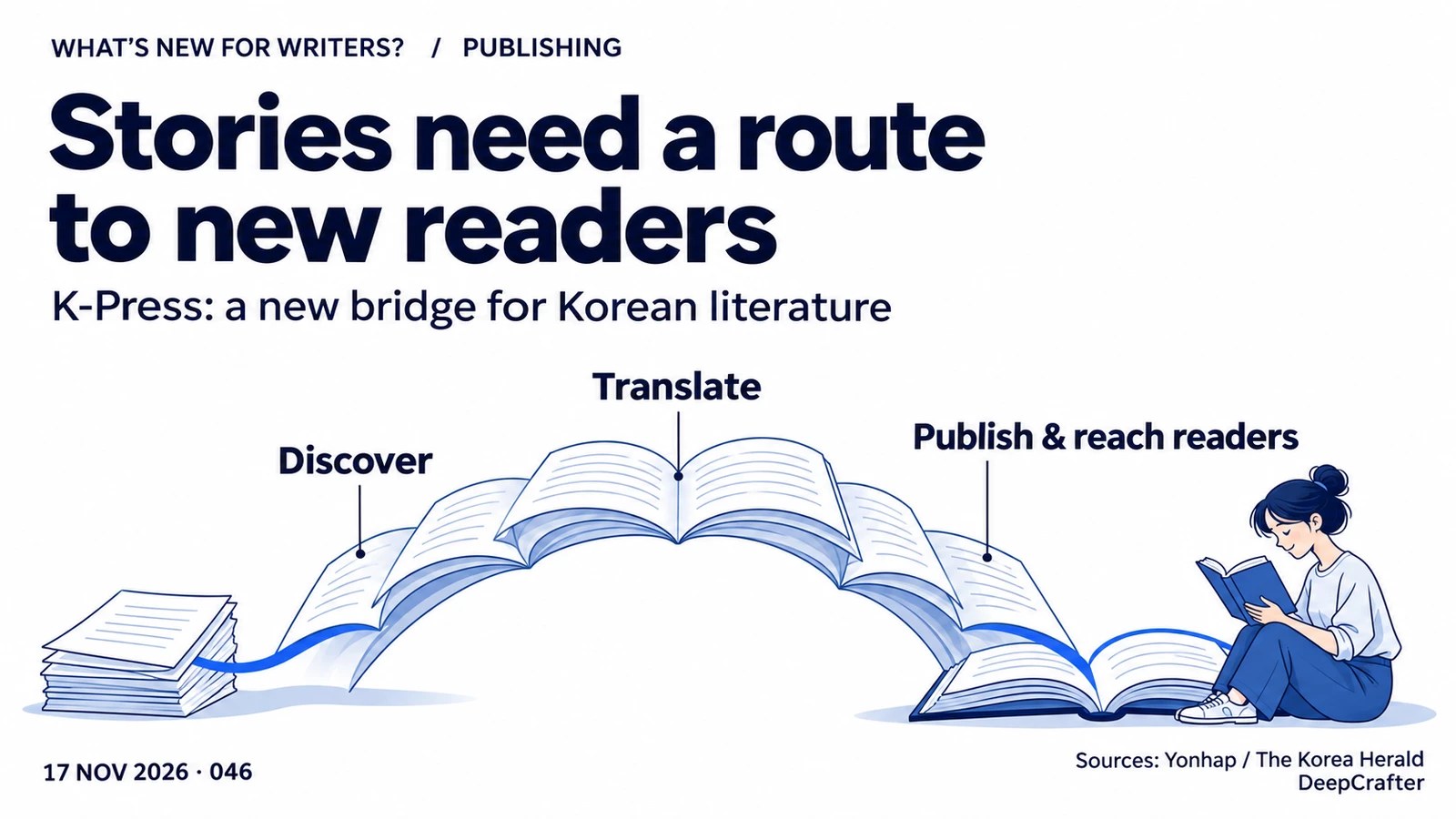
K-Press’s reported Oxford partnership makes the work behind literary translation visible. Build a clearer bridge from a distinctive story to its next readers.
Stories Need a Route to New Readers
An unfamiliar novel rarely reaches a reader through translation alone. Someone has to notice it, explain why its voice matters, secure permission, shape a readable edition and put that edition somewhere a reader will encounter it. These are different kinds of work. Connecting them is a creative achievement in its own right.
A publishing announcement from Oxford makes that connection newly visible. On November 16, 2026, Korean news outlets reported an agreement between Oxford's Korean Studies Centre and independent publisher Oxford eBooks to develop K-Press for Korean literature in English. According to the reported division of responsibilities, the centre will identify works and authors; the publisher will handle contracts, production, distribution and marketing. This is not an Oxford University Press initiative. The Korea Herald and Korea JoongAng Daily describe the agreement.
For writers and translators, the useful question is larger than whether a new imprint succeeds: what does a story need in order to become legible, inviting and available to someone beyond its first language?
A book can have more than one beginning
The announced first title is Mother Star, Cha In-pyo's novel in an English translation associated with Jieun Kiaer and Kate Clanchy. The Korean work first appeared in 2009 and was republished under a different title in 2021; it featured at the Oxford Korean Literature Festival in 2024. The November report concerns its next publishing route, not a newly written novel or proof that the English edition is already on sale. The Korea Herald supplies that publication background.
The sequence is encouraging precisely because it is not instantaneous. A work can gain another beginning when someone encounters it in a new setting. A festival introduction, a translator's sustained interest or an editor's recognition may reopen a book's possibilities long after its first publication.
Our editorial reading is that discoverability is not simply a publicity problem. Before a story can be promoted, someone must make a convincing case for what is worth discovering. That case often begins with close reading rather than a claim about a national trend.
Four jobs, one continuous route
The following framework is DeepCrafter's interpretation of the announcement, not K-Press's submission process. It can help an author or translator prepare a more useful introduction to a work.
Discover: identify the experience, not just the category
“Korean fiction” tells a bookseller something about origin. It does not yet tell a reader what kind of encounter a particular novel offers. The same is true of “family saga,” “literary fantasy” or “a story about belonging.” A category helps locate a book; a distinctive situation helps someone imagine reading it.
Consider an invented example: a daughter returns to a coastal town to empty her mother's shop and discovers that every customer remembers a different version of the same winter. The introduction should make that conflict tangible. What does the daughter want to finish? What prevents her from accepting the memories? What kind of attention does the prose ask from us?
For your own work, write three sentences: the human situation, the pressure that changes it, and the experience the reader will carry away. Keep the work's particularity. Do not turn a quiet, complicated story into a louder genre promise simply because that promise is easier to summarize.
Translate: show what the voice does
A synopsis can explain events while leaving out the reason a book is worth reading. A short, carefully chosen sample can reveal what the synopsis cannot: hesitation, comic timing, the distance between speaker and listener, or a sentence that withholds its emotional turn until the end.
For the invented coastal-town novel, a page of polite conversation might be a stronger sample than a dramatic revelation. If the book's power lies in what nobody will say directly, the sample should let an editor experience that pressure.
A translator's note can help, but give it a specific job. Explain a recurring form of address, a deliberate ambiguity or a tonal choice that the sample makes visible. Rather than claiming that a text is untranslatable, show where a translation must make a meaningful decision. The note should open the reading experience, not surround it with a wall of prerequisites.
Publish: make the handoff understandable
An editor needs enough information to understand both the manuscript and the proposed project. A practical introduction can identify the original edition, author, language, approximate length and the status of the translation sample. It can also identify who can answer questions about rights, where that information is known.
These are preparation suggestions, not universal submission requirements. A particular publisher's current guidelines remain the starting point. Do not assume that an announcement means a press is accepting unsolicited manuscripts or that a relationship with a university creates an open application route.
The creative benefit of this preparation is clarity. When the basic information is easy to find, a conversation can spend more time on the work itself: why this voice, why this reader, and why this edition now?
Reach readers: name an invitation
“A book for everyone” rarely gives a reader a reason to begin. An invitation can be more precise without becoming narrow: readers interested in conflicting family memories; reading groups that enjoy unresolved testimony; people drawn to the social life of a small shop.
For the coastal-town example, a useful event might involve reading one conversation aloud and discussing why its participants remember it differently. That invitation emerges from the book. It is not a generic demand that every author build a personal brand.
Translators, booksellers, librarians and reading groups can each create a different entrance. Their work matters because a translated book must be available both materially and imaginatively: obtainable as an edition, and understandable as a reading possibility.
Prepare a one-page bridge
Choose one completed work or a substantial work in progress. Put the following on a single page:
- The encounter: three sentences about the story's distinctive human situation.
- The voice: a short passage that demonstrates how it sounds, with a translation sample if appropriate.
- The context: only the background needed to enter that passage.
- The project: original-edition details and the current state of the manuscript or translation.
- The reader: one specific invitation grounded in the work.
- The next partner: the person or organization whose actual role matches your next need.
Then ask a reader unfamiliar with the work to describe what they expect from it. If their expectation is wrong, revise the introduction before expanding your outreach. The aim is not to simplify the book. It is to make its complexity approachable.
An opening, not an outcome
The Literature Translation Institute of Korea's KLWAVE directory identifies K-Press as an Oxford eBooks imprint for Korean fiction in English. That listing supports the imprint's identity and purpose; it does not independently date the November agreement. We therefore treat the newly reported partnership as this issue's event, rather than claiming the brand had never existed before.
The agreement is a promising organizational step, not evidence of sales or a completed expansion in readership. Its full memorandum, an open submission policy and a comprehensive release calendar were not independently verified for this article.
Still, the constructive lesson is real: cultural attention becomes more useful when people build a route through it. A writer can keep making the work distinctive. A translator can help another reader hear it. An editor and publisher can turn that encounter into an available book. Stories cross languages through connected acts of attention.
Sources and dates
- The Korea Herald: Oxford launches imprint dedicated to Korean literature, November 16, 2026: agreement and first-title background.
- Korea JoongAng Daily: new Oxford publishing imprint, November 16, 2026: reported responsibilities of the partners.
- KLWAVE: K-Press publisher directory: imprint identity and stated purpose; undated listing.
Event announcement and report date: November 16, 2026. Article date: November 17. The exact memorandum-signing date is unconfirmed. The four-job framework, fictional example and one-page exercise are original editorial contributions, not project requirements or measured findings.
More insights on AI creative writing: https://deepcrafter.ai/insights