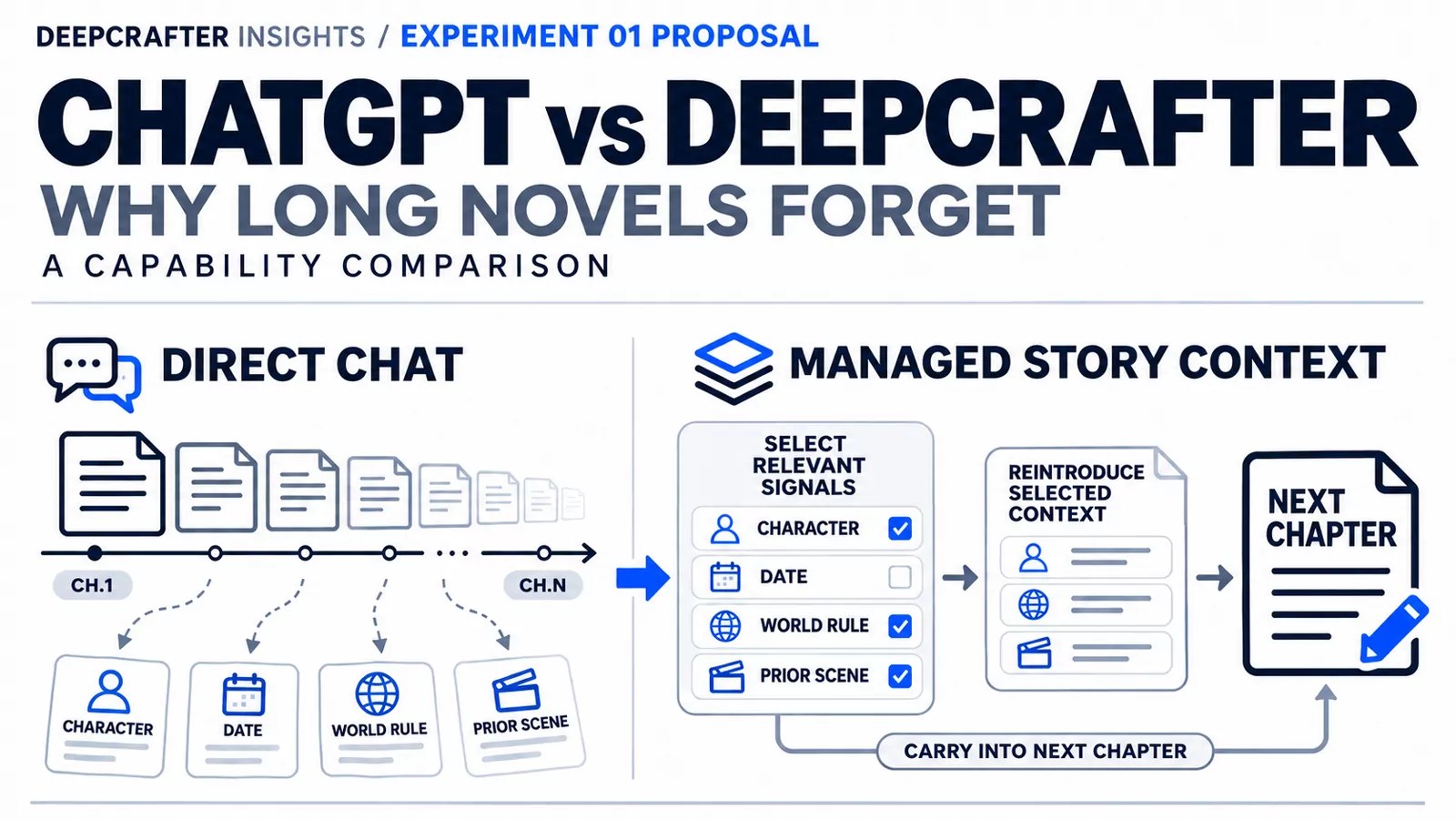
Same Premise, Richer Plot? ChatGPT vs DeepCrafter — Experiment 02 Proposal
A public-capability comparison of ChatGPT Projects and DeepCrafter, focused on how fiction-specific planning, branching and revision can build richer plots.
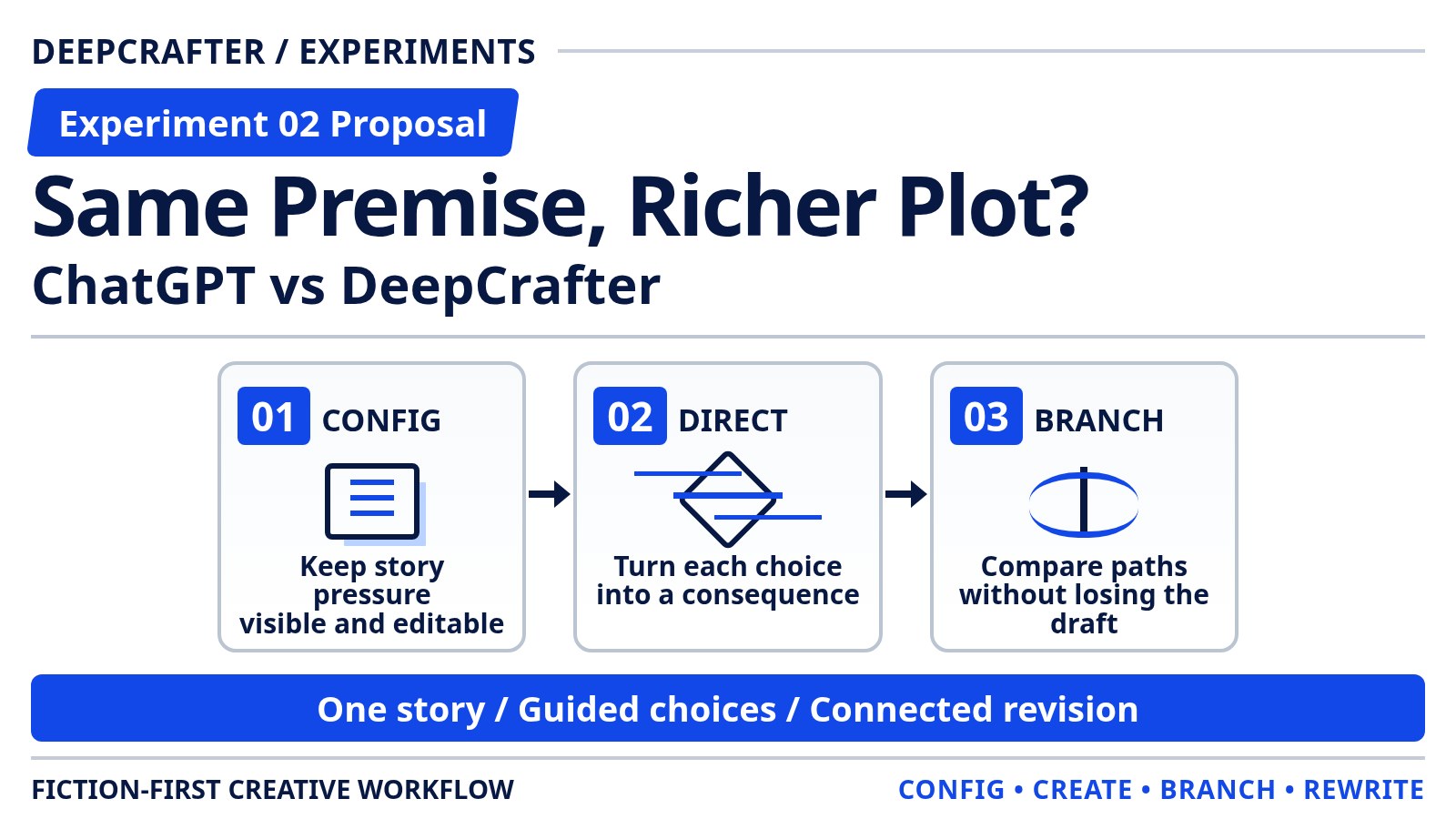
Same Premise, Richer Plot? ChatGPT vs DeepCrafter — Experiment 02 Proposal
Experiment 02 Proposal. This is a public-capability comparison, not a results report.
A strong premise is not yet a strong plot.
An engineer must save a city. Her brother has a competing plan. A witness knows what she concealed. All three elements promise conflict. Yet a draft can still turn them into a succession of convenient meetings: discover a problem, explain it, encounter a larger problem, explain that too. The story gets longer without acquiring more pressure.
The useful question is not which tool can invent more twists. It is which workflow helps a writer make every decision change what can happen next.
That is where the difference between a general AI workspace and a fiction-centered writing environment becomes practical. ChatGPT Projects can keep chats, files and instructions together. DeepCrafter organizes the work itself around premise, literary approach, guided drafting, branching, revision and long-form development. The advantage is not a single magic button. It is the way those functions stay connected to the developing story.
What makes a plot feel richer?
Plot richness is not cast size, outline length or surprise count. It comes from relationships among story elements.
- A causal turn closes one route and makes another necessary.
- A meaningful reversal changes a tactic or objective, rather than merely revealing new information.
- An integrated subplot alters the main action and receives consequences in return.
- A payoff makes an earlier detail useful at a later cost.
Consider this invented example:
- Thin sequence: the warning bell fails; Sela finds another power source; the council believes her.
- Richer sequence: Sela borrows the venue's battery to demonstrate the bell, leaving the rehearsal dark. The cancellation makes Tom withhold the cooperative's help. His refusal removes her safe demonstration route, so she must disclose the earlier test she concealed.
The second version is not automatically better prose. It is richer in dependencies. A solution damages another person's objective; that person acts; the protagonist's options shrink. The plot grows because consequences travel.
ChatGPT Projects: flexible context, writer-built workflow
OpenAI documents Projects as a place to keep related chats, files and project instructions together. A fiction writer can upload a story bible, add working rules and preserve related conversations in one workspace. Branching can protect an original conversation while another idea is explored. OpenAI: Projects in ChatGPT
That flexibility is useful, especially when fiction shares a workspace with research, notes or other tasks. But the writer still has to design the creative sequence: decide when to plan, when to draft, how to preserve canon, how to compare alternatives and which kind of revision the manuscript needs.
For some writers, that open-endedness is the point. For others, it becomes another layer of prompt and process management.
DeepCrafter: the story is the workspace
DeepCrafter begins from a different product assumption: planning, prose, character, structure and revision are related but distinct literary tasks.
Its public guide describes a five-part creative loop—plan, draft, direct, refine, then experience and export—and gives each stage a fiction-specific place in the product. The writer can move backward as the story changes: revise the setup, branch from an earlier decision, rewrite a passage or keep a stronger alternative. DeepCrafter User Guide
That structure creates several concrete advantages for plot development.
1. Story Config keeps the dramatic core editable
A premise is more useful when its pressure points remain visible: protagonist, desire, constraint, opposition, tone, point of view and ending conditions. DeepCrafter's Story Config gives those decisions a persistent home instead of leaving them buried in an old prompt.
For the warning-bell story, the config can keep the non-negotiable trade-off explicit: the same salvage allocation cannot serve both the bell and the ferry before the council vote. If a later scene quietly gives both sides everything, the writer has a clear canon reference for revision.
2. Literary approach is chosen as part of the project
DeepCrafter lets the writer choose an AI Master, use My Writing Style or create a custom approach where available. This separates “what happens” from “how this story should sound.” The same plot can be directed toward restrained civic suspense, intimate literary fiction or a more propulsive thriller without rebuilding the entire workflow from scratch.
The platform also handles model selection and routing internally across planning, drafting and revision. Writers do not need to manage provider accounts or decide which model should perform each request. The product's advantage is workflow coherence: literary tools are available inside one story rather than assembled manually across separate services.
3. AI Create turns continuation into a series of author decisions
In AI Create, the writer can read a passage, choose a suggested direction, enter a custom direction, edit or branch, and then continue. That loop matters for plot because it places the author at each consequential fork.
Instead of asking for an entire outline and hoping its dependencies survive, a writer can intervene when a choice becomes too convenient. If Sela finds a power source without cost, the next direction can require that the source belong to the rehearsal venue. The new decision immediately creates pressure elsewhere in the story.
4. Branches preserve alternatives without erasing the draft
Plot development often improves through comparison, not correction. One branch might have Sela protect her career; another might make her expose the unsafe connection publicly. Keeping both paths allows the writer to compare consequences rather than overwrite one version and reconstruct it from memory.
DeepCrafter's branches and timelines are especially useful when a change affects chronology, perspective, narrating subject or an alternate route through the same material. A branch can become the main story if it creates stronger consequences. This makes nonlinear exploration part of the writing process rather than a pile of disconnected copies.
5. Rewrite and advice can target the level of the problem
Not every weak passage needs more generation. A sentence-level problem may need manual editing or rewriting. A scene-level problem may need a different objective. A structural problem may need a new direction from an earlier branch.
DeepCrafter keeps AI Rewrite, AI Master advice and the AI Writing Assistant close to the manuscript. The writer can ask a precise question—“Which choice in this scene removes an option from the protagonist?”—and judge the advice against the intended story. Human Score adds another revision lens for prose that feels overly uniform or recognizably AI-like.
6. Deep Craft extends a proven setup into long form
Once the premise, voice and pressure system are strong, Deep Craft can develop a complete long-form draft from that setup. DeepCrafter's guide distinguishes this from AI Create: AI Create keeps the writer inside the moment-to-moment loop, while Deep Craft trades some immediate control for scale. How to Create a Long-Form Novel with AI
The useful advantage is continuity of workflow. The same project can move from a guided opening to long-form development, then back into structural, character, continuity, scene and prose review. A writer does not have to treat generation and revision as unrelated products.
7. The workflow continues beyond raw text
DeepCrafter can carry the story into cover creation, audio playback and supported text, ebook and audio downloads. These are not plot-development features by themselves, but they matter to the complete creative process. Listening to a scene can expose repetitive rhythm or missing tension; exporting a draft supports the next editorial stage; a cover helps the writer test whether the story's promise is visible.
One premise, a DeepCrafter route
Return to the warning-bell story:
In the canal city of Orin, municipal engineer Sela Venn has one public rehearsal left to prove that an abandoned flood-warning bell can protect the low district before the council dismantles it. Her estranged brother Tom has promised the same metal to a workers' cooperative building a ferry, while stage technician Iri discovers that the bell's apparently reliable warning depends on an unsafe power connection.
A practical DeepCrafter workflow could look like this:
- Configure the pressure. Record the shared salvage allocation, Sela's concealed test, Tom's cooperative objective and Iri's evidence as story facts.
- Choose the literary lens. Set a restrained close-third approach through Sela, with civic suspense and no last-minute rescue device.
- Draft one decision at a time. Use AI Create until the rehearsal acquires a cost, then direct the next passage around the person harmed by that choice.
- Branch at the irreversible choice. Preserve one route where Sela protects her standing and another where she discloses the failed test.
- Diagnose the consequences. Ask the AI Writing Assistant or AI Master which objectives, options and earlier details changed in each branch.
- Rewrite at the correct level. Repair a local scene with AI Rewrite; return to the branch point if the structural consequence is missing.
- Scale only after the setup works. Move toward long-form development when the conflict can sustain a middle, not merely an opening.
This route shows the central DeepCrafter advantage: the writer does not have to invent a new operating system for every creative stage. The story's setup, literary approach, alternatives and revisions remain part of one environment.
A simple plot test for any draft
After each major scene, ask three questions:
- What option disappeared because of a character's choice?
- Whose objective changed, and how will that person act?
- Which earlier detail now matters differently?
If none has an answer, another twist may be less useful than a more consequential decision.
ChatGPT Projects offer a flexible place to build a custom writing process. DeepCrafter's advantage is that the process is already shaped around fiction: a persistent story setup, literary guidance, directed continuation, branching, revision, long-form development and export live in the same creative loop.
For writers who want to spend less time assembling a workflow and more time choosing what the story should become, that difference is the point.