Why Long Novels Forget: A Capability Comparison of ChatGPT and DeepCrafter
A documented comparison of ChatGPT Projects and DeepCrafter, plus a transparent 30-fact continuity test for long-form fiction.
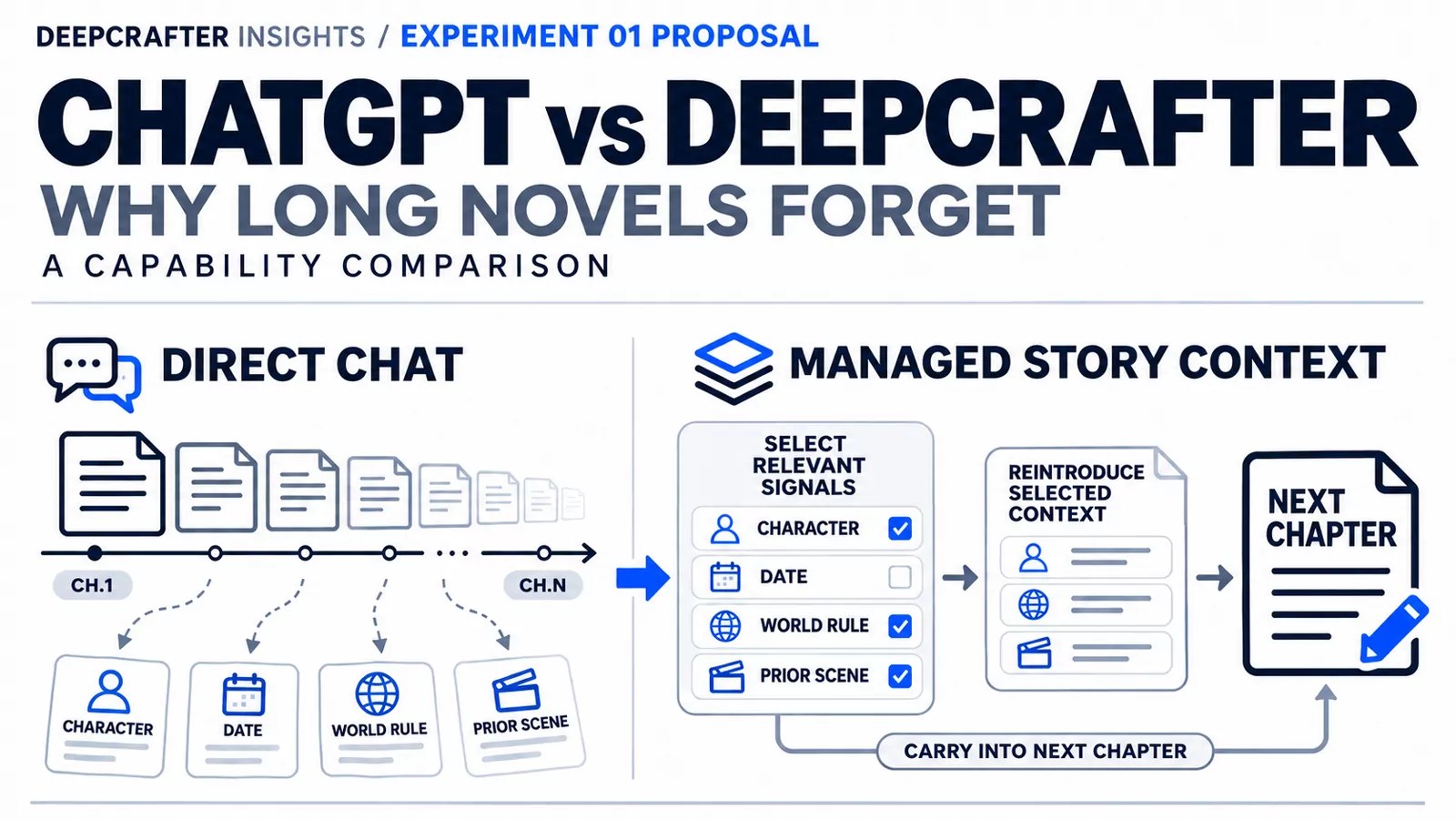
Why Long Novels Forget: A Capability Comparison of ChatGPT and DeepCrafter
Experiment 01 Proposal examines the public capabilities behind two different writing workflows: using ChatGPT Projects as a general-purpose research and drafting space, and using DeepCrafter as a fiction-specific agent for maintaining and developing a long story. It defines a transparent continuity test without presenting unrun results as evidence.
Long fiction rarely breaks because an AI forgets everything at once. It breaks one small fact at a time.
A scar moves from one hand to the other. A character who cannot swim dives into a harbor. A law that once carried exile becomes a minor fine. Each mistake may look harmless inside one scene. Across a novel, the accumulation weakens the reader's trust and turns the author into a full-time keeper of reminders.
That makes “Which model has the larger context window?” an incomplete question. Novelists also need to know how a writing product organizes story knowledge, how earlier material returns to the drafting process, how corrections persist, and what happens after the prose is generated.
This first DeepCrafter Experiment therefore begins with a capability comparison and a preregistered test. The comparison below is based only on public product documentation. The predicted differences are hypotheses, not measured outcomes.
Two products built around different jobs
ChatGPT is a general-purpose assistant. OpenAI's documentation says Projects can keep chats, uploaded files, and project instructions together. Project memory may draw on conversations and files inside the project, and writers can branch a chat without losing the original thread.
Those capabilities make ChatGPT useful for research, brainstorming, source comparison, exploratory worldbuilding, and isolated writing questions. A novelist can upload a story bible, ask questions about it, and keep related conversations in one project.
DeepCrafter is organized around the lifecycle of a story. Its public documentation connects story setup, long-form generation, continuation, branching, revision, character work, cover creation, audio conversion, and supported document downloads in one fiction workspace.
That is a workflow difference before it is a quality claim. ChatGPT gives the writer a flexible general-purpose project. DeepCrafter gives the writer a more opinionated fiction system in which manuscript, characters, world rules, alternatives, revision, and delivery are designed to remain part of the same project.
What public documentation allows us to conclude
ChatGPT Projects reduces fragmentation
A writer does not have to begin every conversation from zero. Relevant files, project instructions, and prior project conversations can remain available inside a dedicated workspace. Branching also lets the writer explore a direction without overwriting the original chat.
DeepCrafter covers more of the fiction production chain
The documented workflow extends beyond a chat response. It includes story configuration, continued drafting, alternative branches, rewriting, character tools, cover generation, audio conversion, and supported downloads. For writers who want the manuscript and its surrounding creative assets to remain connected, that integration is itself a meaningful capability.
Neither capability list proves continuity performance
Keeping a file in a project does not prove that every relevant fact will appear at the right moment. A fiction-specific interface also does not prove that it will never contradict the story. Product architecture suggests different strengths, but only matched outputs can measure the difference.
The continuity problem in practical terms
Consider an original fantasy project called The Archive of Tides.
In the island city of Pelagos, memories can be stored in seawater and read by licensed cartographers. A sealed memory-map begins predicting crimes three days before they occur. Harbor cartographer Nera Vale must decide whether to expose it when her brother's name appears in the third prediction.
The controlled source pack contains 30 facts. Some are simple identity details. Others create dependencies across the story:
- Nera is a cartographer, not a ship captain.
- She cannot swim and has a crescent-shaped burn on her left palm.
- Stored memories lose one sensory detail every time they are opened.
- Nera's brother repairs clockwork tide gates but does not control them.
- The Bell of Low Water controls the eastern floodgate.
- Copying a predictive map is punishable by permanent exile.
- The story begins twelve days before the Festival of Returning Tides.
These facts are not included to make the prose decorative. They constrain what characters can do, what choices cost, and which later events remain plausible.
How the two workflows would approach the same story
In ChatGPT, the strongest reasonable setup would use a dedicated Project. The source pack would be uploaded as a project file, the project instructions would ask the system to preserve canon, and all ten connected scene requests would remain inside one project conversation.
That setup gives the writer flexibility. The author can ask research questions, compare possibilities, branch an alternative, and update the supporting files. It also leaves meaningful responsibility with the writer: the source pack must be curated, instructions must stay clear, and any drift must be identified and repaired.
In DeepCrafter, the same facts would be organized inside the story's maintained context, including the relevant character and world information. The writer would continue and revise the manuscript inside the same fiction workflow, then carry the finished work toward cover, audio, and supported downloads without rebuilding the project elsewhere.
The hypothesis is that a fiction-specific structure may reduce the amount of context management performed manually by the author. The counter-hypothesis is that a carefully maintained ChatGPT Project may preserve the same facts well enough while offering greater freedom for research and open-ended exploration.
Both are credible. That is why the next step is a controlled test rather than a marketing conclusion.
The proposed experiment
Each system will receive the identical 30-fact source pack and ten connected scene requests. The sequence moves from straightforward recall to scenes that combine character history, world rules, geography, and consequences established earlier in the run.
After Scene 6, both systems receive the same correction:
The eastern floodgate is controlled by the Bell of Low Water. Ivo repairs the gate mechanism, but he has never controlled the gate and does not possess the bell.
The test will then measure whether that correction remains stable through Scene 10.
To account for generation variance, the experiment requires three fresh runs per system. The rubric is fixed before any output is scored:
- retention of the 30 planted facts;
- direct contradictions;
- unsupported facts presented as established canon;
- repeated exposition;
- manual reminders, regenerations, and context repairs;
- persistence of the explicit correction.
Product names will be removed before human review. Every deduction must cite the exact generated sentence and the numbered fact it conflicts with.
Which workflow may fit which need?
Based on documented capabilities, ChatGPT is the more natural fit when the work centers on research, brainstorming, source comparison, broad exploration, or a series of isolated creative tasks. Projects can keep those materials together without turning the tool into a fiction-only environment.
DeepCrafter is the more natural fit when the manuscript itself is the center of gravity and the writer wants story context, character and world information, alternatives, revision, cover, audio, and supported downloads to remain in one creative system.
That is a capability-based conclusion, not a claim that one system has already won the continuity test. The actual benchmark will ask whether the predicted workflow difference appears in the ten generated scenes.
A transparent starting point
Calling this an experiment should make the standard higher, not lower. The source pack, scene sequence, correction, and scoring rules are public before the first result is interpreted. No score or winner is being invented in advance.
This is Experiment 01 Proposal: a documented capability comparison and a reproducible method. The results article will follow only when the matched runs exist.
Sources
- OpenAI Help Center, “Projects in ChatGPT”: https://help.openai.com/en/articles/10169521-projects-in-chatgpt
- DeepCrafter User Guide: https://deepcrafter.ai/user-guide
- DeepCrafter, “Deep Craft”: https://deepcrafter.ai/docs/deep-craft